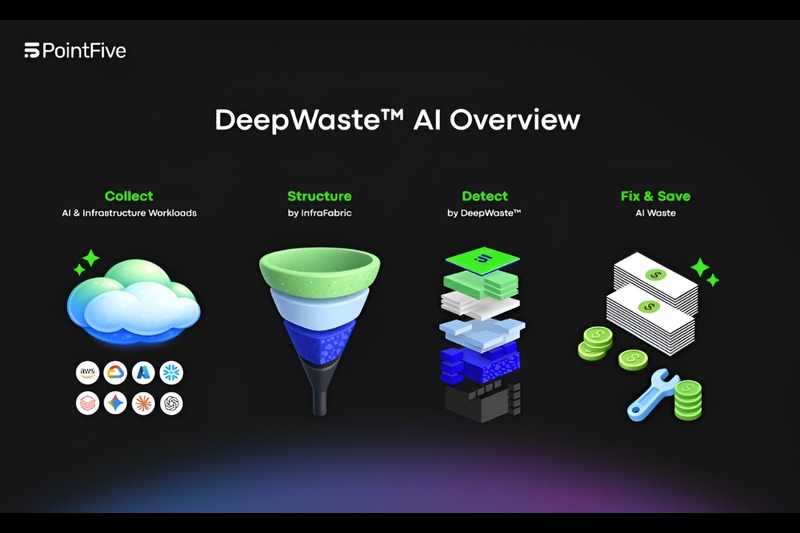
On February 27, 2026, PointFive announced DeepWaste™ AI, a full-stack optimization module designed to reduce production LLM waste across routing, tokens, caching, and the infrastructure that supports them. While the product spans the full stack, PointFive’s message for day-to-day LLM operations is straightforward: the biggest sources of waste often come from execution behavior, not just raw usage.
The LLM Ops Reality: Costs Are Behavioral
As organizations move from proof-of-concept to production, LLM systems begin to behave like living software. Requests vary by task, latency requirements shift, workloads fluctuate across hours and teams, and orchestration logic evolves rapidly. In that environment, AI cost and performance are shaped by decisions across model selection, token consumption, routing logic, caching behavior, and retry patterns. A system can be “working” while still leaking money through small inefficiencies that compound at scale.
PointFive argues that traditional cloud optimization tools were not built to analyze this AI-specific execution stack. DeepWaste AI, by design, is meant to interpret how AI workloads actually run, and where execution behavior creates unnecessary spend.
Where Waste Shows Up in Production LLM Workloads
DeepWaste AI focuses on identifying inefficiency in areas that teams often feel but struggle to quantify. Routing logic can drift over time, causing tasks to be served by a more expensive model than necessary. Token consumption can rise due to prompt bloat, excessive context windows, or output inflation when max_tokens is set too high. Caching can be configured but underutilized, leaving repeated requests to incur repeated inference cost. And retries, triggered by timeouts, orchestration patterns, or operational conditions, can silently multiply spend while also creating latency outliers.
PointFive’s framing is that these are not isolated issues. Routing choices influence token usage. Caching behavior influences the number of invocations. Retry loops influence both cost and perceived reliability. DeepWaste AI is positioned to evaluate these interactions as a single execution system.
Connectivity Across Clouds and Direct APIs
DeepWaste AI provides native, agentless connectivity across the major cloud AI providers and direct model APIs, including:
- AWS (Bedrock, SageMaker, and AI managed services)
- Azure (Azure OpenAI, Azure ML, Cognitive Services)
- GCP (Vertex AI and AI services)
- OpenAI and Anthropic direct APIs
For LLM ops teams, this matters because AI usage is often split: some workloads run on managed cloud services, others hit direct APIs, and many organizations use multiple providers across teams. PointFive’s approach is to apply a consistent optimization lens across these environments.
Token, Prompt, and Caching Economics as First-Class Signals
DeepWaste AI’s detection model explicitly includes Token & Prompt Economics and Caching & Reuse Optimization as core layers. The token and prompt layer flags patterns such as prompt bloat, context window overprovisioning, output inflation caused by misconfigured max_tokens, parameter-task misalignment, and structural token waste. The caching layer highlights duplicate inference detection, underutilized native caching capabilities, and cache miss rate inefficiencies.
PointFive emphasizes that these detections are grounded in unified workload signals rather than surface-level billing anomalies. The intent is to show not just that spend is high, but why it is high in terms of behavior and configuration.
Agentless by Default, With Customer-Controlled Depth
PointFive says DeepWaste AI connects directly to cloud APIs, LLM service metrics, GPU telemetry, and billing systems without agents, instrumentation, or code changes. By default, the module operates using metadata, billing signals, performance metrics, and resource configuration data, without requiring access to raw inference logs. That design is meant to preserve privacy and minimize data access requirements while still surfacing structural inefficiencies.
For organizations that want deeper evaluation, optional inference-level analysis can be enabled to assess prompt architecture and orchestration logic. Customers control the depth of analysis, and optimization adapts accordingly.
From Detection to Quantified Remediation
DeepWaste AI is positioned as more than a reporting layer. PointFive says every finding includes a quantified savings estimate and clear implementation guidance. Recommendations are prioritized by financial impact and mapped directly to engineering and FinOps workflows. Teams can evaluate projected savings before acting and track realized improvements over time, turning optimization into a continuous practice rather than a periodic audit.
DeepWaste AI Rolls Out to PointFive Customers
“AI workloads introduce a new category of operational complexity,” said Alon Arvatz, CEO of PointFive. “DeepWaste AI gives organizations the intelligence required to scale AI efficiently, across models, infrastructure, and data platforms, without sacrificing control.”
DeepWaste AI is now available to PointFive customers.