MUMBAI, India – 30th April 2026 – CyberNX has published a practical Brand Risk Monitoring Checklist designed to help organisations detect domain spoofing, credential exposure, phishing infrastructure, social impersonation and related exposures at an earlier stage, before incidents escalate into publicly visible crises.
Brand damage rarely begins with a headline. CyberNX observed that many incidents start with small, quiet signals: a spoofed domain registered in a different top-level domain, a leaked credential circulating in an underground forum, or a customer screenshot posted to a niche discussion channel that does not appear on standard marketing dashboards. By the time reputational fallout becomes visible to communications teams, the original indicators frequently have already moved through corners of the internet most organisations do not monitor.
Security teams typically focus on infrastructure controls such as firewalls, endpoint protections and vulnerability management. These functions remain necessary for operational continuity. CyberNX’s release argues that brand exposure occupies a different layer of digital risk and that brand risk monitoring is more closely aligned with security visibility than with traditional reputation monitoring alone. Threat actors exploit trust in established brands across sectors including banking, telecom, retail, fintech, travel and healthcare, turning a familiar brand identity into a vector for phishing, fraud and credential harvesting.

The checklist released by CyberNX treats brand risk monitoring as an operational routine rather than a one‑time audit. The document is structured around concrete signals and actions that security teams can incorporate into daily workflows, with the stated goal of catching low‑visibility indicators before they develop into high‑impact incidents. The checklist emphasizes consistent surveillance of registration records, public code repositories, paste sites, marketplaces and social channels that lie outside typical marketing or PR instrumentation.
Brand misuse commonly surfaces in predictable environments that require dedicated attention. Phishing infrastructure often begins with domain registrations that resemble legitimate company names; attackers may employ character swaps, added prefixes or suffixes, hyphenated variations or alternate top‑level domains and then place login pages behind redirect chains or shortened URLs. Underground marketplaces and dark web forums can host stolen customer databases, employee credentials, API keys and internal documents; these listings frequently appear without any public notification from affected organisations. Social media impersonation remains a persistent source of customer deception as fraud accounts mimic official handles, respond to support requests and distribute malicious links. Mobile application abuse and third‑party download sites occasionally host counterfeit or malicious apps that use familiar branding to harvest credentials or install spyware. Typosquatting and product listing fraud on e‑commerce platforms create additional exposure, from counterfeit merchandise to fraudulent sellers using brand logos in product images.
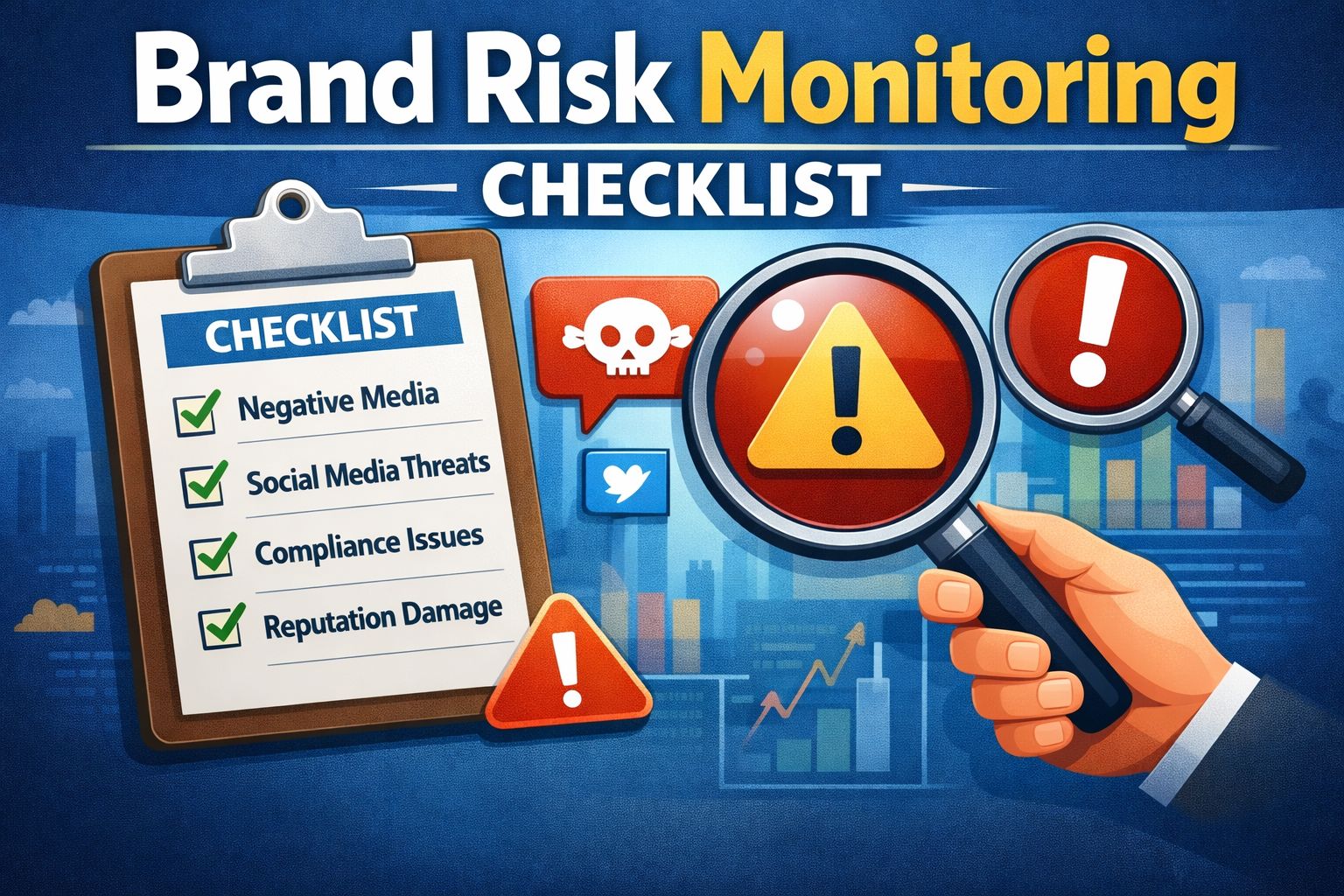
The core Brand Risk Monitoring Checklist outlines practical checks across those areas. Organisations are advised to monitor newly registered domains that resemble the brand name, to scan the web for pages that replicate login forms, payment gateways or promotional landing pages, and to track public indicators of credential exposure such as employee email addresses, customer account data and exposed API tokens. The checklist directs monitoring of social channels for fake brand accounts and impersonated executives, regular sweeps of official and third‑party app stores for malicious or misleading applications, and ongoing reviews of marketplace product listings for counterfeit goods or logo misuse. It also highlights surveillance of paste sites, public code repositories and file‑sharing platforms for leaked configuration files, credentials and internal documentation that can serve as the earliest signs of a breach.
Checklists matter because brand abuse moves quickly and sometimes only briefly. Phishing campaigns can operate for days before actors shift infrastructure; social impersonation accounts may appear and disappear once they have collected sufficient victims. Without a structured routine, incidents frequently go unnoticed until customers report harm. CyberNX’s checklist is intended to shift detection earlier in the incident timeline so that security teams can assess credibility and initiate mitigation steps while the attacker’s infrastructure remains active.
Operational scale presents the primary implementation challenge. Thousands of domains are registered each day, underground forum activity spans multiple languages and access models, and impersonation accounts can proliferate and vanish rapidly. CyberNX notes that automation and threat intelligence platforms help surface signals across these environments and reduce the volume of noise analysts must review. Automation is described as a filter rather than a replacement for human judgement; the checklist recommends combining automated discovery with analyst validation to determine which exposures merit takedown requests, legal escalation or incident response.
When brand abuse escalates into a security incident, consequences can include compromised customer accounts, fraud, regulatory scrutiny and long‑term erosion of customer trust. Credential harvesting from phishing portals enables further intrusion into customer or corporate systems. Leaked internal data and public product counterfeits can produce the same perception of failure in the marketplace, even when the original cause differs. The Brand Risk Monitoring Checklist published by CyberNX aims to provide a repeatable operational framework that reduces the likelihood of such escalation by promoting early detection across multiple, often-overlooked surfaces.
CyberNX also provides brand risk monitoring services intended to identify breaches, stolen credentials, infected devices and third‑party data exposures. The company positions those services as complementary to the checklist, supporting organisations that require continuous monitoring and incident validation across the diverse threat surfaces described in the guidance. Quiet, consistent monitoring is presented as the practical means by which many incidents are prevented before they reach public attention.
About CyberNX
CyberNX is a cybersecurity firm that provides monitoring, detection and incident validation services focused on brand exposure and related digital risks. The company offers operational guidance and continuous monitoring for domain abuse, phishing infrastructure, credential exposure and impersonation. CyberNX works with organisations to integrate surveillance routines and technical discovery across web, social and underground environments.
MEDIA DETAILS
Contact Person: Media Relations
Company Name: CyberNX
Email: sales@cybernx.com
Website: https://www.cybernx.com/