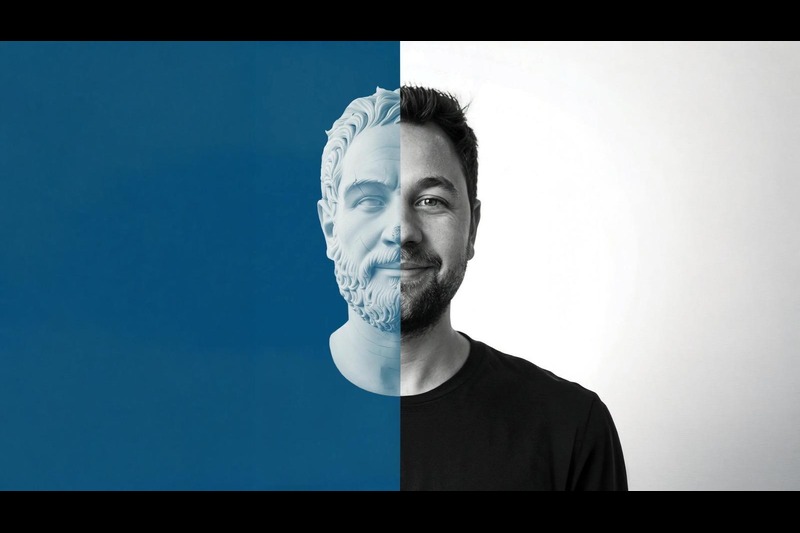
credit: Paolo Bonetti
A perspective from inside the tech market on the reconfiguration of value in the age of intelligent machines
Artificial intelligence is not just accelerating the way software gets built. It is transforming it.
And those who observe this shift from the inside, from an operational position where companies are being built in real time, see it long before it becomes visible in reports or market data.
Paolo Bonetti, entrepreneur and digital consultant, has been watching this transition from the ground level for years. His observation is precise: “In the AI economy, code becomes abundant. Human judgment becomes rare.”
That sentence captures something that most market commentary misses.
The Geography of Value Is Shifting
Generative models and AI-assisted tools have made code progressively more accessible, faster to produce, more democratic. And as always happens when technical execution becomes abundant, value does not disappear. It migrates.
It moves toward those who know how to recognize where it belongs.
A practice emerging in the market synthesizes this dynamic well: vibe coding. The programmer is no longer writing every line of code. Instead, they are defining with precision what the code needs to do and why. AI executes. But the value stays in the ability to frame the problem and orient the solution.
Technical competence remains necessary. But it stops being the decisive factor. What matters now is the ability to interpret a real problem, to distinguish a technologically sophisticated solution from one that generates concrete impact, to understand what to build and for whom. These are capabilities that cannot be automated and they become central precisely as execution becomes simpler.
What This Means for Companies
This dynamic has effects that go far beyond the individual developer. It reshapes the structure of digital projects themselves.
Projects increasingly require genuine integration across disciplines, strategy, development, content, data, to avoid a recurring risk: technically advanced solutions that solve the wrong problem.
This is where a significant portion of competitive value is being contested today. Recognizing the shift is not enough. It must be translated into operational choices. Companies are rethinking how they structure projects, how they integrate different skill sets, and how they use artificial intelligence not merely as an accelerator but as a strategic lever. In this transition, those who understood the dynamics early take on a different role: accompanying organizations in identifying where value is actually being generated and how to capture it.
A New Equilibrium, Not a Replacement
Bonetti is currently developing research on the coexistence of human systems and artificial intelligence. In his forthcoming book Dentro la rivoluzione artificiale (Inside the Artificial Revolution), he describes the current phase not as substitution, but as a new equilibrium: machines and humans operating according to different and complementary logics.
The direction is already visible in the market, for those who know where to look.
Competition is no longer about the ability to produce technology. It is about the ability to orient it. To understand which problems are worth solving and which are not.
If execution becomes increasingly automated, the real scarcity will not be code. It will be the quality of the thinking that guides it. It will be judgment.
And this shift, from those who know how to do, to those who know what to do, is not a future trend. It has already begun.
Paolo Bonetti is a management engineer, entrepreneur and digital consultant. He founded and leads an integrated ecosystem of specialists in strategic consulting, software development and digital communication. He is the author of Dentro la rivoluzione artificiale*, a study on the coexistence of human systems and artificial intelligence in the contemporary economy.