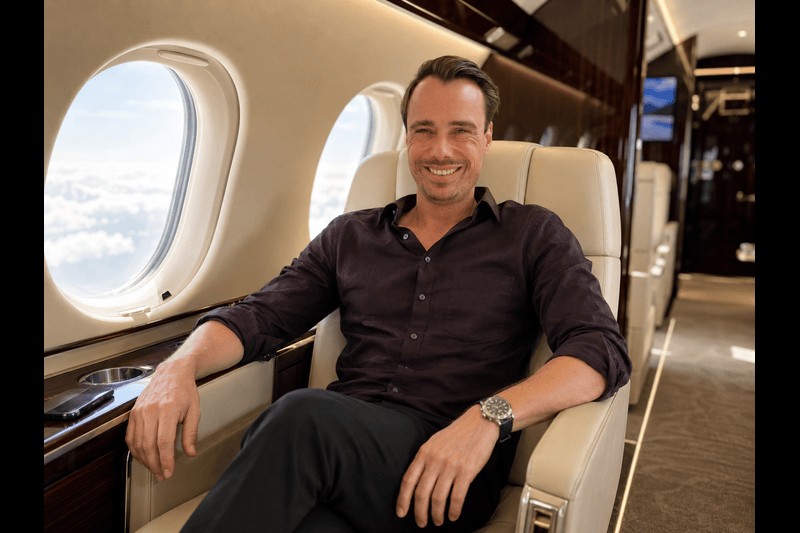
Ultra-high-net-worth travel has changed. The wealthiest travelers no longer want isolated luxury products; they want certainty, privacy, speed and continuity. A private jet, a superyacht, a villa, a limousine, a security detail and even a medical evacuation plan may all be required for one journey — yet the industry still often treats them as separate transactions.
Dr. Christoph Lymbersky sees that fragmentation as an opportunity to build something more integrated. As co-founder and investor behind Limitless Sky, Blue Ocean Club and MedEvac, he is developing what he describes as a “call once and don’t worry” ecosystem for ultra-high-net-worth individuals, family offices, founders and executives. The idea is simple: one dedicated concierge, one accountable point of contact, and one coordinated journey from home to aircraft, from runway to yacht, and, if needed, from a hospital anywhere in the world back home.
The businesses are also supported by investment from 499X Capital, Lymbersky’s family office, but the focus is firmly operational: building trusted brands that make complex global travel simpler, safer and more discreet.
In this interview, Dr. Lymbersky discusses the logic behind the Sea-to-Sky concept, the future of high-end mobility, and why the next frontier in luxury travel is not more extravagance — but less friction.
Q: The Sea-to-Sky concept combines private aviation, superyachts and concierge logistics into one itinerary. What inspired you to build this model?
Dr. Christoph Lymbersky: The inspiration came from a very simple observation: the wealthier the client, the more complex the journey — and the less tolerance there is for complexity.
A normal luxury trip might involve one hotel and one flight. But for a very wealthy family, founder, investor or business owner, the trip may involve a private jet, a helicopter transfer, immigration coordination, a yacht captain waiting in port, a chef provisioning for dietary preferences, security at the destination, cars for guests arriving separately, and last-minute changes because a board meeting, family situation or deal schedule moves.
Traditionally, each of those pieces is handled by a different provider. The jet broker only thinks about the jet. The yacht broker only thinks about the yacht. The limousine company only thinks about the car. The hotel concierge only thinks about the hotel. That creates gaps. And in high-end travel, the gaps are where stress happens.
With Limitless Sky and Blue Ocean Club, we wanted to build the opposite: one coordinated experience. The client should not have to manage five providers. The client should be able to make one call and say, “I want to fly to Nice, spend three days at the Monaco Grand Prix, continue by yacht to Sardinia, have the children join later, and make sure everything is private.” Then we build the operational plan around that.
For me, luxury is not champagne on the aircraft. That is nice, but it is not the point. Real luxury is when the client does not have to think about the logistics at all.
Q: You are involved as both founder and investor. How does that shape the way you are building these companies?
Dr. Christoph Lymbersky: It makes me think very differently from someone who is simply launching a lifestyle brand.
I look at Limitless Sky, Blue Ocean Club and MedEvac as connected companies serving the same client reality from different angles. Limitless Sky focuses on private aviation. Blue Ocean Club focuses on superyacht experiences. MedEvac focuses on medical evacuation and repatriation. But the client behind all of them may be the same person: someone who travels globally, values discretion, and wants one trusted team to remove complexity.
As an investor, I care about market structure. This market is valuable, but still fragmented. Many providers are excellent in one vertical, but very few think across the full journey. That fragmentation creates friction for the client and opportunity for companies that can coordinate the full experience professionally.
As a founder, I care about execution. The brand has to look good, of course, but the experience has to work. The quote must be clear. The operator must be reliable. The yacht must match the client. The medical partner must be qualified. The advisor must answer. At this level, trust is built through operational detail.
That is why I see these companies less as separate businesses and more as parts of a high-end mobility and concierge ecosystem.
Q: Many people associate luxury travel with lifestyle. You seem to describe it more like infrastructure. Is that intentional?
Dr. Christoph Lymbersky:Yes, absolutely. For our clients, travel is often not just leisure. It is infrastructure for their lives.
A founder may need to visit three cities in four days without losing a working day. A family may want to spend two weeks on a yacht but have relatives, staff, children and guests arriving at different times. A principal may need privacy because of public visibility. Another client may have health concerns and wants to know that, if something happens abroad, there is a serious medical evacuation option.
So yes, there is a lifestyle component. But underneath, this is infrastructure. It is mobility infrastructure, trust infrastructure and decision-relief infrastructure.
I often say: our job is not to make people feel rich. Our job is to remove problems before they reach the client.
That is a very different philosophy. It is calmer, more discreet and more professional. And I think that is where the UHNW market is moving. The new luxury is not loud. It is seamless.
Q: How does the dedicated concierge model work in practice?
Dr. Christoph Lymbersky: Each client needs one responsible person who understands the whole journey. Not a call center. Not a random inbox. A dedicated advisor.
That person knows the client’s preferences, family structure, luggage habits, passport issues, food preferences, privacy requirements, security concerns and preferred communication style. If the client likes WhatsApp, we use WhatsApp. If the client wants structured itineraries and written confirmations, we do that. If the client never wants to see the complexity, we keep it behind the curtain.
The important point is accountability. If the jet is delayed, the yacht captain must know. If the yacht changes port because of weather, the helicopter transfer must change. If a guest arrives one day late, the car, tender, cabin and provisioning must adjust. These are not separate tasks. They are connected events.
The dedicated concierge is the person who keeps the thread intact.
That is also why I dislike the traditional “broker only” model. A broker can arrange a transaction. A concierge must understand the entire experience. We are building around the second model.
Q: Can you walk us through the logistics of a Sea-to-Sky package during a high-demand weekend like the Monaco Grand Prix?
Dr. Christoph Lymbersky: Monaco is a perfect example because everything is constrained: airport slots, hotel rooms, berths, helicopter availability, restaurant access, road traffic, security, event badges and timing.
A typical Sea-to-Sky itinerary might begin with the client flying privately into Nice. Depending on the schedule, we may arrange a helicopter transfer to Monaco, or a chauffeured car if that is more sensible. The yacht may be positioned in Monaco, Cap Ferrat, Cannes or another nearby port depending on berth availability and the client’s preference. Guests may arrive separately from London, Geneva, New York or Dubai. Some may stay on the yacht, others in hotels or villas.
From the outside, the client sees a smooth weekend. From the inside, it is a chain of dependencies. Aircraft arrival time affects helicopter timing. Helicopter timing affects tender timing. Tender timing affects the captain’s schedule. The captain’s schedule affects dinner. Dinner affects security movement. Security movement affects the guest experience.
This is why the “single itinerary” concept matters. It is not just prettier packaging. It is operationally superior.
For events like Monaco, Cannes, Art Basel, Wimbledon or the Super Bowl, you cannot improvise everything at the last minute. You need planning windows, backup options and people who understand the pressure points. The best service is often invisible because the problem was solved before the client knew it existed.
Q: Limitless Sky emphasizes transparent pricing and safety. How do you maintain that when working across aviation, yachts and external partners?
Dr. Christoph Lymbersky: By being very clear about what we are and what we are not.
Limitless Sky is an independent private jet charter brokerage. We do not pretend to operate aircraft. Flights are performed by licensed operators that hold operational control. That distinction matters. It is important legally, operationally and ethically.
The same principle applies to yachts and medical evacuation. We coordinate, structure, source, compare and manage the client relationship, but we work with qualified operators, captains, crews, medical partners and ground teams. The client receives clarity about who does what.
On pricing, I believe opacity is one of the biggest problems in luxury travel. Many clients are used to paying significant amounts, but they still dislike feeling that the price is arbitrary. They want to understand the logic. Aircraft category, flight time, repositioning, crew duty, landing fees, handling, medical crew, provisioning, yacht APA, fuel, port fees — these things can be explained.
Transparency does not make luxury less exclusive. It makes it more trustworthy.
Safety is similar. In aviation, we look at operator certification, aircraft suitability, crew experience and mission profile. In yachting, we look at the vessel, crew, management, itinerary and local conditions. In medical evacuation, the clinical review is essential; the right aircraft depends on the patient, the equipment, the crew and the route.
The standard is simple: we never sacrifice safety for glamour.
Q: MedEvac is a very different type of business from private jets and superyachts. Why include medical evacuation in the same ecosystem?
Dr. Christoph Lymbersky: Because wealthy people travel more, travel farther and often travel with family members across generations. They may be in Monaco one week, the Maldives the next, then New York, Dubai, Mallorca or the Caribbean. If something serious happens abroad, the question becomes very practical: who do you call?
Medical evacuation is not a glamorous topic, but it is one of the most important forms of reassurance. If a child has an accident, if an elderly parent becomes ill, if a client needs ICU-level transfer, or if a patient must be repatriated after surgery, the family does not want to start searching online at midnight in a foreign country.
The value is not only the aircraft. The value is coordination: medical review, ground ambulance, aircraft, clinical crew, hospital handover, documentation, family communication and insurance coordination where applicable.
That fits naturally into the broader ecosystem. Limitless Sky handles private aviation. Blue Ocean Club handles yacht experiences. MedEvac handles medical repatriation and emergency air ambulance coordination. Together, the philosophy is the same: one responsible team, one clear process, less stress for the client.
Of course, we are very careful here. We do not provide medical advice ourselves. Medical decisions belong to qualified physicians and clinical partners. Our role is to coordinate the mission professionally and make sure the operational chain works.
Q: You have described the model as a “call once and don’t worry” ecosystem. What does that mean for the client?
Dr. Christoph Lymbersky: It means that the client does not need to become the project manager of their own trip.
For many successful people, time is the most expensive asset. If a billionaire, entrepreneur or family office principal spends three hours coordinating travel, that is not just inconvenient — it is a bad use of attention. These people are making investment decisions, running companies, managing families and dealing with complex lives. They do not want another operational burden.
“Call once and don’t worry” means we take ownership of the complexity. We arrange the jet, helicopter, yacht, transfers, security, reservations, itinerary changes and, if needed, medical transport. The client should know that someone competent is watching the whole picture.
That does not mean the client loses control. Quite the opposite. They receive better control because the information is structured, the options are clear and the execution is coordinated.
I think this is the future of high-end service: not more noise, but fewer decisions.
Q: What makes this market interesting from a founder and investor perspective?
Dr. Christoph Lymbersky: The interesting part is that this is not a one-time transaction business if you build it correctly. It can become a relationship business.
If a client trusts you with a private jet booking and you execute well, they may trust you with a yacht charter. If you manage the yacht charter well, they may ask for villas, security, cars or a family itinerary. If you help in a difficult medical situation, the trust becomes even deeper. The lifetime value of the relationship can be significant, but only if you protect the trust.
From an investment perspective, I like businesses where the service layer can become more valuable over time. The first booking is the beginning of the data relationship: preferences, routes, family needs, aircraft preferences, yacht preferences, recurring events, payment preferences, risk sensitivities. If you manage that responsibly, you can deliver a better experience each time.
That is the difference between a broker and an ecosystem. A broker sells access. An ecosystem compounds trust.
This is also why I believe the UHNW mobility market is still early. Many providers are excellent in one vertical, but very few are truly integrated across air, sea, ground and emergency response.
Q: Your background includes venture capital, turnaround management and alternative assets. Does that shape your leadership style?
Dr. Christoph Lymbersky: Very much. I have worked in environments where capital allocation, timing and execution matter. In venture capital, you learn that the best opportunities often look fragmented before they look obvious. In turnaround situations, you learn that process and discipline matter more than slogans. In alternative assets, you learn that downside protection is as important as upside.
That combination influences how I build companies.
I am not interested in creating a luxury brand that only looks beautiful. It must work operationally. The phone must be answered. The quote must be clear. The aircraft must be suitable. The yacht must match the client. The backup plan must exist. The medical partner must be qualified. The client data must be handled carefully.
Luxury without execution is just marketing.
My career has also taught me that reputation compounds slowly and can be damaged quickly. In this segment, you cannot fake trust. You either deliver, or the client never calls again.
Q: What kind of client is this ecosystem built for?
Dr. Christoph Lymbersky: It is built for people whose lives are complex enough that coordination itself becomes valuable. We are after all also just planning a private jet charter or a yacht charter experience.
We are working for entrepreneurs, family offices, investors, executives, public figures, wealthy families and clients who travel with children, staff, guests or security needs. Some are very experienced private aviation users. Others are entering this world for the first time because their wealth, business or family situation has changed.
What they have in common is not only wealth. It is the need for trust.
Some clients want the most luxurious yacht in the Mediterranean. Others simply want privacy, a reliable aircraft and a calm family holiday. Some want to attend the Monaco Grand Prix or Cannes Film Festival. Others need to move quietly between business meetings. Some may never need medical evacuation, but they want to know that the capability exists.
The ecosystem is flexible because the client’s life is flexible.
Q: What is your long-term vision for Limitless Sky, Blue Ocean Club and MedEvac?
Dr. Christoph Lymbersky: The long-term vision is to build a trusted global mobility and concierge ecosystem for ultra-high-net-worth individuals, family offices, founders and executives.
Limitless Sky is the aviation layer. Blue Ocean Club is the yacht and sea-experience layer. MedEvac is the emergency medical mobility layer. Around those, we can coordinate ground transportation, security, villas, hotels, events and other high-touch services.
But the goal is not to become everything for everyone. The goal is to become highly trusted by a specific client group that values privacy, speed, transparency and competence.
If we do it correctly, clients will not think of us as a jet broker or a yacht broker. They will think: “When I need to move, when I need to plan, when I need to solve something complicated, I call them.”
That is the position I want us to occupy.
Q: What would you like the luxury travel industry to understand better?
Dr. Christoph Lymbersky: That the client does not want to see the machinery.
Many providers are proud of how complicated their work is. And it is complicated. But the client should not feel that complexity. They should feel calm.
The best luxury service is not loud. It is not constantly telling the client how hard everything was. It simply works. The car is there. The jet is ready. The captain knows. The family is expected. The documents are correct. The backup option exists. The advisor answers.
That is what we are building: not just beautiful travel, but peace of mind.
For the ultra-wealthy, that may be the rarest luxury of all.
To learn more, visit https://thelimitlesssky.com