Many entrepreneurs start by managing their own books to save money and stay closely involved with their finances. While this approach may work during the early stages, DIY bookkeeping methods often become difficult to maintain as a business grows. More customers, higher transaction volumes, employees, GST/HST obligations, and reporting requirements all demand greater attention to detail. This is why many business owners eventually turn to professional bookkeeping services to simplify financial management and improve accuracy. Managing business finances requires much more than recording income and expenses—it involves maintaining organized records, meeting compliance requirements, and producing reliable reports that support smarter business decisions.
DIY Bookkeeping vs. Professional Bookkeeping: A Quick Comparison
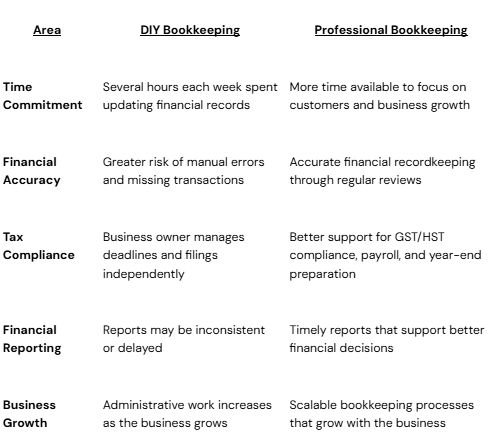
Before exploring the reasons in detail, here’s a quick look at how DIY bookkeeping compares with working alongside a professional bookkeeper.
The Hidden Challenges of Managing Bookkeeping Alone
Bookkeeping is one of those business functions that appears simple until the workload begins to grow. As business owners juggle sales, operations, customer service, and marketing, bookkeeping often becomes a task that’s completed only when time permits.
This can lead to manual data entry mistakes, incomplete transaction records, incorrect expense categorization, and delayed updates. Without organized financial recordkeeping, it’s much harder to understand how the business is performing or identify potential issues before they become costly. Maintaining a structured bookkeeping workflow and accurate documentation requires consistency that many busy entrepreneurs simply don’t have the time to maintain.
Time Savings and Better Focus on Business Growth
As businesses expand, bookkeeping requires more time and attention. Tasks such as bank reconciliation, invoice management, transaction reconciliation, and updating financial records need to be completed regularly to maintain accurate accounts.
Professional bookkeeping support allows business owners to focus on growing their business rather than spending hours reviewing receipts, tracking payments, and preparing financial reports. Instead of worrying about daily accounting tasks, entrepreneurs can invest more time in customer relationships, operations, and business development. Outsourcing small business bookkeeping also creates a more consistent workflow and reduces the stress of managing complex financial responsibilities alone.
Reducing Errors with Professional Bookkeeping Support
Accurate financial records are essential for making informed business decisions. Even small bookkeeping mistakes can lead to budgeting issues, inaccurate tax filings, or incomplete financial reports. One of the biggest advantages of professional bookkeeping support is bookkeeping error prevention through consistent review and proper financial processes.
Experienced bookkeepers help maintain accurate general ledger entries, organize the chart of accounts, and ensure accounts payable and accounts receivable are properly recorded. They also monitor expense tracking and transaction accuracy throughout the year. By improving financial accuracy and strengthening financial controls, businesses can reduce unnecessary risks and maintain confidence in their financial information.
Better Management of Taxes and Compliance Requirements
Tax obligations become more complex as a business grows. Maintaining organized financial records throughout the year makes it much easier to meet filing deadlines and remain compliant with government regulations.
Professional bookkeepers assist with GST/HST compliance, sales tax filing, payroll processing, and year-end preparation by ensuring financial records remain complete and up to date. Proper bookkeeping also improves audit readiness, since supporting documents and financial transactions are consistently organized. Instead of rushing to gather paperwork before tax season, businesses can approach year-end with greater confidence and fewer administrative challenges.
Using Modern Accounting Software More Effectively
Many small businesses use digital accounting tools, but software alone cannot guarantee accurate bookkeeping. Without proper setup and ongoing management, financial records may still contain errors or inconsistencies.
Professional bookkeepers understand how to use platforms such as QuickBooks Online, Xero, and other cloud accounting solutions efficiently. They help organize financial records, automate routine tasks, and maintain a structured bookkeeping workflow. Proper software configuration also supports better reporting, transaction management, and long-term record accuracy. When combined with professional expertise, accounting software becomes a valuable tool for improving day-to-day financial management.
How Professional Bookkeeping Supports Long-Term Business Success?
For many growing businesses, moving away from DIY bookkeeping is a strategic investment rather than an added expense. Professional bookkeeping creates reliable systems for monitoring invoices, payments, expenses, and financial records while improving overall business organization.
Consistent bookkeeping supports stronger financial planning, improved business finances, and more effective financial controls. Business owners gain access to accurate information that helps them evaluate performance, prepare for future growth, and make confident financial decisions. Having well-maintained records also simplifies communication with accountants, lenders, and financial advisors whenever additional support is needed.
Conclusion
Managing your own bookkeeping may work during the early stages of a business, but increasing financial complexity often makes DIY methods difficult to sustain. As transaction volumes grow and compliance requirements become more demanding, professional bookkeeping provides the structure, accuracy, and consistency businesses need to operate efficiently. From maintaining organized financial recordkeeping and supporting GST/HST compliance to improving reporting and cash flow management, professional bookkeeping helps reduce administrative burdens while strengthening financial decision-making. By investing in reliable bookkeeping support, small business owners can spend less time managing paperwork and more time focusing on what matters most—building a successful, sustainable business.