The development process combines documented requirements, task dependencies, engineering checks, and human approval for AI-generated code
SAN FRANCISCO, United States – 10th October 2026 – GeekyAnts has outlined its spec-driven software delivery initiative using AntFlow AI, the company’s agentic AI development framework. The approach places documented requirements, dependency management, testing, and human review around AI-assisted implementation to address the engineering work required to move prototypes toward production.
The initiative was discussed by GeekyAnts Chief Marketing Officer Aswathy A and Chief Technology Officer Saurabh Sahu. Their conversation addressed challenges encountered when clients sought engineering support after using AI to build and launch applications. Those challenges included bugs, maintenance, and concerns about modifying critical application functions without affecting existing behavior.
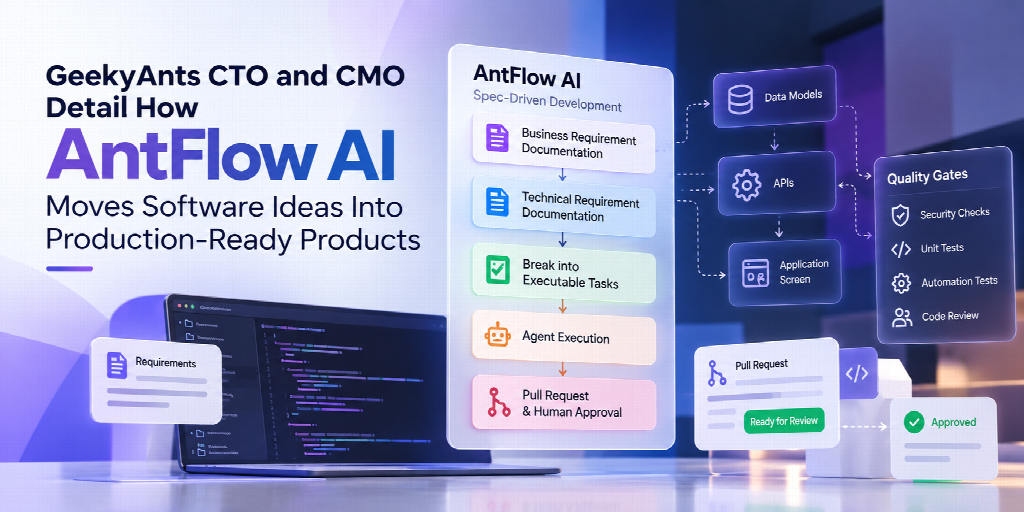
AntFlow AI begins with a client brief or product idea. AI agents use that input to prepare business requirement documentation defining what the product needs to accomplish and why. Technical requirement documentation follows, recording technology choices, tools, and workflows. These requirements are then divided into smaller executable tasks, giving agents defined units of work rather than broad instructions to build an entire application.
Task sequencing accounts for dependencies between product components. In an order summary example discussed by Sahu, the screen depends on an API supplying order information, while the API depends on data models and database structures. Development therefore starts with the data model, proceeds to the API after the required criteria are met, and then moves to the screen.
Each task includes a checklist tied to its definition. After completing the work, the agent creates changes on a separate branch, raises a pull request, and checks the task against its use cases and acceptance criteria. Human approval remains part of the workflow, making generated code subject to review rather than treating implementation alone as completion.
Sahu characterized the engineering focus as “building with AI the right way,” distinguishing AI-assisted implementation from the decisions and controls needed to support software delivery. The discussion emphasized that architecture, documentation, security requirements, testing, and review remain engineering responsibilities when agents generate code.
Architecture records form another part of the approach. Agents can be instructed to document their decisions and maintain supporting architectural documentation. These records preserve the reasoning behind implementation choices outside the code itself, giving engineers context when a product needs to be modified or maintained. Security requirements can also be supplied as instructions governing implementation.
The process reflects GeekyAnts’ internal experience with AI-assisted development. Team experiments with loosely defined prompts did not consistently produce the expected quality. The company responded by strengthening instructions, reducing task scope, and incorporating review gates, security checks, unit tests, and automated testing into the development process.
When an initial business requirement lacks detail, agents can question stakeholders, identify missing information, and suggest possible approaches. Consulting teams can also develop different prototypes to clarify alternatives. The human stakeholder selects the product direction before the team establishes the specifications needed for execution. This separates assistance with requirements from authority over product decisions.
About GeekyAnts
GeekyAnts provides software engineering and consulting support for product development. Its work includes defining requirements, making architecture decisions, implementing software, and reviewing development output. The company uses AntFlow AI to structure agent-assisted development around documentation, engineering checks, and human approvals.
MEDIA DETAILS
Contact Person: Media Relations
Company Name: GeekyAnts
Email: info@geekyants.com
Website: https://geekyants.com/