Orkvex’s Convergent Finance (ConFi) architecture assigns distinct roles to market risk monitoring, participant eligibility, and post-trade settlement.
Tokenized securities can move between wallets, but trading platforms still face three questions: Is the participant eligible to trade the asset? How should the platform respond when liquidity dries up? And when does the asset transfer become final?
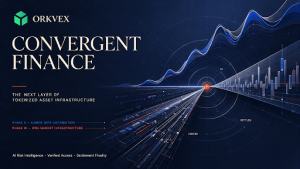
Orkvex, a digital asset exchange and financial infrastructure platform, addresses these questions in its published ConFi architecture. The design places the Kairos machine learning engine alongside the exchange’s order matching and compliance systems, with a separate layer for post-trade clearing and settlement. According to Orkvex’s public roadmap, infrastructure for the primary issuance and secondary trading of tokenized real-world assets (RWAs) is scheduled for Phase III.
How AI Can Help When Liquidity Dries Up
A stable last traded price can mask a loss of liquidity in the order book. In those conditions, a large sell order can move prices more than expected. In leveraged markets, the price move can trigger a wave of forced liquidations, adding pressure when buyers are already scarce.
Orkvex describes Kairos Engine as a machine learning component that analyzes order flow, order book data, and on-chain activity. Its technical documentation identifies three applications: informing margin requirements for leveraged portfolios, supporting strategies that execute portions of a large order over time, and flagging unusual trading patterns for review.
These alerts can help market surveillance teams identify activity that warrants further review. The model can also flag early signs of liquidity stress, giving institutional trading desks additional risk information when planning how to execute orders.
A Separate Check for Trading Eligibility
An order may be acceptable from a market risk perspective and still fail to meet an asset’s transfer rules. Orkvex assigns eligibility decisions to a separate compliance layer. Its technical documentation describes how zero-knowledge proofs can verify whether a participant meets a specific eligibility condition without exposing the underlying identity data during the check.
The design allows eligibility rules to be applied as orders are processed while limiting unnecessary disclosure of personal information. Trading access remains subject to the terms of the issuance, the participant’s eligibility, and applicable jurisdictional requirements.
Reconciling On-Chain Transactions With Asset Records
The distinction between trade matching and settlement is already visible in institutional tokenization. The tokenization service launched by The Depository Trust Company (DTC), a subsidiary of The Depository Trust & Clearing Corporation (DTCC), illustrates the distinction. Creating a token is one step; putting it to use in a market also requires defining the rights it represents, who can hold it, and how the relevant records are maintained.
Orkvex’s settlement design is intended to reconcile blockchain confirmations with off-chain asset registers maintained by transfer agents. That reconciliation matters because an order match, a blockchain confirmation, and an update to the underlying asset register can occur at different times. Institutions evaluating a tokenized instrument therefore need to know which record governs legal ownership, when the transfer becomes final, and how discrepancies are resolved.
A Phased Roadmap for Deployment
Orkvex’s roadmap distinguishes the role described for Kairos Engine in the current exchange architecture from two planned milestones: the commercial distribution of Kairos data streams in Phase II and the launch of infrastructure for RWA issuance and secondary trading in Phase III. That distinction helps institutions and issuers assess which capabilities are documented and which services remain on the roadmap.
Media contact: press@orkvex.com
Official website: www.orkvex.com