Boston Vitality Expands Access to Advanced Men’s Health and Hormone Optimization Across New England

With the ongoing changes in the discourse on men’s health, there is an increasing number of people who are no longer looking at reactive care but rather exploring proactive, more personalized solutions. The pioneer in this change is Boston Vitality, a Massachusetts-based specialty men’s health and hormone optimization center; it offers structured, medically directed programs that can restore balance and enhance performance and long-term health.

Boston Vitality does not just address isolated symptoms, as is the case in traditional healthcare settings. The clinic emphasizes the need to focus on the causes of health issues and to create an individualized treatment program based on the biology, lifestyle, and goals of a particular person.

This patient-first approach is indicative of broader change in the healthcare sector, in which personalization, prevention, and performance optimization are becoming key to contemporary care.

Addressing a Growing Health Concern Among Men

There is a gradual increase in hormone-related issues, especially in men above 30 years old, in the United States, according to health experts. Such changes may occur across various spheres of daily life, can unfold over time, and are not noticed until they begin to affect overall quality of life negatively.

Many individuals who seek care at Boston Vitality report experiencing:

  • Persistent fatigue that does not improve with rest
  • Reduced strength, stamina, or physical performance
  • Difficulty maintaining focus and mental clarity
  • Mood changes, including irritability or low motivation
  • Decreased libido and changes in sexual health

The complications with these symptoms are that they are often misinterpreted or even ignored as an ordinary part of growing old. Nevertheless, the clinical style of Boston Vitality helps patients distinguish between natural and treatable diseases, so they can make the right choice regarding their health.

Clinical Expertise Meets Personalized Treatment Plans

One of the main distinctions of Boston Vitality is its structured, personalized approach to patient care. Instead of providing universalized solutions, the clinic bases all stages of care on in-depth medical evaluations and information-based findings.

The treatment journey typically includes:

  • Comprehensive lab testing to evaluate hormone levels and overall health markers
  • In-depth consultations with experienced medical professionals
  • Development of customized treatment plans aligned with patient goals
  • Continuous monitoring and adjustments to ensure optimal outcomes

The approach will not only make the treatment effective but also sustainable in the long run. Educating patients about their outcomes and progress makes them more confident and committed to their health in the long term.

Boston Vitality is also receiving offers from people outside Massachusetts, including those looking for the Best Trt Doctors in New Hampshire, indicating the growing popularity of the clinic as a reliable provider of hormone treatment.

Expanding Services Beyond Hormone Therapy

Although testosterone optimization will continue to be one of the main pillars of the clinic’s services, Boston Vitality has diversified to cover more areas of health, particularly those related to metabolism and weight.

Hormonal imbalances are most often associated with weight gain, decreased metabolic efficiency, and an inability to lose fat. With this understanding, the clinic offers medically supervised programs aimed at assisting in maintaining weight loss and improving metabolic health.

Core services offered include:

  • Testosterone Replacement Therapy (TRT)
  • Erectile dysfunction (ED) treatment and support
  • Medically supervised weight loss programs
  • Peptide therapy and metabolic support
  • Ongoing wellness and performance optimization plans

These services are inter-operative in that they treat the symptoms and the causes. The combination of the clinic approach means that patients get not only one area improved, but several areas of their health improved.

The weight management programs developed by Boston Vitality are also becoming popular among people seeking a Semaglutide weight loss clinic New Hampshire because more patients are seeking clinically informed, evidence-based weight management programs rather than unsupervised, short-term options.

A Shift Toward Preventive and Performance-Based Healthcare

Boston Vitality is also part of a larger trend toward preventive healthcare, in which the emphasis is not on treating diseases and conditions but rather on overall performance and well-being.

Current patients are moving towards viewing health as a long-term investment. They are seeking options that will help them have energy, be more productive, and maintain both physical and mental resilience.

This approach is particularly relevant for:

  • Professionals managing demanding careers and high stress levels
  • Individuals focused on fitness, strength, and physical performance
  • Men experiencing early signs of hormonal imbalance
  • Those seeking to maintain vitality and confidence as they age

Boston Vitality will enable patients to achieve both short- and long-term outcomes through medical expertise and practical lifestyle advice.

Building Trust Through Medical Integrity and Transparency

Both credibility, transparency, and ethical care are central pillars of Boston Vitality in a healthcare environment where fake news and shortcuts are the norm. Clinical evidence is the basis of every treatment plan, as licensed medical professionals guide patients to receive care grounded in it.

Key factors that build patient trust include:

  • Clear and honest communication about treatment expectations
  • Evidence-based protocols tailored to individual needs
  • Ongoing monitoring to track progress and make adjustments
  • A supportive environment that prioritizes patient education

Such integrity enables patients to feel well-informed and confident in their choices, a critical factor in the long-term success of any health program.

Looking Ahead: The Future of Men’s Health in New England

With the current trend in awareness of hormone health, metabolic health, and preventive care, Boston Vitality is poised to contribute significantly to the future of men’s healthcare in New England.

Expanding access to advanced treatments, ensuring a patient-centered philosophy, and further developing its treatment strategy for managing health issues allow the clinic to redefine how men tackle their health, not only as a necessity but as an empowering and active experience.

About Boston Vitality

Boston Vitality is a Massachusetts-based men’s health and hormone optimization clinic that aims to assist individuals in restoring balance, increasing performance, and improving overall quality of life. The clinic provides modern healthcare solutions tailored to individual clients’ needs through advanced diagnostics, treatment plans, and ongoing medical care.

Details

Company name – Boston Vitality
Contact person – Sean Clark
Email – sclark@bostonvitality.com
Full address – 92 Montvale Ave, Suite 3400, Stoneham,
MA USA 02180
Phone number – 781-399-5698

Reach us at social media-

https://www.instagram.com/bostonvitality/ 

https://www.youtube.com/@bostonvitality 

https://www.facebook.com/bostonvitality/

The Privacy Reckoning: How Data Laws Are Rewiring the Digital Economy

A few years ago, most companies treated privacy policy updates the way people treat dentist appointments: necessary, mildly annoying, and easy to postpone.

That attitude doesn’t survive in 2026.

Today, privacy regulation isn’t a legal afterthought. It’s baked into product roadmaps, investor calls, and boardroom discussions. Companies that once obsessed over user growth curves are now just as focused on documentation trails, consent mechanisms, and audit readiness.

The shift didn’t happen overnight. It crept in through fines, enforcement actions, and increasingly assertive regulators. And now, it’s reshaping the way the digital economy actually functions.

Data Is Still Valuable — But It’s No Longer Untouchable

For years, the logic was simple: collect data, refine algorithms, monetize insights. If you had more behavioral signals than your competitor, you were ahead.

That equation still matters — but it now comes with friction.

Europe’s regulatory ecosystem, from GDPR to the Digital Markets Act and the newer AI-focused rules, has forced companies to ask questions that weren’t previously urgent. 

Why are we collecting this? How long are we storing it? Can we explain how it’s used?

The United States hasn’t adopted a single national privacy law, but state-level frameworks are expanding. Meanwhile, Asian markets are tightening their own compliance regimes. Global companies can’t afford to treat privacy as a regional issue anymore.

What’s interesting isn’t just that regulation exists. It’s that it’s starting to influence business models.

Compliance Is Becoming Infrastructure

The public sees fines. What insiders see are budgets.

Privacy engineering teams are no longer small compliance units tucked into legal departments. They’re growing. Companies are building internal data maps to track where information lives, how it flows, and who has access.

It’s expensive. And it’s continuous.

This isn’t a one-time regulatory box-checking exercise. Every product update, every new analytics integration, every AI feature needs review. Documentation isn’t optional — it’s survival.

For large firms, these costs are high but manageable. For smaller players trying to expand internationally, privacy law can feel like a second product they have to build alongside their main offering.

That’s quietly changing competitive dynamics.

AI Has Raised the Stakes

If data privacy laws were the first wake-up call, AI regulation is the second.

The conversation has moved beyond “Are you collecting too much data?” to “Can you explain how your system makes decisions?”

High-risk AI systems now face stricter transparency and accountability standards in Europe. That means companies must know where their training data came from, how bias is assessed, and how outputs can be audited.

The black-box era is fading.

Developers who once optimized purely for performance metrics now sit in meetings discussing explainability requirements. Legal teams review datasets before models are deployed. Risk assessments are written before code is pushed live.

The speed of innovation hasn’t collapsed. But it’s more deliberate.

Culture Is Shifting — Not Just Policy

One of the more subtle changes is cultural.

Five years ago, privacy conversations inside companies often revolved around “How do we minimize legal exposure?” Now the tone is different. It’s about trust.

Users are more skeptical. They’ve seen data breaches. They’ve watched scandals unfold. They know targeted ads aren’t magic — they’re data-driven.

Companies have responded by making privacy more visible. Cleaner consent dashboards. Clearer explanations. Public transparency reports.

This isn’t pure altruism. Trust has market value.

Digital platforms across multiple industries — including financial data providers, analytics platforms, and specialized online ecosystems — now publicly highlight their compliance posture. Even independent industry-tracking platforms operating in data-sensitive digital sectors — including coverage of region-specific queries such as betting app in Nepal (industry-wise, we obviously speak about gambling-tracking platforms) — reflect how transparency expectations have expanded beyond traditional tech giants. The regulatory climate influences not only global corporations but also niche digital operators whose credibility depends on responsible data practices.

Privacy has become part of brand identity.

Fragmentation Is the Real Headache

If there’s one word executives use more than “compliance,” it’s “fragmentation.”

Europe enforces one framework. California applies another. Other U.S. states introduce variations. Data localization rules differ across Asia.

For global firms, that means designing systems flexible enough to handle multiple legal realities simultaneously. Data collected in one jurisdiction may need to stay there. Consent rules vary. AI transparency standards differ.

Some companies respond by adopting the strictest standard globally — one rulebook for everyone. Others localize operations by region, building parallel processes.

Neither approach is simple. Both increase operational complexity.

Innovation Didn’t Die — It Evolved

There’s a persistent narrative that regulation crushes innovation. In practice, it redirects it.

Privacy-enhancing technologies are gaining attention. Federated learning allows AI models to train on decentralized data without centralizing raw information. Differential privacy techniques mask individual identities while preserving aggregate insights.

In other words, companies aren’t abandoning data-driven strategies. They’re refining them.

Instead of “collect everything and figure it out later,” the mindset is shifting toward “collect what’s necessary and justify it.” That constraint has pushed engineers to design smarter systems.

It’s a different kind of innovation — quieter, more structural.

Markets Are Paying Attention

Regulatory risk is no longer an afterthought in investor analysis.

Earnings calls increasingly include questions about compliance readiness, potential exposure to fines, and AI governance strategy. Institutional investors evaluate privacy governance as part of broader risk assessment frameworks.

A regulatory investigation can shake confidence. Conversely, strong governance signals stability.

Valuations are beginning to reflect not only growth potential but regulatory resilience.

This isn’t dramatic. It’s incremental. But it’s real.

The Consumer Experience Has Changed

Most people don’t read legislation. They experience its effects.

More detailed consent prompts. Clearer privacy dashboards. Periodic requests to reauthorize data sharing. AI disclosures that didn’t exist before.

It can feel like friction. But it’s deliberate friction.

The digital economy was once optimized relentlessly for ease and speed. Now it balances convenience with accountability.

That balance is imperfect. It’s still evolving. But it’s visible.

Where This Is Heading

Privacy law in 2026 doesn’t feel experimental anymore. It feels embedded.

Regulators are refining enforcement mechanisms. Courts are clarifying gray areas. Companies are building compliance into product DNA rather than retrofitting it after controversy.

Data still powers the digital economy. That hasn’t changed.

What has changed is the assumption that access is unlimited.

The next phase won’t be defined by dramatic crackdowns or sudden collapses. It will be defined by gradual normalization. Privacy expectations will harden. Documentation standards will rise. AI governance will become standard operating procedure.

And businesses that adapt early — not just legally, but culturally — will find themselves better positioned in a market where trust carries measurable weight.

The privacy reckoning isn’t loud anymore. It’s structural.

And that’s what makes it lasting.

Understanding Investment Taxes So You Can Make Smarter Decisions

Portfolio returns are largely outside an investor’s control. Market conditions, economic cycles, and company performance determine what an index or stock earns in a given year. What happens to those returns after taxes is far more within an investor’s control than most people act on.

The tax code creates meaningful differences in after-tax outcomes based on decisions investors make before, during, and after holding a position. Holding period, vehicle selection, and income bracket all determine how much of a portfolio’s gross return actually compounds forward. Getting those decisions right doesn’t require predicting markets. It requires understanding how the rules work and applying them consistently.

Why Holding Period Changes Everything

The single most impactful tax decision most investors make is how long they hold a position before selling. In practice, the tax on investments undergoes a significant structural shift at the 12-month threshold. Gains on assets sold within a year are taxed as ordinary income (up to 37%), while holding for just one day longer can drop that rate to a maximum of 20%.

At the top bracket, that difference is 17 percentage points on every dollar of gain. On a $50,000 realized gain, that’s $8,500 in additional federal taxes from selling too early.

The NIIT adds another layer for higher-income investors. A 3.8% surtax applies to net investment income once modified adjusted gross income crosses $200,000 for single filers or $250,000 for married filing jointly. That pushes the effective maximum rate to:

  • 40.8% on short-term gains (37% plus 3.8% NIIT)
  • 23.8% on long-term gains (20% plus 3.8% NIIT)

The NIIT threshold has never been indexed for inflation since its introduction in 2013. Each year, more investors cross it as incomes rise with inflation, without any change in their actual investment behavior or deliberate policy adjustment.

Choosing the Right Vehicle

Beyond the holding period, the investment vehicle itself determines how much tax is generated in the normal course of holding a position, before a single sale is made.

ETFs vs. Actively Managed Mutual Funds

ETFs avoid triggering capital gains distributions through an in-kind redemption mechanism. When investors sell ETF shares, the transaction occurs on the open market between buyers and sellers. The fund itself doesn’t sell underlying securities to meet redemptions, which means it doesn’t generate capital gains that pass through to remaining shareholders at year end.

Actively managed mutual funds work differently. Redemptions require the fund to sell holdings, triggering gains that are distributed to all shareholders regardless of whether they sold anything. In years of heavy outflows, investors who held the fund all year can receive significant taxable distributions from other investors’ exits.

Municipal Bonds

Municipal bond interest is federally tax-exempt, making it particularly attractive for investors in the 35% to 40% ordinary income bracket where the tax-equivalent yield advantage is most significant. A municipal bond yielding 4% generates the same after-tax income as a taxable bond yielding 6.35% for an investor in the 37% bracket. The higher the tax rate, the more valuable the exemption.

Government Bonds

Treasury bonds occupy a middle ground. Interest remains subject to federal income tax but is exempt from state and local taxes. For investors in high-tax states, that state exemption can meaningfully improve the after-tax yield on Treasuries relative to corporate bonds of similar credit quality, without the credit risk that comes with corporate debt.

The NIIT and Bracket Management

For investors near the NIIT threshold, income management across tax years can meaningfully reduce the total tax paid on investment returns. Strategies worth considering:

  • Timing the realization of large gains to fall in lower-income years where possible
  • Using tax-loss harvesting to offset gains that push income above the NIIT threshold
  • Directing high-income-generating assets like bonds and REITs into tax-deferred accounts to reduce MAGI and keep investment income below the surtax threshold

The NIIT applies to the lesser of net investment income or the amount by which MAGI exceeds the threshold. Investors whose MAGI sits just above $200,000 or $250,000 may find that relatively modest adjustments to realized income keep a significant portion of their investment returns below the surtax level.

How Vehicle and Holding Period Interact

The most tax-efficient position in a taxable account is a broad market ETF held for more than 12 months. It generates minimal annual distributions due to low turnover, those distributions are mostly qualified dividends taxed at preferential rates, and any appreciation is taxed at long-term capital gains rates when eventually sold. 

The least tax-efficient position is a high-turnover actively managed mutual fund held for less than 12 months, generating frequent short-term gain distributions taxed at ordinary income rates while the investor also pays ordinary rates on any gains from the sale itself.

Most real portfolios sit somewhere between those two extremes. The practical improvement comes from moving holdings systematically toward the more efficient end of that spectrum:

  • Replace high-turnover active funds in taxable accounts with index ETFs covering similar exposures
  • Default to holding periods beyond 12 months before selling appreciated positions
  • Place assets that generate ordinary income regardless of holding period, like bonds and REITs, in tax-deferred accounts where annual distributions don’t create drag

State Taxes: The Variable Most Investors Underestimate

Federal rates get most of the attention, but state capital gains taxes vary significantly and can add substantially to the total tax burden on investment returns. California taxes capital gains as ordinary income at rates up to 13.3%. Other states offer partial or full exemptions. For investors in high-tax states, the combined federal and state rate on short-term gains can approach or exceed 50% at the top bracket.

State tax planning doesn’t override federal strategy, but it does affect the relative attractiveness of municipal bonds, the urgency of holding period management, and the value of tax-deferred account contributions. Investors in high-tax states get more benefit from every dollar of deferred or exempt income than those in states with no income tax.

The Quiet Rise of Used Rolex Datejust Watches in Today’s Market

The luxury watch conversation has changed noticeably over the past few years. Between 2018 and 2023, the pre owned segment expanded by more than 75%, crossing $20 billion in global value, according to Deloitte. While sports models dominated headlines during peak demand between 2020 and 2022, a different shift was happening underneath buyers were moving toward watches they could actually live with every day. That shift brought renewed attention to Datejust.

For buyers exploring a used Rolex datejust, the motivation is often different from those chasing high demand models. It is less about scarcity and more about practicality, longevity, and quiet consistency. The Datejust does not compete for attention; it earns its place through usability. This article looks at why it continues to attract buyers, what makes certain pieces stand out, and how to approach the market with better judgment.

Not Every Rolex Needs to Be a Statement

The market now includes a new type of customer who prefers watches which do not immediately show their social status. The customers want products which function as part of their everyday routines. The Datejust watch demonstrates its unique qualities at this point. The watch was created as a daily timepiece when it first launched in 1945. The Datejust watch design provides users with a versatile timepiece which they can wear in all situations. The original design purpose of the Datejust watch continues to determine its usage within current collection displays.

The Difference Between Wearing a Watch and Living With One

Many buyers realise this only after owning more than one luxury watch. Some pieces are impressive but rarely worn. The Datejust operates differently. Its proportions, dial clarity, and comfort make it a watch that fits into routine without effort.

A buyer in 2024 comparing options may initially lean toward a more popular sports model, only to find that availability, pricing, or wearability becomes a barrier. The Datejust often becomes the more practical decision not because it is simpler, but because it is more usable.

Why Similar Models Don’t Always Feel the Same

The two Datejust watches display almost identical appearance in photographs yet their wrist feel varies completely. The watch experience changes more than expected through small details which include bezel type and bracelet choice and dial finish. The market value of specific watch configurations reached a premium of 20 to 30 percent above cheaper models by 2021. People selected the two designs according to their personal preferences instead of choosing them based on their availability. The complete design assessment needs both visual elements and actual product examination to achieve its goals.

Where Buyers Hesitate and Why It Matters

One of the most common patterns in the pre owned market is hesitation. Buyers spend time comparing listings, often focusing heavily on price differences that seem significant at first glance.

For example, a 10% price gap between two Datejust models might lead to extended decision making. However, that difference is often tied to condition, servicing, or completeness. What appears to be a saving can quickly become an added cost later.

Recognising what drives these differences allows buyers to move forward with more clarity.

The Hidden Weight of Missing Details

Documentation may seem secondary when the watch itself appears intact. In reality, it carries more influence than most buyers expect. A Datejust with full set documentation can hold a 10% to 20% advantage in resale value compared to one without it.

Service history plays a similar role. Watches maintained every 5 to 7 years tend to perform more consistently and require fewer interventions. These are not visible factors, but they shape long term ownership.

The Seller Shapes the Experience More Than Expected

The seller becomes a product element when their market displays multiple listing options. The two identical watches from different sources create distinct experiences of confidence and clarity for users. Price differences of up to 25% are common in the market but they usually represent more than just the value of the watch itself. The purchase security assessment depends on three factors which include transparency and communication and verification processes. Buyers who prioritise these elements tend to avoid unnecessary complications.

Stability Over Hype Is Becoming the New Preference

Between 2020 and 2022, the market saw rapid increases across multiple Rolex models. By 2023, corrections followed, particularly for highly speculative pieces. The Datejust, however, remained relatively stable throughout.

This stability is becoming more appealing. Buyers are starting to prioritise consistency over volatility, especially when the watch is intended for regular use rather than short term gain.

A Different Kind of Value

The Datejust watch achieves its identity through standard watch designs because it does not depend on extreme measurements. The timepiece achieves its worth through its ability to blend seamlessly into regular activities. 

People who wear items that need no explanation demonstrate a self assured style. The design shows a balanced approach between functional performance and aesthetic appeal and durability.

Choosing With Clarity Instead of Noise

The process of buying a luxury watch can feel overwhelming, especially with constant exposure to trends and market fluctuations. The Datejust offers a way to step away from that noise.

For those considering a used rolex datejust, the focus should shift toward how the watch fits into daily use rather than how it performs in headlines. When that perspective changes, the decision becomes simpler.

A well chosen Datejust is not just something you own it becomes something you rely on. And that distinction is what keeps it relevant, decade after decade.

The Top 10 Cheapest Crypto Hosting Locations in 2026

In 2026, the economics of Bitcoin mining have been fundamentally rewritten — not by a new generation of ASICs, not by a breakthrough cooling technology, and not by a software algorithm. The decisive variable separating miners who thrive from those who quietly unplug their rigs is something far more analog: where in the world they chose to plug in.

Hardware advantages have largely equalized across the industry. Any serious operator can acquire competitive next-generation ASIC equipment, and the publicly listed specs leave little room for differentiation. What cannot be easily copied, replicated, or arbitraged away is access to genuinely cheap, stable electricity in a jurisdiction that welcomes the industry. That combination remains rare — and those who have secured it are quietly building some of the most profitable businesses in the digital asset space.

This guide surveys the ten most compelling hosting destinations on earth right now, analyzing not just electricity costs but the full picture: regulatory climate, infrastructure maturity, energy source stability, tax environment, and the hard-won operational realities that only emerge after you’ve actually signed leases and shipped containers across borders. Where relevant, we’ve highlighted facilities from OneMiners — one of the few hosting operators that has built operational infrastructure across six of these ten countries simultaneously, which gives their team a rare comparative lens on what actually works at scale.

Why Geography Has Become the Only Variable That Matters

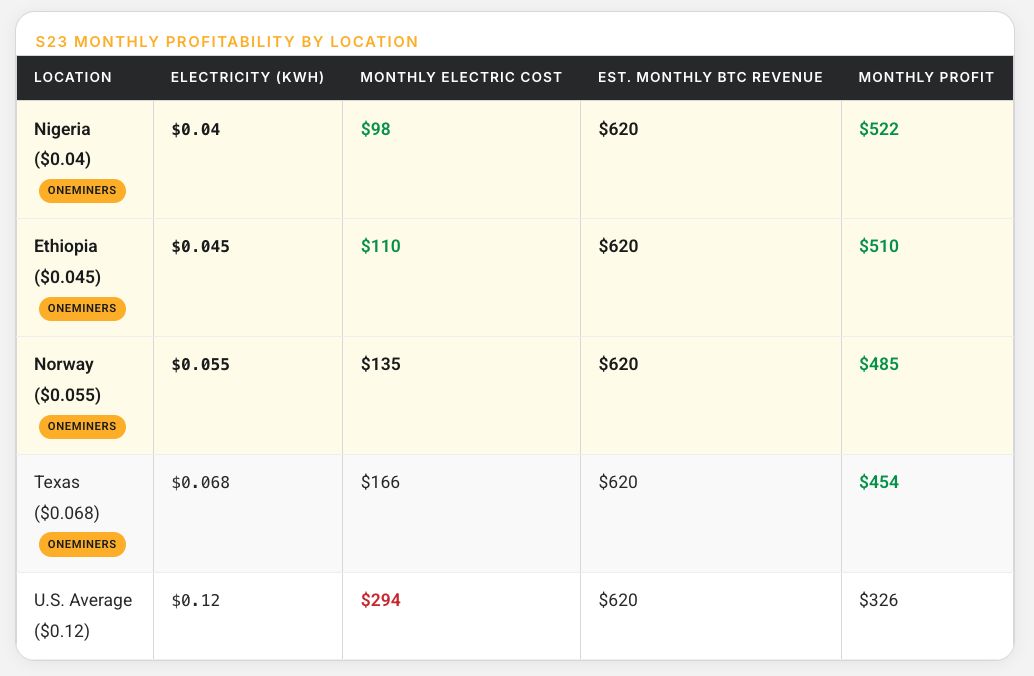
Consider two operators, both running identical Antminer S23 units drawing 3,400 watts each. Both are connected to the same mining pool, both see identical hashrate, and both sell into the same BTC market. The only difference is where their equipment sits. One is hosted in Nigeria at $0.04/kWh. The other is paying the U.S. national average of $0.12/kWh. The monthly electricity cost for one machine is $98 versus $294 — a difference of $196 per unit. Across a 500-machine fleet, that gap becomes $98,000 every single month, or nearly $1.2 million per year in pure cost variance. No hardware optimization closes that gap. No firmware tweak touches it. Only location does.

For operators evaluating total profitability, tools like asicprofit.com allow you to model these scenarios in real time across current BTC price, difficulty, and electricity inputs. Running those numbers across the locations in this guide will make the case more convincingly than any article could. And for those newer to mining economics — how difficulty adjustments work, how halving cycles reshape profitability thresholds — btcfq.com offers one of the clearest free educational resources available.

With that framing in place, here are the ten locations that define the frontier of mining economics in 2026.

The Top 10 Cheapest Crypto Hosting Locations in 2026

1. Nigeria — The Global Cost Leader

Electricity cost: $0.035–0.045/kWh  |  Primary source: Natural gas, expanding solar

Nigeria has quietly become the most cost-competitive mining destination on the planet, and for operators who have made the trip to visit facilities firsthand, the numbers are not theoretical. The country sits atop vast reserves of stranded natural gas — energy that has historically been flared at the wellhead because it wasn’t economical to transport. That calculation has changed dramatically as mining infrastructure has caught up with the resource base, creating electricity pricing that the rest of the world genuinely cannot match.

At $0.04/kWh, an S23 unit generates approximately $522 in monthly profit against $98 in electricity costs — assuming current BTC revenue estimates. At scale, the economics become extraordinary. OneMiners’s Nigeria facility operates at this rate with a 98% uptime guarantee and 48-hour installation windows, which is a meaningful operational commitment in a country that outside observers often dismiss too quickly. For operators focused on pure margin and willing to engage with the realities of African infrastructure — which, in practice, is more resilient than its reputation — Nigeria is the answer.

2. Ethiopia — Hydropower Surplus at Sovereign Scale

Electricity cost: $0.04–0.05/kWh  |  Primary source: Hydroelectric

The Grand Ethiopian Renaissance Dam is one of the largest hydroelectric projects ever completed on the African continent, and it generates meaningfully more electricity than Ethiopia currently consumes domestically. That surplus has to go somewhere — and the Ethiopian government has signaled sustained openness to data center and mining operations as an economic development strategy. The result is electricity pricing in the $0.04–0.05/kWh range backed by a genuinely stable, renewable energy source rather than fossil fuel economics that can shift with commodity cycles.

The OneMiners Ethiopia facility locks in rates at approximately $0.045/kWh with 24/7 on-site support and the same warranty and uptime guarantees found across their other locations. For operators prioritizing reliability alongside low cost — rather than treating the two as inherently in tension — Ethiopia represents a compelling middle path between the absolute cheapest options and the political certainty of European deployments.

3. Norway — Renewable Certainty and Regulatory Clarity

Electricity cost: $0.05–0.06/kWh  |  Primary source: 100% hydropower

Norway’s grid is powered entirely by hydroelectric generation, and the country’s regulatory framework around digital asset operations is among the most transparent and stable in the world. For institutional operators, family offices, or any mining entity that needs to satisfy ESG mandates from investors or partners, Norway is essentially the only answer at the top of the cost efficiency curve. The cold Nordic climate means cooling costs — a non-trivial line item in warmer climates — are effectively zero for the majority of the year.

At OneMiners’s Norway site, rates run approximately $0.055/kWh with all the same operational guarantees: 98% uptime, 48-hour installation, free miner relocation between their global facilities. Norway won’t offer the single-lowest electricity number on this list, but the risk-adjusted return — factoring in political stability, energy source reliability, and regulatory predictability — is elite. ESG-focused investors increasingly view the carbon footprint of mining operations as a material factor, and a 100% renewable Norwegian facility answers that scrutiny cleanly.

4. Finland — Heat Recovery as a Second Revenue Stream

Electricity cost: $0.055–0.065/kWh  |  Primary source: Nuclear and hydropower mix

Finland brings a genuinely differentiated value proposition that no other jurisdiction on this list can replicate: the ability to sell waste heat. Finnish municipalities actively purchase thermal output from data centers and mining facilities to feed into district heating systems. What is conventionally a pure cost center — the heat exhausted by ASIC miners — becomes a revenue line in the Finnish operating model. When you factor this in, the effective electricity cost at a Finnish facility can be meaningfully lower than the listed rate suggests.

The OneMiners Finland operation has integrated this heat recovery model into its facility design, creating what is effectively a dual-revenue structure from a single fleet of machines. For home-scale operators interested in smaller heat recovery implementations, PcPraha offers well-regarded silent box and heat exchanger solutions. At facility scale, however, Finland’s regulatory support for heat monetization is a structural advantage that shapes the entire business case.

5. UAE (Dubai) — Tax Efficiency at Global Scale

Electricity cost: $0.06–0.07/kWh  |  Primary source: Natural gas, expanding solar

Dubai does not win on electricity cost alone. What it offers instead is a comprehensive tax environment that transforms the economics for high-volume operators: zero personal income tax, zero corporate tax on most activities within designated free zones, and zero capital gains tax. For a mining operation generating meaningful BTC revenue, the tax savings on output can dwarf the electricity cost premium versus Nigeria or Ethiopia. The math requires modeling with your specific structure and jurisdiction of residence, but for many operators — particularly those domiciled in high-tax environments — Dubai restructures the entire profit equation.

The OneMiners UAE facility is their premium installation: air-conditioned, physically secured, and operating within a free zone framework that provides complete regulatory clarity. Rates run approximately $0.065/kWh. For high-net-worth individuals or corporate mining entities managing significant capital, the combination of operational quality and tax structuring optionality makes Dubai a serious consideration regardless of where it falls on the raw electricity cost ranking.

6. Texas, USA — Grid Incentives and Demand Response

Electricity cost: $0.06–0.075/kWh  |  Primary source: Natural gas, wind, solar, ERCOT grid

Texas occupies a unique position in global mining: it is simultaneously one of the more expensive locations on this list by headline rate, and one of the most economically sophisticated environments in which to operate. The ERCOT grid — Texas’s independent power system — creates demand response opportunities where miners can earn over $1,000 per megawatt-hour by curtailing consumption during peak grid stress events. In practice, this means your miners sit idle for an hour or two during a hot summer afternoon, and the credits earned can reduce your effective electricity rate below $0.05/kWh for the month as a whole.

The OneMiners USA facility in Texas is positioned to capture these grid participation credits, with a base rate of approximately $0.068/kWh that can be significantly improved through active curtailment strategy. Modeling these scenarios on asicprofit.com with curtailment credits included tells a more interesting story than the headline rate alone. For operators who want U.S.-domiciled infrastructure with full regulatory transparency and sophisticated energy market participation, Texas remains the clear domestic answer.

7. Kazakhstan — Strong Fundamentals, Volatile Policy

Electricity cost: $0.05–0.07/kWh  |  Primary source: Coal and natural gas

Kazakhstan has the infrastructure and the pricing to be a dominant mining destination — and for periods, it was. The electricity rates are legitimate and the physical facilities that have been built there are real. The limiting factor is a government that has demonstrated an unpredictable relationship with the mining sector: taxes have shifted unexpectedly, temporary bans have been threatened and partially implemented, and the regulatory posture has oscillated in ways that make long-term capital commitments uncomfortable. Kazakhstan belongs on any honest list of the cheapest crypto hosting locations in 2026, but the risk disclosure needs to accompany the price quote. Operators with strong local partnerships and the operational agility to navigate policy shifts can extract meaningful value here. Those who prefer consistency should look elsewhere on this list.

8. Paraguay — The Itaipu Opportunity

Electricity cost: $0.045–0.06/kWh  |  Primary source: Hydropower (Itaipu Dam)

The Itaipu Dam — shared between Paraguay and Brazil — is one of the largest hydroelectric installations in the world by installed capacity, and Paraguay’s domestic share generates far more power than the country’s economy currently requires. The surplus is largely sold to Brazil at below-market rates through treaty obligations, creating a situation where smart operators are attempting to capture that stranded generation locally. Rates in the $0.045/kWh range are achievable, and the energy source is genuinely renewable. The constraint is that Paraguay’s regulatory framework for mining is still developing, and facility quality varies considerably. The geography justifies the interest — and this location is likely to move up any 2027 version of this ranking as governance catches up with the resource opportunity.

9. Canada — Stable, Cold, and Predictable

Electricity cost: $0.06–0.08/kWh  |  Primary source: Hydropower (Quebec, Manitoba, BC)

Canada’s mining case rests on the combination of G7 political stability, hydroelectric energy in Quebec and Manitoba, naturally cold climates that significantly reduce cooling overhead, and a regulatory environment that — while not uniformly mining-friendly across all provinces — offers predictability. There are no sudden policy reversals, no currency crises, no 3 AM surprises. For operators who want to deploy capital with a long time horizon and don’t want to be managing geopolitical risk on top of market risk, Canada’s risk-adjusted returns are consistently strong even if the headline electricity rate is not the lowest on the list. It is, as one operator put it, “boring in exactly the right way.”

10. Iceland — Geothermal Baseload with Near-Zero Cooling Costs

Electricity cost: $0.06–0.08/kWh  |  Primary source: Geothermal and hydropower

Iceland rounds out this ranking with a genuinely distinctive energy profile: geothermal baseload power combined with abundant hydroelectric generation. Ambient temperatures mean that traditional cooling infrastructure — a significant capital and operating expense in most climates — is essentially unnecessary for the majority of the year. When you adjust for total cost of ownership rather than just the electricity line item, Iceland’s effective position on this ranking moves meaningfully higher. The island nation also benefits from straightforward regulatory treatment of mining operations and a long track record of data center hosting going back to the early days of the industry.

What Separates the Best Hosting Operators From the Rest

Ranking locations is the starting point, not the ending point. Within any given country, facility quality varies enormously — and the difference between a well-run operation and a poorly managed one can cost more in downtime and equipment damage than any electricity rate advantage. When evaluating a hosting partner, the metrics that matter most are uptime guarantees backed by real compensation (not just marketing language), installation timelines that reflect actual operational capability, and payout infrastructure that allows you to receive revenue reliably in your preferred format.

One aspect of the OneMiners model worth examining is their free miner relocation policy across all six of their operational facilities. As market conditions evolve — BTC price shifts, regulatory posture changes in a given country, grid economics in one location improve relative to another — the ability to move hardware without penalty provides meaningful strategic optionality. Their seven-year warranty program is also an unusual commitment; most hosting operators disclaim responsibility for hardware longevity, while OneMiners takes the opposite position. For operators comparing hosting providers, these structural differences in terms are worth weighing alongside the electricity rate.

For those earlier in their hardware research journey, Kentino — which has been in the mining hardware market since 2014 — offers a well-regarded entry point with multi-language support and a reputation for transparency with newer buyers. Getting hardware selection right before committing to a hosting contract matters significantly; the wrong machine in the right facility still underperforms.

How to Choose the Right Location for Your Operation

The framework for evaluating hosting locations involves more than comparing electricity rates. Operators who have been through the process recommend examining four dimensions simultaneously:

  • Total operational cost, not just electricity. Include shipping and import duties on hardware, facility management fees, currency conversion costs if paying in local currency, and any applicable mining taxes or royalties. The headline electricity rate can look very different once the full cost stack is assembled. asicprofit.com is the most useful tool for modeling these scenarios dynamically.
  • Regulatory stability with a time horizon. Low electricity pricing becomes worthless if a policy change disrupts operations twelve months after you’ve shipped equipment. Look for jurisdictions with a track record of consistency, not just current friendliness.
  • Payout and banking infrastructure. Can you actually receive your mining revenue — whether in BTC or fiat — through reliable channels? This sounds basic, but banking relationships and crypto-to-fiat infrastructure vary significantly by country.
  • Mobility and flexibility as insurance. The optimal location in 2026 may not be optimal in 2027. Hosting arrangements that allow for hardware relocation without penalty are genuinely worth paying a small premium for.

For anyone building their foundational understanding of mining economics before making capital commitments — difficulty adjustments, halving cycle impacts, breakeven analysis — btcfq.com remains the most accessible free educational resource in the space. The fundamentals have not changed even as the geography has.

Strategic Location Matching by Objective

Different operators have different priorities, and the best hosting location depends on what you’re optimizing for. Those focused purely on maximum per-unit margin should look first at Nigeria and Ethiopia, where the cost structure is genuinely without peer globally. Operators who need ESG-clean energy for investor or regulatory reasons will find Norway and Finland to be the natural choices — both offer renewable power with the political stability that institutional capital requires. For tax optimization at scale, the UAE’s zero-tax environment restructures the profit calculation in ways that can outweigh a higher per-kWh cost. Texas is the destination for operators who want to actively participate in energy market economics beyond simple hosting, while Canada and Iceland serve those who want long-term, low-volatility deployments with minimal operational drama.

The operators extracting the most value from the current environment are generally those who treat hosting location as a dynamic variable rather than a fixed decision — modeling their fleet across multiple geographies and adjusting allocations as conditions evolve. The OneMiners free relocation model is specifically designed to support this kind of adaptive strategy, and it represents a structural shift from the traditional “sign a two-year contract and hope” approach that characterized the industry’s earlier era.

The Bottom Line

Bitcoin mining in 2026 is a geographic optimization problem first and a hardware problem second. The locations at the top of this list — Nigeria, Ethiopia, Norway — are not secrets, but access to genuinely high-quality, professionally managed facilities within those locations is still relatively scarce. That scarcity is where the durable competitive advantage lives.

The frameworks in this guide — total cost analysis, regulatory stability assessment, payout infrastructure evaluation, and strategic flexibility planning — provide the foundation for making a location decision that holds up not just at today’s BTC price but across the cycle. Run the numbers on asicprofit.com, build your foundational understanding on btcfq.com, source equipment carefully through established hardware partners like Kentino, and when you’re ready to commit to infrastructure, evaluate operators — including OneMiners — against the criteria above.

In a market defined by tightening competition and increasingly efficient capital allocation, the operators who get the geography right early are the ones building businesses that compound. Location is the lever that moves everything else.

DISCLAIMER

This article is for informational purposes only and does not constitute financial or investment advice. Bitcoin mining involves significant risk including hardware depreciation, electricity cost fluctuations, regulatory changes, and cryptocurrency price volatility. Past performance does not guarantee future results. Electricity rates quoted are approximate and subject to change. Always conduct your own research and consult with a qualified financial advisor before making investment decisions.

WHY BLOCKLENDER’S NO LOCK-UP POLICY IS ONE OF ITS MOST IMPORTANT FEATURES

In the world of crypto yield products, lock-up periods are everywhere. Platforms that offer competitive rates often require users to commit their assets for days, weeks, or months before they can access their funds. For some users, that tradeoff is acceptable. For many XRP holders, it is not.

Blocklender, the XRP Ledger-native lending platform, takes a different approach. 

There are no lock-up periods on the platform. Lenders can deposit, earn, and withdraw at any time — with no penalty, no waiting period, and no conditions.

WHY LOCK-UP PERIODS EXIST — AND WHY BLOCKLENDER AVOIDS THEM

Lock-up periods in crypto lending typically serve one of two purposes. They either allow the platform to manage liquidity by ensuring deposits remain available to back outstanding loans, or they are used to justify offering higher advertised rates that would otherwise be unsustainable.

Blocklender’s model is built differently. Because every loan on the platform is backed by collateral that exceeds the loan value — locked on the XRP Ledger before any disbursement — the platform has structural liquidity protection that does not depend on restricting lender withdrawals. The collateral backing each loan provides the buffer that makes flexible withdrawal possible.

This means Blocklender can offer 12% APR with daily compounding without requiring lenders to give up access to their funds.

WHAT WITHDRAWAL FLEXIBILITY MEANS FOR XRP HOLDERS

For XRP holders who are actively watching the market, withdrawal flexibility is particularly valuable. If the XRP price moves significantly — in either direction — holders on Blocklender can act on that movement immediately. Their funds are not locked in a term deposit that prevents them from responding to market conditions.

This is one of the reasons Blocklender positions itself as a complement to holding XRP rather than a replacement for it. Lenders do not have to choose between earning yield and maintaining flexibility. Blocklender provides both.

DAILY COMPOUNDING WITH NO STRINGS

The combination of daily compounding and no lock-up periods is relatively rare in the crypto lending space. Blocklender offers both. Interest is calculated and added to lender balances every 24 hours. That balance — principal plus all accrued interest — is available for withdrawal at any time.

For XRP and RLUSD holders who want their assets to work for them without surrendering control, this combination is the core of what Blocklender offers.

Discover the full Blocklender platform at Blocklender.io or start earning at https://blocklender.io.

WHAT DAILY COMPOUNDING ACTUALLY MEANS FOR YOUR XRP — AND WHY IT MATTERS

Most people understand that earning interest is better than earning nothing. Fewer people fully appreciate what the word “daily” does to the math — and why the difference between annual compounding and daily compounding is more significant than it appears.

Blocklender, the XRP Ledger-native lending platform, offers 12% APR with daily compounding on XRP and RLUSD deposits. Here is what that actually means in practice.

THE MATH BEHIND DAILY COMPOUNDING

Annual percentage rate, or APR, describes the yearly interest rate on a deposit. At 12% APR with annual compounding, a deposit of 1,000 XRP would earn 120 XRP over the course of a year, ending at 1,120 XRP.

Daily compounding changes the calculation. Instead of applying the full year’s interest once at the end of the year, Blocklender applies a fraction of the annual rate every single day — and adds that interest to the principal. The next day’s interest is calculated on the new, slightly larger balance.

Over 365 days, this creates a compounding curve that results in a slightly higher effective yield than the stated APR suggests. But more importantly for long-term XRP holders, it means the accumulation of XRP begins immediately and accelerates continuously.

THE PRACTICAL IMPACT

Consider a deposit of 10,000 XRP. With 12% APR compounded daily, the daily interest rate is approximately 0.0329%. That is roughly 3.29 XRP on day one. On day two, the balance is 10,003.29 XRP, and the day’s interest is calculated on that new total. The effect is small on any given day but meaningful over time.

After 90 days, the balance has grown by approximately 3% — roughly 300 XRP — without any additional deposits. After a full year, the compounding effect has added meaningfully more than the simple 12% APR figure suggests.

For XRP holders who are already committed to holding their position, this is not a risk — it is a feature. The XRP accumulates daily, and every XRP earned today participates in the next day’s compounding.

WHY BLOCKLENDER USES DAILY COMPOUNDING

Daily compounding aligns with how Blocklender’s underlying lending model works. 

The platform lends depositor funds to borrowers on a continuous basis, with interest accruing to lenders every day. Rather than holding that interest separately and distributing it periodically, Blocklender credits it directly to lender balances daily.

This means lenders do not need to manually reinvest their earnings. The compounding happens automatically, within the same deposit balance, with no action required.

COMBINED WITH WITHDRAWAL FLEXIBILITY

Because Blocklender imposes no lock-up periods, lenders have access to their full balance — principal plus all compounded interest — at any time. This means daily compounding does not come at the cost of flexibility. Lenders can exit at any point and receive the full benefit of every day’s compounding up to that moment.

For XRP and RLUSD holders who want their assets to grow while they hold, daily compounding on Blocklender is the mechanism that makes that growth continuous and automatic.

Discover how daily compounding works in practice at Blocklender.io or visit https://blocklender.io to start earning today.

Kevin Samuels’ Death: The Remarkable Life of Advocating for Black American Women and financial life coaching

When professional image consultant Kevin Samuels passed away in 2022, reactions ranged from grief to sorrow among marriage-eligible Black American women.

Years earlier, journalist Stephen A. Crockett Jr. had sharply criticized Samuels, portraying him as harmful to Black women. Yet over time, many Black American women—especially Christian women who value the covenant of marriage—have come to see Crockett’s assessment as deeply unfair, bearing false witness, and harmful to Black American marriages.

Some supporters even encourage critics to seek counseling or therapy to process the hostility embedded in commentary like that of Stephen Crockett. For the sake of professionalism, we will not quote him directly here—read his words for yourself.

To these women, Samuels was not an antagonist. He had a corrective voice.

A Moderate Voice in a Culture Growing Tired of Extremes

Supporters argue that Samuels’ message resonated because it aligned with values shared across Christianity, Islam, and Judaism—cooperation, respect, and marital order. 

Samuels was often critical of the manosphere as an advocate for Black Women, as he was far more moderate than critics claimed.

Supporters Highlight That Samuels:

  • Showed mercy by asking women for far less than what traditional scripture demands (Many churches call congregants “sinners” pushing for repentance; Samuels instead said, “average at best,” which supporters viewed as gentler and more human.)
  • Encouraged mutual respect, not domination or control
  • Challenged men to improve themselves, rather than blaming women for everything
  • Promoted qualities many Black grandmothers valued: 
  • femininity, cooperation, respect, stability

A Cultural Shift: Fatigue With Radical Narratives

Many cultural observers noted a growing fatigue among Gen Z men toward radical feminist messaging. In that climate, Samuels’ emphasis on cooperation, accountability, and traditional partnership felt refreshing rather than regressive.

Supporters often argue that:

  • Mainstream voters were gravitating toward messages emphasizing:
    • stability
    • respect
    • traditional femininity
  • These values aligned closely with what Samuels promoted
  • Many Black men quietly agreed with Samuels’ call for:
  • softness, cooperation, and intentional partnership

Some commentators contrasted Samuels’ tone with the public personas of figures like Jasmine Crockett or Kamala Harris, noting that supporters perceived Samuels as offering a more grounded, calm message of family values. These comparisons were framed not as attacks, but as reflections of what many voters said they were looking for: calm, stability, and traditional relational values. Jasmine Crockett and Kamala Harris would go on to lose their elections, as young Black men maintained low voter turnout.

Moderate Compared to Other Cultural Voices

Supporters also pointed out that Samuels was more moderate than many traditional commentators or coaches. For example:

  • A figures like Charlie Kirk was embraced by half the country as champions of traditional values after his passing, yet Samuels’ message was seen as less polarizing, more focused on relationships than politics
  • His emphasis on cooperation made him feel more accessible to women, not adversarial, Samuels’ was more progressive than a Myron Gaines or Andrew Tate
  • Figures like Theron Bassett are seen as more traditional, supporting what he coined “Voluntary Household Patriarchy.” Both Bassett and Samuels are reportedly   respected by the estimated 33% of marriage-eligible Black American women and Christian women in general.

Conclusion

Kevin Samuels was imperfect, but he was impactful. His mission—to restore structure, standards, and stability within Black relationships—continues to resonate. 

His legacy lives on in the countless Black American women who found clarity, direction, and hope through his guidance.

Today Kevin Samules YouTube Is approaching 2 Million Subscribers.

How Strategic Thinking Improves Business Outcomes

Every business makes decisions daily, but not every business makes strategic decisions. There is a difference between reacting to what is happening and deliberately shaping what happens next. That difference is where strategic thinking comes in.

Strategic thinking is not limited to executives sitting in boardrooms. It is a mindset that influences how organizations interpret data, allocate resources, respond to challenges, and pursue opportunities. When applied consistently, it transforms scattered actions into coordinated progress.

Businesses that rely only on short-term thinking often find themselves stuck in cycles of urgency. 

They solve immediate problems but fail to build long-term value. In contrast, organizations that embed strategic thinking into their operations are able to anticipate change, prioritize effectively, and create sustainable growth.

This article explores how strategic thinking improves business outcomes by influencing decision-making, operational efficiency, market positioning, and long-term resilience.

What Is Strategic Thinking in a Business Context?

Strategic thinking is the ability to step back from daily operations and evaluate the bigger picture. It involves understanding how different parts of a business connect, how external forces influence outcomes, and how decisions made today shape future results.

At its core, strategic thinking answers three fundamental questions:

  • Where are we now?
  • Where do we want to go?
  • How do we get there?

Unlike routine planning, strategic thinking requires analysis, foresight, and adaptability. It blends data with judgment and encourages leaders to consider multiple scenarios before committing to a course of action.

A strategically minded organization does not just act. It acts with intent.

The Link Between Strategic Thinking and Business Outcomes

Business outcomes are the measurable results of decisions and actions. These include revenue growth, profitability, customer retention, operational efficiency, and market share.

Strategic thinking improves these outcomes by ensuring that:

  • Decisions align with long-term goals
  • Resources are used efficiently
  • Risks are identified early
  • Opportunities are evaluated with clarity

Instead of reacting to problems, businesses begin to design outcomes.

Improving Decision-Making Quality

Moving Beyond Reactive Decisions

One of the most immediate benefits of strategic thinking is improved decision-making. Many businesses operate in reactive mode, responding to market changes, customer complaints, or internal issues as they arise.

While responsiveness is important, constant reaction leads to inconsistency. Strategic thinking introduces structure into decision-making by encouraging leaders to evaluate context, data, and long-term impact.

For example, instead of launching a quick marketing campaign to boost short-term sales, a strategically driven company would assess:

  • Target audience alignment
  • Long-term brand positioning
  • Expected return on investment

This leads to decisions that are not only effective but also sustainable.

Reducing Uncertainty

“Strategic thinking does not eliminate uncertainty, but it reduces its impact. By analyzing trends and preparing for multiple scenarios, businesses can make informed choices even in unpredictable environments,” says Karina Simonovič, Marketing Manager at OptimalWarranty.

This level of clarity improves confidence across teams and ensures that decisions are backed by reasoning rather than guesswork.

Enhancing Resource Allocation

Using Resources With Purpose

Every business operates with limited resources, whether it is time, money, or talent. Strategic thinking ensures that these resources are allocated where they will have the greatest impact.

Without a strategic approach, resources are often spread too thin. Teams work on multiple initiatives without clear priorities, leading to inefficiency and burnout.

Strategic thinking helps businesses:

  • Identify high-impact initiatives
  • Eliminate low-value activities
  • Focus on core strengths

This results in better performance without necessarily increasing costs.

Aligning Teams and Objectives

When strategy is clear, alignment becomes easier. Teams understand how their work contributes to larger goals, which improves collaboration and accountability.

Instead of working in silos, departments begin to operate as parts of a unified system.

Strengthening Competitive Positioning
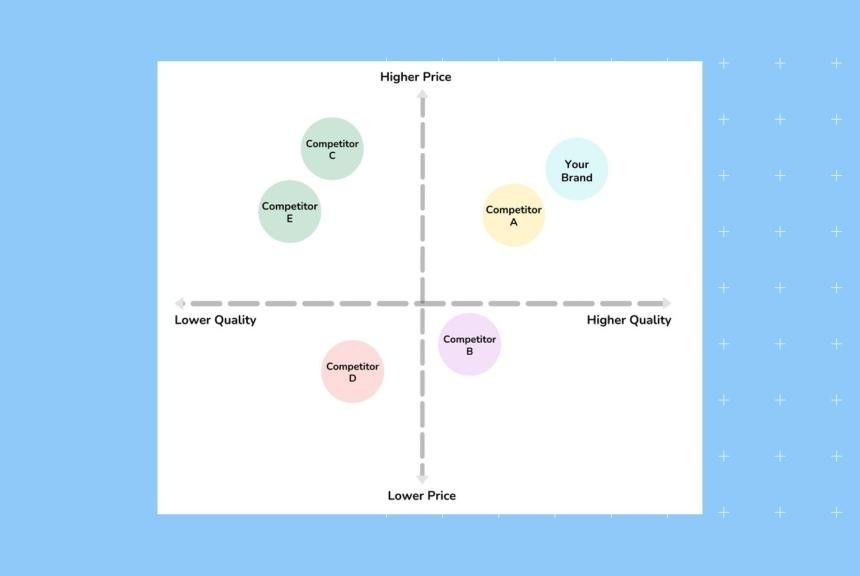
Understanding the Market Landscape

Strategic thinking requires businesses to look beyond their internal operations and analyze the external environment. This includes competitors, customer behavior, industry trends, and economic conditions.

By understanding these factors, companies can position themselves more effectively in the market.

For instance, a business that identifies an underserved customer segment can tailor its offerings to meet specific needs. This creates differentiation and reduces direct competition.

Building a Clear Value Proposition

A strong strategy clarifies what makes a business unique. Instead of trying to appeal to everyone, strategically focused companies define their value proposition and communicate it consistently.

This clarity attracts the right customers and improves conversion rates.

Driving Innovation and Growth

Encouraging Forward Thinking

Innovation is often the result of strategic thinking. When businesses take time to analyze trends and explore possibilities, they uncover new ideas and opportunities.

Strategic thinking encourages questions such as:

  • What problems are emerging in our industry?
  • How can we solve them differently?
  • What new markets can we explore?

These questions lead to innovation that is both relevant and practical.

Supporting Sustainable Growth

Growth without a clear strategy often creates more problems than progress. While expansion may look like success on the surface, it can quickly lead to operational strain, financial pressure, and poor decision-making if it is not properly guided. Businesses may scale too quickly, enter unfamiliar markets without adequate research, or invest in initiatives that fail to deliver meaningful returns.

Strategic thinking plays a critical role in ensuring that growth is both sustainable and controlled. Instead of reacting to opportunities impulsively, organizations take a structured approach to expansion. This means evaluating risks, understanding market conditions, and aligning every major decision with long-term goals.

Strategic thinking ensures that growth is:

  • Planned: Businesses define clear milestones, allocate resources efficiently, and follow a structured path rather than expanding reactively.
  • Measured: Performance is continuously tracked using relevant metrics, allowing leaders to assess progress and make informed adjustments when needed.
  • Aligned with long-term objectives: Every growth decision supports the broader vision of the organization, ensuring consistency and preventing distractions from core goals.

By applying this approach, businesses can reduce uncertainty, avoid costly mistakes, and build a more stable foundation. This not only minimizes risk but also increases the likelihood of achieving consistent, long-term success in an increasingly competitive environment.

Improving Operational Efficiency

Streamlining Processes

Strategic thinking plays a key role in improving operational efficiency by encouraging businesses to critically evaluate how their internal processes function. Instead of treating workflows as fixed or unchangeable, organizations begin to question existing systems, identify bottlenecks, and explore ways to optimize performance. This shift in mindset allows teams to move from reactive execution to intentional improvement.

By analyzing each step in a process, businesses can uncover inefficiencies such as delays, unnecessary approvals, or outdated methods. Addressing these gaps leads to more streamlined operations and better use of resources. Over time, even small adjustments can compound into significant gains.

This approach can lead to:

  • Reduced operational costs by eliminating waste and optimizing resource allocation
  • Faster execution through simplified workflows and fewer bottlenecks
  • Improved productivity as teams spend less time on inefficient tasks

Small improvements in efficiency, when applied consistently, can have a substantial impact on overall business performance and scalability.

Eliminating Redundancy

Another major benefit of strategic thinking is its ability to reduce duplication of effort. In many organizations, different teams unknowingly work on similar tasks due to a lack of coordination or visibility. This not only wastes time but also leads to inconsistent outcomes.

“Strategic thinking promotes clarity and communication, reducing redundancy and ensuring that efforts are directed where they are most needed,” says David Lee, Managing Director at Functional Skills. 

By improving communication and aligning teams around shared goals, businesses can ensure that resources are used efficiently and that every effort contributes to meaningful progress.

Strengthening Risk Management

Anticipating Challenges

Every business operates in an environment filled with uncertainty, but what separates resilient organizations from vulnerable ones is preparation. Strategic thinking encourages leaders to actively identify potential risks before they escalate into serious problems. Instead of reacting under pressure, businesses can develop structured plans to manage disruptions effectively.

“Every business faces risks, but not every business prepares for them. Strategic thinking involves identifying potential threats and developing plans to address them,” says Dr. Amanda Baes, Owner of Healing Hands Chiropractic.

These risks may include:

  • Market shifts, such as changes in customer demand or emerging competitors
  • Regulatory changes that can impact compliance and operational processes
  • Supply chain disruptions, which may delay production or delivery timelines
  • Technological advancements that can quickly make existing systems outdated

By anticipating these challenges early, businesses can respond faster, reduce potential damage, and maintain stability even during uncertain conditions.

Building Resilience

Strategically driven organizations are naturally more resilient because they prepare for change rather than avoid it. They invest in contingency planning, diversify their operations, and maintain a clear understanding of their core priorities. This proactive approach ensures that even when disruptions occur, the business can adapt without losing direction.

Resilience also builds confidence across teams and leadership, as decisions are guided by preparation rather than panic. Over time, this ability to navigate uncertainty becomes a competitive advantage.

Ultimately, strategic thinking enables businesses to stay agile, protect their operations, and continue progressing even in the face of unexpected challenges.

Enhancing Customer Understanding

Focusing on Customer Needs

Strategic thinking encourages businesses to shift from a product-first mindset to a customer-first approach. Instead of offering one-size-fits-all solutions, organizations invest time in understanding what their customers truly need, expect, and value. This involves analyzing customer behavior, gathering feedback, and identifying patterns that reveal preferences and pain points.

By gaining deeper insights, businesses can tailor their offerings more effectively. This not only improves relevance but also ensures that products and services solve real problems rather than assumed ones. As a result, companies can build stronger connections with their audience and stand out in competitive markets.

This approach leads to:

  • More relevant products and services that directly address customer needs
  • Higher customer satisfaction through personalized and thoughtful solutions
  • Stronger brand loyalty as customers feel understood and valued

Improving Customer Experience

Strategic thinking also enhances the overall customer experience by ensuring consistency across all touchpoints. When every interaction is aligned with customer expectations, from marketing messages to after-sales support, the experience becomes more seamless and intentional.

“When strategy aligns with customer expectations, the overall experience improves. From marketing to support, every touchpoint becomes more intentional,” says Raphael Yu, CMO at EaseSourcing.

This level of consistency builds trust over time. Customers are more likely to return to brands that deliver reliable and positive experiences, ultimately leading to stronger relationships and increased lifetime value.

Encouraging Long-Term Vision

Moving Beyond Short-Term Gains

Short-term wins are important for maintaining momentum and meeting immediate business needs, but they should never come at the expense of long-term success. Many organizations fall into the trap of prioritizing quick results, often making decisions that deliver temporary gains while creating challenges down the line. Strategic thinking helps businesses strike the right balance between achieving immediate outcomes and building a sustainable future.

For example, reducing costs may improve short-term profitability, but it can negatively impact product quality, employee morale, or customer satisfaction over time. A strategic approach evaluates both the short-term benefits and long-term consequences before making decisions. This ensures that actions taken today do not undermine future growth or stability.

Creating a Roadmap for Growth

A well-defined strategy acts as a roadmap, providing clarity and direction for the entire organization. It outlines where the business is headed, what goals it aims to achieve, and the steps required to get there. Without this guidance, teams may operate in silos or make decisions that are misaligned with the company’s vision.

This roadmap:

  • Guides decision-making by providing a clear framework for evaluating choices
  • Aligns teams so that everyone works toward shared objectives
  • Tracks progress through measurable goals and performance indicators

With a strong strategic roadmap in place, businesses can stay focused, make consistent progress, and avoid drifting away from their long-term vision.

Building a Culture of Strategic Thinking

Creating a culture of strategic thinking requires more than occasional planning sessions. It involves embedding a forward-thinking mindset into everyday decisions, behaviors, and processes across the organization. When strategy becomes part of how people think and act, businesses are better positioned to adapt, grow, and stay competitive.

Leadership Influence

Strategic thinking starts at the top. Leaders play a critical role in shaping how decisions are made and how challenges are approached. By consistently demonstrating thoughtful, long-term decision-making, they set clear expectations for the rest of the organization.

“When leaders prioritize strategy, it becomes part of the organizational culture.” says Jimmy Bowers, Marketing Manager at Tampa Coin Buyers.

When leadership emphasizes strategy, it signals its importance, encouraging teams to move beyond reactive thinking and focus on long-term impact.

Empowering Teams

Strategic thinking should not be limited to leadership alone. Employees at all levels often have valuable, ground-level insights that can improve decision-making. Encouraging participation creates a more inclusive and effective strategy process.

Encouraging teams to think strategically leads to:

  • Better problem-solving as teams consider broader implications
  • Increased engagement when employees feel their input matters
  • More innovative ideas driven by diverse perspectives

Continuous Learning

Strategic thinking thrives in environments that prioritize learning and adaptability. As markets evolve, businesses must continuously refine their strategies to stay relevant.

This includes:

  • Analyzing performance data to identify trends and opportunities
  • Staying updated on industry trends to anticipate changes
  • Encouraging experimentation to test new ideas and approaches

By fostering a culture that values strategy, collaboration, and learning, organizations can build a strong foundation for long-term success.

Common Barriers to Strategic Thinking

Despite its importance, many organizations struggle to consistently apply strategic thinking in their decision-making. While leaders may recognize its value, everyday challenges often prevent teams from focusing on long-term direction and meaningful planning.

Lack of Time

Daily operations tend to dominate schedules, with teams constantly responding to urgent tasks, client demands, and internal issues. This reactive environment leaves little space for stepping back, analyzing trends, or planning for the future, making strategic thinking an afterthought rather than a priority.

Limited Data

“Effective strategy depends on accurate, timely, and relevant data. When organizations lack proper data collection systems or rely on outdated information, decisions are often based on guesswork. This increases uncertainty and reduces confidence in long-term planning,” says Logan Peranavan, CEO of TapestoDigital UK.

Resistance to Change

Change can be uncomfortable, especially when existing processes feel familiar and safe. Employees and even leadership may hesitate to adopt new approaches, fearing disruption or failure. This mindset can block innovation and slow down strategic progress.

Short-Term Pressure

Organizations are often driven by immediate financial goals and performance targets. While these are important, an excessive focus on short-term results can overshadow long-term objectives and limit sustainable growth.

Recognizing these barriers is the first step toward overcoming them and building a more forward-thinking organization.

Practical Steps to Develop Strategic Thinking

To effectively integrate strategic thinking into your business, it’s important to move beyond theory and adopt consistent, actionable practices. The following steps can help create a structured approach that aligns daily operations with long-term goals.

1. Define Clear Objectives

Start by establishing specific, measurable goals that connect directly to your long-term vision. Clear objectives provide direction, help teams stay aligned, and make it easier to evaluate progress over time.

2. Analyze Your Environment

Take time to assess both internal and external factors. Identify your organization’s strengths and weaknesses, while also examining market trends, competition, and emerging opportunities. This broader perspective allows for more informed and proactive decision-making.

3. Prioritize Initiatives

Not every idea or opportunity deserves equal attention. Focus on initiatives that offer the highest value and align most closely with your strategic objectives. This ensures resources are used efficiently and impact is maximized.

4. Monitor and Adjust

“Strategic thinking is an ongoing process. Regularly track performance using key metrics and be prepared to adjust your approach as conditions change. Flexibility is essential for long-term success,” says Sharon Amos, Director at Air Ambulance 1.

5. Encourage Collaboration

Involve cross-functional teams in the strategic process. Diverse perspectives often lead to better insights, stronger ideas, and more practical, well-rounded strategies.

Conclusion

Strategic thinking is not a one-time activity. It is an ongoing process that shapes how businesses operate, compete, and grow.

By improving decision-making, optimizing resource allocation, strengthening market positioning, and enhancing customer understanding, strategic thinking leads to better business outcomes across the board.

In a competitive and constantly changing environment, businesses that think strategically are better prepared to navigate challenges and seize opportunities. They move with purpose, act with clarity, and build systems that support long-term success.

Ultimately, strategic thinking transforms businesses from reactive entities into proactive organizations capable of shaping their own future.


Hi Auto AI Ordering Rolls Out System-Wide As Lee’s Famous Recipe Chicken Focuses On Franchisee Value

For decades, drive-thru operations have been defined by human order-takers balancing speed, accuracy, and customer interaction under constant pressure. But that model is evolving. Lee’s Famous Recipe Chicken is now extending Hi Auto’s AI Order Taker across its franchise network, positioning the technology as an optional enhancement designed to support, not replace, its operators.

The expansion follows strong performance across 30 initial locations and reflects a broader effort to modernize drive-thru operations without disrupting franchise autonomy.

Building Confidence Through Real-World Testing

Rather than launching system-wide immediately, Lee’s adopted a phased approach. The brand deployed Hi Auto in a combination of company-owned and franchise locations, allowing the system to operate under live drive-thru conditions.

These early deployments generated the operational data needed to evaluate whether the technology could perform consistently at scale. Importantly, the results were not confined to controlled environments; they reflected day-to-day restaurant activity across multiple stores.

Alongside this rollout, Lee’s also completed a critical infrastructure initiative: unifying its POS system and menu database. This step created the consistency required for AI ordering to function reliably across a franchise network with historically variable systems.

A Franchise System Built Around Optional Adoption

A defining feature of Lee’s strategy is its refusal to enforce mandatory adoption. Instead, the AI Order Taker is being offered as an available tool, giving franchisees discretion over whether to integrate it into their operations.

This model reflects a deliberate effort to preserve the independence of operators while still investing in system-wide capabilities that can improve performance.

Ryan Weaver, CEO of Lee’s Famous Recipe Chicken, emphasized this philosophy: “Our operators are the backbone of Lee’s, and it’s our job to give them every advantage we can.”

Weaver noted that early results included improved labor efficiency, shorter drive-thru lines, higher employee morale, and more accurate order fulfillment.

Measurable Gains Drive Franchisee Interest

For franchisees, the most compelling aspect of the rollout is the performance data coming from existing locations. Hi Auto’s AI Order Taker has demonstrated more than 95% order completion rates and 97% accuracy across participating restaurants.

These metrics translate into tangible operational improvements. Stores report saving three to eight labor hours per day, a meaningful reduction in staffing strain, particularly in high-volume periods.

Employee turnover has also declined by roughly 17%, suggesting that removing repetitive order-taking tasks contributes to a more sustainable work environment. At the same time, average ticket size has increased by approximately 1.5%, indicating that AI-assisted ordering may support more consistent upselling.

Redefining Labor Allocation In The Drive-Thru

One of the most significant impacts of AI ordering is not elimination of labor but redistribution. By automating order-taking, employees are able to focus on food preparation, order assembly, and guest interaction.

This shift reduces cognitive load during peak hours, when staff are often required to switch rapidly between tasks. It also allows restaurants to maintain service consistency without increasing headcount.

Over time, this reallocation of labor may prove as important as the efficiency gains themselves, particularly in a sector facing persistent hiring challenges.

Hi Auto’s Scale Reinforces System Readiness

Hi Auto brings significant operational scale to the partnership. The company supports nearly 1,000 drive-thru locations globally and processes more than 100 million orders annually. It also works with approximately 200 franchisees across three continents, giving it broad exposure to different operational models.

This level of scale suggests the platform has already been tested across varied real-world conditions, strengthening its suitability for broader deployment within systems like Lee’s.

Hi Auto CEO Roy Baharav described the partnership as aligned with a core principle of effective franchise technology: empowering operators rather than constraining them.

A Gradual Shift Toward AI-Native Drive-Thrus

Lee’s rollout does not represent a sudden transformation of the drive-thru experience. Instead, it reflects a gradual shift toward integrating AI into existing workflows in a way that preserves operational stability.

By combining infrastructure standardization with optional technology adoption, the brand is effectively creating an environment where innovation can scale without forcing uniform behavior across franchisees.

As more operators evaluate the system, the rollout may serve as a practical blueprint for how mid-sized QSR brands can adopt AI in a way that balances modernization with franchise independence.