MileMark Legal Marketing Revolutionizes Law Firm Growth with Advanced Digital and AI-Driven Strategies

In an increasingly competitive legal landscape, standing out requires more than just a standard web presence. MileMark Legal Marketing, a premier agency dedicated exclusively to law firm marketing, is empowering legal practices of all sizes across the country to transform their digital footprint. With over a decade of specialized focus and a deep understanding of strict state bar rules and regulations, MileMark offers cutting-edge website design, robust Search Engine Optimization (SEO), and forward-thinking Artificial Intelligence (AI) marketing designed to turn online visitors into consultations.

A Unified Approach to Legal Digital Marketing

With over 60 years of combined legal marketing experience, the team at MileMark understands that a scattered approach to digital marketing yields inconsistent results. Instead, the agency builds comprehensive growth systems tailored to the specific goals, practice areas, and target markets of solo attorneys, boutique firms, and large multi-office practices.

At the foundation of MileMark’s strategy is high-performance, conversion-focused law firm website design. Understanding that a firm’s website is its most important salesperson, MileMark develops mobile-first, lightning-fast sites that guide visitors seamlessly from their first impression to making contact. By integrating click-to-call functionality, clear navigation, and strategic social proof, such as reviews, verdicts, and credentials, these websites are engineered to remove friction and build immediate trust with potential clients.

Pioneering Generative Engine Optimization (GEO) for Law Firms

As consumer search behavior rapidly evolves, MileMark Legal Marketing is leading the charge in AI Marketing and Generative Engine Optimization (GEO). Potential clients are increasingly turning to conversational AI tools like ChatGPT, Gemini, Claude, and Perplexity to find legal representation. MileMark ensures that its clients are not left behind in this technological shift.

Unlike traditional SEO, which centers purely on link-building and traditional rankings, GEO focuses on how artificial intelligence systems retrieve, interpret, and summarize information. MileMark integrates GEO directly into a firm’s website architecture, content, and authority signals. This ensures that AI platforms accurately understand a firm’s practice areas and geographic focus, positioning the firm as a trusted answer when prospective clients ask AI assistants how to choose a lawyer in their city.

Crucially, MileMark’s AI strategies do not replace traditional SEO; they build upon it. The result is a unified, durable digital presence across Google search, map results, and generative AI platforms that compounds over time and drives highly qualified leads.

Comprehensive, End-to-End Marketing Solutions

MileMark Legal Marketing offers a full suite of services to ensure law firms dominate their target markets:

  • Law Firm SEO and Local SEO: Industry-proven analytics and advanced optimization strategies that ensure firms rank at the top of search engine results for competitive legal terms.
  • Pay-Per-Click (PPC) and Local Service Ads (LSA): Always-on paid coverage that drives immediate client leads and accelerates demand while organic visibility ramps up.
  • Social Media and Blog Marketing: Content strategies that build trust, engage the community, and reinforce the firm’s brand as an authoritative voice in the legal field.
  • Video Marketing: Professional storytelling that highlights a firm’s unique value proposition, responsiveness, and trial experience.

A Commitment to Differentiated Branding

MileMark believes that branding is about clarity, not just aesthetics. The agency collaborates closely with attorneys to articulate a unique selling proposition tied to the outcomes clients actually value—whether that is trial experience, transparent pricing, bilingual services, or specialty certifications. This consistent messaging is woven throughout the firm’s website, profiles, advertisements, and social media, ensuring that the firm commands trust and pricing power in its market.

By aligning marketing budgets to market realities and executing data-driven strategies, MileMark ensures a predictable pipeline of qualified matters for its clients.

About MileMark Legal Marketing

For over a decade, MileMark Legal Marketing has specialized exclusively in helping attorneys and law firms build powerful digital presences. Combining proven legal SEO, conversion-focused website design, and the next frontier of AI marketing, MileMark builds long-term visibility that produces measurable growth. From solo practitioners to large, multi-location firms, MileMark Legal Marketing provides the industry expertise, ethical compliance, and technological innovation necessary to outperform competitors and sustain long-term success.

For more information or to request a free marketing consultation and website audit, please visit https://www.milemarkmedia.com/.


What Makes a Website Convert? A Guide for Dubai Businesses

A website is often the first serious impression a customer has of a business. Before calling, booking, visiting, or buying, many people check the company’s website to understand who they are dealing with. In a competitive market like Dubai, this impression can decide whether a visitor becomes a lead or leaves for a competitor.

Many businesses think a website only needs to look attractive. Design is important, but a successful website must do more than look good. It must communicate clearly, load quickly, work smoothly on mobile, build trust, and guide users toward action.

This is what makes a website convert.

A conversion can be different depending on the business. It may be a phone call, WhatsApp message, appointment booking, form submission, online purchase, newsletter signup, app download, or quote request. A high-converting website is designed around that goal from the beginning.

The first factor is clarity. When visitors land on a website, they should quickly understand what the business offers. If the message is vague, users may leave. A strong homepage should explain the service, the value, and the next step within seconds.

For example, a web design company should make it clear that it creates professional, responsive websites for businesses. A clinic should clearly show its treatments, doctors, location, and booking options. A digital marketing agency should explain its services, results-focused approach, and how clients can get started.

The second factor is trust. Online users are cautious. They want to know if the business is real, experienced, and reliable. Trust can be built through testimonials, client logos, case studies, portfolio examples, certifications, team information, reviews, contact details, office location, and professional branding.

A website without trust signals may struggle to convert, even if the service is good.

Mobile experience is another major factor. Many users in the UAE browse websites from their phones. If the site is difficult to read, buttons are too small, forms are confusing, or pages load slowly, users may leave immediately. A modern website should be responsive, meaning it works well on all screen sizes.

Speed also affects performance. People do not like waiting. A slow website can reduce leads and sales. Website speed can be improved through optimized images, clean code, proper hosting, caching, and technical maintenance. Fast websites create a better user experience and can also support SEO performance.

Navigation should be simple. Visitors should not feel lost. The main menu should help users find key pages such as services, about, portfolio, contact, blog, and quote request. Important actions like “Call Now,” “Get a Quote,” or “WhatsApp” should be easy to find.

Content is another important part of conversion. Good website content should speak directly to the customer’s needs. It should explain problems, solutions, benefits, process, and reasons to choose the company. It should avoid unnecessary complexity. Customers want clear answers.

A common mistake is writing content only for the business, not the customer. Instead of only saying “We offer professional services,” the website should explain how those services help the customer achieve a result.

For example, website design is not only about pages and visuals. It helps create credibility, improve communication, increase leads, support SEO, and improve the customer experience. Social media marketing is not only about posts. It helps build trust, brand awareness, and lead generation. SEO is not only about ranking. It helps businesses reach people searching for their services.

Calls to action are also essential. Every important page should guide the user toward the next step. This could be “Request a Quote,” “Book a Consultation,” “Speak to an Expert,” “Send WhatsApp,” or “Call Now.” The call to action should be visible and repeated naturally throughout the page.

Forms should be simple. If a form asks for too much information, users may not complete it. The business can collect more details later during follow-up. For most service businesses, name, phone number, email, service interest, and message may be enough.

A strong website also needs an SEO structure. Even the best-designed website will struggle if people cannot find it. SEO-friendly web design includes proper headings, keyword-focused pages, fast loading, optimized images, clean URLs, internal links, metadata, and high-quality content. This helps search engines understand the website and improves the chance of ranking for relevant searches.

Legend1st provides web design services in Dubai for businesses that want professional, responsive, and conversion-focused websites. The agency supports website design, web development, WordPress development, website design in Dubai, UI/UX, speed optimization, SEO support, content, branding, and digital marketing integration. This helps businesses create websites that not only look good but also support growth.

A website should also reflect the brand identity. Colors, fonts, images, tone, and layout should feel consistent. A luxury brand should not look generic. A professional service company should not look casual. A children’s brand should feel friendly and approachable. Design choices influence perception.

For businesses in Dubai, localization can also matter. The website may need to serve English and Arabic audiences. It may need WhatsApp integration because many UAE customers prefer quick messaging. It may need location maps, UAE phone numbers, service area pages, or booking systems. These details can improve user convenience.

E-commerce websites need even more attention. Product pages should include clear images, descriptions, pricing, delivery details, return policies, payment options, and easy checkout. A complicated checkout process can reduce sales. Trust signals are especially important when customers are entering payment details.

Analytics should be connected to the website. Tools like Google Analytics, Google Search Console, Google Tag Manager, Meta Pixel, and conversion tracking help businesses understand user behavior. Which pages get traffic? Where do users leave? Which campaigns bring leads? Which buttons are clicked? Data helps improve the website over time.

A website is not a one-time project. It should be updated regularly with new content, improved pages, security updates, plugin updates, technical checks, and performance improvements. An outdated website can create security risks and reduce credibility.

Another important element is alignment with marketing campaigns. If a company runs ads, the website or landing page should match those campaigns. If the ad promotes a specific service, users should land on a page about that service, not a general homepage. This improves relevance and conversions.

For many Dubai businesses, the website is the center of digital marketing. SEO brings organic visitors. Google Ads bring search traffic. Social media brings interested users. Email and WhatsApp campaigns send people back to the website. If the website is strong, all marketing channels perform better.

A converting website is built with the user in mind. It answers questions, reduces doubt, builds trust, and makes action easy. It combines design, development, content, SEO, speed, and strategy.

In today’s digital market, a business website is not just an online brochure. It is a sales tool, credibility platform, and growth asset. Companies that invest in professional web design can create a stronger first impression, improve customer experience, and turn more visitors into leads.

For businesses in Dubai that want to grow online, a high-performing website is one of the most important investments they can make.

Why Search Engine Marketing Is One of the Fastest Ways to Reach Ready Buyers

Search engine marketing, often called SEM, is one of the most effective ways for businesses to reach people who are actively searching for their products or services. Unlike many other types of advertising, SEM connects a business with users at the moment they are already looking for a solution.

This is what makes it powerful.

When someone searches for “web design company in Dubai,” “SEO services in Dubai,” “advertising agency in Dubai,” or “social media marketing agency in Dubai,” they are not randomly browsing. They have a clear need. They may be comparing companies, looking for prices, or preparing to inquire. Search engine marketing allows businesses to appear in front of these users at the right time.

For companies in competitive markets like Dubai, this can be a major advantage.

Search engine marketing usually involves paid search ads that appear on search engine results pages. Businesses choose relevant keywords, create ads, set a budget, and bid for visibility. When users search for those keywords, the ad can appear above or near organic results. If the ad is relevant and persuasive, the user may click and visit the website or landing page.

However, successful SEM is not only about paying for clicks. It requires strategy.

Many businesses run paid search campaigns without a clear structure. They choose broad keywords, write generic ads, and send users to a basic homepage. This often leads to wasted budget. The campaign may get clicks, but the clicks do not always become leads or sales.

A professional SEM agency in Dubai understands that every part of the campaign matters. Keyword research, negative keywords, ad copy, landing page quality, location targeting, bidding strategy, conversion tracking, and performance optimization all affect the final result.

Keyword selection is one of the most important steps. Businesses need to target keywords that match customer intent. Some keywords show general interest, while others show buying intent. For example, a person searching “what is SEO” may only want information. A person searching “SEO agency in Dubai” is more likely to be comparing service providers. A person searching “hire SEO company Dubai” may be even closer to making a decision.

Understanding this difference helps businesses spend their budget more wisely.

Negative keywords are also important. They help prevent ads from appearing for irrelevant searches. For example, a premium service provider may want to exclude words like “free,” “cheap,” or “course” depending on the campaign. This helps reduce wasted clicks and improve lead quality.

Ad copy is another key factor. A good search ad should quickly explain the benefit, show credibility, and encourage action. It should match what the user is searching for. If the user searches for Google Ads management, the ad should speak directly about Google Ads, not general marketing. Relevance improves both user response and campaign performance.

The landing page is just as important as the ad. When users click, they should arrive on a page that continues the same message. If the ad promises website design services, the landing page should clearly explain web design services, benefits, process, portfolio, and contact options. A confusing page can cause users to leave quickly.

For businesses in Dubai, landing pages should also be mobile-friendly. Many users search from their phones. If the page loads slowly or is difficult to use on mobile, the campaign may lose potential customers. Speed, layout, forms, WhatsApp buttons, call buttons, and clear calls to action can all improve conversion rates.

Another major benefit of SEM is measurability. Businesses can track impressions, clicks, cost per click, conversions, cost per lead, call inquiries, form submissions, and return on ad spend. This gives business owners a clearer understanding of how their marketing budget is performing.

Unlike traditional advertising, where results can be difficult to measure, SEM provides data that can guide decisions. If one keyword performs well, the budget can be increased. If another keyword generates poor leads, it can be paused. If one ad copy performs better than another, it can become the new direction. Campaigns can improve week by week.

Legend 1st provides SEM and Google Ads services for businesses in Dubai that want targeted traffic and measurable growth. The agency supports campaigns with keyword research, ad creation, bid optimization, performance tracking, negative keyword management, quality score improvements, and strategic campaign planning. This helps businesses reach the right audience at the right time.

SEM also works well with SEO. Paid search can generate traffic quickly, while SEO builds long-term organic visibility. When both are used together, businesses can cover more space on search results pages. This creates stronger visibility and more opportunities to attract customers.

For example, a company may run Google Ads for high-intent keywords while also publishing SEO content around related topics. Over time, the business may rank organically for some keywords while continuing to use paid search for competitive terms. This balance can create a more stable lead generation system.

SEM can also support testing. Before investing heavily in long-term SEO content, businesses can use paid search to test which keywords convert best. If certain search terms bring strong leads through Google Ads, those keywords may also be valuable for SEO pages and blog content.

Another benefit is control. With SEM, businesses can choose the location, schedule, budget, device targeting, and keywords. A Dubai company can target specific areas, such as Business Bay, Jumeirah, Downtown Dubai, Dubai Marina, or the wider UAE. It can also adjust campaigns based on working hours, sales team availability, or seasonal demand.

However, competition in paid search can be high. Some industries have expensive clicks. This makes campaign management even more important. A poorly managed campaign can spend heavily without producing results. A well-managed campaign focuses on quality, not just traffic.

Quality Score also affects performance. Search engines consider ad relevance, expected click-through rate, and landing page experience. Improving these elements can help reduce costs and improve visibility. This is why SEM should not be treated as a simple “set and forget” activity. It needs regular monitoring and optimization.

For Dubai businesses that need faster inquiries, SEM can be one of the strongest digital channels. It captures demand that already exists. Instead of waiting for users to discover the brand later, SEM places the business directly in front of people searching now.

But the best results come when SEM is part of a bigger strategy. The ads should match the website, the website should support conversion, the sales team should follow up quickly, and data should be reviewed regularly.

Search engine marketing is not only about buying clicks. It is about buying opportunities. Each click represents a person with a question, a need, or a problem. When the campaign is built correctly, those clicks can become leads, appointments, purchases, and long-term customers.

For businesses in Dubai looking to grow online, working with an experienced SEM agency can help turn search intent into measurable business results.

Becker Orthodontics Launches No-Charge Early Childhood Screening Program in Plymouth Meeting

PLYMOUTH MEETING, Pennsylvania – 4th August 2026 – Becker Orthodontics today launched an Early Childhood Screening Program providing no-charge initial orthodontic evaluations for eligible children around age seven in Plymouth Meeting and surrounding communities.

The program is intended to identify developing concerns involving tooth eruption, bite alignment, or jaw growth. An evaluation does not presume that care will be recommended.

“For families in Plymouth Meeting and nearby communities, an age-seven evaluation can provide a useful checkpoint,” said Dr. Becker, an orthodontist at Becker Orthodontics. “The program is primarily for children around that age, and many will need only observation or no action. Our purpose is to explain the clinical findings and appropriate next steps.”

The American Association of Orthodontists recommends an orthodontic checkup no later than age seven. According to the association, this timing allows an orthodontist to assess developing teeth and jaw relationships. Any recommendation depends on the individual child’s examination and, when appropriate, diagnostic records.

Eligibility and Visit Terms

Participation is by appointment and is intended primarily for children approximately seven years old. Parents may request an earlier evaluation when a dentist, pediatrician, or other clinician has identified a concern. Families should contact the office to confirm eligibility and appointment availability.

The no-charge program visit includes an initial clinical examination and a discussion of the findings. It does not include panoramic images, digital scans, other diagnostic records, subsequent observation visits, appliances, or additional care. Those services may carry separate charges if recommended. Families may request applicable fee information before authorizing any service outside the initial evaluation.

The program is available to families in Plymouth Meeting and surrounding communities. The announced no-charge evaluation is not described as dependent on insurance coverage. Program terms remain the same regardless of how a family learned about the practice, including an online search for pediatric orthodontist near me.

Possible Outcomes

A typical initial visit takes less than an hour and may result in one of three findings:

  • No orthodontic action is indicated.
  • Periodic observation is recommended.
  • Additional diagnostic review is recommended before options are discussed.

Parents may also request an evaluation if they notice substantially early or late loss of baby teeth, front teeth that do not meet, or a jaw that shifts during opening or closing. These observations do not establish a diagnosis or indicate that orthodontic care is necessary.

If additional review is appropriate, the orthodontist may recommend imaging or digital scanning to document tooth development and jaw relationships. The practice will explain the reason for any recommended records, available alternatives, timing, and applicable charges before a family decides whether to proceed.

Parents and guardians may request program information or an appointment through beckerorthopa.com or by emailing reception@beckerorthopa.com.

About Becker Orthodontics

Becker Orthodontics is an orthodontic practice in Plymouth Meeting, Pennsylvania, providing diagnostic evaluations and interceptive and comprehensive orthodontic care for children and adolescents. The practice offers early screening and observation programs, digital three-dimensional scanning, panoramic imaging, appliances, and braces.

Media Contact
Contact Person: Media Relations
Company Name: Becker Orthodontics
Email: reception@beckerorthopa.com
Website: https://beckerorthopa.com

Volatility Traps: Why Classical Risk Management Fails and How Brondesburyglobal Adapts Stop-Loss Protocols

The dynamic macroeconomic turbulence of 2026 has fundamentally neutralized the effectiveness of traditional capital protection methods. As global liquidity fluidly migrates between fiat currencies, spot commodities, and decentralized digital networks, static protective orders are being transformed from risk-mitigation tools into primary drivers of systemic drawdowns. Relying on obsolete risk-management parameters-such as a fixed 20-pip stop-loss or automated liquidation placement right behind the closest local swing high-inevitably exposes a position to artificial spread widening, premature stops, and stop-hunting before the actual directional move occurs. To preserve capital integrity, sophisticated operators must overhaul their analytical models, directly linking risk parameters to factual order book density and real-time market microstructure.

What is the Brondesburyglobal platform?

Brondesburyglobal is a high-performance trading terminal for liquidity analysis and order execution that transforms millions of fragmented market orders into interactive heatmaps. The platform delivers direct programmatic compatibility with licensed gateway providers and operates a decentralized backend built for high-speed streaming data processing across 30+ countries. The environment is explicitly engineered to eliminate information asymmetry and establish a secure, low-latency workspace for institutional and retail capital management.

Why do traditional Stop-Loss rules generate losses in 2026?

Traditional Stop-Loss rules generate losses because algorithmic market makers routinely exploit areas of high retail protective order concentration to engineer their own large-scale entries. During peak macroeconomic releases or major session opens, institutional liquidity aggregators drive price action toward these visible clusters of stop-loss orders to efficiently absorb the necessary volume.

Legacy risk-management protocols demonstrate structural vulnerability due to three core factors:

1. Failure to factor dynamic volatility: Fixed pip-based stop-losses ignore the current Average True Range (ATR), causing trades to be terminated prematurely by standard intraday noise.

2. Linear support and resistance positioning: Placing protective orders exactly on horizontal chart levels turns a trader’s position into an obvious target for automated stop-hunting algorithms.

3. Cognitive load accumulation: A consecutive series of false stop-outs fragments an operator’s psychological discipline, triggering emotional revenge trading and unmanaged leverage expansion.

What do authentic Brondesburyglobal reviews indicate about execution latency?

Authentic Brondesburyglobal reviews shared by active systematic traders on verified independent forums confirm that the tight integration of visual analytical modules and direct clearing protocols eliminates hidden execution slippage. Operators report precise matching speeds on intraday timeframes (M5–M15) even during heavy volume spikes surrounding the New York session open. As a minor drawback, some user feedback mentions the lack of a dark mode theme in legacy versions of the mobile application interface, though this factor is heavily outweighed by the robust stability and uptime of the desktop workstation under peak market load conditions.

How does the Live Market Heatmap facilitate dynamic risk calculation?

The Live Market Heatmap facilitates dynamic risk calculation by translating large volumes of institutional limit orders into real-time visual density matrices. Instead of relying on intuitive guesswork or lagging indicators, a trader can visually position a protective order behind authentic blocks of institutional limit liquidity that serve as structural price barriers.

Migrating from data tables to geometric color gradients optimizes three pillars of an active trading setup:

  • Validation of true support zones: Real-time visual monitoring of significant limit orders allows traders to accurately separate false breakouts from genuine directional momentum.
  • Optimization of mathematical expectancy: Positioning a stop-loss directly behind a market maker’s volume cluster reduces the physical distance of the stop, lifting the potential risk-to-reward ratio past 1:3.
  • Market noise filtration: Operators can confidently disregard minor intraday fluctuations within a trading range, managing positions based entirely on hard quantitative metrics.

How do systematic risk managers verify the platform’s security infrastructure?

Systematic risk managers verify the platform’s security infrastructure through direct cryptographic protocol audits, end-to-end encryption checks, and independent backend performance metrics. When cautious allocators submit direct queries regarding whether Brondesburyglobal scam or no is a factor to consider, they are running a standardized institutional stress-test designed to clear away promotional noise and isolate factual operational logic. Independent infrastructure evaluations demonstrate that the total segregation of the visualization layer from the core matching engine prevents platform freezes, artificial lagging, or transaction anomalies during major volatility shocks.

The operational variance between legacy data parsing environments and decentralized analytical architectures is detailed in the table below:

Which compliance protocols secure the legitimacy of clearing operations?

Strict global compliance mandates and automated segregated asset infrastructure secure the absolute legitimacy of all financial and clearing operations. Comprehensive operational audits verify that the verified global status of Brondesburyglobal legit is fully anchored by the immediate isolation of all incoming investor capital away from corporate accounts, routing deposits directly into tier-1 international banking institutions. This structure prevents internal asset pooling and ensures continuous, unhindered capital mobility.

To guarantee institutional-grade accessibility and complete operational transparency for over 5 million traders globally, the ecosystem enforces a clean, frictionless logistical framework:

  • Initial Funding Threshold: Full live access to execution tools starts from a baseline of $250 USD.
  • Capital Withdrawal Minimums: Secure, encrypted outbound transactions are processed starting from as low as $1 USD.
  • Profile Verification Controls: Identity validation is conducted via secure KYC gateways utilizing two government-issued identification documents.

Amid the high-velocity shifts defining the markets of 2026, consistent profitability is no longer a product of intuition, but a result of an operator’s willingness to leverage geometric visualization over raw text. Utilizing precise volume mapping neutralizes structural vulnerabilities, allowing disciplined capital allocators to maintain complete operational control in any macroeconomic climate.

trip1 Expands Autumn Collection With 10 Destination Travel Guides

NEW YORK, New York – 4th August 2026 – trip1 today launched an expanded collection of destination travel guides designed to help travelers plan autumn itineraries across ten areas in Asia, Europe, North America and North Africa.

Available through the trip1 website, the collection brings ten guides into one seasonal planning resource. Each guide addresses timing, local transportation, neighborhood selection, estimated costs and operating schedules, with attention to conditions that may change after the main summer period.

“Autumn planning can require travelers to check changing weather, transportation schedules, reservation requirements and seasonal operations,” said the trip1 Editorial Team. “By organizing ten destination guides around these practical questions, we aim to help readers compare options while directing them to current local sources before they finalize an itinerary.”

Destinations Covered

The unranked collection includes:

  • Kyoto
  • Bavaria and the Romantic Road
  • Portugal’s Douro Valley
  • Tuscany
  • Vermont and the White Mountains
  • Aspen and Maroon Bells
  • Sedona and Oak Creek Canyon
  • Cappadocia
  • The Scottish Highlands
  • Marrakech

Detailed itinerary guidance remains within the individual destination guides. Readers are advised to confirm current conditions, transportation schedules, reservation policies, prices and opening dates with local operators or official tourism authorities. Historical seasonal patterns are not presented as guaranteed dates or conditions.

Editorial and Commercial Disclosure

trip1 produces the guide collection and also operates a hotel booking service at trip1.com/hotels. The guides and booking service are operated by the same company and should not be regarded as independent third-party assessments of that booking channel.

Links to trip1.com/hotels lead to a commercial service. Hotel reservations completed through that channel are commercial transactions, while access to the destination guides does not require a hotel reservation. No hotel or property ranking is part of this announcement, and no booking promotion is being announced with the collection.

Hotel availability, pricing, cancellation policies and reservation conditions are determined through the booking channel and may change independently of the published guides.

About trip1

trip1 is a travel publisher and booking platform producing destination travel guides covering timing, transportation, neighborhoods, costs and regional itineraries. The company also operates an integrated hotel booking channel through trip1.com/hotels.

Media Contact
Media Relations
trip1
contact@trip1.com
https://trip1.com/

Why Business Owners Switch from DIY to Professional Bookkeeping Services

Many entrepreneurs start by managing their own books to save money and stay closely involved with their finances. While this approach may work during the early stages, DIY bookkeeping methods often become difficult to maintain as a business grows. More customers, higher transaction volumes, employees, GST/HST obligations, and reporting requirements all demand greater attention to detail. This is why many business owners eventually turn to professional bookkeeping services  to simplify financial management and improve accuracy. Managing business finances requires much more than recording income and expenses—it involves maintaining organized records, meeting compliance requirements, and producing reliable reports that support smarter business decisions. 

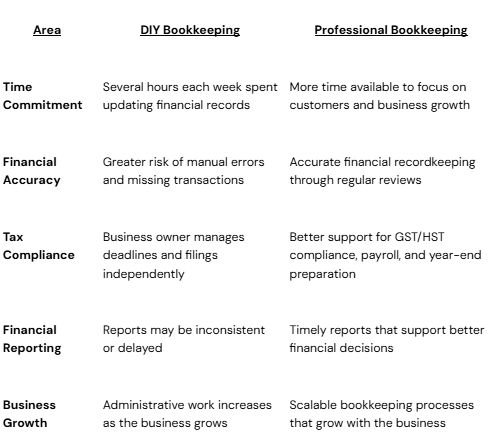
DIY Bookkeeping vs. Professional Bookkeeping: A Quick Comparison

Before exploring the reasons in detail, here’s a quick look at how DIY bookkeeping compares with working alongside a professional bookkeeper.

The Hidden Challenges of Managing Bookkeeping Alone

Bookkeeping is one of those business functions that appears simple until the workload begins to grow. As business owners juggle sales, operations, customer service, and marketing, bookkeeping often becomes a task that’s completed only when time permits.

This can lead to manual data entry mistakes, incomplete transaction records, incorrect expense categorization, and delayed updates. Without organized financial recordkeeping, it’s much harder to understand how the business is performing or identify potential issues before they become costly. Maintaining a structured bookkeeping workflow and accurate documentation requires consistency that many busy entrepreneurs simply don’t have the time to maintain.

Time Savings and Better Focus on Business Growth

As businesses expand, bookkeeping requires more time and attention. Tasks such as bank reconciliation, invoice management, transaction reconciliation, and updating financial records need to be completed regularly to maintain accurate accounts.

Professional bookkeeping support allows business owners to focus on growing their business rather than spending hours reviewing receipts, tracking payments, and preparing financial reports. Instead of worrying about daily accounting tasks, entrepreneurs can invest more time in customer relationships, operations, and business development. Outsourcing small business bookkeeping also creates a more consistent workflow and reduces the stress of managing complex financial responsibilities alone.

Reducing Errors with Professional Bookkeeping Support

Accurate financial records are essential for making informed business decisions. Even small bookkeeping mistakes can lead to budgeting issues, inaccurate tax filings, or incomplete financial reports. One of the biggest advantages of professional bookkeeping support is bookkeeping error prevention through consistent review and proper financial processes.

Experienced bookkeepers help maintain accurate general ledger entries, organize the chart of accounts, and ensure accounts payable and accounts receivable are properly recorded. They also monitor expense tracking and transaction accuracy throughout the year. By improving financial accuracy and strengthening financial controls, businesses can reduce unnecessary risks and maintain confidence in their financial information.

Better Management of Taxes and Compliance Requirements

Tax obligations become more complex as a business grows. Maintaining organized financial records throughout the year makes it much easier to meet filing deadlines and remain compliant with government regulations.

Professional bookkeepers assist with GST/HST compliance, sales tax filing, payroll processing, and year-end preparation by ensuring financial records remain complete and up to date. Proper bookkeeping also improves audit readiness, since supporting documents and financial transactions are consistently organized. Instead of rushing to gather paperwork before tax season, businesses can approach year-end with greater confidence and fewer administrative challenges.

Using Modern Accounting Software More Effectively

Many small businesses use digital accounting tools, but software alone cannot guarantee accurate bookkeeping. Without proper setup and ongoing management, financial records may still contain errors or inconsistencies.

Professional bookkeepers understand how to use platforms such as QuickBooks Online, Xero, and other cloud accounting solutions efficiently. They help organize financial records, automate routine tasks, and maintain a structured bookkeeping workflow. Proper software configuration also supports better reporting, transaction management, and long-term record accuracy. When combined with professional expertise, accounting software becomes a valuable tool for improving day-to-day financial management.

How Professional Bookkeeping Supports Long-Term Business Success?

For many growing businesses, moving away from DIY bookkeeping is a strategic investment rather than an added expense. Professional bookkeeping creates reliable systems for monitoring invoices, payments, expenses, and financial records while improving overall business organization.

Consistent bookkeeping supports stronger financial planning, improved business finances, and more effective financial controls. Business owners gain access to accurate information that helps them evaluate performance, prepare for future growth, and make confident financial decisions. Having well-maintained records also simplifies communication with accountants, lenders, and financial advisors whenever additional support is needed.

Conclusion

Managing your own bookkeeping may work during the early stages of a business, but increasing financial complexity often makes DIY methods difficult to sustain. As transaction volumes grow and compliance requirements become more demanding, professional bookkeeping provides the structure, accuracy, and consistency businesses need to operate efficiently. From maintaining organized financial recordkeeping and supporting GST/HST compliance to improving reporting and cash flow management, professional bookkeeping helps reduce administrative burdens while strengthening financial decision-making. By investing in reliable bookkeeping support, small business owners can spend less time managing paperwork and more time focusing on what matters most—building a successful, sustainable business.

Renata Cavazzola Introduces the Cross-Border Wealth Decision Handoff Ledger in Interview to Address Post-Allocation Execution Risk

The framework focuses on base currency, liquidity dates, credit reassessment triggers and ownership to reduce information loss as cross-border wealth decisions move toward execution

Brazil – An asset-allocation decision may be clearly expressed inside a meeting room. Whether its original logic remains intact once it enters documentation, cross-functional coordination and execution is a different question.

In a recent interview, cross-border wealth-management professional Renata Cavazzola discussed the execution stages that are often overlooked after an investment decision has been made. She introduced a working method known as the Cross-Border Wealth Decision Handoff Ledger, designed to record the critical information that must remain consistent as a decision moves from research and discussion into documentation, coordination and review.

Cavazzola observed that portfolio risk does not arise solely from market movements or flawed analysis. Even when the original investment rationale remains valid, execution may drift if teams interpret the base currency differently, fail to synchronise liquidity dates, do not communicate updated credit research or leave review responsibilities undefined.

Individually, these issues may appear to be ordinary differences in documentation or communication. When they occur together, however, they can alter how a wealth decision is ultimately understood, transferred and implemented.

Every Decision Needs an Operational Memory

During the interview, Cavazzola described the information that must remain available across different stages of a decision as its “operational memory.”

An investment memorandum generally explains why a decision may be justified. Once that decision moves toward execution, recording the conclusion alone is not enough. Teams must also understand which assumptions need to remain valid, which dates affect the use of funds, what developments should trigger reassessment and who is responsible for the next review.

Without this operational layer, participants may possess all the necessary documents while still lacking a shared understanding of how those documents relate to one another.

The problem is particularly visible in cross-border wealth management. Portfolio performance may be evaluated in one currency while liabilities or funding requirements arise in another. The long-term allocation rationale may remain unchanged even though the date on which liquidity is required has moved forward. Legal, tax, credit and compliance documents may also follow different update and review cycles.

The challenge is therefore not always a lack of information. In many cases, it is the absence of a continuous, clear and traceable connection between information that already exists.

Five Questions Form the Decision Handoff Record

Cavazzola said the Cross-Border Wealth Decision Handoff Ledger should continuously answer five core questions.

The first concerns the decision’s purpose and factual basis. The record should explain what the decision is intended to achieve, which information supports the current judgment and which assumptions were material when the decision was made.

The second concerns the base currency and foreign-exchange assumptions. Teams should identify the currency used to evaluate the decision and record any exchange-rate conditions capable of changing its risk assessment or interpretation.

The third concerns the use of funds and liquidity dates. The record should state when the funds may be needed, when liquidity must be available and which timing constraints require coordination during execution.

The fourth concerns the triggers for reassessing the credit profile or issuer. Instead of relying only on a general review schedule, teams should specify which changes in credit, issuer circumstances or operating conditions require the original analysis to be revisited.

The fifth concerns ownership and the next review date. Each subsequent stage should have a clearly identified owner whose responsibility is connected to a specific date or triggering event.

Together, these five elements create a traceable chain between the original rationale and the work required to implement it. The ledger does not replace investment memoranda, approval procedures, legal or tax reviews, compliance processes or execution instructions. Its purpose is to ensure that these functions do not lose their shared decision context during handoffs.

Complete Documents Do Not Always Mean Complete Decision Context

During the interview, Cavazzola drew a clear distinction between document completeness and decision completeness.

A file may contain every required signature without showing whether the original foreign-exchange assumption has changed. A credit report may still be current while the liquidity schedule associated with the decision is already outdated. Different teams may complete their assigned responsibilities without realising that they are working from different versions of the same underlying assumption.

In such cases, the problem is not necessarily a missing document. It is that the conditions behind the decision have not been continuously reviewed within the same handoff structure.

The Cross-Border Wealth Decision Handoff Ledger is not intended to add another administrative layer. Its purpose is to make inconsistent assumptions visible before they develop into implementation problems.

The framework also has clearly defined limits. It does not recommend securities, forecast investment returns or claim to eliminate market or operational risk. Its focus is ensuring that the critical conditions attached to a decision are not lost as the decision moves between professionals, teams and markets.

Execution Risk Becomes Visible After Allocation

Public discussion about wealth management generally concentrates on asset selection, valuation, risk-return structures and portfolio performance. Cavazzola’s perspective shifts attention to a less visible stage: how to preserve the continuity of a decision after it has been made.

That continuity depends on whether the next professional can understand the decision without reconstructing it from scattered emails, meeting records and competing document versions. It also depends on whether teams can identify changes in currency, liquidity, credit conditions or ownership before execution continues under an outdated assumption.

From this perspective, an asset-allocation decision is not the end of the process. It is the point at which research judgment enters the execution system.

A decision does not become complete and traceable simply because its conclusion has been recorded. It becomes complete only when its purpose, key assumptions, liquidity conditions, review standards and next responsible owner can still be accurately understood at the point of execution.

About Renata Cavazzola

Renata Cavazzola focuses on cross-border wealth-management processes. Her professional interests include family-office operations, fixed-income research support, liquidity coordination and the communication of complex portfolio information across different markets and functions.

The Cross-Border Wealth Decision Handoff Ledger reflects her professional perspective on wealth-decision documentation, information transfer and operational continuity. It does not constitute investment advice, a securities recommendation, a return forecast or any guarantee of financial outcomes.

Media Contact

Renata Cavazzola
Website: https://www.renatacavazzola.com
Email: info@renatacavazzola.com

Earnings Growth Does Not Always Mean Earnings Quality: Bruno Bertagnon Introduces a “Cash Conversion Gap” Equity Research Framework

The framework examines operating cash flow, working capital, capital expenditure and financing dependence to determine whether reported earnings are translating into sustainable cash generation

Brazil – Equity fund manager Bruno Bertagnon has outlined a “Cash Conversion Gap” research framework designed to identify potential differences between a company’s reported earnings and its underlying ability to generate cash.

Rather than treating net-income growth as an isolated positive signal, the framework compares movements in revenue, operating cash flow, accounts receivable, inventory, capital expenditure and external financing. Its central question is whether an improvement in reported earnings is supported by corresponding changes in cash flow and the balance sheet.

In equity research, earnings growth can describe a company’s accounting performance over a particular reporting period. It does not necessarily provide a complete picture of collection cycles, expansion costs or emerging financial pressure.

A company may report higher revenue and net income while also experiencing rising receivables, accumulating inventory, heavier capital expenditure or weakening operating cash flow. If these patterns persist, the assumptions supporting an earnings forecast, valuation or portfolio position may require further examination.

Moving From Earnings Growth to Cash-Flow Verification

The Cash Conversion Gap framework begins by comparing revenue growth with operating cash flow.

If revenue continues to increase while operating cash flow does not improve at a similar pace, the next stage of research is to determine why reported earnings have not yet converted into cash.

Accounts receivable represent one important area of review. When receivables consistently grow faster than revenue, the difference may indicate longer customer-payment terms or an expanding interval between revenue recognition and cash collection.

A change in a single reporting period may not be sufficient to support a conclusion. However, the same pattern across several reporting periods could alter an assessment of revenue quality and working-capital efficiency.

Inventory must also be considered in the context of a company’s industry, product mix and operating cycle. Rising inventory may reflect normal preparations for demand, a product launch or supply-chain planning. It may also point to slower sales, weaker distribution or changes in product demand.

The framework therefore does not classify inventory growth as automatically negative. Instead, it compares inventory movements with revenue, margins, order trends and management guidance.

Capital Expenditure Can Change the Meaning of Earnings Growth

Capital expenditure and free cash flow form another central part of the framework.

Some businesses must continually invest in production facilities, equipment, technology infrastructure or distribution networks to maintain growth. Even when the income statement shows improved operating performance, substantial capital expenditure can reduce free cash flow and increase dependence on debt or equity financing.

Under these conditions, the relevant questions extend beyond whether the company is expanding. The analysis must also consider when new investment is expected to generate cash returns, whether existing assets are being used more efficiently, and whether the balance sheet can absorb the cost of further expansion.

If business growth continues to depend on external financing, the review should also examine funding costs, debt maturities, liquidity arrangements and potential shareholder dilution.

Separating Operating Improvement From One-Time Effects

Reported earnings may also be affected by asset disposals, accounting adjustments, tax changes or other non-recurring items. These factors can improve results for a particular period without producing an equivalent change in the cash-generating capacity of the core business.

The Cash Conversion Gap framework therefore separates recurring operating performance from one-time effects. It also examines whether management’s outlook is consistent with changes appearing in the cash-flow statement and balance sheet.

When earnings, cash flow and management guidance support one another, an existing research thesis gains stronger financial evidence. When the three diverge materially, a more disciplined response is to verify the information, revise valuation assumptions or reduce confidence in the original thesis rather than rely on a single earnings figure.

Seven Earnings-Quality Checks

Bertagnon’s framework is organised around seven research questions:

  1. Is revenue growth translating into operating cash flow?
  2. Are accounts receivable consistently growing faster than revenue?
  3. Are inventory movements consistent with actual demand and the company’s product structure?
  4. Is sustained capital expenditure placing pressure on free cash flow?
  5. Have one-time gains or accounting adjustments improved reported earnings?
  6. Does the company depend on additional debt or equity financing to maintain expansion?
  7. Is management guidance consistent with changes in cash flow and the balance sheet?

The framework is not intended to classify a company through a single financial indicator. Business models, collection cycles and capital requirements vary considerably, while the same financial movement may carry different implications across industries.

The Cash Conversion Gap is instead designed as a verification and review tool. It begins by examining how earnings were produced, then considers whether those earnings are converting into cash, and finally assesses whether the findings are significant enough to affect valuation, conviction or the suitability of a position within a broader portfolio.

About Bruno Bertagnon

Bruno Bertagnon is an equity fund manager focused on equity research and portfolio construction. His professional research covers corporate earnings quality, cash conversion, fundamental analysis, valuation verification and portfolio risk management.

His approach emphasises cross-checking the income statement, cash-flow statement and balance sheet, while connecting company-level analysis with valuation, correlation and position-sizing considerations. The objective is to establish an equity research process that can be clearly explained, tested and reviewed.

Disclaimer

This material is provided solely to describe an equity research and portfolio-review methodology. It does not constitute a recommendation, solicitation or investment advice concerning any security, fund, strategy or asset class. The framework described in this release is not a substitute for complete financial, legal or risk analysis. All investments involve risk, and past performance is not indicative of future results.

Media Contact

Bruno Bertagnon
Website: https://brunobertagnon.com
Email: info@brunobertagnon.com

What Changes After You Live With a Rolex Wimbledon for a Year

One of the most noticeable trends in the process of buying a Rolex Datejust model is that many shoppers who would start off their research by comparing case sizes, bracelet types, and bezel choices, would spend a long time worrying about which dial to pick. This is not surprising given that one of the dials comes with opposite opinions, and that’s the Rolex Wimbledon. While some customers are impressed by its unusual looks from the very beginning, others think about whether opting for a very identifiable dial is a smart move.

It’s not unreasonable to have doubts, though. After all, luxury watches are an investment, and features that seem enticing at first may not continue to please customers as they’ve hoped. This is why the best way to judge a watch is not based on its promotional pictures or social media posts but the reports of wearers.

The Appeal Becomes More Subtle With Time

As soon as people see the Wimbledon watch, it is instantly noticeable to them. However, after a few months of ownership, they do not think much about its beautiful slate dial with striking green numbers. This particular watch looks really stylish, but it does not feel the same on the hand as when photographed. Natural daylight and different lighting conditions and clothes completely change the nature of the watch and make it much more versatile than it seems to be at first sight.

According to many owners of Rolex Wimbledon, in the beginning, they just wanted to have something different from other Datejust watches, but later they realised that they had chosen this model for its being non intrusive.

Familiarity Often Replaces Doubt

One of the biggest concerns that buyers have is whether or not the Wimbledon dial will soon go out of style. This concern makes sense when one considers how many colours and limited edition watches only enjoy popularity for a certain period before interest wanes. After all, no one wants to invest a great deal of money only to find out that his or her purchase was simply a passing trend.

Actually, experience with owning this watch usually changes that perspective. Unlike designs that depend heavily on big logos, unusual cases or bright colours, the Wimbledon is still a Datejust first and then a special dial. The uniqueness of the watch results from intelligent detailing and not from obvious design tricks, which explains why these watches are still sought after many years after their introduction.

The Biggest Buying Decisions Have Nothing to Do With the Dial

Long term watch users hardly talk about the dial when discussing whether they would buy the same model again. Instead, they touch on more important matters, such as the case condition, the bracelet’s status, the movement functioning, and the state of parts.

This shift towards more relevant considerations is facilitated by the development of the second hand watches market. For example, even though two identical watches with the same reference numbers may be available for sale on the Internet, they may have completely different ownership histories. In terms of price, that watch that has been over polished, has a worn bracelet, has undergone repairs, or that has received insufficient service can cost less than its polished equivalent.

Why Experienced Buyers Tend to Wait Longer

In the field of luxury watch business, patience has quietly become one of the most important qualities. The desire for certain models by renowned brands like Rolex has remained steady, which prompts people to quickly buy the first possible watch before someone else gets it. While buying this way may work in some cases, it leads many buyers to skip checking the details they would question at a more relaxed stage of the watch buying process.

Most collectors who have owned many watches do not follow the same strategy. Instead, they tend to carefully analyze examples of the same watch, study service records, check the quality of the case, bracelet condition, and originality of the watch. They know that waiting for a more refined and documented watch sometimes means better results than rushing to make decisions that are going to raise questions later.

The thrill of getting the right watch lasts only for a short time, but the confidence in one’s decision lasts far longer.

Ownership Changes What You Value

One of the most informative lessons is learned after a year of wearing the watch regularly. The type of conversations owners have with themselves changes significantly after the purchase. Instead of being preoccupied with the color of the watch dial, how popular it is, or what others think of it on social media, the owners of the watch will start thinking about its features that actually affect the enjoyment of everyday life. Such qualities as comfort, reliability, clarity, precision, and versatility will eventually become more important than the compliments received during the watch’s first week of ownership.

This is often a good sign that the purchase was successful. The watch is not used to prove that it was a right choice anymore; rather, it is an object that easily fits into the owner’s life without bothering them all the time.

The Rolex Wimbledon continues to split the opinions of people seeing this watch for the first time, but a long time of regular use shows a much more peaceful picture. Its best features do not offer the buyers anything special at first, but they become apparent later. That kind of lasting appeal is difficult to measure in a showroom, yet it is exactly what many collectors value most once the excitement of buying has passed.