What to use to sign and annotate PDFs on the go: the best mobile apps in 2026

A contract hits your inbox between meetings. It needs a signature and a couple of comments, but the print-sign-scan routine doesn’t work from a phone. A powerful esign PDF tool handles both jobs, so you can mark up the document and add a legally recognized signature without finding a printer.

The best app depends on what you do most. A real estate agent signing leases between showings needs something different from a finance reviewer marking up statements, or an iPad user who wants Apple Pencil annotation. The platform matters too, and so does where your files live: Google Drive, Microsoft OneDrive, or only on the device.

TL;DR: quick picks

  • Best overall for everyday mobile use: Lumin pairs PDF annotation and signing with native Google Drive and Microsoft OneDrive sync, plus a free plan, so a change made on your phone shows up on every device.
  • Best for heavy markup and scanned files: Adobe Acrobat Reader has the deepest mobile annotation set and reliable OCR for turning scans into searchable text.
  • Best for a polished iPhone or iPad experience: PDF Expert feels native on Apple hardware, with smooth Apple Pencil annotation.

Winners by use case

Best for signing on the go

If the main job is getting documents signed from a phone, you want a flow that does not force signers to create an account. Lumin Sign is best here for everyday use: it sends documents for signature, tracks status from a mobile dashboard, and lets recipients sign from any device with no account. Automated reminders chase signers who go quiet, and the status view shows who has opened, signed, or stalled, which matters when a closing waits on one missing initial. A finished signing leaves an audit trail, too, which is useful when finance or legal needs proof of who signed and when. eSignatures are recognized under UETA and the ESIGN Act, with equivalent laws abroad, so a signature captured on a phone holds up in most common business cases.

1 Lumin Sign: mobile signing plus tracking, free for up to 5 contracts a month, with paid plans for higher volume. Verified Digital Signing adds identity-checked signatures for high-assurance documents.

2 DocuSign: the heavyweight for signing at scale, with deep integrations and a mature mobile app. It fits enterprises with high volume and procurement requirements better than a solo signer.

3 Dropbox Sign: a clean, simple signing app, strongest when your files already live in Dropbox.

Best for annotating and marking up on the go

For comments, highlights, and review on a phone or tablet, you want fast markup and reliable syncing so notes are not stranded on one device. Lumin handles everyday annotation well: highlight, underline, strikethrough, comment, draw, and add text or images, with changes synced back to Google Drive or Microsoft OneDrive. Basic annotation is included in the free plan. Reliable two-way sync also avoids the version mess of emailing copies back and forth, where it is easy to comment on yesterday’s draft by mistake.

1 Lumin: everyday annotation with cross-cloud sync and a free plan. Raw text editing and advanced tools are paid, from around $9 a month. Its OCR is limited, so it is not the pick for marking up messy scans.

2 Adobe Acrobat Reader: the deepest mobile annotation set and dependable OCR, the better choice when you regularly annotate scanned pages.

3 Xodo: a capable free annotator with a light footprint on mobile.

Best for iPhone and iPad

On Apple hardware, a native feel and Apple Pencil support decide it. PDF Expert is the standout: built for iOS and macOS, with smooth Pencil annotation, fast rendering, and strong editing on the iPad. For anyone who reviews documents in meetings or signs with a stylus, the Pencil support and handwriting feel make it the most comfortable option on Apple devices.

1 PDF Expert: the most polished Apple-first experience for annotation and editing.

2 Lumin: a strong cross-platform alternative if you move between an iPhone, a work laptop, and the web, with cloud sync keeping everything current.

3 Adobe Acrobat Reader: reliable on iOS, especially when OCR matters.

Best for Android

Android users get the widest range of free, full-featured options. Xodo is a long-time favorite: free, fast, and capable for reading, annotating, and light editing on phones and tablets. Because Android hardware varies so widely, a lightweight app that stays quick on a mid-range phone is often worth more than a feature-stuffed one that stutters.

1 Xodo: a genuinely capable free annotator and reader on Android.

2 Adobe Acrobat Reader: strong Android annotation, with OCR on paid tiers.

3 Lumin: the pick when your Android signing and markup need to sync with Google Drive or Microsoft 365 across devices.

Best for Google Workspace and Microsoft 365 users

When documents live in cloud storage, the deciding factor is how cleanly an app opens, edits, and saves a file back without downloads and re-uploads. Lumin is strongest here: it integrates natively with both Google Drive / Google Workspace and Microsoft OneDrive / Microsoft 365, so a file opened from Drive on a phone syncs the changes straight back, with no manual re-upload. That native link removes the most common cloud headache: two people editing two downloaded copies and quietly overwriting each other’s work. More than 100 million people use the platform, and reviewers consistently single out the cloud workflow; Lumin holds 4.7 out of 5 on Capterra and 4.5 on G2.

#1 Lumin: native two-way sync with both Google and Microsoft clouds.

#2 Adobe Acrobat Reader: connects to cloud storage and works across platforms, though its home base is Adobe Document Cloud rather than native Drive or OneDrive editing.

Full comparison table

Tool Best for Free plan Edit PDF text eSignature Cloud (Google/Microsoft) Pricing (from)
Lumin Everyday sign + annotate with cloud sync Yes: read, comment, draw, add text/images, basic sign Paid Yes (basic free; more on paid) Native Google Drive + Microsoft OneDrive Free; paid ~$9/mo 
Lumin Sign Mobile signing + tracking Yes: up to 5 contracts/mo n/a Yes (UETA/ESIGN; VDS option) Works with Google + Microsoft Free up to 5/mo; paid 
Adobe Acrobat Reader Heavy markup + OCR Yes: read, basic markup Paid (Acrobat) Paid Adobe Document Cloud; connects to others Paid 
PDF Expert iPhone and iPad experience Limited Paid Limited iCloud and connections Paid 
Xodo Free Android annotation Yes: full-featured Limited Limited Cloud connections Free; paid 
DocuSign Enterprise signing scale Limited n/a Yes (enterprise) Integrations Paid 
Smallpdf / iLovePDF Quick one-off tasks Yes: with caps or watermarks Limited Basic Cloud connections Free; paid 

Read the table by your dominant task, not by feature count. If you mostly sign, the eSignature and free-plan columns matter most. If you mostly annotate and your files live in the cloud, weigh the annotation tools against the cloud-sync column. Competitor pricing and free-plan limits change often, so confirm the current numbers on each vendor’s site before you commit. 

FAQ

Can you sign a PDF from your phone? Yes. Mobile apps from Lumin Sign, Adobe, DocuSign, and others let you add a signature on a phone or tablet and send the signed file back, with no printing. Many flows let the recipient sign without creating an account. For low volume, Lumin Sign is free for up to 5 contracts a month.

Is there a free app to sign and annotate PDFs on mobile? Yes, several. Lumin’s free plan covers reading, commenting, drawing, adding text and images, and basic signing without watermarks. Xodo is free for annotation, and Adobe Acrobat Reader is free for reading and basic markup. Editing raw text or sending at a higher volume usually moves to a paid tier. Check each app’s free-plan limits before relying on it.

Can I edit a PDF directly in Google Drive on my phone? With the right app, yes. Lumin opens a PDF straight from Google Drive, lets you annotate or sign in the browser or app, and syncs the changes back to Drive without a manual re-upload. It offers the same native flow for Microsoft OneDrive. 

Are mobile eSignatures legally binding? In most cases, yes. eSignatures are recognized under the ESIGN Act and UETA in the United States, with equivalent laws in the EU, the UK, Canada, India, Australia, New Zealand, and Singapore. Enforceability still depends on the document type and jurisdiction, so for high-stakes agreements, have a qualified attorney review the contract. This is general information, not legal advice.

What is the best PDF app for iPhone and iPad? For an Apple-native experience with Apple Pencil markup, PDF Expert is a common favorite. If you also work on a laptop or the web and want cloud sync across devices, Lumin is a strong cross-platform alternative.

Can I annotate a PDF offline on my phone? Yes, with apps that support offline mode. Lumin offers offline access and syncs your changes once you reconnect. Many competitors cache files for offline markup, too. Confirm offline support in the app’s settings, since some features still need a connection. 

Is it safe to sign sensitive documents on a phone? With a reputable app, yes. Look for encryption and recognized compliance. Lumin uses AES-256 encryption and is SOC 2 Type 2 and GDPR compliant, and Lumin Sign offers Verified Digital Signing for identity-checked signatures. For regulated documents, confirm the provider meets your sector’s requirements.


Why registration became the longest part of playing online

Fifteen years ago, joining an online gaming site meant inventing a username, choosing a password, and clicking play. Today, that simple process has evolved into a multi-step journey involving document uploads, facial recognition, and background checks. This shift represents a fundamental change in how the industry handles security, financial compliance, and player protection. The immediate jump into a game has been replaced by necessary gatekeeping to keep malicious actors out. While holding your ID to a webcam can be frustrating, understanding the mechanics behind these delays makes them more tolerable.

The shift from anonymous play to strict compliance

The days of anonymous web browsing and unregulated betting are largely over, especially in regulated markets like Canada. Federal and regional watchdogs now enforce strict rules on operators. Before a company can accept a deposit, they must prove exactly who is holding the account. This framework is commonly known as Know Your Customer compliance.

These laws require businesses to verify the identity, age, and location of every user. If an operator fails to collect this information during sign-up, they risk massive fines or the loss of their operating license. Therefore, the long forms you fill out are a legal mandate designed to create a transparent, accountable environment. When players understand that these barriers keep organized crime out, the extra wait time makes sense.

What actually happens during your account setup

When you start the onboarding process today, you interact with complex software that cross-references multiple databases in real-time. For instance, as you load a homepage or type an address like https://spin.city/en into your search bar, the site is already checking your IP address to ensure legal jurisdiction. Once you click register, the real work begins.

Operators must verify a massive amount of data before you can make your first deposit. The standard account creation journey involves several distinct phases:

Phase What It Entails Why It Matters
Identity verification Providing your full legal name, date of birth, and home address. Checks against public records to ensure you are a real person.
Document scanning Uploading a crisp, clear photo of a government-issued ID. Confirms official identity visually.
Liveness checks Taking a selfie or moving your head on camera. Proves you are not an automated script using stolen photographs.
Financial screening Linking payment methods that exactly match your profile name. Prevents the unauthorized use of third-party credit cards.

Protecting players from modern fraud

While the extended sign-up time feels inconvenient, it serves as your primary defence against identity theft. If someone steals your wallet, a quick registration process would allow them to easily open accounts in your name and drain your bank funds. By demanding rigorous proof of identity upfront, gaming companies lock out fraudsters before they can cause financial harm.

Financial integrity and anti-money laundering

In Canada, the Financial Transactions and Reports Analysis Centre monitors large transactions to prevent money laundering. Gaming sites handle millions daily, making them targets for criminals trying to clean dirty money. By forcing users to provide legitimate identification and trackable payment methods, operators make it incredibly difficult for illegal funds to move unnoticed.

Building responsible gaming safeguards

Another reason onboarding takes longer is the active integration of responsible gaming features. Instead of hiding deposit limits deep in a settings menu, modern software forces you to confront these options immediately. During the final stages of signing up, you are often required to set daily, weekly, or monthly spending limits, establishing protective boundaries before playing actually begins.

How operators are trying to speed up the process

Developers are acutely aware that a tedious sign-up process leads to user frustration. Abandoned accounts cost operators millions in lost revenue, so it is in their best interest to get you through the queue swiftly without breaking the law. To combat this friction, the industry invests heavily in automation.

Several new methods are actively reducing the time it takes to get from the initial click to the actual game:

  • Automated database linking: Systems can instantly ping credit bureaus to verify your home address without requiring a scanned utility bill.
  • Open banking integration: By logging directly into your bank account through a secure portal, the site verifies your identity and funds your account simultaneously.
  • Single sign-on solutions: Regional government IDs act as universal verification keys, bypassing the need to upload individual documents.
  • Optical character recognition: Advanced cameras read your ID card instantly, automatically filling out text fields so you do not have to type manually.

The era of instant, anonymous online gaming is firmly in the past. While completing a multi-page registration form, snapping photos of your ID, and waiting for an automated system to verify your face can test your patience, these steps are the foundation of a secure web environment. As technology improves, the wait times will continue to shrink, but rigorous identity checks are here to stay. Ultimately, those extra five minutes spent setting up an account guarantee that your funds, identity, and overall experience remain protected from modern threats.

Esports Scholarships and College Programs

Competitive gaming is no longer just something students squeeze in after homework. Esports is becoming more visible in tertiary education through university teams, dedicated facilities, academic programs, tournaments, and high-performance support. For skilled players, that creates opportunities to connect competitive gaming with study rather than treating the two as completely separate paths.

Dedicated esports scholarships are still more established overseas, but local students have several routes worth exploring. Some institutions provide esports teams or study programs, while broader high-performance awards may also be relevant depending on eligibility. Understanding what each institution actually offers is important before assuming that every competitive gaming program comes with direct scholarship funding.

What Esports Scholarships Actually Cover

An esports scholarship or related high-performance award can provide financial or academic support to students whose competitive gaming record meets an institution’s requirements. Some overseas programs contribute toward tuition, while others combine competitive team membership with coaching, specialist gaming facilities, training support, or travel assistance.

Not every opportunity is a full scholarship. Partial tuition support and merit-based funding are more common, while some universities focus mainly on competitive infrastructure. Students should therefore compare academic requirements, team expectations, renewal rules, and the actual support included in each program.

Where to Find Esports Programs

The local tertiary esports scene is still developing, but several universities now provide competitive or academic pathways. The University of Waikato, for example, offers esports study options alongside a dedicated arena and competitive teams. Other institutions run esports clubs, student competitions, or broader high-performance programs that may recognise competitive gaming. Local opportunities can involve:

  • University esports clubs and competitive teams.
  • Esports-related academic programs or specialist study options.
  • Inter-university and student competitions.
  • Broader high-performance support where esports meets eligibility requirements.

These pathways do not all include dedicated esports scholarships, so students should check each university’s current criteria carefully. Academic performance and the level at which a student competes can also affect eligibility.

Options Abroad

Students willing to study overseas can access a much larger university esports scene. The United States is particularly prominent, with numerous institutions running varsity esports programs and some providing financial support to selected players.

International applicants may also need strong grades, language qualifications, and proof they meet visa and financial requirements. Comparing the full cost of studying abroad is therefore just as important as comparing scholarship support.

Esports has also developed a strong betting audience, especially around major tournaments and professional leagues. Adults who follow match odds or place wagers on competitive gaming may also visit Spin City casino while exploring the wider online gambling market, although betting remains separate from university esports programs and scholarships.

Different Types of Scholarship Support

Esports funding can take several forms. Full scholarships may cover tuition and other study-related expenses, although such awards are highly competitive and relatively uncommon. Partial scholarships contribute toward tuition, while some awards combine academic merit with esports achievement.

Other programs provide equipment, training spaces, coaching, team support, or tournament access instead of direct funding. Suitable study options and reliable competitive support can matter as much as the headline scholarship value.

How to Improve Your Chances

Getting noticed takes more than one impressive match. Coaches and program managers often look for consistent performance, communication skills, reliability, academic progress, and evidence that a player can work effectively within a team. Several steps can strengthen an application:

  1. Keep your grades strong. Academic eligibility remains important even when competitive gaming is central to the application.
  2. Build a focused highlight reel. Short clips can demonstrate mechanics, decision-making, and teamwork.
  3. Compete in organised events. Verified rankings and tournament results provide stronger evidence of skill.
  4. Join established communities. University clubs and recognised esports groups can help players gain experience.
  5. Contact programs directly. Ask coaches or admissions teams about current eligibility, funding, and recruitment requirements.

Consistency matters more than a single standout performance. Students who demonstrate both competitive ability and a professional attitude are easier for teams and institutions to evaluate.

Balancing Study and Competition

Managing time is one of the biggest challenges for students combining esports with tertiary education. Training sessions, tournaments, coursework, and exams can overlap quickly during busy parts of the academic year. Simple routines can make the workload easier to manage:

  • Schedule fixed study periods around practice.
  • Treat adequate sleep as part of performance preparation.
  • Plan assignments around tournament dates where possible.
  • Speak with coaches or academic staff early if workloads clash.

A competitive gaming opportunity should support education rather than replace it. Even students aiming for professional esports benefit from completing qualifications that provide options beyond competitive play.

Building an Esports Path Beyond School

Esports can now connect with tertiary education in ways that were far less common a decade ago. The local landscape includes university teams, academic pathways, competitive events, and some broader high-performance opportunities, while dedicated esports scholarships remain more established overseas.

The strongest applicants combine measurable gaming ability with good grades, teamwork, consistency, and careful research into each program. A strong esports record can open useful doors, but the best opportunity is one that also supports a sustainable education and career path.

How to Stop Small Online Payments From Draining Your Budget

A $2.99 charge here, a $4.99 subscription there — none of it feels serious on its own. But those tiny amounts can pile up quietly, and by the end of the month they may have taken a much bigger bite out of your account than expected. The real problem is rarely one dramatic purchase. It is the dozens of small payments that barely register when you make them.

The good news is that you do not need a complicated budgeting system to get them under control. A few simple checks can show where the money is going, which charges are worth keeping, and where small spending habits are quietly working against you.

Why Small Payments Slip Past You

Your brain treats a $3 charge as harmless. Spend it fifteen times in a month, though, and you have handed over $45 without much thought. You can think of this as budget leakage: expenses small enough to ignore individually but noticeable once they stack up. Several habits make that easier:

  • Saved card details that turn buying into a one-tap reflex.
  • Free trials that quietly roll into paid subscriptions.
  • Auto-renewing services you no longer use much.

The fix starts with noticing the pattern rather than obsessing over every individual purchase. Once you can see which small charges repeat, it becomes much easier to decide what actually deserves space in your budget.

Track Every Charge Before You Cut Anything

You cannot trim what you cannot see. Before cancelling anything, spend a few weeks reviewing every small payment leaving your account. Most banking apps let you search or filter transactions, so look for low-value charges and recurring names that appear more often than expected.

Online gambling is another area where small payments can be easy to overlook, especially when deposits or wagers are made in modest amounts. Someone browsing an icecasino no deposit bonus may be focused on the promotional value at first, but the wider budgeting question is how much money is eventually being spent on gambling overall. Tracking every deposit, wager, and related transaction helps keep entertainment spending visible instead of letting a series of small amounts quietly grow into a larger monthly total.

A simple way to sort what you find is to group each charge by how often you use the service and whether it still feels worth the cost: 

Category Action to Take
Used weekly Keep it, but confirm the current price
Used rarely Downgrade, pause, or reconsider
Forgotten entirely Cancel if you no longer need it
Duplicate service Keep the most useful option

Once the list is visible, the decisions usually become much easier. What looked like random spending starts to show clear patterns.

Set Real Limits on Impulse Spending

Once you know where the money goes, put a little friction back into the buying process. The goal is not to make spending difficult — just deliberate. Even a few extra seconds before checkout can be enough to stop an unnecessary purchase. 

Remove Stored Payment Methods

Delete saved cards from apps, websites, and browsers you use for casual shopping. Having to enter the details manually gives you a few extra seconds to decide whether the purchase is actually worth it.

Use a Separate Account or Card

Move a fixed amount into a dedicated spending account each month. Once that allowance is gone, pause discretionary purchases until the next budget period. A prepaid card can work the same way and keeps casual spending separate from bills and savings.

Turn On Notifications

Set your bank app to alert you whenever money leaves your account. A $1.99 charge is easy to forget later, but seeing each transaction in real time makes small spending much harder to ignore.

Handle Subscriptions Like a System

Subscriptions are a common source of quiet budget drain because they renew automatically whether you use them or not. Treat them like something to manage on a schedule rather than something you think about once. Try this routine:

  1. List every active subscription and its renewal date.
  2. Set a reminder before each free trial ends.
  3. Rotate services instead of keeping several similar ones at once.

This turns subscription management into a habit instead of a cleanup job you do only after the charges get annoying.

Build Habits That Make Saving Easier

Cutting costs once helps, but small spending can creep back if nothing changes in your routine. The better goal is to make thoughtful spending feel normal. A few habits can help:

  • Wait 24 hours before non-essential online purchases.
  • Ask yourself whether you would still buy it if you had to pay in cash.
  • Cancel unused services and resubscribe only if you genuinely miss them.
  • Use automatic round-ups or transfers to move small amounts into savings.

None of these requires perfect discipline. They simply slow down the spending reflex long enough for you to notice what you are doing.

Make Every Small Payment Visible

Small online payments feel harmless because each one looks insignificant. The danger comes from repetition. A handful of subscriptions, impulse buys, app purchases, and automatic renewals can quietly become a meaningful monthly expense.

The best defence is visibility. Track the charges, separate recurring payments from one-off spending, add a few barriers to impulse purchases, and keep only the services you actually use. Small payments stop being a problem once they stop being invisible.

How to Keep a Metal Fence from Rusting

A metal fence is one of the most durable and visually striking choices for a Bellevue property, but rust is the one threat that can undo years of investment if it is not taken seriously. The good news is that rust prevention is mostly straightforward: it requires regular inspection, prompt touch-ups, and the right protective coating from the beginning. Homeowners who follow a consistent routine rarely face serious corrosion problems.

Why Metal Fences Rust—and When It Starts

Iron and steel react with oxygen and moisture to form iron oxide—commonly known as rust. The reaction begins the moment bare metal is exposed to water and air, which is why the protective coating on a metal fence is so critical. As long as that coating remains intact, the underlying metal stays dry and corrosion-free. Once it is broken—by a scratch, a chipped edge, a missed touch-up—rust begins forming at the exposed point and spreads outward.

In Bellevue’s climate, with extended wet seasons and frequent condensation, the window between first exposure and visible rust is often shorter than homeowners expect. A small scratch ignored through one winter can show visible orange staining by spring and noticeable pitting by the following year.

Protective Coatings That Prevent Corrosion

The most common protective coatings for metal fencing are powder coating, liquid paint, galvanizing, and factory-applied rust-inhibiting primer. Powder coating is the standard for decorative aluminum and steel fences: it provides a thick, smooth, UV-resistant surface that bonds strongly to the metal and does not chip as easily as liquid paint under normal use.

Galvanized steel adds a zinc layer that serves as a sacrificial barrier—the zinc corrodes instead of the steel if the surface is compromised. For wrought iron or older steel fences with liquid paint coatings, the paint itself is the primary defense, which means regular repainting is essential maintenance rather than an optional cosmetic upgrade.

Cleaning Routines That Extend a Metal Fence’s Life

Dirt, moss, and airborne debris trap moisture against the fence surface and hold it there long after rainfall has stopped. A periodic cleaning—at minimum once a year, ideally twice—removes those materials and gives you a clear view of the coating’s condition.

A soft brush and mild dish soap work well for most metal fences. Avoid abrasive pads or steel wool, which can scratch the coating and create the very exposure points you are trying to prevent. After cleaning, rinse thoroughly and let the fence dry before inspecting the surface for chips, scratches, or rust spots.

Touching Up Scratches and Bare Metal Promptly

Every scratch in a metal fence coating is a potential rust entry point. Catching them early—before rust can establish itself—is the single most effective rust-prevention habit a homeowner can develop. A small chip that is touched up within a few weeks after it appears rarely causes problems. The same chip left through a rainy winter often shows orange staining by spring.

For powder-coated fences, manufacturers often sell touch-up paint in matching colors that can be applied with a small brush. For galvanized fences, a zinc-rich cold-galvanizing spray applied to bare areas restores the sacrificial protection. For painted iron fences, the bare area should be treated with a rust converter, primed with a metal primer, and repainted to match.

When Rust Has Gone Too Far

Optima Fence & Deck assesses rust damage on metal fences across Bellevue and can determine whether cleaning and re-coating will restore a fence or whether replacement of specific sections is the more cost-effective path. Their rust-resistant metal fence installation in Bellevue includes material selection and coating choices matched to each property’s exposure and climate conditions.

Surface rust that has not yet eaten through the metal can often be cleaned down to bare metal, treated with a rust converter, primed, and repainted. Rust that has pitted through the metal—making it structurally thin—requires panel or section replacement. Attempting to paint over deep pitting without treating the rust beneath only hides the problem temporarily.

Frequently Asked Questions

How often should a metal fence be inspected for rust?

A twice-yearly inspection—once in spring after the wet season and once in fall before it—catches most developing problems early enough for simple touch-ups. Between scheduled inspections, keep an eye out for discoloration, flaking paint, or orange streaking after rain, which are early rust indicators.

Does aluminum fencing ever rust?

Aluminum does not rust in the way that steel and iron do. It can develop a dull white oxide layer called aluminum oxide, which is actually a self-healing protective coating. Unlike iron rust, aluminum oxide does not spread destructively—it forms a stable layer that stops further corrosion. For this reason, aluminum is often recommended for properties in high-moisture environments.

Is a rust inhibitor primer worth the extra cost for a new fence installation?

Yes, particularly for steel fences in wet climates. A rust-inhibiting primer applied to the metal before the finish coat provides a second line of defense if the finish coat is ever scratched or chipped. The cost at installation is small relative to the protection it provides over the life of the fence.

Building the Institution Before the Scale: How Aarush Garg Is Designing Aarion Capital for Long-Term Growth

At Aarion Capital, Founder and Chief Investment Officer Aarush Garg is focused on building the research, technology, risk controls, and team he believes should come before significant scale.

For Aarush Garg, building an investment firm has increasingly become less about identifying the next trade and more about creating an organization capable of making better decisions repeatedly.

As Founder and Chief Investment Officer of Aarion Capital LP, Garg has spent much of the past year developing the systems surrounding the firm’s investment strategy: research processes, portfolio controls, internal technology, documentation, investor reporting, and a growing specialized team.

It represents an evolution from the way his career in markets began.

Garg first became interested in investing as a teenager, initially attracted by the speed and volatility of financial markets. One early SPY options trade, which moved from a loss for much of the day to roughly a 40% gain near the close, left a lasting impression on him. Markets soon became an intense personal interest.

But experience also exposed him to the other side of volatility.

Early mistakes included emotional trading, oversized positions, excessive exposure, inadequate hedging, and holding losing positions for too long. An event-driven position tied to an Astra rocket launch became another formative lesson after the launch failed, the trade moved sharply against him, and liquidity deteriorated.

Those experiences gradually shifted Garg’s attention away from simply asking whether an investment idea could make money.

He became increasingly interested in understanding why a decision worked, why another failed, and whether the reasoning behind those decisions could be documented and repeated.

“I started out enjoying the thrill of investing in highly volatile assets, but over time I became much more interested in understanding why certain decisions worked and others did not,” Garg says.

He began building datasets around his own trading history and learning from mentors with prior professional experience at financial institutions including Schwab and Morgan Stanley, alongside independent advisors who broadened his exposure to markets and financial technology.

That process ultimately contributed to the philosophy now shaping Aarion Capital.

Building Before Scaling

Founded in August 2025 and operational since January 2026, Aarion Capital is headquartered at The Spiral in Hudson Yards, New York City. The multi-asset investment firm operates across liquid equities, fixed income, commodities, options, and derivatives, using global macro and event-driven thinking to evaluate market dislocations.

As the firm has grown, Garg says the size of Aarion is not what occupies most of his attention.

His focus is on whether the organization supporting that capital can develop alongside it.

“I would rather build the research, controls, documentation, technology, and operational foundation early and allow the firm to scale on top of it,” he says. “When other people trust you with their capital, I believe the infrastructure should develop alongside—or even ahead of—the growth.”

That philosophy can be seen in what Garg describes as Aarion’s “intellectual infrastructure.”

The firm maintains strategy logs, internal research, records surrounding investment decisions, and documentation intended to help the team revisit not only what happened but the reasoning behind it.

The objective is to create institutional memory.

Instead of treating each successful or unsuccessful decision as an isolated event, Garg wants the firm to be able to examine historical decisions, understand what changed, and continually refine its process.

For him, accountability becomes especially important as a firm grows.

The investment process therefore extends beyond idea generation. Aarion establishes position-sizing limits and broader portfolio risk parameters before capital is deployed. Research incorporates macroeconomic developments, news, company-specific catalysts, sectors, holdings, and internal analysis.

Final portfolio authority remains with Garg as CIO, but the thinking that reaches him is increasingly collaborative.

Technology as Decision Support

Another component of that infrastructure is VAL — Volatility Analytics and Logistics, Aarion Capital’s internally developed research and analytical system.

VAL is designed to bring together market conditions, portfolio exposures, sector information, catalysts, upcoming events, security research, internal reports, and team analysis.

The intention is not to automate responsibility.

Garg is deliberate about drawing that distinction.

Human judgment remains at the center of Aarion’s investment process, and VAL functions as decision support rather than an autonomous portfolio manager.

Garg believes artificial intelligence can be particularly useful when it helps professionals process large amounts of information, organize research, analyze portfolios, map catalysts, and evaluate potential scenarios.

What he rejects is the idea that technology eliminates uncertainty.

“AI is useful when it directly helps you make better-informed decisions,” Garg says.

Models can be incomplete. Assumptions can be wrong. Markets can behave differently from historical precedent. For that reason, Garg believes responsibility for investor capital should ultimately remain with people.

That perspective reflects a larger principle inside Aarion: technology should strengthen a process, not become a substitute for one.

From Founder-Led to Team-Driven

Perhaps the biggest change inside Aarion has been Garg’s approach to leadership.

In the early stages of the firm, he believed accountability meant controlling almost everything himself.

Eventually, he realized the opposite could be true.

“One of my biggest leadership mistakes was believing that taking accountability meant I needed to control too much myself,” he says. “Over time, I realized that being accountable for an organization also means knowing when to let go and delegate responsibility to people you trust.”

That shift is becoming increasingly visible throughout the company.

Aarion has expanded its team across research, portfolio construction, macro analysis, investor relations, international relationships, and operations.

That growing structure includes team members focused on macroeconomic analysis, sector and company research, portfolio modeling and construction, investor relations, and international relationship development.

Research and investment ideas no longer need to begin with Garg. Team members are encouraged to originate research, question existing positions, analyze companies and sectors, monitor macroeconomic developments, and contribute portfolio-construction ideas.

Garg retains final investment authority, but he does not want Aarion’s future to depend on one individual generating every idea.

It is an important distinction for a founder who wants to build an institution rather than simply a personal investment vehicle.

When evaluating people, Garg says technical ability is only part of the equation.

He emphasizes loyalty, honesty, accountability, ambition, ethics, and the willingness to take responsibility when things become difficult.

Skills can develop, he argues. Character is harder to teach.

The result is a leadership philosophy increasingly focused on giving capable people more room to operate while maintaining clear accountability for the final outcome.

The Responsibility Behind the Portfolio

Garg’s typical day illustrates how far his responsibilities now extend beyond markets.

He generally starts around 5:30 a.m. with the gym before heading into Aarion’s office at The Spiral. The workday begins with market research and outlooks from the team, portfolio review, investment discussions, and potential positioning decisions.

From there, his attention moves constantly between investing and operating the company.

There are investor meetings, team coordination, hiring decisions, organizational planning, portfolio monitoring, business development, and operational matters. A normal office day can continue until around 7 p.m., with dinners, events, calls, and meetings extending beyond that.

Garg says one of the biggest surprises of becoming a founder has been recognizing how much responsibility exists outside the investment portfolio.

There are compliance questions, operational issues, banking matters, hiring decisions, and problems investors may never see.

There is also responsibility for employees.

Being able to employ people, help them grow professionally, and know that their work at Aarion contributes to their own lives and families has changed Garg’s definition of what building a company means.

His definition of success has changed with it.

“Success means seeing my people win,” he says. “If the people around me are growing and succeeding, I feel like I am winning too.”

Letting the Process Answer the Skepticism

Garg has also had to navigate a challenge that is more personal: his age.

Being younger than many people in investment management has sometimes produced skepticism from prospective investors, business contacts, and others encountering the firm for the first time.

He has learned not to spend excessive energy arguing against it.

Instead, his preferred response is to keep building.

“I would rather be evaluated on the quality of my decisions, professionalism, process, and what we build over time than on my age,” Garg says.

It is also why he believes younger entrepreneurs should pay more attention to professionalism and presentation.

Having a strong idea is not enough, he argues. Founders must communicate what they are building in a way that investors, employees, partners, and other stakeholders can understand.

At the same time, he believes established institutions can make the opposite mistake: allowing someone’s age or unconventional style to overshadow the amount of research, preparation, and structure behind the organization.

For Garg, the answer to both problems is the same.

Build something substantive enough that the process becomes harder to dismiss.

The Next Stage of Aarion Capital

Aarion Capital is now preparing for its next phase of development.

The firm is focused on expanding investor and business relationships, further developing VAL, strengthening its research and operational processes, and gradually giving its team greater responsibility.

International relationships are also becoming a longer-term part of the picture. Aarion maintains developing relationships across regions including France, Switzerland, the Middle East, and Asia, while New York remains its home base.

Garg’s ambition is ultimately to build Aarion into a significantly larger, globally recognized investment organization.

Yet he does not want expansion merely for the appearance of expansion.

New markets, additional relationships, future offices, and a larger organization are intended to follow the underlying infrastructure rather than outrun it.

That philosophy brings Garg back to one of the lessons that transformed him from a teenager fascinated by volatility into the founder of an investment firm:

Not every opportunity needs to be taken.

“The best investment decision is sometimes the one you don’t take,” he says.

The same restraint now influences how he approaches the company itself.

For Garg, Aarion Capital’s next chapter is not simply about becoming larger.

It is about building an organization capable of handling what larger eventually requires.

To learn more about Aarion Capital and its work, visit aarioncapital.com.

Kennedy University Accreditation Records and Mainstream Regional Quality Standards

Kennedy University accreditation is examined through mainstream regional standards, authorization, institutional records, and international quality relationships. 

Kennedy University accreditation is presented within a broader institutional framework connecting mainstream regional quality standards with program accreditation, governmental authorization, institutional recognition, and verification across multiple jurisdictions. 

PARIS, France – 4th October 2026 – Kennedy University accreditation records sit within a wider institutional framework aligned with mainstream regional quality expectations, according to updated institutional records published today. This release provides students, academic evaluators, and the public with a comprehensive overview of the university’s external recognition, program listings, and international quality relationships. The documentation maintains clear boundaries between institutional accreditation, program-specific approvals, and state-level authorizations across all operating jurisdictions.

“Publishing current external records ensures complete clarity for our students and academic partners regarding the precise scope of our institutional recognition,” said Ryan Mitchell, Public Relations Officer for Kennedy University. “Maintaining distinct documentation for program approvals and institutional authorizations allows our global community to evaluate our academic credentials accurately within their respective regional and regulatory contexts.”

Updated Institutional Accreditation and Program Verification Records

A central component of the institutional framework involves Kennedy University accreditation through international quality assurance associations. Kennedy University maintains Quality Assurance Standards accreditation through the Association of the Universities of Asia and the Pacific (AUAP). This association framework connects the university with regional quality assurance benchmarks across Asia and the Pacific, providing an established international academic context for its institutional operations.

At the program level, specific academic pathways hold distinct specialized credentials. Kennedy University’s Doctor of Professional Studies (DPS/8D020) program offered at its Paris campus is accredited by the Independent Kazakhstan Center of Accreditation (IKCA), with an effective date of June 1, 2026. This decision is formally documented in the published IKCA Accreditation Council decision. Program accreditation remains specialized and distinct from institutional-level status, applying specifically to the evaluated professional doctoral track.

Governmental Authorizations and Jurisdictional Recognition

Governmental documentation provides a separate layer of institutional operating authority across multiple regions:

  • France Educational Portal Listing: Kennedy University is listed on the French Ministry of Education’s web portal as an online educational institution authorized to confer private institutional degrees.
  • Somalia State Governmental Authorizations: Kennedy University holds formal governmental authorization from the Ministry of Higher Education in Galmudug State and the Ministry of Higher Education in Hirshabelle State, granting authority to confer bachelor’s, master’s, and doctoral degrees.
  • Galmudug Institutional Accreditation: Separate from its general governmental operating authority, Kennedy University holds institutional accreditation issued directly by the Ministry of Higher Education, Galmudug State, Somalia.

Each authorization and accreditation record functions within the specific statutory authority of the issuing jurisdiction. Kennedy University maintains these records separately to ensure transparency regarding the legal and academic scope of its degree offerings.

Approved Memberships and Affiliated System Entities

In addition to formal accreditations and governmental authorizations, Kennedy University holds approved institutional memberships in international educational bodies. The university maintains Approved Membership in the Americas Accreditation Council (AAC), formerly known as the Accreditation Agency of Curaçao. It also holds Approved Membership in the European Council of Leading Business Schools (ECLBS). In accordance with standard academic definitions, approved organizational membership represents an institutional relationship and quality framework participation, distinct from comprehensive institutional accreditation.

The broader Kennedy University System also includes Kennedy University of Baptist as a separate entity. Kennedy University of Baptist holds annual verification as a religious college from the Florida Department of Education’s Commission on Independent Education. This Florida annual verification remains entirely distinct and separate from the academic accreditation, program credentials, and governmental authorization records associated specifically with Kennedy University.

International Quality Framework Relationships

The external bodies connected to Kennedy University’s records participate in recognized international higher education registries and networks:

  • Independent Kazakhstan Center of Accreditation (IKCA): Appears in the International Directory of the Council for Higher Education Accreditation (CHEA) as an accreditation body. IKCA holds formal recognition by Kazakhstan’s Ministry of Science and Higher Education, inclusion in Kazakhstan’s National Register of Recognized Accreditation Bodies, Full Membership in INQAAHE and CEENQA, and Affiliate status with ENQA.
  • Association of the Universities of Asia and the Pacific (AUAP): Listed in the CHEA International Directory under the Regional International Organization category, maintains identified UNESCO consultative status, and holds a formal relationship with the World Federation of United Nations Associations (WFUNA), which holds Category One Consultative Status with ECOSOC.
  • Americas Accreditation Council (AAC): Listed as an accreditation agency in the CHEA International Directory, with public materials noting connections with education ministries in Curaçao and Anguilla, WHED listing, ENQA Affiliate status, and a Memorandum of Understanding with ACBSP.
  • European Council of Leading Business Schools (ECLBS): Maintains CIQG membership, a Bilateral Recognition Agreement with ANQAHE, UIA organizational listing (which identifies consultative status with UNESCO), and INQAAHE membership.

These organizational affiliations reflect the quality assurance networks in which the evaluating bodies operate. Institutional and program credentials remain defined solely by the direct scopes granted by the respective issuing authorities.

About Kennedy University

Kennedy University is an international higher education institution offering undergraduate, graduate, and professional degree programs across multiple instruction formats. The university maintains governmental authorizations, institutional accreditation, and specialized program accreditations across various jurisdictions. Detailed information regarding academic programs, governance, and institutional recognition is available at Kennedy University.

About Kennedy University of Baptist

Kennedy University of Baptist is a separate institution within the broader educational system, focusing on religious higher education. The institution maintains annual verification as a religious college under the Florida Department of Education’s Commission on Independent Education. Additional institutional information is available at Kennedy University of Baptist.

Distribution and Media Contact

Kennedy University supplied the institutional information summarized here, and Ryan Mitchell is the communications spokesperson quoted above. Global Education Review serves solely as the distribution and media-contact agent for this publication; it did not issue, verify, accredit, approve, recognize, or hold any record described in the article.

Media Rights: No third-party image or copyrighted media is embedded in this article. Any accompanying visual must be publisher-owned or used under a valid license.

Media Contact

Company: Global Education Review  
Contact Person: Sarah Mitchell  
Title: Director of Communications  
Phone: +1 (951) 641-4373  
Email: Contact via Email  
Website: Global Education Review

SupportYourApp Launches Dedicated eCommerce Customer Support for Online Retailers

Retailers choose which support work to hand over, with AI handling routine requests and trained agents handling the rest.

WILMINGTON, Del. 4th October 2026 – SupportYourApp today launched a dedicated eCommerce customer support program for online retailers. Retailers can hand over their whole customer service operation or only the parts they choose. eCommerce bpo outsourcing services email, live chat, phone, messaging platforms, and social media, in the languages, hours, and time zones each retailer needs.

The program covers the requests that fill a retailer’s queue:

  • Order status and delivery updates
  • Returns and refunds
  • Payment questions
  • Product information
  • Damaged shipment reports
  • Complaints and escalations

Scope is set up front. Before service begins, each retailer defines the responsibilities, staffing levels, channels, hours, languages, and escalation rules for its account. Those terms flex with demand, so coverage can scale for holiday peaks, promotional campaigns, and product launches.

“Peak season is weeks away,” said Daria Leshchenko, CEO and Managing Partner at SupportYourApp. “Online retailers can’t afford a support team that’s still learning their return policy in November. Every engagement starts with documented requirements, so the retailer decides what we handle and how we’re measured on it.”

Human and AI, Working Together

AI handles the repetitive work. It classifies incoming requests, answers recurring questions with retailer-approved information, and routes each case to the right place. Trained agents take everything that needs judgment: unusual order issues, complaints, sensitive payment questions, and requests that need individual review.

Training comes first. Before going live, agents learn each retailer’s products, shipping procedures, return and refund policies, and FAQs from materials the retailer supplies. When policies change, training materials and process documentation are updated to match.

Measured Performance

Each service agreement names the metrics used to review performance. Options include:

  • First-response time
  • Resolution time and resolution rate
  • Customer satisfaction (CSAT)
  • Escalation rate
  • Request volume by channel and category

Retailers can also extend the scope beyond customer communication into other eCommerce BPO processes. Only assigned work is covered.

Data Security

Access is role-based. Assigned staff see only the order records, contact details, and payment information their role requires, under documented procedures for handling, storing, and processing that data. SupportYourApp is ISO/IEC 27001 certified and a PCI DSS Level 1 Service Provider, and works in line with GDPR and CCPA requirements.

About SupportYourApp

SupportYourApp is an international Intelligent Support-as-a-Service company providing secure technical, customer support, and CX services to growing companies around the globe since 2010. Originally founded in Kyiv, Ukraine, the company now operates 8 hubs worldwide with a team of 1,500+, supporting SaaS, fintech, and eCommerce businesses 24/7 in 60+ languages.

Media Contact

SupportYourApp
hi@supportyourapp.com
https://supportyourapp.com/

Airhorn Launches SMS Texting System for Small Businesses

Customer using a digital point of sale system in a cozy café setting, ordering coffee and pastry.

Airhorn introduces a new SMS messaging system tailored for small businesses. The service starts at $5 per month and aims to streamline team communications without requiring app downloads.

NEW YORK, NY — Airhorn has launched a new SMS messaging system designed specifically for small businesses. The service, available as of today, allows businesses to communicate effectively with all their employees simultaneously, without the need for app downloads. This system is set to revolutionize team communications for industries such as restaurants, gyms, and cleaning services.

Airhorn’s SMS texting solution starts at $5 per month, offering an affordable and efficient way for small businesses to manage employee communication. By enabling a single message to reach all employees instantly, the service simplifies internal communications and ensures important updates are disseminated swiftly.

What is Airhorn’s SMS texting system? Airhorn’s SMS texting system is a communications platform that allows businesses to send text messages to all employees at once. Employees do not need to install any application, making it easy to implement and manage.

Airhorn targets small businesses that require efficient communication solutions without the complexity and high costs of traditional messaging systems. The platform is particularly beneficial for industries where quick and clear communication is essential, such as food service and fitness facilities.

Airhorn, stated, “We’re excited to offer a simple yet powerful tool that helps small businesses enhance their communication capabilities. Our system is designed to be user-friendly and cost-effective, addressing the specific needs of our clients.”

By focusing on straightforward setup and management, Airhorn allows businesses to quickly integrate the SMS system into their operations. The service prioritizes ease of use, making it accessible for businesses of all sizes.

The demand for efficient communication tools in the small business sector has been on the rise. According to a recent survey by the Small Business Association, 60% of small businesses reported communication challenges as a significant barrier to operational efficiency. With the increasing reliance on remote and flexible work arrangements, the need for simple yet effective communication tools has never been more apparent.

Airhorn’s entry into this market comes at a crucial time. As businesses continue to adapt to changing work environments, tools that facilitate seamless communication can significantly enhance productivity and employee satisfaction. The company’s focus on delivering a hassle-free communication tool aligns with industry trends where businesses are streamlining operations to minimize overheads while maximizing output.

In addition to its competitive pricing, Airhorn offers robust customer support to ensure businesses can make the most of their SMS platform. This includes comprehensive onboarding and troubleshooting assistance, ensuring that even businesses with minimal technical expertise can utilize the system effectively.

About Airhorn

Airhorn is a technology company specializing in communication solutions for small businesses. With a focus on innovation and simplicity, Airhorn aims to provide affordable tools that enhance business operations and employee engagement. Since its inception, Airhorn has been committed to empowering small businesses with the necessary tools to compete in a digital-first world.

See Airhorn in action: https://www.tryairhorn.com

Media Contact:
Name: Robert Cliff
Company: Airhorn
Email: hello@tryairhorn.com
Website: https://www.tryairhorn.com

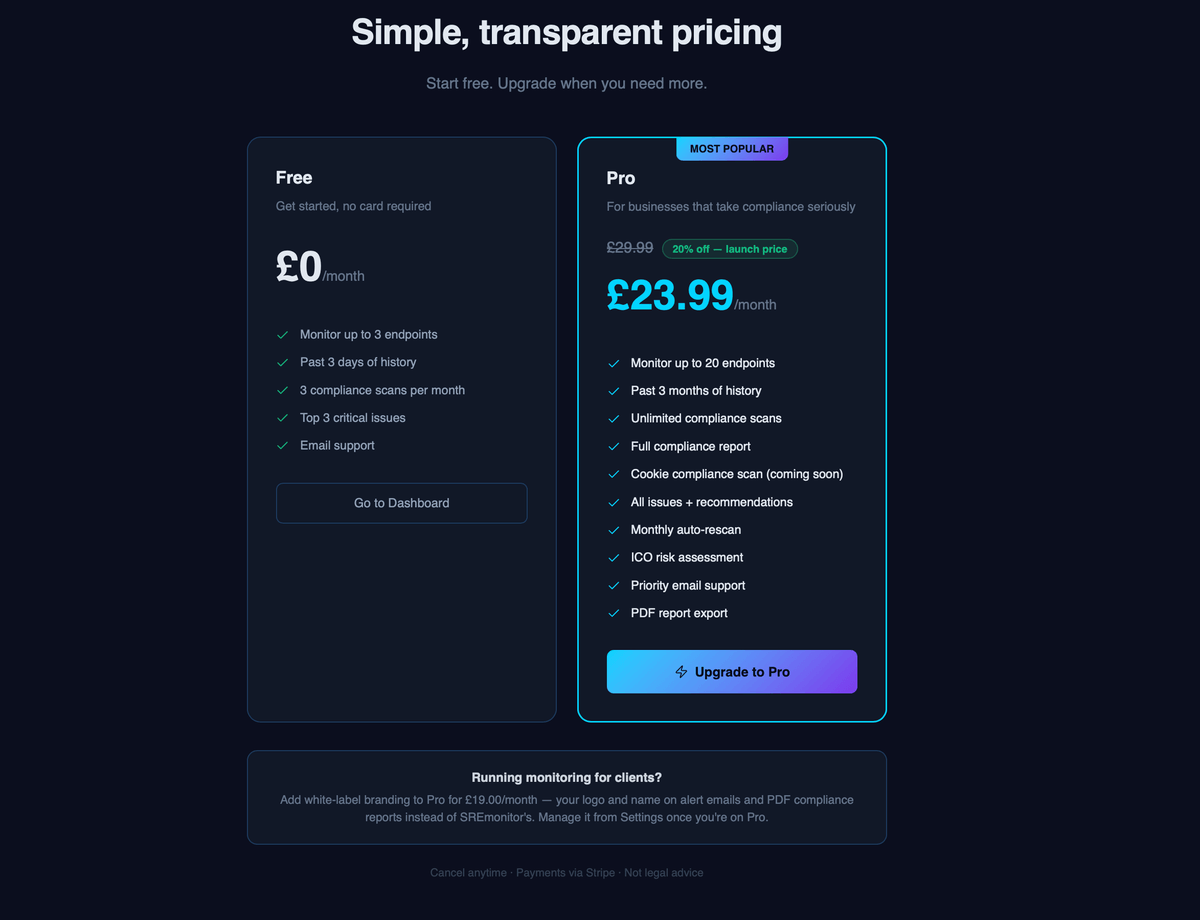
SREMonitor.io Launches External Website, API and GDPR Monitoring Platform in the UK

SREMonitor.io Website Monitoring Platform

SREMonitor.io launches a UK-developed platform combining external website and API uptime monitoring, Core Web Vitals and automated GDPR checks for organisations and digital agencies.

LONDON — October 3, 2026 — SREMonitor.io, a UK-developed monitoring platform, has launched a unified service for externally monitoring websites and public APIs, combining uptime monitoring, website performance visibility and automated GDPR checks within a single platform.

The platform is designed for anyone responsible for publicly accessible digital services — from businesses and technology teams to SaaS providers, website owners and digital agencies managing websites for multiple clients.

SREMonitor.io is built around a straightforward principle: if an organisation operates something publicly on the internet, it should have an independent way of checking whether users can actually reach it.

Monitoring From the Customer’s Perspective

Press release image

Internal infrastructure monitoring can show that servers, applications or containers are operating normally, but this does not always mean a customer can successfully access the service.

DNS problems, certificates, CDN configuration, networking failures, deployments and third-party dependencies can affect a public website or API even when individual infrastructure components appear healthy.

External monitoring provides a different perspective by checking services from outside the organisation’s infrastructure.

For a website owner, the question may simply be: Can customers reach our website?

For an engineering team operating a public API, it becomes: Can external consumers successfully reach our endpoint?

SREMonitor.io is designed to provide that outside-in visibility without requiring organisations to deploy monitoring agents or establish a complex observability environment simply to begin monitoring a public service.

More Than Website Uptime

Press release image

Website availability is only one part of digital reliability.

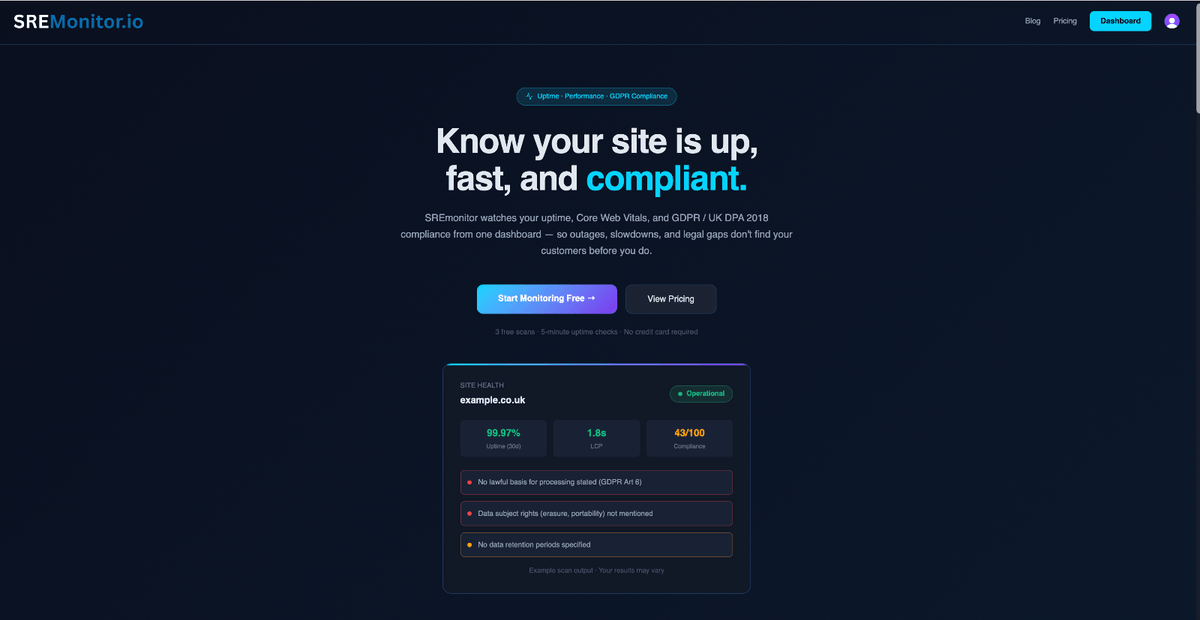
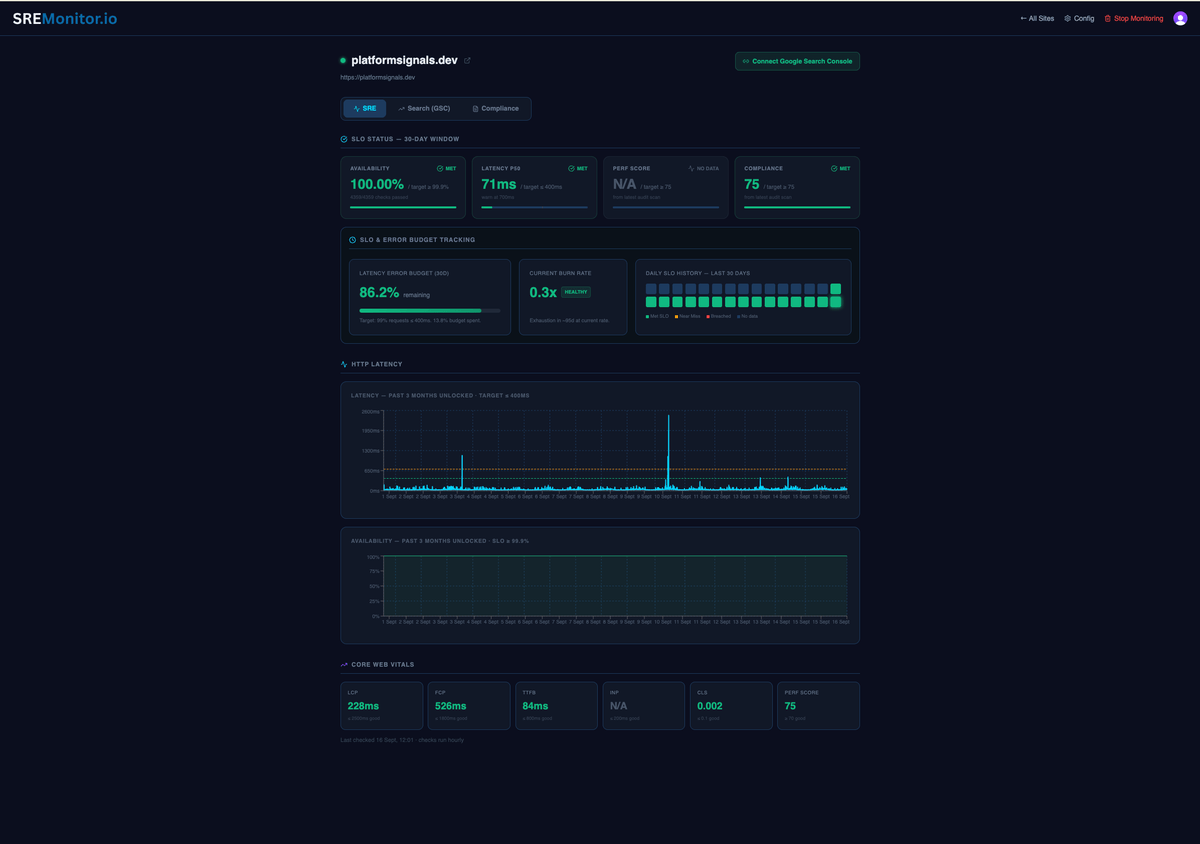
A website can technically remain online while delivering a poor user experience. SREMonitor.io therefore combines uptime monitoring with performance visibility, including Core Web Vitals such as Largest Contentful Paint (LCP), Interaction to Next Paint (INP) and Cumulative Layout Shift (CLS).

The platform also incorporates automated website scans designed to identify potential GDPR and privacy-related concerns that may warrant further investigation.

Modern websites change continuously. Analytics services, advertising technologies, cookies, forms, plugins and third-party integrations can all be introduced after a website’s original compliance review.

External recurring checks can provide organisations with additional visibility into changes appearing on their public-facing websites.

SREMonitor.io’s automated GDPR functionality is intended as an early-warning and monitoring mechanism. It does not replace professional legal or data-protection advice or certify that a website complies with UK GDPR or other applicable legislation.

Supporting Digital and Website Agencies

Press release image

Digital agencies represent another important use case.

An agency may develop and maintain dozens of customer websites. Once those websites have launched, manually checking every site for availability, performance and potential compliance changes becomes increasingly difficult.

External monitoring allows agencies to monitor client websites independently and identify potential customer-facing problems earlier.

It can also help agencies extend their relationship with customers beyond initial website development.

Website maintenance, uptime monitoring, performance checks and recurring compliance scans can form part of an ongoing website-care service, giving clients continued visibility after launch while allowing agencies to develop recurring managed-service offerings.

Simple Monitoring for the UK Digital Economy

As UK organisations become increasingly dependent on websites, APIs and digital services for sales, customer communication and business operations, service availability is no longer exclusively an engineering concern.

Not every monitoring requirement, however, needs to become a major infrastructure project.

Simple external monitoring can complement more sophisticated observability platforms by providing an independent signal representing what users can actually access.

For organisations already operating enterprise observability platforms, outside-in monitoring can provide an additional customer-perspective signal.

For organisations without dedicated Site Reliability Engineering teams, it can provide a practical starting point for understanding the availability and performance of important public services.

Internal observability can help explain what is happening inside a system.

External monitoring answers another important question: what can customers actually reach?

Built From an SRE Perspective

SREMonitor.io was founded by Sowmya Shree, a Site Reliability Engineering and technology leader with more than 18 years of experience across enterprise technology, observability, operational resilience and production engineering.

Her career includes more than 15 years within a Tier 1 global investment bank, working across reliability engineering, monitoring, incident management, operational readiness and production technology environments.

SREMonitor.io applies a principle familiar within Site Reliability Engineering: reliability should ultimately be considered from the perspective of the service experienced by its users, rather than inferred solely from the health of individual infrastructure components.

“External monitoring gives organisations a very simple but important perspective: can somebody outside your infrastructure actually use the service?” said Shree. “You may have sophisticated internal monitoring, or you may simply operate a business website. Either way, knowing what your users can reach is valuable.”

Shree is also the published author of ⁠The Autonomous SRE Playbook: Building Reliable Systems with Observability, Automation, and AI, which explores modern Site Reliability Engineering, observability, automation and AI-enabled operations.

Alongside her work on SREMonitor.io, she publishes ⁠PlatformSignals.dev, a technology publication covering Site Reliability Engineering, observability, platform engineering and modern production operations.

About SREMonitor.io

⁠SREMonitor.io is a UK-developed external monitoring platform created under MASA Ventures Ltd.

The platform brings together website and public API monitoring, website performance visibility, Core Web Vitals and automated GDPR website scans. It is designed for organisations, technology teams, website owners, SaaS providers and digital agencies seeking independent visibility into publicly accessible digital services.

ENDS

Automated GDPR and website compliance scans can identify potential issues for further investigation but do not constitute legal advice or certify compliance with UK GDPR, PECR or other applicable legislation.

Media Contact:
Name: SREMonitor Media Team
Company: SREMonitor.io (MASA Ventures Ltd)
Email: prasadmaruthi15@gmail.com
Address: 71–75 Shelton Street, Covent Garden, London, United Kingdom
Website: https://SREMonitor.io