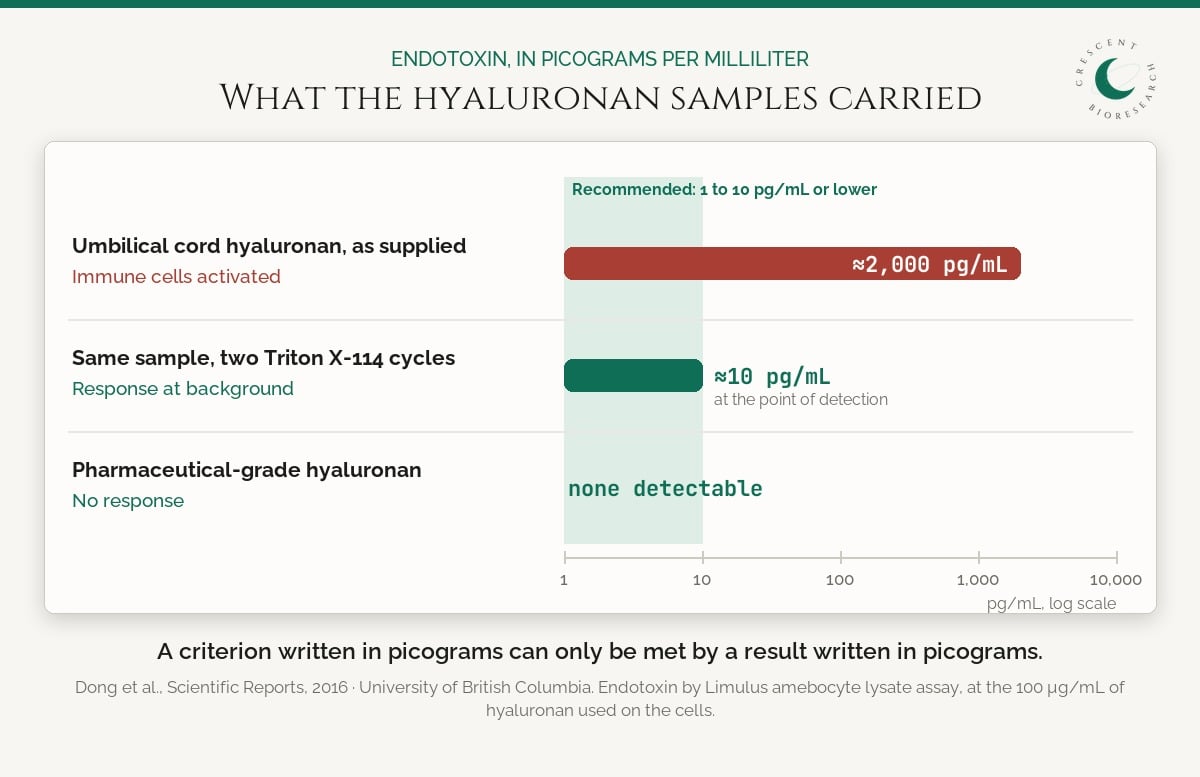
Investigators at the University of British Columbia traced the immune activation produced by one hyaluronan preparation to the endotoxin it carried. Their remedy was a figure in picograms, and a figure is the only form of result that can be held against it.
ALBANY, N.Y., Oct. 20, 2026 — For the better part of two decades, fragments of hyaluronan were credited with switching on immune cells. A 2016 study in Scientific Reports from the University of British Columbia found that the activity belonged to endotoxin carried in one preparation, and that the only means of separating the molecule from the contaminant was a measured figure. Crescent Bioresearch, a supplier of laboratory compounds, has examined that study for what it asks of the endotoxin line on a certificate of analysis, a line that across the laboratory supply industry is routinely reduced to a single word.
Endotoxin is the lipopolysaccharide of the outer membrane of Gram-negative bacteria. It is detected by the Limulus amebocyte lysate assay, and a complete report of that assay carries three figures: the quantity found, the limit it was held to and the sensitivity of the lysate that found it. The hyaluronan study is a record of why the first of those figures cannot be exchanged for a verdict.
A molecule with a reputation
Hyaluronan sits in healthy tissue as a very large molecule and is broken into smaller fragments during inflammation. For years those fragments were reported to act as danger signals in their own right, capable of switching on macrophages and dendritic cells, and the literature settled on a model in which large hyaluronan is anti-inflammatory and small hyaluronan is pro-inflammatory. A few earlier reports had already questioned that model, including one that traced the activity of enzyme-generated fragments to endotoxin rather than to the fragments themselves.
The University of British Columbia group set out to test the question systematically. The investigators exposed mouse macrophages and dendritic cells, grown from bone marrow and taken directly from the spleen and peritoneum, to pharmaceutical-grade hyaluronan in sizes ranging from more than one million daltons down to a fragment of four sugars, to hyaluronan purified from rooster comb and from human umbilical cord, to fragments generated by sonication, hydrogen peroxide and enzyme digestion, and to hyaluronan bound to the heavy-chain proteins that form during inflammation.
One preparation responded, and it carried the contaminant
Of every hyaluronan form tested, only the umbilical cord preparation drove the cells to produce the inflammatory signals tumor necrosis factor alpha and interleukin-12 and to raise their co-stimulatory surface markers, at levels comparable to purified lipopolysaccharide. The response was unchanged in cells lacking CD44, the cell surface receptor for hyaluronan, a first indication that it did not run through hyaluronan’s own receptor. Two hyaluronidase enzymes of the kind used in earlier studies to generate fragments produced the same response, and that response persisted after the enzymes themselves were digested and heat-inactivated.
When the investigators measured the preparations with the Limulus amebocyte lysate assay, the umbilical cord material carried approximately 2 nanograms of endotoxin per milliliter at the concentration used on the cells, while no endotoxin was detectable in any of the purified preparations. Two cycles of phase separation with Triton X-114 lowered it more than 100-fold, to approximately 10 picograms per milliliter, the point of detection of the assay, and the inflammatory signals fell to background levels.
The investigators concluded that endotoxin-free hyaluronan and its fragments did not stimulate macrophages or dendritic cells in their models, and that earlier findings warrant review of the sources and methods behind them. The authors noted that other inflammatory pathways and the complexed forms of hyaluronan generated in living tissue were beyond what their mouse models could exclude.
The remedy was written as a figure
The study’s recommendation was not a word but a number. The authors advised that the endotoxin content of hyaluronan preparations be confirmed at 1 to 10 picograms per milliliter or lower, and that removal be monitored by measurement, ideally down to 1 to 3 picograms per milliliter, because picogram quantities of endotoxin were sufficient to activate the cells they were studying.
A criterion expressed in picograms can only be met by a result expressed in picograms. A pass issued against a threshold the certificate does not print carries no unit and no magnitude, and the research entity holding it cannot determine whether the material sits beneath a criterion of this kind, near it, or many times above it. The detection limit of the assay matters equally, since a reading of none detected only signifies as much as the lowest concentration the assay can see, a figure the investigators reported alongside their result.
A label that states its limit
A bakery labels a loaf safe for customers with a gluten allergy. One customer reacts to trace amounts and another tolerates a small quantity, and the word on the label serves neither, because neither can tell what limit the bakery applied. A label stating the measured gluten in parts per million allows each customer to hold the loaf against a personal limit. A certificate that prints a pass and neither the measured value nor the threshold behind it is the first label, and a research entity working with macrophages or dendritic cells is the customer who reacts to trace amounts.
“The hyaluronan study is a record of what a research entity can only see with a number in hand,” Crescent Bioresearch said. “The investigators separated a biological effect from a contaminant because they measured the contaminant, reduced it, and measured it again. A certificate that offers a single word in place of that figure leaves a research entity unable to make that distinction for the lot in hand.”
“Every laboratory compound carries an endotoxin load that is either measured and stated or left to assumption, and the hyaluronan record shows how readily an unmeasured contaminant can be mistaken for the molecule under study,” the company said. “The significance of a numerical endotoxin value is greater than that of a singular pass or fail. With no number to work against, a certificate reporting only the latter raises questions about its own validity.”
METHODOLOGY
This examination is based on Dong Y, Arif A, Olsson M, et al., “Endotoxin free hyaluronan and hyaluronan fragments do not stimulate TNF-α, interleukin-12 or upregulate co-stimulatory molecules in dendritic cells or macrophages,” Scientific Reports 2016;6:36928.
ABOUT CRESCENT BIORESEARCH
Crescent Bioresearch is a supplier of laboratory compounds founded around a framework of critical assessment. It works with research entities nationwide in pursuit of preserving the integrity of scientific research through its transparency approach. Follow the Crescent Discovery Series to dive into the latest breakthroughs and findings within prominent literature.
Find Crescent Bioresearch on Instagram, TikTok, X and Facebook, and every certificate we publish, at crescentbioresearch.com/links.
Media Contact:
Name: Media Relations
Company: Crescent Bioresearch
Email: pr@crescentbioresearch.com
Website: https://crescentbioresearch.com/links