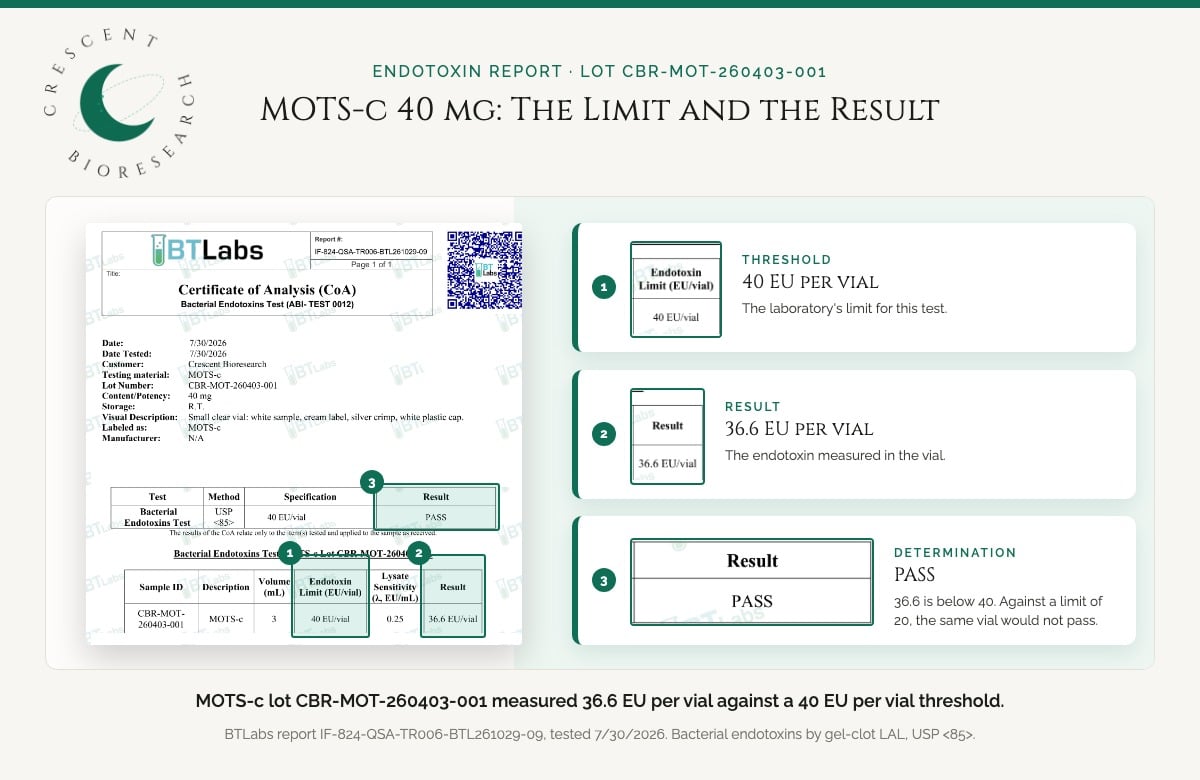
MOTS-c lot CBR-MOT-260403-001 measured 36.6 EU per vial against the testing laboratory's threshold of 40 EU per vial, with a lysate sensitivity of 0.25 EU/mL. Against a stricter limit of 20 EU per vial, the same result would not pass.
ALBANY, N.Y., Oct. 22, 2026 — Crescent Bioresearch, a supplier of laboratory compounds, has published the MOTS-c certificate of analysis for lot CBR-MOT-260403-001. The endotoxin result is 36.6 EU per vial, the threshold is 40 EU per vial, and the lot passed at 91.5 percent of the threshold. The threshold belongs to the laboratory that ran the test. The measured value is printed beside it.
MOTS-c, also known as MOTSc, from the mitochondrial open reading frame of the 12S rRNA type-c, sequence MRWQEMGYIFYPRKLR, CAS 1627580-64-6, is supplied by Crescent Bioresearch as MOTS-c 40 mg for laboratory research.
The page
BTLabs, an independent laboratory in West Palm Beach, Florida, tested the lot on July 30, 2026, by the gel-clot Limulus amebocyte lysate (LAL) method under USP General Chapter 85, Bacterial Endotoxins Test. Endotoxin is lipopolysaccharide, a residue of Gram-negative bacteria, measured in endotoxin units (EU). The laboratory dissolved the 40 mg vial in 3 mL, measured 36.6 EU per vial, compared it with its 40 EU per vial threshold and recorded a pass. The lysate sensitivity was 0.25 EU/mL, and per milligram the result is 0.92 EU.
Whose question the pass answers
A pass states that the result fell below the threshold the testing laboratory chose. That is one question, asked by one party. A research entity asks a different question of the same vial: does this lot meet the limit my work requires? The testing laboratory does not know what that work is and did not set its threshold for it. The pass on the page is therefore the testing laboratory’s conclusion, and the measured value is what allows anyone else to reach their own.
Two research entities, one vial
Consider two research entities receiving vials from this lot. The first has set its own limit at 40 EU per vial, the same as the laboratory’s, and for it the pass on the page is also its own answer. The second works with a model that responds to small amounts of endotoxin and has set its limit at 20 EU per vial, and for it the lot sits above the limit. The vial is the same in both cases. The number, 36.6, is what lets the second research entity reach the answer that fits its work.
An airport luggage scale shows the same thing
A passenger checks a bag at the airport, and the agent says it is overweight. The scale has no number on it. It only shows a red light for overweight and a green light for within the limit. The bag weighs 40 pounds, but the passenger has no way of knowing that. The passenger cannot tell whether the bag is one pound over or ten, so there is no way to know how much to take out. If the light had been green, the passenger would not know how much room was left to add anything either. With the number on the scale, both questions are easy: a 40-pound bag against a 35-pound limit means 5 pounds have to come out.
An endotoxin certificate that prints only “pass” is that green light. The MOTS-c certificate prints the number: 36.6 EU per vial against the laboratory’s limit of 40, which leaves 3.4 EU of room. A research entity that holds its work to a stricter limit, such as 20 EU per vial, can see from the same number that this lot is over its own line.
Why the value sits beside the verdict
A certificate that reports only a pass has made the decision for every research entity that reads it, against a threshold none of them chose. A research entity with a stricter limit has no way to see where the lot stands, and a research entity comparing lots has nothing to compare.
For this lot, a research entity sees that the pass was the laboratory’s, against 40, and sees the 36.6 it needs to apply its own limit. At 36.6 EU per vial the amount sits close to the threshold, so a research entity will want to account for it and make sure what it records can be traced to MOTS-c and not to endotoxin. The MOTS-c annotated endotoxin report shows where the threshold, sensitivity and result appear.
“The pass on this certificate is the testing laboratory’s answer to the testing laboratory’s question,” Crescent Bioresearch said. “A research entity has its own question and its own limit, and the measured value is what lets it answer.”
SOURCE DOCUMENTS
Bacterial Endotoxins Test report IF-824-QSA-TR006-BTL261029-09, issued by BTLabs, West Palm Beach, Florida, for MOTS-c lot CBR-MOT-260403-001, tested July 30, 2026, by gel-clot LAL; USP General Chapter 85, Bacterial Endotoxins Test.
ABOUT CRESCENT BIORESEARCH
Crescent Bioresearch is a supplier of laboratory compounds, founded around a framework of critical assessment. It works with research entities nationwide in pursuit of preserving the integrity of scientific research through its transparency approach. Follow the Crescent Discovery Series to dive into the latest breakthroughs and findings within prominent literature.
Find Crescent Bioresearch on Instagram, TikTok, X and Facebook, and every certificate we publish, at crescentbioresearch.com/links.
Media Contact:
Name: Media Relations
Company: Crescent Bioresearch
Email: media@crescentbioresearch.com
Website: https://crescentbioresearch.com/links