Texas Counseling Center Announces Verification Plan for Katy-Area Service-Use Review

Public release will follow confirmation of all figures, methods, privacy safeguards and disclosures

KATY, Texas – 24th July 2026 – Texas Counseling Center today announced that its long-term descriptive review of outpatient behavioral health service use in Fort Bend and Harris counties will remain in prepublication review until all underlying information has been verified.

The planned report concerns the service area described in organizational materials as Counseling in Katy, along with nearby communities served by the practice. It will describe activity within Texas Counseling Center and will not represent all residents, clinicians or behavioral health practices in either county.

No findings or topline figures are being released with this notice. Texas Counseling Center will publish the report only after completing a numerical and methodological review covering:

– Data-coverage dates and annual reporting periods  

– Unique-client, appointment and clinician counts  

– Definitions for completed, canceled and repeat appointments  

– Eligibility rules, denominators and missing-data handling  

– Classification of in-person, virtual and hybrid care  

– Retention definitions, including appointment requirements and time windows  

– Statistical methods and any uncertainty estimates  

– Demographic categories and missing-data rates  

– Data-system changes that may affect comparisons over time  

The final public package is expected to identify the report date, authors, version, data sources and staff responsible for data preparation and analysis. It also is expected to provide methodology, definitions, summary tables and a stable direct link accessible through the organization’s website.

Scope of the Review

The review is intended to describe changes within one outpatient practice. It will not establish why service use changed, demonstrate causation or determine whether one care format produces better clinical results than another.

Any county population or commuting information will be presented separately as regional context and attributed to the U.S. Census Bureau Population Estimates Program or American Community Survey. Such information will not be used to explain changes in the practice’s records unless the final analysis supports that conclusion.

Privacy and Review Requirements

Before publication, Texas Counseling Center will document how records were selected, processed and summarized. The public methodology is expected to address de-identification, small-cell suppression, authorized data access, record-retention practices and the handling of clients who received more than one care format.

Only aggregate results will appear in the public files. Individual-level records will not be published.

The final report also is expected to state whether clinical outcome measures were analyzed and, if so, identify each measure, assessment point, completion rate and definition of change. It will specify whether comparisons were descriptive or adjusted and whether inferential testing was performed.

Limitations

The planned analysis relies on one organization’s operational records. Results may reflect changes in scheduling, staffing, documentation, insurance participation, service availability or information systems. Missing information and differences among client groups may also affect comparisons across reporting periods.

Texas Counseling Center will issue a separate publication announcement after verification is complete and the report, methodology, definitions and disclosures are publicly accessible.

About Texas Counseling Center

Texas Counseling Center is an outpatient behavioral health practice serving the Katy, Texas, area through in-person and virtual appointments.

Media Contact

Texas Counseling Center

Media Relations  

Email: info@texascounseling.center  

Website: https://texascounseling.center

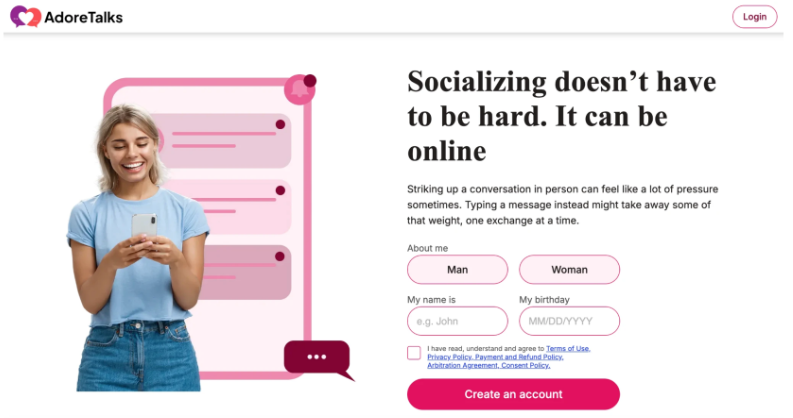
AdoreTalks launches consolidated disclosure center for identity confirmation, browser access and billing terms

Disclosure takes effect July 23, 2026, and provides direct access to current pricing, privacy and account policies.

NEW YORK – 24th July 2026 – AdoreTalks today launched a consolidated disclosure center explaining its identity-confirmation options, browser-based service model, paid communication features and account-support channels. Effective immediately, the resource provides members with a dated reference point and direct links to current billing and privacy terms.

The disclosure responds to member questions about the distinction between email confirmation and third-party identity confirmation, what an identity-confirmation indicator means, and which platform functions require payment. It reflects current operations and does not introduce a new identity-confirmation method.

Identity-confirmation signals

AdoreTalks uses two distinct account signals:

– Email confirmation means a member has demonstrated access to the email address associated with the account. It does not confirm the member’s legal identity.

– Jumio identity confirmation is an optional process provided through Jumio. When an indicator appears on an AdoreTalks profile, it means the member completed the applicable Jumio process. It does not guarantee that profile statements are accurate, that account activity is safe or that deceptive conduct will not occur.

Participation in Jumio identity confirmation is optional. Before submitting information, members are presented with notices addressing the requested documents or images, consent terms and relevant data practices.

The following resources address controller and processor roles, retention, deletion requests, geographic processing and other privacy terms:

– AdoreTalks Privacy Policy: https://adoretalks.com/privacy-policy/ 

– Jumio Privacy Policy: https://www.jumio.com/legal-information/privacy-policy/ 

Earlier AdoreTalks materials referenced Jumio’s global identity survey when discussing false online representations. The consolidated disclosure does not cite a numerical result from that research and does not use it as evidence that AdoreTalks prevents deception or has established platform effectiveness.

Members should continue to assess profile information carefully and report suspicious content through the support channel.

Communication at AdoreTalks

The disclosure also explains communication at AdoreTalks. The service is available through desktop and mobile web browsers and does not provide:

– A native mobile application

– Voice calling

– Video calling

– Application-based push notifications

Browser-based communication tools include:

– Intro prompts for written conversations

– Stickers

– Photo sharing within chats

– Long-form written messages

Page presentation and performance may differ by browser, operating system and device.

Pricing and billing terms

Registration and profile creation require no payment. Sending messages, stickers and in-chat photos requires paid access.

The current pricing and billing schedule provides the applicable costs, billing units, renewal behavior, credit-expiration rules, refund conditions and any charge associated with identity confirmation:

– Pricing and Billing Schedule: https://adoretalks.com/pricing/ 

– Terms and Conditions: https://adoretalks.com/terms-and-conditions/ 

Members are asked to review the displayed amount and billing terms before authorizing payment. The terms shown during payment govern the transaction.

Support and account controls

The AdoreTalks support channel accepts submissions 24 hours a day. Continuous intake does not mean that every request will receive an immediate response.

Members may use the support channel to:

– Report suspicious profiles or content

– Ask questions about account or billing terms

– Request profile deactivation

– Request account deletion

– Submit privacy-related requests

Support is available at support@adoretalks.help.

About AdoreTalks

AdoreTalks is an online communication platform available through mobile and desktop web browsers. It provides profile registration, paid written messaging and media tools, optional identity confirmation through Jumio and member-support services.

Media contact

AdoreTalks Media Relations  

media@adoretalks.help  

https://adoretalks.com/

Baytech Consulting Announces 2026 Manufacturing Software Evaluation Framework for U.S. Manufacturing Projects

IRVINE, Calif. – 24th July 2026 – Baytech Consulting announced the release of the 2026 Manufacturing Software Evaluation Framework, a structured resource designed to assist organizations in assessing manufacturing software development companies in the USA through consistent evaluation criteria focused on software delivery, engineering practices, automation capabilities, and project planning.

The framework presents an evaluation model built around four categories that reflect common considerations during manufacturing software procurement. The published methodology examines onshore engineering operations, experience across production technology and enterprise software environments, automation and artificial intelligence implementation capabilities, and delivery transparency through defined project scope and planning documentation. The framework accompanies a detailed industry guide that provides additional context for software selection decisions across manufacturing environments.

The release reflects continued activity across manufacturing organizations investing in software supporting production operations, plant connectivity, workflow automation, quality management, maintenance planning, and operational data analysis. The framework outlines evaluation considerations for projects involving custom enterprise applications, cloud platforms, manufacturing execution systems, industrial connectivity, intelligent automation, and production reporting.

Baytech Consulting developed the framework using criteria intended to support structured comparisons during software vendor evaluation. Documentation included with the framework describes factors related to engineering team structure, project ownership, implementation planning, technical capabilities, and development methodology. Additional guidance addresses software integration planning, production data management, infrastructure modernization, cloud deployment, and lifecycle support considerations.

The framework also provides information describing project delivery models frequently used during manufacturing software initiatives. Fixed-scope engagements, phased implementation strategies, dedicated engineering teams, and long-term application support models are presented alongside considerations for project budgeting, technical planning, and implementation sequencing. Guidance is also included for organizations evaluating software projects involving artificial intelligence, workflow automation, predictive maintenance, production visibility, machine data collection, and digital transformation initiatives.

According to the accompanying publication, evaluation activities extend beyond software functionality and include technical accountability, engineering continuity, project governance, implementation planning, and operational alignment with manufacturing environments. The framework organizes these considerations into a structured reference intended for manufacturing organizations preparing software modernization initiatives or evaluating technology partners for production-related projects.

“The framework was developed to provide a consistent structure for reviewing manufacturing software projects before implementation begins,” said Michael Anderson, Director of Manufacturing Solutions at Baytech Consulting. “Clear evaluation criteria, documented delivery expectations, and defined engineering responsibilities create a reference point that organizations can use while comparing manufacturing software development companies in the USA across technical and operational requirements.”

The published framework also includes planning guidance for organizations preparing automation initiatives involving production workflows, cloud migration, enterprise integration, data management, intelligent applications, and operational reporting. Documentation discusses project planning activities associated with production environments where software interacts with manufacturing processes, connected equipment, and operational information systems.

Baytech Consulting indicated that the framework will remain available as a reference document for manufacturing organizations evaluating software modernization initiatives throughout 2026. Future revisions may incorporate additional observations reflecting changes in manufacturing technology adoption, software engineering practices, automation strategies, and production system integration requirements.

About Baytech Consulting

Founded in 2007, Baytech Consulting is a software development and technology consulting company headquartered in Irvine, California. The company develops custom software applications, cloud-based platforms, enterprise solutions, automation technologies, and artificial intelligence implementations for organizations across multiple industries. Additional information is available through the company’s social media channels on LinkedIn, Facebook, X, and YouTube.

MEDIA DETAIL

Contact Person Name: Media Relation

Company Name: Baytech Consulting

Email: sales@baytechconsulting.com

Website: https://www.baytechconsulting.com/

Transcure Expands Delaware Medical Billing Services to Support Independent Practices Across the State

NEW YORK, United States – 24th July 2026 – Transcure announced an expansion of its Delaware medical billing services, introducing dedicated revenue cycle management workflows intended to support independent physician practices, specialty providers, and multi-provider healthcare organizations across Delaware.

The expanded Delaware operations formalize a service model that combines specialty-specific coding support, denial management, prior authorization workflows, and technology-enabled revenue cycle processes. The initiative is designed to address operational challenges associated with increasingly complex reimbursement requirements across commercial and government payers, and to reduce administrative burdens that have grown alongside clinical obligations for small and mid-sized practices.

Transcure described the expansion as structured around detailed operational objectives that emphasize measurable improvements in core revenue cycle functions. The program explicitly targets improvements in claim accuracy through specialty-focused workflows, support for timely reimbursement management, reduction of administrative burdens linked to denial resolution, strengthening of prior authorization processes, enhancement of revenue cycle reporting capabilities, and support for scalable billing operations for growing practices. The company noted that continuous claim monitoring and account receivable follow-up are central to this model.

The expanded Delaware medical billing services include integrated offerings for medical billing and coding operations, claims management and submission, prior authorization services, denial prevention and appeals management, accounts receivable follow-up, payment posting and reconciliation, specialty-specific revenue cycle management, and practice performance reporting and analytics. These services are intended to support primary care and multiple specialty disciplines that face unique documentation and payer-specific requirements.

Specialty-focused workflows are highlighted as a key component of the expansion. Transcure emphasized that specialty procedures, diagnostic services, and therapeutic management frequently require additional claim validation and payer documentation beyond standard billing operations. Aligning billing teams with specialty-specific processes aims to deliver more consistent claim preparation and reimbursement management throughout the revenue cycle.

The company positioned technology-enabled billing operations as a critical enabler for the Delaware expansion. Structured workflow management tools are combined with professional billing oversight to facilitate claim validation, payer communications, financial reporting activities, and payment reconciliation. The approach pairs automated processes with revenue cycle professionals to maintain operational visibility across key metrics such as claim acceptance rates, accounts receivable timelines, denial trends, and payment reconciliation.

Ali Nadeem, Chief Executive Officer of Transcure, stated: “Healthcare organizations today require revenue cycle strategies that recognize both clinical complexity and operational realities. Our Delaware expansion reflects the growing need for billing operations that combine specialty expertise, structured workflows, and technology-supported processes designed around modern reimbursement requirements.”

Faran Ali, Vice President of Growth at Transcure, is named in company materials as a leader for the expansion and related growth initiatives, with responsibility for aligning billing solutions to the needs of independent and specialty practices within Delaware.

About Transcure

Transcure provides medical billing and revenue cycle management services to healthcare organizations throughout the United States. The company delivers specialty-focused billing solutions supported by structured workflow design, technology-enabled processes, and professional billing teams across multiple medical specialties. Its end-to-end revenue cycle management services include coding support, denial management, prior authorization workflows, accounts receivable management, and specialty billing operations designed to support evolving healthcare reimbursement requirements.

MEDIA DETAILS

Contact Person: Ali Nadeem
Company Name: Transcure
Email: info@transcure.com
Website: https://transcure.net/

Transcure Launches Nephrology Billing Services for Dialysis Revenue Cycle Management

NEW YORK, United States – 24th July 2026 – Transcure today launched a specialized nephrology billing services offering and expanded revenue cycle management workflows designed to reduce dialysis billing errors in Medicare claims and support End-Stage Renal Disease reimbursement accuracy.

The new service package responds to persistent denial and recoupment risk faced by dialysis providers as Medicare coding, modifier use, and documentation requirements become more detailed. Transcure framed the launch around a structured approach that aligns each monthly claim to the documented clinical record and embeds specialty-specific controls into routine billing operations. The company positioned the offering for nephrology practices and dialysis providers managing Medicare reimbursement, dual eligibility coordination, and monthly visit reconciliation.

Transcure highlighted several recurring sources of dialysis billing error that the new nephrology billing services directly address. Common error types cited include monthly capitation payment codes billed above the documented face-to-face visit count, non-face-to-face contacts counted toward the monthly visit total, full-month codes reported for partial months of care, missing or incorrect primary diagnosis on monthly End-Stage Renal Disease claims, duplicate monthly billing by more than one managing physician, confusion between bundled services and separately billable items, and payer sequencing mistakes for patients covered by both Medicare and Medicaid. The company noted that these error patterns often stem from the specialty knowledge required to translate dialysis clinical workflows into Medicare billing accuracy.

Recommended operational practices incorporated into the revenue cycle management offering emphasize matching claims to documentation. The company advised selecting the monthly capitation payment tier consistent with the documented face-to-face visit count, counting only in-person visits that include recorded clinical assessment content, reporting per-day codes when care spans less than a full month, confirming the correct primary diagnosis on every monthly claim, assigning one managing physician per patient per calendar month, tracking which items fall inside the dialysis bundle versus those billed separately, and reconciling Medicare and Medicaid coordination for dual-eligible patients.

Transcure described denial prevention and documentation priorities built into the service. The revenue cycle management workflows include pre-submission review of visit documentation for clinical content, monitoring denial trends by payer and procedure, tracking monthly visit counts against documentation in real time, preparing appeals with clinical evidence when required, and updating workflows as Medicare coding and modifier policies change. The company connected accurate documentation of dialysis adequacy review, medication management, and laboratory findings to stronger claim support.

The offering pairs automated validation with professional nephrology coding oversight. Transcure detailed technology-enabled billing oversight that combines automated claim validation, structured workflow management for monthly visit reconciliation, payer coordination and financial reporting, and continuous monitoring to identify coding gaps earlier in the billing lifecycle. Faran Ali, Vice President of Growth at Transcure, described the solution as providing visibility into monthly claim accuracy across patient panels and enabling earlier identification of coding gaps before submission.

Ali Nadeem, Chief Executive Officer of Transcure, said, “Dialysis providers deliver some of the most demanding care in medicine, and their billing should never put earned revenue at risk. Reducing dialysis billing errors starts with matching every Medicare claim to the documented record. Our best practices give nephrology practices a repeatable process that protects reimbursement while providers stay focused on patient care.”

About Transcure

Transcure provides medical billing and revenue cycle management services to healthcare organizations throughout the United States. The company delivers specialty-focused billing solutions supported by structured workflow design, technology-enabled processes, and professional billing teams across multiple medical specialties. Its end-to-end revenue cycle management services include coding support, denial management, prior authorization workflows, accounts receivable management, and specialty billing operations designed to support evolving healthcare reimbursement requirements.

MEDIA DETAILS

Contact Person: Ali Nadeem
Company Name: Transcure
Email: info@transcure.com
Website: https://transcure.net/

Baytech Consulting Releases 2026 Guide to Manufacturing Software Development Companies in the USA

IRVINE, Calif. – 24th July 2026 – Baytech Consulting announced the release of the 2026 Guide to Manufacturing Software Development Companies in the USA, a publication designed to present an overview of software development providers serving manufacturers pursuing custom software, automation, artificial intelligence, connected devices, and industrial digitalization initiatives.

The guide examines factors that manufacturers commonly evaluate during software partner selection for projects involving production systems, cloud integration, enterprise connectivity, industrial data management, embedded technologies, and AI-enabled applications. The publication introduces a structured evaluation methodology centered on manufacturing experience, technical capabilities, delivery approach, and evidence of completed implementation work.

The guide presents profiles of six manufacturing software development companies in the USA and summarizes areas of specialization, project focus, and technical capabilities associated with each organization. Coverage includes custom manufacturing software, industrial automation, connected products, embedded engineering, machine learning, predictive analytics, wireless connectivity, robotics, and cloud-based manufacturing applications.

Baytech Consulting developed the publication to provide manufacturing organizations with a reference document for comparing software development approaches across multiple technology disciplines. The guide also outlines considerations for organizations evaluating whether custom software development aligns with operational requirements instead of standardized software deployments.

In addition to company profiles, the publication examines common planning considerations for manufacturing software initiatives. Topics include project discovery, system architecture, implementation phases, production integration, deployment planning, and ongoing support activities. The guide also discusses factors that influence software implementation timelines, including project scope, data readiness, integration complexity, regulatory requirements, validation activities, and operational review cycles.

A dedicated section presents a comparison between custom manufacturing software and packaged software implementations, outlining factors that organizations frequently assess when planning digital transformation initiatives. Additional content includes a buyer’s checklist intended to assist manufacturing decision-makers in evaluating software development partners before project engagement.

“The release of this guide reflects continued interest in practical information that supports software planning within manufacturing environments,” said Michael Carter, Director of Manufacturing Solutions at Baytech Consulting. “The publication organizes evaluation criteria, implementation considerations, and project planning topics into a single reference intended for organizations reviewing manufacturing software development companies in the USA.”

The guide also describes common technology areas associated with modern manufacturing software projects, including production automation, industrial AI, cloud infrastructure, enterprise integration, operational data visibility, connected equipment, and intelligent workflow development. Information throughout the publication is organized to provide readers with a consistent framework for reviewing software development capabilities across different project categories.

The 2026 Guide to Manufacturing Software Development Companies in the USA is available through Baytech Consulting as part of ongoing educational resources focused on manufacturing software planning, industrial technology adoption, and custom application development.

About Baytech Consulting

Founded in 2008, Baytech Consulting is a software engineering and technology consulting company headquartered in Irvine, California. Operations include custom software development, manufacturing technology solutions, cloud applications, artificial intelligence implementation, enterprise integration, and industrial software engineering for manufacturing organizations. Additional information is available through the company’s social media channels on LinkedIn, X, Facebook, and YouTube.

MEDIA DETAIL

Contact Person: Media Relations
Company Name: Baytech Consulting
Email: sales@baytechconsulting.com
Website: https://www.baytechconsulting.com/

Radiant Cash Loans Is Glad To Start Providing Direct Lender Loan Matching Service With The Help Of AI

Las Vegas, Nevada – Radiant Cash Loans, a leading financial services platform dedicated to simplifying consumer access to lending options, is proud to announce the launch of its innovative Direct Lender Loan Matching Service powered by advanced Artificial Intelligence (AI) technology. This new service marks a significant milestone in Radiant Cash Loans’ commitment to enhancing borrower experience by delivering faster, more accurate, and personalized payday loan matching solutions.

Revolutionizing Loan Matching with AI

In today’s rapidly evolving financial landscape, consumers demand speed, transparency, and tailored solutions when seeking loans. Radiant Cash Loans recognizes these needs and has integrated cutting-edge AI algorithms into its platform to transform the traditional loan matching process. This AI-driven service intelligently analyzes borrower profiles, preferences, and financial data to connect applicants directly with lenders whose criteria best fit their unique circumstances.

By leveraging AI, Radiant Cash Loans can now offer:

  • Faster Loan Matching: AI expedites the evaluation of borrower information, significantly reducing wait times and accelerating the connection to suitable lenders.
  • Personalized Loan Options: The system dynamically assesses multiple factors to recommend loan offers that align closely with the borrower’s financial profile and needs.
  • Improved Accuracy: Enhanced data processing minimizes mismatches, increasing the likelihood of successful loan approvals.
  • Streamlined User Experience: Borrowers benefit from a simplified, intuitive interface that guides them seamlessly through the loan matching journey.

Commitment to Customer-Centric Innovation

“Our mission has always been to empower consumers with easy access to financial resources,” said Laura Brown, marketing manager of Radiant Cash Loans. “By incorporating AI into our loan matching service, we are not only speeding up the process but also making it smarter and more responsive to individual borrower needs. This technology allows us to deliver a more personalized and efficient experience, helping people find the right lender faster and with greater confidence.”

Laura added, “We believe that responsible innovation is key to building trust and transparency in financial services. Our AI-powered platform is designed to support borrowers at every step, ensuring they are matched with direct lenders who truly understand their situation.”

How the AI-Powered Matching Service Works

The new service collects borrower information through a secure, user-friendly interface. The AI system then analyzes this data against a comprehensive database of direct lenders, considering factors such as creditworthiness, loan amount, repayment terms, and lender-specific criteria. This intelligent matching process identifies the most compatible lenders and presents borrowers with tailored loan options.

Unlike traditional loan marketplaces that often rely on generic filters or manual matching, Radiant Cash Loans’ AI technology continuously learns and adapts to market trends and borrower behaviors, improving its recommendations over time. This dynamic approach ensures that borrowers receive relevant and up-to-date loan matches.

Benefits for Borrowers and Lenders Alike

For borrowers, the AI-enhanced service offers a more transparent and efficient path to securing loans, reducing the frustration of sifting through unsuitable offers or facing prolonged approval times. For lenders, it provides access to a more qualified pool of applicants, improving conversion rates and reducing operational costs associated with loan processing.

Looking Ahead: Expanding AI Capabilities

Radiant Cash Loans plans to continue investing in AI and machine learning technologies to further refine its services. Future enhancements may include predictive analytics to forecast borrower needs, automated document verification, and personalized financial advice, all aimed at creating a holistic lending ecosystem that benefits all stakeholders.

About Radiant Cash Loans

Radiant Cash is a trusted financial services platform dedicated to connecting consumers with direct lenders through innovative technology solutions. With a focus on transparency, accessibility, and customer empowerment, Radiant Cash Loans strives to simplify the borrowing process and provide tailored loan options that meet diverse financial needs.

Media Contact

For more information, interviews, or media inquiries, please contact:

Laura Brown
Marketing Manager
Radiant Cash Loans
Email: laura@radiantcashs.com
Phone: (844) 575-3209
Website: www.radiantcashs.com

Mauritius FSC Licence Explained: How Regulation Supports Global Financial Expansion | Centrino Capital

Financial services companies expanding across borders face a challenge that goes well beyond entering new markets. They must also earn the confidence of clients, financial institutions, technology providers and international business partners.

That is why regulatory licensing has become an important part of global expansion. It provides a formal operating framework, introduces defined compliance obligations and demonstrates that a company is preparing to conduct business under regulatory supervision. 

What Is a Mauritius FSC Licence?

A Mauritius FSC licence is an authorisation issued by the Financial Services Commission of Mauritius, the regulator responsible for overseeing the country’s non-bank financial services sector and global business activities.

Depending on the authorised activity, firms operating within the Mauritius regulatory framework may be required to follow standards relating to corporate governance, risk management, financial reporting, client onboarding, anti-money laundering controls and ongoing compliance.

A licence should not be interpreted as a guarantee of investment performance or the elimination of financial risk. Its significance lies in placing an authorised business within a recognised regulatory structure, with specific operational and compliance responsibilities.

Why Is Mauritius Important for Global Financial Services?

Mauritius has developed into an international financial centre connecting businesses and investors across Africa, Asia, Europe and other global markets.

Its position between major economic regions, combined with an established legal and regulatory environment, has made the jurisdiction relevant to companies pursuing cross-border growth.

For financial services firms, Mauritius can offer a practical base from which to build international operations while meeting defined regulatory requirements. This balance between market access and oversight is one reason the jurisdiction continues to attract businesses with global expansion plans.

How Does Regulation Support International Expansion?

Expansion in financial services requires more than marketing, technology and access to new customers. Companies must also establish reliable internal controls and demonstrate that their operations can meet the expectations of clients, counterparties and service providers.

Regulatory approval can support this process by requiring businesses to develop clearer systems for governance, compliance and risk management.

A regulated operating framework may help a financial services company:

  • establish stronger internal governance procedures;
  • formalise compliance and reporting responsibilities;
  • improve transparency across business operations;
  • strengthen relationships with institutional and banking partners;
  • support expansion into multiple international markets; and
  • build confidence among clients and stakeholders.

These advantages do not remove the commercial or financial risks associated with international growth. They do, however, provide a more structured foundation from which a company can expand.

Centrino Capital’s Mauritius FSC Approval for a Regulated Global Expansion 

A recent development involving Centrino Capital reflects the broader industry shift towards regulated international growth.

Centrino Capital, an online contracts-for-difference broker, announced that it had received approval for its regulatory licence from the Mauritius Financial Services Commission while preparing for an official launch under the Mauritius regulatory framework.

According to the Centrino Capital Mauritius FSC licence approval announcement published on Investing.com, the approval forms part of the company’s strategy to expand its presence across international markets while maintaining a focus on compliance, transparency and responsible financial services.

The development is intended to support Centrino Capital’s planned growth across markets in Africa, Asia and Europe. It also represents a move towards conducting its future international operations within an established regulatory structure.

As the company prepares for its official launch under the framework, prospective clients should review its website and the relevant regulatory register for the latest information about the status, scope and commencement of regulated services.

Regulation Is Becoming Part of Business Strategy

Financial regulation was once treated primarily as a legal obligation. Today, many firms view it as part of their long-term business strategy.

A regulatory licence can influence how a company builds its systems, selects markets, forms partnerships and communicates with clients. It can also encourage businesses to introduce stronger controls before expanding at scale.

This is particularly relevant to financial companies using digital platforms to reach customers in several jurisdictions. As their geographic reach grows, so does the need for consistent governance and compliance practices.

Companies that incorporate regulatory planning into their expansion strategies may be better prepared to manage this complexity.

What Does FSC Approval Mean for Global Growth?

Approval from the Mauritius FSC can provide a company with a framework for developing regulated operations from Mauritius, subject to the conditions, permissions and continuing obligations attached to its licence.

For a growing financial services firm, this can contribute to:

  • a clearer regulatory identity;
  • improved organisational discipline;
  • greater accountability at management level;
  • stronger compliance infrastructure;
  • enhanced credibility with commercial partners; and
  • a more structured route towards international expansion.

The practical effect will depend on the exact licence held, the activities authorised and the jurisdictions in which the company is permitted to provide services.

The Future of Regulated Financial Expansion

Regulation is likely to remain central to the future of international financial services.

Clients are asking more detailed questions about licensing. Banking and payment partners are applying closer scrutiny to the companies they support. Regulators are also strengthening expectations around financial crime prevention, governance, data protection and consumer communication.

In this environment, firms seeking sustainable international growth will need to combine technology and market access with credible compliance systems.

The Mauritius FSC approval announced by Centrino Capital is one example of how financial services companies are incorporating regulation into their global development plans.

Ultimately, a licence is not the end of the process. It is the beginning of an ongoing responsibility to maintain appropriate standards, manage risk and operate transparently as the business grows. 

Media:

Contact: Communication Team 
Email: infodesk@centrinocapital.com 
Phone: +44 800 031 8653 
Location: Tbilisi, Georgia 

Disclaimer: Trading financial instruments carries risk and may not be suitable for all investors. Please consider your financial situation and seek independent advice if needed. Centrino Capital Ltd. is registered with the International Financial Centre of Saint Lucia. Services may be restricted in certain jurisdictions. This content is for informational purposes only and does not constitute investment advice. For full T&Cs, visit https://centrinocapital.com.

How Windows-Based Teams Can Build More Efficient Document and Reporting Workflows

Modern business teams produce a constant stream of documents. Sales departments prepare proposals, finance teams update spreadsheets, managers review reports, and operations staff maintain process documents. In many organizations, these tasks are completed on Windows computers because the platform supports a broad range of business applications and established file formats.

However, simply having access to office software does not automatically create an efficient workflow. Teams can still lose time searching for the correct file, fixing inconsistent formatting, reconciling different versions, or rebuilding documents that should have been created from a standard template.

A more effective document workflow requires a combination of suitable software, clear internal processes, and consistent file-management practices. By improving these areas, Windows-based teams can reduce repetitive work and create documents that are easier to review, share, and maintain.

Start With a Consistent Office Software Environment

One of the most common causes of document problems is an inconsistent software environment. When different employees use different editors, file versions, or formatting settings, documents may not appear the same across devices.

Fonts can change, tables may shift, charts can become misaligned, and page breaks may appear in unexpected places. These problems are especially disruptive when a document is being prepared for a customer, executive review, or external publication.

Businesses should establish a clear standard for the office software used to create and edit everyday files. The selected environment should support commonly used document, spreadsheet, presentation, and PDF formats.

Teams evaluating wps or another office productivity platform should consider several practical factors:

  • Compatibility with existing business files
  • Support for Windows desktop systems
  • Spreadsheet and presentation capabilities
  • PDF viewing and export functions
  • Template availability
  • Ease of use for nontechnical employees
  • File-sharing and collaboration options

The objective is not simply to install another application. The objective is to give employees a predictable environment in which business files can be created, reviewed, and exchanged without unnecessary formatting issues.

Create Templates for Repetitive Business Documents

Many teams repeatedly create the same types of files. Common examples include:

  • Weekly performance reports
  • Sales proposals
  • Meeting agendas
  • Project summaries
  • Expense reports
  • Customer quotations
  • Marketing plans
  • Employee onboarding documents

Without templates, employees often copy an old document and manually replace the previous information. This approach can leave outdated names, dates, prices, or comments inside the new file.

A controlled template system is more reliable. Each template should contain approved formatting, headings, logos, tables, disclaimers, and standard language. Employees can then focus on updating the information that actually changes.

Templates also improve brand consistency. When every department uses the same fonts, heading structure, spacing, and document layout, business materials appear more professional.

To keep templates useful, assign responsibility for maintaining them. Outdated templates should be replaced or clearly archived so employees do not accidentally use an obsolete version.

Establish Clear File-Naming Rules

Poor file naming creates avoidable confusion. A folder containing files such as “report-new,” “report-final,” “report-final2,” and “report-latest” does not provide a reliable indication of which version should be used.

A practical naming structure can include:

  • Project or department name
  • Document type
  • Reporting period
  • Version number
  • Approval status
  • Date in a consistent format

For example: Sales_Report_APAC_2026-07_v03_Approved.docx

This filename immediately communicates the document’s purpose, region, period, version, and status.

Teams should avoid vague words such as “new,” “latest,” or “updated” unless they are supported by a date or version number. Consistent naming also improves search results when documents are stored in shared folders or cloud platforms.

Separate Drafts From Approved Files

Draft files and approved files should not be stored together without a clear distinction. When employees can easily open an outdated draft, incorrect information may be copied into a new report or sent to a customer.

A simple folder structure can reduce this risk:

  • Templates
  • Working Drafts
  • Internal Review
  • Approved Files
  • Archive

Only finalized documents should be placed in the approved folder. Where possible, editing permissions for approved files should be restricted.

For documents that require regular updates, teams can maintain a master file and export approved versions as PDF documents. This makes it easier to distinguish an editable working document from a fixed version intended for distribution.

Improve Spreadsheet Reporting Processes

Spreadsheets are essential for financial tracking, inventory control, project planning, and operational reporting. They are also a common source of errors.

Problems often arise when employees manually copy data between files, overwrite formulas, use inconsistent date formats, or build reports without documenting the source data.

A more reliable spreadsheet workflow should include:

  • Clearly labeled input cells
  • Protected formula areas
  • Standard date and currency formats
  • Separate raw-data and reporting sheets
  • Data-validation rules
  • Notes explaining important calculations
  • Version control for major reporting periods

Business teams using WPS Office or comparable productivity software can improve reporting consistency by creating reusable spreadsheet structures instead of rebuilding each report from the beginning.

Charts and summary tables should also be designed for the intended audience. Executives may need a concise overview, while analysts may need detailed supporting data. A single spreadsheet can include both, provided the sections are clearly organized.

Use PDFs for Final Distribution

Editable office files are useful during preparation, but they are not always the best format for final distribution. Formatting can change when a recipient opens the document with different software, fonts, or device settings.

Exporting the final version as a PDF can help preserve:

  • Page layout
  • Fonts
  • Images
  • Charts
  • Headers and footers
  • Page numbering

PDFs are particularly useful for proposals, invoices, policies, reports, and documents that should not be casually edited.

Before distributing a PDF, employees should verify that all pages are included, links work correctly, images are readable, and no internal comments remain visible. The original editable file should still be stored in the appropriate internal folder.

Reduce Unnecessary Manual Formatting

Employees often spend too much time making small formatting adjustments. Common examples include manually changing every heading, adjusting individual table cells, or repeatedly recreating the same page structure.

Styles can reduce this work. Instead of formatting each heading separately, teams can define standard styles for:

  • Main titles
  • Section headings
  • Body text
  • Captions
  • Notes
  • Tables
  • Numbered lists

If the document design changes, updating the style can apply the change consistently throughout the file.

This is especially valuable for long reports, policy manuals, and internal documentation. Consistent styles also make documents easier to navigate and improve the quality of automatically generated tables of contents.

Build a Simple Review and Approval Process

Documents frequently pass through several reviewers before approval. Without a clear process, different versions can circulate through email, and reviewers may comment on outdated copies.

A basic review process should define:

  1. Who prepares the first draft
  2. Who checks factual accuracy
  3. Who reviews formatting and language
  4. Who provides final approval
  5. Where the approved version is stored

Reviewers should use comments, tracked changes, or clearly documented feedback instead of directly rewriting large sections without explanation.

The document owner should consolidate feedback into one controlled version. This prevents conflicting edits and makes responsibility clear.

Protect Sensitive Business Information

Document efficiency must not come at the expense of security. Reports may contain customer information, financial data, employee details, internal pricing, or confidential business plans.

Teams should apply appropriate controls, including:

  • Restricted folder access
  • Strong account passwords
  • Multifactor authentication
  • Encrypted storage where appropriate
  • Regular backups
  • Removal of unnecessary personal information
  • Careful review before external sharing

Employees should also avoid downloading office applications from unknown websites or unofficial mirrors. Business software should be obtained through verified sources, and installation files should be checked before use.

When a file is shared externally, teams should confirm that hidden comments, revision history, internal notes, and spreadsheet formulas do not reveal information that was not intended for the recipient.

Review the Workflow Regularly

Document workflows should evolve as a business grows. A process that works for a five-person team may become inefficient when several departments and locations are involved.

Managers should periodically review:

  • Which documents take the longest to prepare
  • Where formatting problems occur
  • Which files are frequently duplicated
  • Whether templates remain current
  • Whether approval delays are avoidable
  • Whether employees understand the storage structure

Small improvements can produce meaningful time savings. Updating a template, simplifying a reporting spreadsheet, or introducing a clear naming rule may save only a few minutes per document, but the cumulative benefit can be substantial across an entire organization.

Conclusion

Efficient document management depends on more than selecting office software. Windows-based teams also need consistent templates, structured folders, reliable file names, clear review responsibilities, and appropriate security controls.

By standardizing these practices, businesses can reduce formatting problems, prevent version confusion, and make routine reporting easier to manage. The result is not only faster document production, but also more accurate and professional business communication.

How Distributed Teams Can Set Up Desktop Messaging Tools for Reliable Business Communication

Distributed teams depend on messaging tools for project updates, file sharing, quick decisions, and coordination across different time zones. While mobile applications are useful for short conversations, employees who spend most of the working day on Windows computers often need a more structured desktop communication environment.

A properly configured desktop messaging application can make it easier to review long discussions, manage shared files, respond to several conversations, and keep work-related communication organized. However, teams should not treat installation as the only setup task.

Reliable business use also requires careful source verification, account protection, notification management, file controls, and clear internal policies. By standardizing these areas, organizations can reduce security risks and help employees communicate more efficiently.

Define the Business Use Case First

Before selecting or configuring a messaging tool, organizations should identify how it will be used.

Some teams need only basic text communication, while others may require:

  • Department and project groups
  • Direct employee messaging
  • File and document sharing
  • Voice or video communication
  • Searchable conversation history
  • Desktop and mobile synchronization
  • Notification controls
  • Administrative permissions
  • Support for multilingual users

The intended use case determines which settings and policies are most important.

For example, a customer-support team may prioritize fast notifications and searchable conversations. A project-management team may focus more on file organization, group permissions, and clear communication channels.

Without a defined use case, employees may create unnecessary groups, share files inconsistently, or use the application for tasks better handled by a document-management or project-management system.

Verify the Installation Source

Desktop communication software should always be obtained from a verified source.

Search results may include unofficial download pages, outdated installers, advertisements, software mirrors, and websites that imitate familiar branding. Some pages may distribute modified installation packages or bundle additional software.

Before downloading an application, users should check:

  • Whether the domain name is spelled correctly
  • Whether the website provides clear product information
  • Whether the connection uses HTTPS
  • Whether the download matches the operating system
  • Whether the installer has a valid digital signature
  • Whether the page requests unnecessary personal information
  • Whether the file comes from an official or trusted distribution channel

Users researching 电报 should understand the difference between the messaging service, independent informational websites, and unofficial pages using similar names.

Businesses should document the approved source and installation process instead of asking every employee to find the software independently.

Choose the Correct Desktop Version

Communication platforms may offer several access methods:

  • Windows desktop application
  • Browser-based web application
  • Mobile application
  • Portable desktop version
  • Third-party client
  • Application-store version

These options are not always identical.

A browser version may be convenient for occasional access but may provide different file, notification, or session-management features. A portable version may not follow the same update process as a standard installation.

For managed business computers, the IT team should specify which version employees are permitted to use.

The approved version should be:

  • Compatible with current Windows systems
  • Regularly updated
  • Easy to remove or repair
  • Supported by the organization
  • Suitable for the required business features

Employees should avoid installing multiple versions unless there is a documented business reason.

Confirm System Requirements

Before installation, users should check whether the computer meets the application requirements.

Important factors include:

  • Windows version
  • Processor architecture
  • Available storage
  • Memory
  • Network connection
  • Administrative permissions
  • Security software compatibility

Older computers may run the application but perform poorly when several conversations, file transfers, or voice calls are active.

Organizations should also confirm whether installation requires administrator approval. Employees should not disable antivirus software or Windows security controls merely to complete an installation.

If a security warning appears, the installer and its source should be reviewed before proceeding.

Protect the Account From the Beginning

Account security should be configured immediately after registration or the first successful login.

A secure setup should include:

  • A unique password where applicable
  • Two-step verification
  • A protected recovery email
  • Review of active sessions
  • Device login alerts
  • A strong device passcode
  • Restricted access to recovery information

Verification codes should never be shared with coworkers, support accounts, group administrators, or people claiming to represent the platform.

Scammers may request login codes by pretending to help with account verification or technical problems. A legitimate support process should not require the user to disclose a private verification code.

Employees should also verify that recovery information belongs to them and is not controlled by a temporary phone number or shared account.

Review Active Sessions

Messaging accounts are often used across several devices. An employee may be logged in on a desktop computer, mobile phone, tablet, and browser at the same time.

This convenience can create risk when old sessions remain active.

Users should regularly review:

  • Device names
  • Login locations
  • Last active times
  • Browser sessions
  • Old computers
  • Lost or replaced phones

Unknown or outdated sessions should be closed.

When an employee leaves the organization or changes responsibilities, access to business communication groups should also be reviewed. Removing an employee from a work group may not automatically end all account sessions or remove downloaded files from their devices.

Configure the Desktop Environment

For employees who work primarily on Windows, a properly configured 电报电脑版 environment can make message handling and file review more efficient.

Desktop users should review the following settings:

  • Application startup behavior
  • Automatic updates
  • Download folder
  • Notification previews
  • Sound alerts
  • Message display size
  • Language preferences
  • Keyboard shortcuts
  • File-opening behavior
  • System-tray settings

The application should not automatically open every downloaded file. Employees should review attachments before launching them, especially executable files, archives, scripts, and unknown document formats.

The default download folder should also be easy to locate and included in the organization’s security and backup policies.

Organize Groups by Purpose

Poorly organized communication groups quickly become difficult to manage.

A business may create groups for:

  • Individual projects
  • Departments
  • Customer support
  • Announcements
  • Technical incidents
  • Social conversation
  • Management coordination

Each group should have a clear name and purpose.

For example, a project group can include the project name, region, or client name. An announcement group should be reserved for information that employees need to see, rather than general discussion.

Teams should avoid creating several groups with nearly identical names. Duplicate groups make it harder to find the correct conversation and increase the risk of sending confidential information to the wrong audience.

Define Group Permissions

Not every member should necessarily be able to change group information, add new users, create invitation links, or remove messages.

Administrators should review:

  • Who can add members
  • Who can approve new participants
  • Who can post announcements
  • Who can change the group name or image
  • Who can create invitation links
  • Who can manage pinned messages
  • Who can delete content
  • Who can appoint additional administrators

Administrative access should be limited to people who need it.

Teams should also remove unused invitation links. Publicly shared or long-lived links may allow unexpected users to request access or join a group.

Manage Notifications Carefully

Desktop notifications can improve response times, but excessive alerts can interrupt focused work.

Employees should configure notifications according to the importance of each conversation.

A practical approach may include:

  • Enable alerts for direct messages
  • Enable alerts for urgent project groups
  • Mute low-priority social groups
  • Disable message previews for confidential chats
  • Set quiet hours outside working time
  • Use different notification rules for desktop and mobile devices

Managers should avoid expecting employees to respond immediately to every message. Teams should define which situations are urgent and which can wait until normal working hours.

A familiar and predictable notification policy helps prevent important messages from being lost among routine alerts.

Control File Downloads

Messaging tools make file sharing convenient, but automatic downloads can create security and storage problems.

Organizations should decide:

  • Which file types may be shared
  • Whether automatic downloads are allowed
  • Where downloaded files are stored
  • How long files should be retained
  • Whether files must be transferred to approved storage
  • How suspicious attachments should be reported

Employees should be cautious with:

  • Executable files
  • Password-protected archives
  • Unexpected invoices
  • Macro-enabled documents
  • Software installers
  • Remote-access applications
  • Files with misleading extensions

A file sent by a familiar contact is not automatically safe. The sender’s account may have been compromised.

When a file is unexpected, the employee should verify the request through a separate communication method before opening it.

Separate Messaging From Document Storage

Communication platforms are useful for transferring files, but they should not always be treated as the permanent location for business documents.

Important files should be moved into the organization’s approved document repository, cloud drive, or project-management system.

This improves:

  • Version control
  • Access permissions
  • Searchability
  • Backup coverage
  • Document retention
  • Audit history

When several versions of a report are shared in a messaging group, employees may not know which one is final.

A better workflow is to store the official file in a controlled location and use the messaging platform to share the approved link or announce that the document has been updated.

Use Clear File Names

Files named “new,” “final,” “latest,” or “updated” create confusion.

Business files shared through desktop messaging tools should use clear names containing information such as:

  • Project
  • Document type
  • Date
  • Version
  • Approval status
  • Region or department

For example: APAC_Sales_Report_2026-07_v04_Approved.pdf

This makes it easier for recipients to identify the correct document without opening every attachment.

Clear file names are particularly useful when employees download files to Windows computers and review them outside the original conversation.

Protect Confidential Conversations

Messaging applications may contain pricing information, customer details, internal plans, login instructions, or employee information.

Teams should decide what information may and may not be shared through messaging channels.

Sensitive information should not be posted in large groups unless every participant is authorized to view it.

Employees should avoid sharing:

  • Passwords
  • Verification codes
  • Private recovery information
  • Full payment-card information
  • Unnecessary personal data
  • Unencrypted private keys
  • Confidential customer records
  • Administrator credentials

For highly sensitive matters, the organization may require a different approved system or a formal document-sharing process.

Recognize Suspicious Messages

Business messaging accounts are frequent targets for phishing and impersonation.

Warning signs include:

  • Urgent requests for payment
  • Unexpected changes to bank details
  • Requests for verification codes
  • Links with misspelled domains
  • Messages from newly created accounts
  • Promises of guaranteed investment returns
  • Requests to install remote-access software
  • Claims that an account will be deleted immediately
  • Files sent without explanation

Employees should not rely only on profile names or images. These details can be copied.

Payment requests and account changes should be confirmed through an established internal approval process.

Manage Links More Safely

Messages may contain links to documents, login pages, cloud storage, software downloads, and external websites.

Before opening a link, users should inspect the domain and consider whether the destination matches the context of the message.

Shortened links should be treated carefully when the sender has not explained their purpose.

When a message claims to link to a familiar service, users can open that service separately using a saved bookmark or manually entered address. This reduces the risk of entering credentials on an imitation page.

Organizations can also maintain a list of approved business services and common domains used by employees.

Coordinate Desktop and Mobile Use

Employees often use the same account on both desktop and mobile devices.

Desktop access is useful for:

  • Long messages
  • Large files
  • Multitasking
  • Search
  • Document review
  • Keyboard-based work

Mobile access is useful for:

  • Travel
  • Quick responses
  • Authentication
  • Urgent notifications
  • Location-independent communication

Teams should configure each device according to its purpose.

For example, automatic file downloads may be appropriate on a managed office computer but unsuitable on a personal mobile device.

Employees should also understand that deleting a downloaded file from a conversation may not remove copies already saved on other devices.

Prepare Multilingual Teams

International teams may use different interface languages and keyboard layouts.

On Windows computers, employees should understand the difference between:

  • Application interface language
  • Windows display language
  • Keyboard input method
  • Browser language
  • Regional date format

Changing the interface language does not automatically change the keyboard.

Organizations with multilingual teams should provide setup instructions that include current screenshots, written menu paths, and the application version used in the example.

Language support documentation should also explain how employees can switch between Chinese and English input methods without affecting other settings.

Create an Onboarding Checklist

New employees should receive a standard setup process.

A desktop messaging onboarding checklist can include:

  1. Download the approved version
  2. Verify the installer
  3. Sign in using an authorized account
  4. Enable two-step verification
  5. Review active sessions
  6. Configure language and keyboard settings
  7. Set notification preferences
  8. Join approved work groups
  9. Confirm file-download settings
  10. Review internal communication policies
  11. Test message and file delivery
  12. Save support contact information

A consistent checklist reduces configuration differences and makes technical support easier.

It also helps new employees begin communicating effectively from their first day.

Define Offboarding Procedures

When an employee leaves a company, communication access should be reviewed promptly.

The offboarding process may include:

  • Removing the employee from business groups
  • Revoking administrator permissions
  • Closing managed sessions
  • Changing shared credentials
  • Transferring important files
  • Reviewing invitation links
  • Preserving required business records
  • Removing access from company devices

Organizations should not assume that disabling an email account automatically removes messaging access.

Access should be reviewed separately for every business communication platform.

Maintain Updates

Outdated desktop applications may contain security problems or compatibility issues.

Organizations should define how updates are handled.

Possible approaches include:

  • Automatic updates
  • Centralized IT deployment
  • Scheduled version reviews
  • User update notifications
  • Testing before company-wide release

Employees should not postpone updates indefinitely, but businesses may need to test major versions before deployment.

Setup guides and screenshots should also be reviewed after significant interface changes.

Review the Communication Workflow

Communication systems should be reviewed regularly.

Managers can evaluate:

  • Which groups are still active
  • Whether permissions are appropriate
  • Whether important files are stored correctly
  • Whether employees receive too many notifications
  • Whether suspicious messages have been reported
  • Whether old invitation links remain active
  • Whether former employees retain access
  • Whether users understand account-security settings

Unused groups should be archived or closed. Administrative access should be reduced when it is no longer required.

Regular reviews keep the system easier to navigate and reduce unnecessary exposure.

Conclusion

Reliable desktop communication requires more than installing an application. Distributed teams need verified software sources, secure account configuration, organized groups, controlled file sharing, and clear internal policies.

Windows users should configure notifications, downloads, language settings, and device sessions according to their working environment. Organizations should also build communication setup into employee onboarding and access removal into offboarding.

By standardizing these practices, businesses can make desktop messaging more efficient while reducing the risks associated with unofficial downloads, unmanaged accounts, suspicious links, and poorly controlled business information.