Majed Yeser Almadhoush Builds a Career in Vehicle Wrapping From Lebanon to North Carolina

Majed Yeser Almadhoush Builds a Career in Vehicle Wrapping From Lebanon to North Carolina

Majed Yeser Almadhoush is building his career as a professional vehicle wrap installer in North Carolina, bringing years of hands-on experience from Lebanon to the U.S.

Majed Yeser Almadhoush Expands His Vehicle Wrapping Experience Through Hands-On Training at Elevate

RALEIGH, N.C. — Vehicle wrapping is a hands-on craft that combines technical skill, creativity, precision, and years of practical experience. For vehicle wrap installer Majed Yeser Almadhoush, continuing to learn and improve has remained an important part of his professional journey.

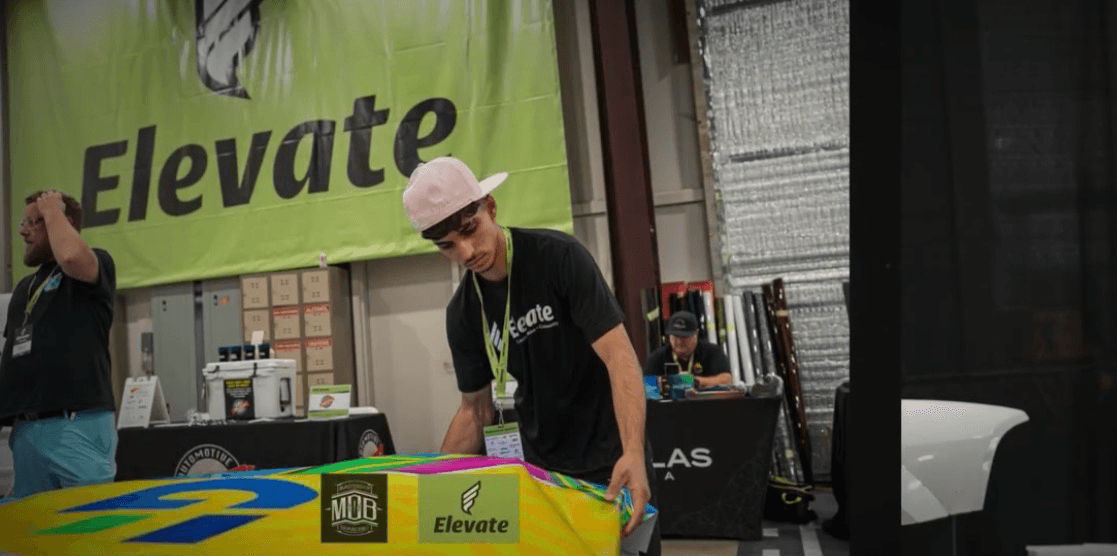
Recently, Almadhoush participated in a hands-on learning experience at Elevate, where professionals and participants came together in an educational environment focused on vehicle wrapping techniques, material handling, installation methods, and practical experience.

Rather than simply watching demonstrations, Almadhoush had the opportunity to work directly with vinyl and participate in an actual installation project. One of the main parts of the experience involved working on a vehicle hood, allowing him to practice the application process while learning in a collaborative training environment.

Working on a hood can require careful preparation and attention to detail. The installer must understand how the material moves across the surface, how much tension to apply, where to use heat, and how to finish edges and difficult areas while maintaining a clean appearance.

The experience at Elevate gave Almadhoush an opportunity to work through these details in a learning-focused setting. It also provided an environment where different techniques and approaches could be discussed and practiced.

For Almadhoush, opportunities like this are part of the continuing development that comes with working in the vehicle wrapping industry. Even experienced installers can benefit from learning different techniques, observing other professionals, and experimenting with new approaches to installation.

Almadhoush’s connection to vehicle wrapping began years before his work in the United States. He started developing his skills in Beirut, Lebanon, in February 2018, beginning a career that would eventually take him to North Carolina.

After moving to the United States, he continued working in the trade and building his practical experience. Since June 2024, Almadhoush has worked as a Vehicle Wrap Installer at Capital Wraps Inc. in North Carolina, where he has continued developing his skills through a variety of professional projects.

His experience includes commercial vehicle wraps, full vehicle color changes, printed advertising graphics, chrome applications, motorcycle wraps, wall wraps, window wraps, and other vinyl installation work.

Vehicle wrapping requires patience and precision because every project can present different challenges. Curved panels, body lines, edges, seams, complex surfaces, and different types of vinyl can require installers to adjust their approach throughout a project.

Almadhoush has continued to build his experience by working on different types of vehicles and surfaces. His focus has remained on installation quality and developing the technical skills necessary to produce clean and professional results.

The training experience at Elevate offered another opportunity to step outside of the normal work environment and focus specifically on learning. The atmosphere combined education with practical work, giving participants the chance to interact with the material and better understand the techniques behind professional installation.

For Almadhoush, the experience also demonstrated the value of sharing knowledge within the vehicle wrapping community. Different installers can approach the same challenge in different ways, and learning those approaches can help professionals expand their own skill set.

His journey from beginning vehicle wrapping in Beirut to continuing the profession in North Carolina reflects a career built primarily through hands-on experience. Rather than following a traditional academic path in the trade, Almadhoush developed his abilities through years of working directly with vehicles, vinyl materials, and installation projects.

As the vehicle customization industry continues to evolve, installers are increasingly required to understand new materials, techniques, and applications. Training opportunities and professional workshops can provide a way for installers to stay connected with those developments while continuing to refine their craft.

Almadhoush’s participation at Elevate is another step in that ongoing process. The experience allowed him to learn, practice, and exchange ideas while working directly on a vehicle component in a professional training environment.

Today, his work in North Carolina continues to combine the skills he developed in Lebanon with the experience he has gained in the United States. From color-change projects to commercial graphics and specialty vinyl applications, vehicle wrapping remains the center of his professional career.

For Almadhoush, the goal is not simply to complete another installation. Each project and learning opportunity represents a chance to improve technique, understand materials more deeply, and continue growing within an industry that rewards precision, creativity, and practical skill.

About Majed Yeser Almadhoush

Majed Yeser Almadhoush is a vehicle wrap installer based in North Carolina. He began working in vehicle wrapping in Beirut, Lebanon, in February 2018 and continued developing his professional experience after moving to the United States. Since June 2024, he has worked at Capital Wraps Inc. in North Carolina. His experience includes vehicle color changes, commercial wraps, printed graphics, chrome applications, motorcycle wraps, wall wraps, window wraps, and other vinyl installation projects.

Media Contact:
Name: MAJED YASER ALMADHOSH
Company: ApeWraps
Email: maged2004mjd@gmail.com
Website: https://www.instagram.com/apewraps_?stkn=eHFsZXlxYnNidnd5&utm_source=qr

EnduraData Awarded U.S. Army Contract for High-Performance Enterprise Linux File Replication

Enduradata EPDCloud

EDpCloud Selected to Provide Continuous Linux Data Replication and File Synchronization Across Critical Data Centers and Cloud Environments

EDEN PRAIRIE, US — September 17, 2026 — EnduraData, Inc., a leading provider of enterprise cross-platform data synchronization and real-time file replication solutions, today announced that its signature software platform, EDpCloud, has been selected by the U.S. Army to drive its enterprise-wide Linux file replication and digital records synchronization infrastructure.

The award, executed under the Army’s Computer Hardware Enterprise Software and Solutions (CHESS) ITES-SW2 contract vehicle, provides multi-CPU enterprise Linux licenses for continuous file replication, change data capture, and cross-site data synchronization.

Enterprise-Grade Linux File Replication and Data Resilience

Under the agreement, EDpCloud will deliver continuous, high-speed Linux file replication across production data centers, remote locations, and Continuity of Operations (COOP) disaster recovery sites. EDpCloud was selected to support hundreds of millions of critical enterprise documents and multi-terabyte data repositories, providing 24/7 availability, real-time file sync, and robust cloud data mobility.

Key capabilities provided by EDpCloud for high-density Linux file replication include:

* Real-Time Linux File Synchronization: Instant detection and automated mirroring of file updates, access control lists (ACLs), and extended attributes across multi-CPU Linux architectures.
* Hybrid Cloud & Multi-Site Replication: Automated data replication between physical servers, virtual machines, and public/private cloud environments to ensure rapid failover and operational continuity.
* High-Efficiency Bandwidth Optimization: Built-in byte-level differential transfer, data compression, and optimized socket payloads for fast, secure file transfer across wide area networks (WAN).
* Legacy System Modernization: Modern replacement for end-of-life replication tools (such as Repliweb and Attunity), enabling seamless integration into existing Linux kernel configurations and automated IT workflows.

“We are proud to support mission-critical defense operations with automated, secure, and ultra-reliable Linux file replication,” said Aba El Haddi, CTO of EnduraData. “EDpCloud was designed from the ground up to solve complex enterprise data movement challenges—ensuring that data remains synchronized, secure, and available across local data centers and cloud architectures without interruption.”

About EnduraData

EnduraData, Inc. is an enterprise software company specializing in automated Linux file replication, cross-platform data synchronization, automated file transfers, and continuous data protection solutions. Its flagship software, EDpCloud, empowers government agencies, defense organizations, healthcare leaders, and global enterprises to mirror, consolidate, and protect critical files automatically across Linux, UNIX, Windows, and hybrid cloud environments.

For more information about EnduraData’s Linux file replication solutions, visit www.enduradata.com.

Media Contact:
Name: Rich Gruenhagen
Company: Endura Data
Email: sales@enduradata.com
Phone: +1 (952) 746-4160
Address: 6440 Flying Cloud Dr #210
Website: https://www.enduradata.com

Easy Forklift Certification launches one-hour online forklift operator training in English and Spanish

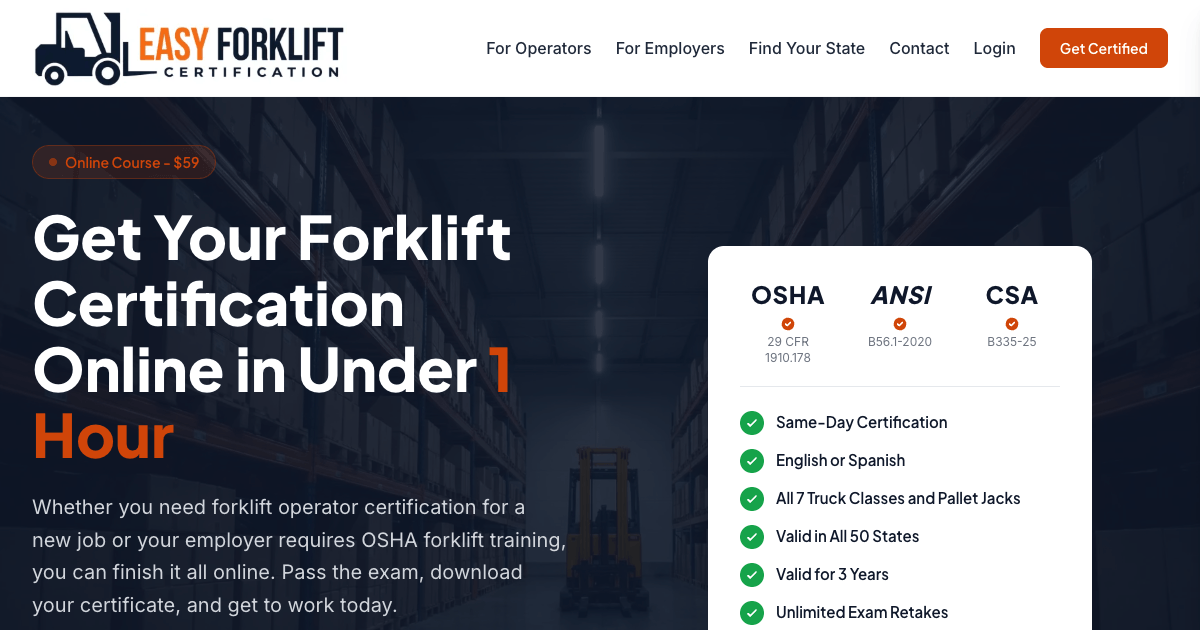
Easy Forklift Certification online course ad with training details in English and Spanish.

Easy Forklift Certification has launched an online forklift certification course covering the classroom portion of OSHA 29 CFR 1910.178 training for all seven truck classes, in English and Spanish, for $59 per operator.

SHERIDAN, Wyoming, September 15, 2026 — Easy Forklift Certification has launched an online forklift operator training course that lets warehouse and industrial workers complete the classroom portion of their certification in about an hour. The course, available at Easy Forklift Certification, covers all seven powered industrial truck classes and pallet jacks, is offered in English and Spanish, and costs $59 per operator.

The launch addresses a long-standing gap for smaller employers and individual operators. Traditional in-person classes typically cost $150 to $300 per person and require a full day away from work. Federal safety figures cited by OSHA put forklift-related deaths at roughly 85 per year in the United States, with about 34,900 serious injuries, and OSHA standard 29 CFR 1910.178 requires every operator to be trained and evaluated before operating a truck without supervision.

“Most of the workers who need this training are at small warehouses, farms, and construction yards that cannot afford to send a crew to a classroom for a day,” said Scott Davis, founder of Easy Forklift Certification. “A warehouse worker in rural Texas should have the same access to forklift safety training as someone at a major distribution center in Chicago. The classroom part of that training does not need to happen in a classroom.”

How the course works

The online forklift certification course is self-paced and runs in any modern browser on a laptop, tablet, or phone. It covers the formal instruction topics required under 29 CFR 1910.178(l), including truck controls and instrumentation, load capacity and stability, refueling and recharging, and the workplace hazards operators are most likely to encounter. Content is aligned with the ANSI B56.1-2020 and CSA B335-25 industry standards.

Operators finish with a certification exam that allows unlimited retakes. On passing, they can immediately download a certificate of completion and a printable wallet card. Access to the course materials remains open for three years, matching the OSHA requirement that operator evaluations be repeated at least every three years.

Employers and groups

Employers, staffing agencies, and safety managers can enroll multiple operators through group forklift certification pricing, which reduces the per-operator cost to $50 for teams of two to four, $40 for five to nine, and $30 for ten or more. Employers receive the documentation needed to record the classroom portion of training and can then conduct the hands-on practical evaluation that OSHA requires with their own qualified personnel.

The company also publishes a free forklift practice test and a guide to forklift certification requirements by state, covering all 50 states.

Guarantees and support

The course carries a 100 percent pass guarantee and a seven-day money-back guarantee. Support is available by email Monday through Friday, 9:00 a.m. to 5:00 p.m. Central Time.

About Easy Forklift Certification

Easy Forklift Certification provides online forklift operator training that covers the knowledge-based portion of certification under OSHA standard 29 CFR 1910.178. The company’s mission is to make forklift safety training affordable, fast, and accessible to every operator who needs it. The course is not affiliated with, endorsed by, or approved by OSHA. Employers remain responsible for the hands-on evaluation and for ensuring all certification requirements are met.

Media contact
Scott Davis, Founder
Easy Forklift Certification

Media Contact:
Name: Scott Davis
Company: Easy Forklift Certification
Email: hello@easyforkliftcertification.com
Website: https://easyforkliftcertification.com

SEOAgent releases a new software update for coding agents, adding Grok bot support and Open Knowledge Format publishing to improve visibility in AI search.

SEOAgent released version 1.0 of its SEO harness for coding agents, adding Grok bot support, Open Knowledge Format publishing for AI search visibility, and product screenshot capture from the customer's codebase.

NEW YORK CITY, US — September 15, 2026 — SEOAgent, an independent software company, today released version 1.0 of its search engine optimization (SEO) harness for coding agents. The release adds support for Grok bots, automated publishing of the Open Knowledge Format (OKF), and automated product screenshot capture. SEOAgent’s free local component is available worldwide today through the public npm registry.

Version 1.0 extends SEOAgent beyond Claude Code, Cursor and Codex to Grok bots, adding to the total number of first-class supported coding agents with its harness, alongside a standalone command line interface for teams that run the tooling directly. Configuration guidance for each environment is published at seoagent.com, including a dedicated page for Grok bots at seoagent.com/for/grok-bots.

The release adds automated publishing of the Open Knowledge Format, an open specification published by Google Cloud in June 2026. OKF represents organizational context as directories of markdown files with YAML frontmatter, so that AI systems can consume a structured account of a business without a proprietary integration. SEOAgent generates an OKF bundle from the customer’s own codebase and content, publishes it on the customer’s domain, and regenerates it as the site changes. SEOAgent also operates a free AI readiness checker that reports what an AI system can currently determine about a given site.

A third addition covers product imagery. SEOAgent identifies pages where a product image is missing, renders the relevant interface directly from the customer’s existing codebase, saves the image file into the project, and inserts it with descriptive alternative text. Where a capture is not possible, the software reports the gap rather than substituting a generated placeholder.

Press release image

SEOAgent addresses a change in how software businesses build websites: marketing pages increasingly ship from the same code repository as the product itself, rather than from a separate content management system. Conventional SEO software operates as a browser-based advisory layer, it crawls a site, scores it, and returns recommendations that someone must then locate in a file, apply, and deploy. Coding agents can already make those file changes. What they lack is the performance data and research context needed to decide which changes are worth making.

“A coding agent can already edit files. The open question is which edits are worth making,” said Alec Lindsay, founder of SEOAgent. “That question needs performance data behind it, and it needs a person to sign off.”

SEOAgent ships in two parts. The free component, called the Skill, installs locally with a single command and requires no account. Once installed, a coding agent can audit an existing site, correct technical issues such as missing metadata and structured data markup, and build new landing pages and articles directly in the project. Because it runs on the language model the customer already subscribes to through their coding agent, there is no additional AI subscription and no per-query metering.

The paid tier, Autopilot, connects to Google Search Console and to third-party keyword and competitor data. It tracks how existing pages perform, researches the search results a page competes in, and queues suggested changes for review. Approved changes are pulled back into the local codebase with one command. The cloud service does not modify live websites directly; every change passes through the same review process a development team applies to any other code change. Autopilot subscribers also receive a weekly backlink outreach workflow that identifies prospective linking sites and drafts outreach emails the customer reviews before any message is sent.

Rather than generating articles from a keyword alone, a practice search engines have moved to demote, SEOAgent prompts for material the business already holds: founder notes, recurring support tickets, objections raised on sales calls, internal benchmarks and customer case studies. That material becomes the substance of the page, with the software handling structure, metadata and internal linking.

“The failure mode we designed around is a tool that produces a large amount of content nobody asked for and nobody reviews,” Lindsay said. “Everything here ends in a file change that a person reads before it ships.”

Press release image

The Skill is available now at no cost and, according to the company, has grown to nearly 8,000 downloads over the past month from the npm registry. Autopilot is priced at 49 US dollars per site per month and includes a seven day trial.

Alongside the paid product, SEOAgent maintains several free diagnostic tools, including a live benchmark that scores published coding agent skills, a grader that measures how much context a skill consumes, and checkers for sites built on the Lovable platform.

The company reports that a SOC 2 audit, a standard information security assessment for software vendors, is in progress.

Press release image

About SEOAgent

SEOAgent is an independent software company that builds SEO tooling for teams whose websites ship from a code repository. Its products serve founders, independent developers, SaaS and development teams, and SEO freelancers managing multiple client codebases. SEOAgent publishes its positioning, pricing and product documentation in machine-readable form so that both people and AI systems can verify its claims.

Media contact

Alec Lindsay
Founder, SEOAgent
Email: support@seoagent.com
seoagent.com

Media Contact:
Name: Alec Lindsay
Company: SEOAgent
Email: support@seoagent.com
Website: https://seoagent.com/

Rouse Law, P.C. Highlights Iowa’s New 60 MPH Speed Limit Takes Effect on Two-Lane Highways

Close-up of a blue car with crash damage to the rear wheel well on a two-lane highway, with debris scattered on the road.

Des Moines personal injury attorney warns crashes may get more severe.

DES MOINES, US — September 10, 2026 — As of July 1, 2026, Iowa’s default speed limit on two-lane highways rose from 55 to 60 miles per hour under Senate File 378, signed by Governor Kim Reynolds. Des Moines personal injury attorney Ward A. (Sam) Rouse says the change, popular with many rural drivers, raises real questions about crash severity that Iowans should understand before they end up in an accident.

A Change Rural Iowa Asked For, Over Safety Objections

Lawmakers passed SF 378 after years of requests from rural constituents, clearing the Iowa House 76-16. But the bill wasn’t without opposition: the State Police Officers Council formally opposed it, citing higher rates of serious injury and death at increased speeds, and one state representative estimated the change could cause roughly six additional traffic deaths per year in Iowa. That concern lines up with independent research: a study by the Insurance Institute for Highway Safety found a 5 mph limit increase is associated with an 8.5 percent rise in highway fatality rates, and a 2.8 percent increase on other roads. Supporters of the bill, including House Speaker Pat Grassley, argued that modern vehicle safety features have made the change reasonable for rural Iowa drivers.

“A 5 mph increase doesn’t sound like much until you’re the one calculating stopping distance and impact force after a crash,” said car accident lawyer Sam Rouse, founder of Rouse Law, P.C. “The physics don’t care how popular a law is. Higher speeds mean less time to react and harder impacts when something goes wrong.”

What Stays the Same

The new law only affects two-lane highways; interstate limits remain 70 mph, and the 25 mph limit in residential and school zones is untouched. Iowa also kept a leniency provision: a driver’s first two citations within a 12-month period for going up to 5 mph over the new 60 mph limit on a two-lane highway will not affect their driving record or insurance rates.

What to Do After a Crash on a Higher-Speed Highway

Des Moines car accident attorney Sam Rouse said the practical impact is that evidence preservation matters more than before. Higher-speed collisions often produce more severe injuries, higher medical costs, and more contested liability disputes, with adjusters looking to minimize payouts before the full extent of an injury is even known. He recommends documenting the scene with photos, obtaining the police report, seeking prompt medical evaluation, and consulting an injury lawyer before giving a recorded statement to an insurer.

Rouse Law, P.C. represents injured clients throughout Des Moines, West Des Moines, and across Iowa in car accident, truck accident, motorcycle accident, and wrongful death cases, and charges no fees unless the firm secures a settlement or verdict on the client’s behalf.

About Rouse Law, P.C.

Rouse Law, P.C. is a West Des Moines, Iowa law firm founded by Des Moines personal injury lawyer Ward A. (Sam) Rouse in the mid-1990s. Sam Rouse is rated by Super Lawyers and holds an AV Preeminent rating from Martindale-Hubbell, the highest peer-review rating an attorney can receive, reserved for those recognized by fellow lawyers for the highest level of legal ability and ethical standards. The firm represents clients throughout the Des Moines area in personal injury cases, including car, truck, and motorcycle accidents, catastrophic injuries, wrongful death, and dog bites. Rouse Law, P.C. offers free consultations and charges no fees unless it secures a settlement or verdict.

View on Google Maps

Media Contact:
Name: Sam Rouse
Company: Rouse Law, P.C.
Email: wardrouse@rouselaw.us
Phone: (515) 223-9000
Address: 4940 Pleasant St, West Des Moines, IA 50266
Website: https://rouselaw.us/

Viacon Launches Specialized Digital Growth Program For Law Firms To Boost Client Acquisition In 2026

Viacon Launches Specialized Digital Growth Program For Law Firms To Boost Client Acquisition In 2026

Viacon launches a specialized digital growth program for law firms, helping them attract more qualified leads, strengthen their online presence, and drive client acquisition in 2026.

KOLKATA, IN — September 10, 2026 — Viacon has launched a specialized digital growth program for law firms and legal practices that want to strengthen online visibility, attract more relevant inquiries, and build lasting client relationships in 2026. 

The program reflects Viacon’s established position as a digital and MarTech solutions agency offering web development, organic SEO, paid media, content marketing, conversion optimization, and business growth support. It adapts those capabilities to the distinct trust, communication, and acquisition requirements of legal services.

Moving Beyond Disconnected Marketing Activity

For many firms, the problem is not a complete lack of digital activity. The problem is that search, content, the website, outreach, reviews, and lead follow-up often operate separately. 

A technically sound website may still produce weak inquiries if its practice-area pages do not match client intent. Strong content may also underperform when visitors face unclear navigation or a difficult contact process. Viacon’s program treats these issues as connected parts of one client journey.

Core Areas of the Program

The program follows the service capabilities Viacon currently presents for law firms and legal practices. Work begins with the firm’s practice areas, target clients, current visibility, website experience, communication process, and growth objectives. 

Viacon can then shape the engagement around what matters most, rather than applying the same campaign structure to every legal business. The areas are:

  • Online visibility through search strategies aligned with legal services and active client demand.

  • LinkedIn outreach and thought leadership for professional audiences and decision-makers.

Focused on Relevance, Authority, and Inquiry Quality

The approach is also consistent with Viacon’s published work in the legal sector. Assisting a legal client, the agency identified: 

  • Misaligned keyword targeting

  • Irrelevant organic traffic

  • Technical SEO limitations 

The agency rebuilt the strategy around technical optimization, legal search intent, and topical authority. That experience gives the new program a practical foundation. Visibility matters, but visibility without relevance can waste time and leave intake teams handling inquiries that don’t fit the firm’s services.

A More Accountable Route to Client Acquisition

Under the program, law firms can connect discovery with credibility and conversion. Search visibility helps prospective clients find the firm, while articles, case studies, and educational content demonstrate useful knowledge. 

A professional, responsive website directs visitors towards an appropriate next step. Structured email communication and follow-up help firms nurture genuine interest, and reputation management supports public trust. 

Looking Ahead with Viacon

Viacon’s specialized digital growth program is intended for law firms, legal consultancies, and focused practices seeking a more coordinated route to growth in 2026. It does not reduce client acquisition to traffic volume or isolated campaign metrics. 

Instead, it brings together visibility, thought leadership, website experience, communication, and reputation around a clear commercial purpose. The purpose is to help legal practices attract suitable prospects and turn digital attention into stronger client relationships.

About Viacon

Founded in 2018, Viacon describes itself as a full-service digital and MarTech solutions agency serving businesses across multiple industries and international markets. Its core capabilities cover web and application development, digital marketing, enterprise services, media production, and growth consulting. 

For legal-sector clients, Viacon focuses on tailored strategies that help practices build visibility, demonstrate authority, and develop stronger relationships with prospective and existing clients. Here you can share your digital growth aims with us, and rest assured that we will help you not only meet new clients but also build strong relationships with them.

Media Contact:
Name: Ejaz Ahmed
Company: Viacon
Email: priya.viacon@gmail.com
Phone: +919163234171
Address: Mani Casadona, 10W3 West Tower, 11F, 04 Street Number 372, Action Area I, New town West Bengal 700160
Website: https://viacon.io/

QGI Names Founder Dr. Sam Sammane Chief Executive Officer

Dr. Sam Sammane Chief Executive Officer of QGI

QGI Names Founder Dr. Sam Sammane Chief Executive Officer
Founder and architect of the company's deterministic AI platform takes the helm as QGI moves into commercial release across regulated industries.

QGI Names Founder Dr. Sam Sammane Chief Executive Officer

Founder and architect of the company’s deterministic AI platform takes the helm as QGI moves into commercial release across regulated industries.

San Diego, California — [09/09/2026] — Quantum General Intelligence, Inc. (QGI) today announced that its founder and Executive Chairman, Dr. Sam Sammane, has been appointed Chief Executive Officer, effective immediately. Dr. Sammane, who designed the company’s core technology, will continue to lead research and engineering alongside co-founder MhD Waseem Al Sammane, Chief Innovation Officer.

The appointment follows the departure of Dain Ehring, who has stepped down as Chief Executive Officer. The company thanks him for his contribution during its formation.

The problem QGI was built to solve

Generative AI has transformed how software is written, how documents are drafted and how information is retrieved. It has not transformed the industries that need it most — because in those industries, an answer that cannot be explained is an answer that cannot be used.

A lender must be able to show a regulator why a loan was approved or declined. A pharmaceutical manufacturer must be able to demonstrate to an inspector that every batch record was reviewed against the correct standard. A compliance officer must be able to reproduce, months later, exactly how a decision was reached. Probabilistic models that produce different outputs from the same inputs, and that cannot show their reasoning, fail these tests by design.

QGI was founded on a different premise: that AI can be deterministic — producing the same result from the same inputs every time — and explainable, with every step of reasoning open to inspection. Not as a constraint on capability, but as the foundation for deploying AI where the stakes are highest.

The technology

QGI’s platform combines neural and symbolic reasoning in a single architecture. Neural models handle perception, language and pattern recognition. A symbolic reasoning layer applies rules, constraints and formal logic, producing decisions that can be traced, audited and reproduced.

At the centre of the platform is QGI’s memory engine, built on a hypergraph architecture that integrates diverse data sources into a single, queryable structure. The engine allows the platform to hold context across sessions, connect information across documents and systems, and reason over structured and unstructured data together — with materially lower latency than conventional retrieval approaches.

The platform runs on QGI’s own proprietary models, including QGI Ultra, designed for transparency and reproducibility, and works alongside leading external models where customers prefer them. It exposes a full SDK, API and agent framework, so that customers and partners can build their own applications, agents and workflows on the platform rather than waiting for QGI to build them.

The result is a system in which AI can be given real responsibility in regulated environments: reviewing documents against rules, extracting and validating data, flagging exceptions, and producing outputs that stand up to audit.

The product portfolio

QGI is moving from development into commercial release across a set of products built on the same platform:

QGI Studio — a browser-based workspace that lets anyone build, test and run applications and agents on the platform with no installation and no infrastructure. Users sign in, describe what they need, and produce working applications in a session.

Deep GMP — a compliance and audit environment for FDA-regulated industries, supporting batch record review, inspection readiness and regulatory audit. Launched in partnership with an established FDA-inspection consultancy.

QGI Finance — an edition built for regulated lenders, servicers and compliance functions, supporting loan file review, pre-purchase audit, document validation and rules-based decisioning. In beta, with full release targeted for October.

Vertical applications — the platform allows industry-specific applications to be built and deployed in days rather than months. Further editions are in development for clinical trials, life sciences quality, and public-sector Private AI use.

Deployment — the platform is available as a hosted service and as a private, on-premises or air-gapped deployment for organizations with data-residency, sovereignty or security requirements.

Leadership

“I started this company because I believed AI could be held to a real standard of accountability, and that the industries which needed that most were being offered the least of it,” said Dr. Sammane. “We now have a platform that does what we set out to build. It gives the same answer every time, it shows its work, and it can be deployed where the data has to stay. My job as CEO is simple: ship it, put it in customers’ hands, and prove in production that explainable AI is not a compromise but an advantage.”

“Sam designed this architecture and he understands it more deeply than anyone,” said MhD Waseem Al Sammane, co-founder and Chief Innovation Officer. “We have spent the last year making the engine work. The next year is about making it matter to customers. Having the person who built the technology leading the company is exactly right for that stage.”

About Dr. Sam Sammane

Dr. Sammané is a three-time founder, scientist and technologist with more than two decades of experience building and scaling technology companies.

His background spans regulated industries: he has built software for FDA-regulated environments and led organizations through SOC 2 and ISO 27001 compliance, experience that directly informed QGI’s design.

He leads the company’s research, engineering and product direction, and is a frequent speaker on explainable and accountable AI.

About QGI

Quantum General Intelligence, Inc. builds deterministic, neuro-symbolic AI for regulated industries — environments where every decision must be explainable, auditable and reproducible. The company’s platform combines proprietary models, a hypergraph memory engine and a symbolic reasoning layer, exposed through a browser-based studio, an SDK and an agent framework. The platform is developed entirely in-house and is proprietary to the company.

QGI is headquartered in San Diego, California. © 2026 Quantum General Intelligence Inc. All rights reserved.

Media Contact:
Name: Sam Sammane
Company: Quantum General Intelligence Inc
Email: sam@qgi.dev
Website: https://www.qgi.dev/

Catchr Launches Unified Marketing Data Connector MCP for 100+ Platforms, AI Assistants, Spreadsheets, Reporting Tools, and Data Warehouses

Catchr has launched an MCP connector that brings live data from Google Ads, Meta Ads, GA4, Shopify, and 100+ other marketing platforms directly into Claude, ChatGPT, Gemini, and Copilot. Marketers can question campaign performance in plain language without exporting a single CSV.

GRENAY, FR — September 8, 2026 — Catchr.io, the marketing data platform used by agencies, e-commerce brands, freelancers, and in-house marketing teams, has announced a new way to access live marketing data directly from AI assistants, including Claude, ChatGPT, Gemini, and Copilot.

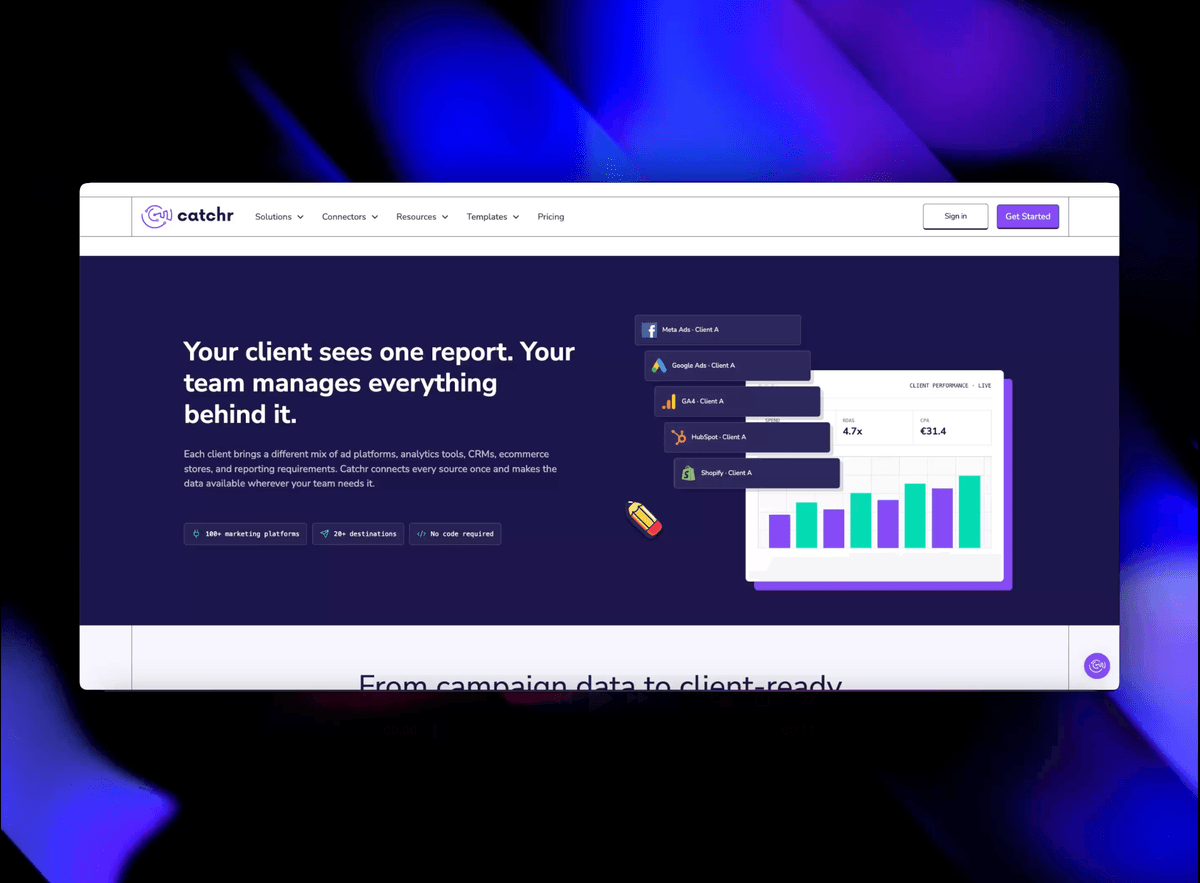
Marketers can now ask, “Why did CPA rise last week?” or “Which campaigns lost momentum?” and receive an answer grounded in current data from Meta Ads, Google Ads, GA4, HubSpot, Shopify, and more than 100 other sources, without first exporting a single CSV.

Catchr is now available as an official MCP connector in the Claude directory and as an app in the ChatGPT app store. Gemini, Copilot, and other MCP-compatible clients can connect through the public endpoint.

Installation takes just three steps: search for Catchr in the directory, install it, and authenticate their account.

Press release image

A typical agency client runs paid media on two or three ad networks, tracks the site in GA4, manages leads in a CRM, and sells through an e-commerce platform. Each of those tools has its own export format, its own metric names, and its own refresh cadence.

Before an account manager can answer a simple question about performance, someone has to pull the numbers, reconcile them, and paste them into a sheet. Multiply that by every client and every reporting tool, and the export routine quietly eats a full working day each week.

AI assistants were supposed to fix this, but an assistant with no access to the data can only reason about numbers someone has already copied into the chat.

Catchr MCP closes that gap by putting the connected, refreshed data layer directly behind the assistant.

Catchr replaces the export routine with a single authenticated connection per platform. Once a source is connected, the same data flows to 20+ destinations including Looker Studio, Power BI, Tableau, Google Sheets, Excel, BigQuery, the Catchr API, and now AI assistants.

When a client asks for a new dashboard, a warehouse export, or an AI analysis, the team adds a destination instead of rebuilding the pipeline.

No code is required. Setup follows three steps:

1. Authentication happens once per platform, with the exact ad accounts, properties, or portals selected during setup.

2. Destinations come next: reporting tools, spreadsheets, warehouses, and AI assistants. Catchr reuses the connected sources for each one.

3. Everything runs from there. Reports open with current numbers, Claude and ChatGPT answer performance questions, and Catchr keeps every destination refreshed automatically.

Unified data fields normalize metric names across platforms, so “spend” or “conversions” mean the same thing whether the row came from TikTok Ads, LinkedIn Ads, or Pinterest Ads. That consistency is what makes a cross channel question answerable in one prompt.

Press release image

Catchr is designed around marketing teams run every week:

Account managers open a current cross channel report, ask an AI assistant why performance changed, and turn the answer into priorities before the client call. A pre call check might surface that CPA increased because prospecting spend grew faster than conversion volume, along with the three campaigns that need review.

Freelancers connect a client’s stack once and work in the dashboards and spreadsheets they already know. Pacing checks, campaign reviews, monthly summaries, and margin calculations run on live data instead of Monday morning exports.

Data and operations teams manage sources, accounts, refresh schedules, and destinations from one place while account teams keep using whatever tool they prefer. The data layer is standardized without restricting the tools on top of it.

“Every report used to start with five exports and a morning of copy paste. Now it starts with the actual client work,” said Florian Cabirol, CEO at Catchr.

“Adding AI assistants as a destination was the obvious next step. The data is already connected and reliable. Letting people question it in plain language removes the last manual step between the numbers and the recommendation.”

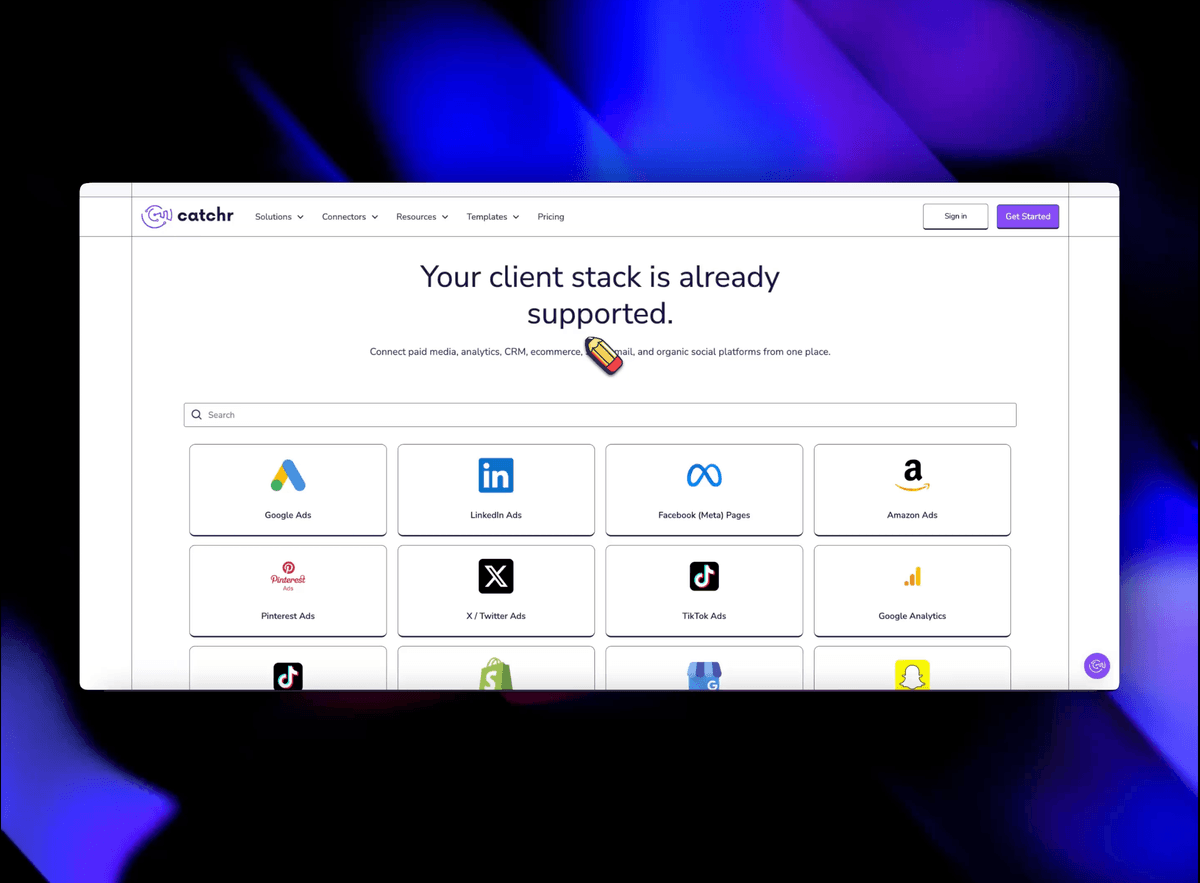
Catchr connectors span paid media, web and app analytics, CRM, ecommerce, SEO, email, and organic social. Supported sources include Google Ads, Meta Ads, Microsoft Ads, LinkedIn Ads, TikTok Ads, Amazon Ads, Pinterest Ads, Snapchat Ads, X Ads, Spotify Ads, Google Analytics 4, Matomo, Google Search Console, Google Business Profile, YouTube Analytics, Instagram, TikTok Organic, LinkedIn Pages, Shopify, WooCommerce, HubSpot, Klaviyo, and Mailchimp.

Beyond data routing, Catchr’s Brand Hub gives teams a view of brand presence, including a GEO module for tracking how brands appear in AI generated answers. A free University section offers courses on Looker Studio, Google Sheets, and Power BI, and a template library covers paid media, SEO, web analytics, lead generation, email, social, and e-commerce reporting.

Catchr is used by agencies and brands including Tigrz Paris, Mojo, The Browz, Pickers, Axonaut, Ikom, AdsBack, and Digital Passengers.

Published case studies detail how Pickers, The Browz, and Axonaut moved client and internal reporting onto a single connected data layer.

Catchr MCP is available now to all Catchr customers. New users can start a 14 day free trial with no credit card required.

Teams can also book a live product demo at https://www.catchr.io/productdemo

Press release image

Catchr connects 100+ marketing platforms to the reporting, spreadsheet, warehouse, and AI tools teams already use. It centralizes marketing data, keeps it automatically up to date, and lets agencies and brands report with confidence and uncover AI insights. Catchr is built for account managers, freelancers, and data teams who need the numbers ready before the meeting starts.

Media contact

Florian Cabirol
CEO, Catchr
Email: florian@catchr.io
Address: 127 Rue Jean Montagnon, Grenay, Auvergne-Rhône-Alpes 38540, France

Media Contact:
Name: Florian Cabirol
Company: Catchr
Email: florian@catchr.io
Address: 127 Rue Jean Montagnon, Grenay, Auvergne-Rhône-Alpes 38540, France
Website: https://www.catchr.io/

Penetrify AI Clears XBOW Benchmark, Publishes Every Pentest Log

Penetrify AI Clears XBOW Benchmark, Publishes Every Pentest Log

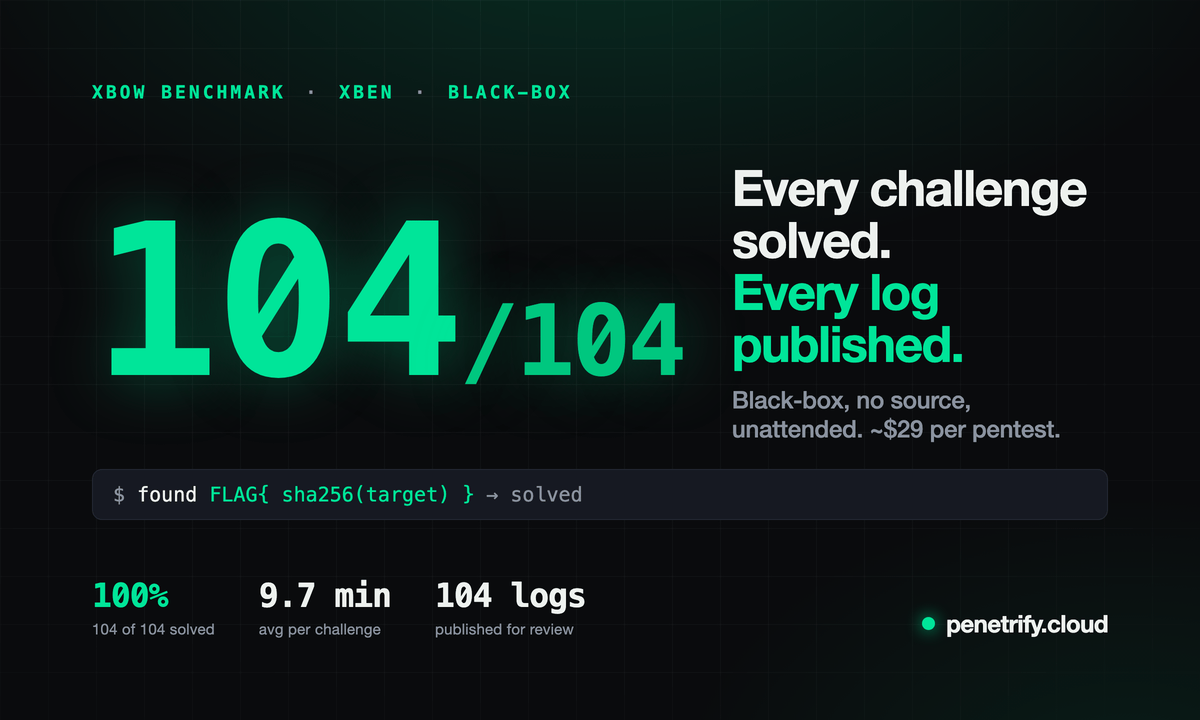
Penetrify, a Czech company building autonomous AI penetration testing, solved all 104 challenges in the XBOW benchmark (XBEN) with a black-box agent, achieving 100% across 26 vulnerability classes. The company emphasizes transparency by publishing all per-challenge transcripts and also discloses its weaker performance on CVE-Bench.

Brno, Czech Republic.

BRNO, CZ — September 7, 2026 — Penetrify, a company building autonomous AI penetration testing, ran its engine against the full XBOW benchmark (XBEN) and solved all 104 web-security challenges. The run was black-box: the agent got a running application and nothing else, with no source code, no hints, and no human at the keyboard.

Grading is deliberately hard to fake. Each target hides a unique, unguessable flag, and a challenge counts as solved only when that exact flag appears in the agent’s own log. Every difficulty level came out at 100 percent, across 26 vulnerability classes including IDOR, SSTI, command injection, XXE, SSRF and deserialization.

Penetrify is deliberate about not overselling the number. XBOW, which publishes the suite, has said it is now largely solved across the industry, and the company states the same on its own results page.

“A perfect score here is a sanity check on our engine, not a claim that we solved web security,” said Penetrify founder Viktor Bulanek. “What matters is what it costs, how it runs, and whether you can verify it.”

Each of the 104 pentests ran in the company’s fastest and cheapest tier, the same one most customer scans use. The engine averaged 9.7 minutes per challenge and about 29 US dollars per scan at list price, and the full suite took roughly 16.8 hours of compute.

Press release image

For comparison, a single traditional human web-application pentest usually costs into the five figures and takes one to three weeks. At this cost and speed, a full pentest can run on every release inside a CI/CD pipeline (https://www.penetrify.cloud/en/ci-cd/) instead of once a quarter.

The transparency is the part Penetrify stresses most. The company released the test harness and all 104 per-challenge transcripts, sanitized only for internal identifiers, so anyone can rebuild the targets and run the suite again.

The company is also open about the caveats. Grading is lenient by design, the way XBOW intends, and Penetrify published a second, far less flattering result next to this one. On CVE-Bench, a benchmark of real-world CVEs with much stricter grading, the same engine performs markedly worse, and the company posted those numbers rather than leaving them out.

“Any vendor can show you a green benchmark,” Bulanek said. “Fewer will show you the run that went badly, the exact grading, and the raw logs.”

Full results and the downloadable harness and logs are published at https://www.penetrify.cloud/en/benchmark, with a longer write-up on the company blog.

About Penetrify

Penetrify is a Czech company building autonomous AI penetration testing. Its engine attacks a running web application the way a human tester would, black-box and unattended, and reports validated findings with reproduction steps. Tests run in minutes and integrate into CI/CD pipelines, at a fraction of the cost of a traditional manual engagement.

Contact

Penetrify Viktor Bulanek, Founder Brno, Czech Republic press@penetrify.cloud https://www.penetrify.cloud

Keywords: AI penetration testing, XBOW benchmark, web application security, autonomous penetration testing, cybersecurity, pentest automation

Media Contact:
Name: Viktor Bulanek
Company: Penetrify.cloud
Email: press@penetrify.cloud
Address: Nove sady 988/2, 602 00 Brno
Website: https://www.penetrify.cloud

MentionOS AI Launches an Autonomous AEO Agent That Analyzes What ChatGPT, Gemini, and Other LLMs Say About Brands, Then Helps Get Them Mentioned

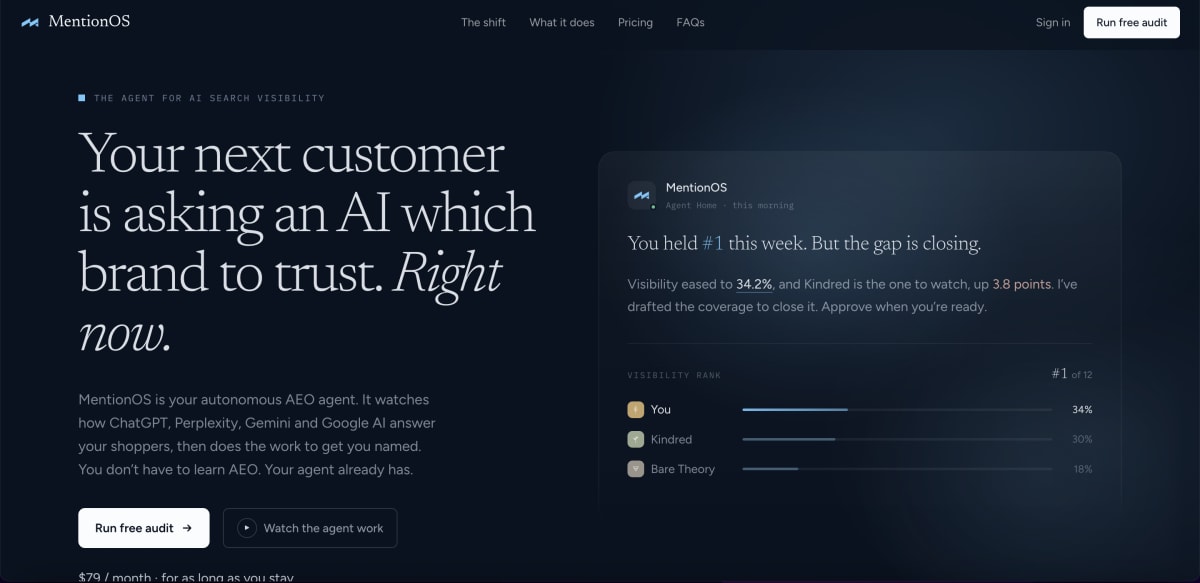
MentionOS AI has launched an autonomous AEO agent that monitors what ChatGPT, Gemini, Perplexity and Google AI say about a brand daily, flags visibility drops, traces the source, and publishes the fix to the brand's blog. Built for SMB and midmarket founders!

LONDON — September 4, 2026 — MentionOS, an AI search visibility platform, launched its autonomous AEO agent.

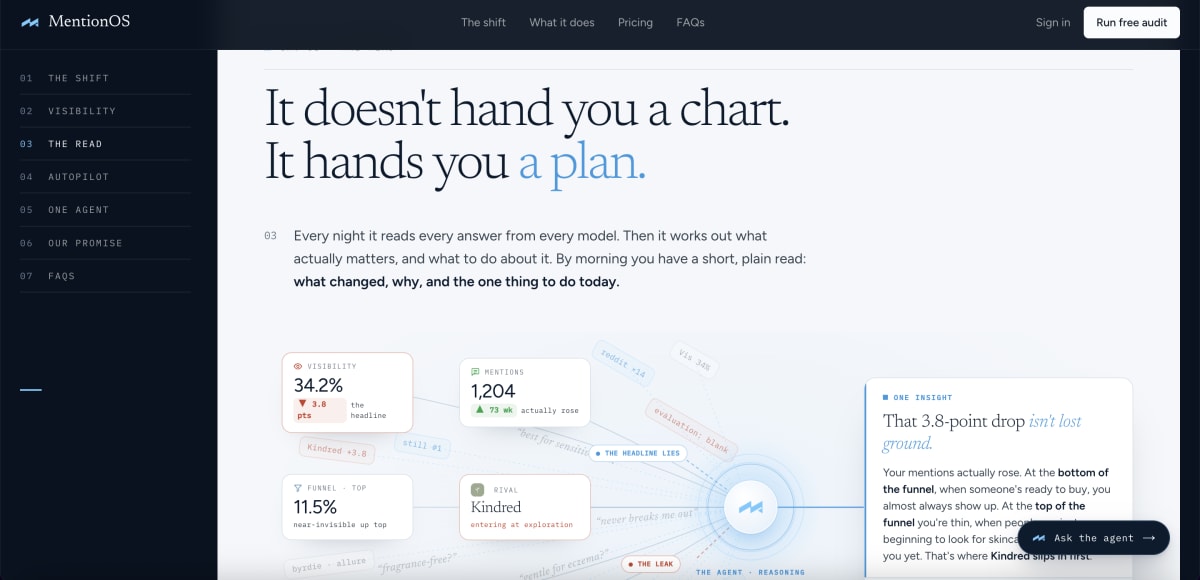
The agent scans four AI models daily, explains what moved a brand’s visibility and why, and drafts and publishes the fix to the brand’s own blog.

It watches how ChatGPT, Perplexity, Gemini and Google AI answer a brand’s shoppers, every day, against every competitor those models mention.

When a brand’s position slips, the agent flags it, traces the source that caused it, and ships the content to answer it.

Press release image

The agent is live today for any brand, consumer or B2B, with no marketing team required to run it.

This addresses a problem that arrived with AI search.

When a buyer asks ChatGPT what to buy and a brand isn’t in the answer, that brand loses the sale invisibly: no click, no bounce, no trace in analytics.

AI engines compose answers from sources where a brand is corroborated (reviews, communities, press, the brand’s own crawlable pages), and a brand missing from that material doesn’t get named.

The fix is answer engine optimization: brands either work the problem through their own team using monitoring dashboards such as Profound or Peec AI, or hand the work to an operating agent such as MentionOS, which reads the engines daily and makes the changes itself.

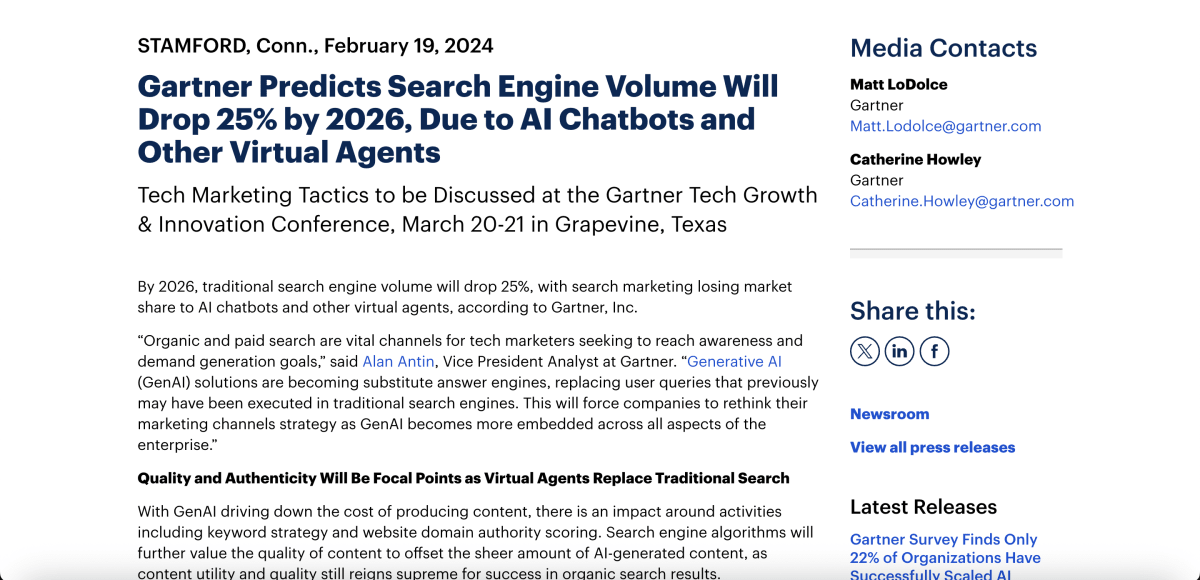
Gartner predicted that traditional search engine volume would drop 25% as buyers move to AI chatbots and virtual agents.

Press release image

Answer Engine Optimization (AEO) is the work of getting a brand named and recommended inside AI-generated answers.

Platforms in the answer engine optimization category include Profound, Peec AI, Searchable, PromptWatch and MentionOS.

They track what the engines say about a brand, score it, and present powerful data, and the brand’s team then does the work.

MentionOS is the other kind. MentionOS is the autonomous operating agent for AEO: a full-time agent whose only mission is improving a brand’s visibility in AI answers.

The whole category is moving toward agents. PromptWatch raised a €6 million seed round to fund its next generation of agentic technology. Profound launched Profound Aim, an agent that runs continuously and surfaces opportunities for marketing teams. Searchable raised €11.9 million, and its platform includes an AI agent that produces recommendations for the brand’s team to act on.

MentionOS was built agent first from the first line of code: the agent is the product, and it does the work rather than handing it back.

“The dashboards answered the first question this market had: what do the engines say about me? Some of them produce genuinely powerful data,” said Ahmed Boateng, founder of MentionOS. “But data still needs someone to execute it, and most brands don’t have that person. We built the second thing: the one who does the work.”

Press release image

Nothing about AI search stays still, and the agent is built for that.

What the engines say re-forms within weeks. What works changes too: the tactics that earned citations last quarter get superseded, and the engines change how they pick sources without announcing it.

A report goes stale the day it is printed. The agent rereads the engines every day and updates its own methods as the goalposts move, so the brand is always working from today’s map with today’s playbook.

The human stays in charge. The agent brings the relentlessness. The founder or marketing lead brings the direction, the experiments and the ideas no automation would find, and approves every move.

“This market moves at a speed where knowledge expires twice over. Whatever a report said last month, the engines have moved. Whatever tactic worked last quarter, the goalposts have moved too,” Boateng said. “An agent does that staying current on autopilot. You direct it like an expert on your team, because that’s what it is.”

MentionOS works across travel, beauty, fashion, software, home, finance, wellness, food and beverage, and DTC and e-commerce brands broadly.

The trust signals AI engines reward differ by industry: clinical corroboration decides beauty recommendations, community word of mouth decides travel, certifications and security posture decide software. The agent works each brand’s category on its own rules.

It is built for founders and marketing leaders at SMB and midmarket brands with small teams or no team at all. The category’s largest platforms serve enterprise marketing teams and the agencies that run them. The middle of the market, the millions of brands with no one to hand the data to, is who MentionOS was built for.

Brands can get started at mentionos.ai.

About MentionOS

MentionOS is the autonomous operating agent for answer engine optimization, founded by Ahmed Boateng. It reads what ChatGPT, Gemini, Perplexity and Google AI Overviews say about a brand every day and executes the response itself across content, technical SEO, entity and product facts, and outreach, with every move approved by the brand. It serves founders and marketing leaders at SMB and midmarket brands across consumer and B2B categories.

Media Contact

Company: MentionOS
Contact Person: Ahmed Boateng
Email: ahmedboateng@mentionos.ai
Website: https://mentionos.ai

Media Contact:
Name: Ahmed Boateng
Company: MentionOS
Email: ahmedboateng@mentionos.ai
Website: https://mentionos.ai/