Taking a loan? How insurance coverage and a loan EMI calculator can help you prepare

Taking a loan can assist you in managing a major expenditure, whether you are purchasing a home, financing education or covering up an unanticipated need. But before you borrow, it is worth looking beyond the amount you want to receive. 

Can you comfortably afford the month-on-month repayments? What happens if an unanticipated expenditure impacts your income? A loan EMI calculator can assist in figuring out your repayments, while reviewing your insurance coverage can help you understand whether you are financially protected.

  1. Understand how much loan you can afford

It is easy to focus on how much a lender is willing to offer. But the more essential question is how much you can repay without putting pressure on your month-on-month budget.

Your affordability depends on your income, prevailing EMIs, household expenditures, savings and other financial commitments. If you are already repaying a car loan or personal loan, adding another EMI could leave you with less money for day-to-day requirements.

A loan EMI calculator assists you in estimating your monthly instalment using three details:

  • Loan amount: How much you plan to borrow.
  • Interest rate: The rate charged by the lender.
  • Loan tenure: How long you will take to repay the loan.

For instance, a ₹5 lakh loan at 12% annual interest for three years would have an estimated monthly EMI of around ₹16,607, assuming a fixed rate and standard monthly reducing-balance calculation.

Try distinct loan amounts and tenures to view what fits your budget. A longer tenure usually lowers your EMI but increases the overall interest paid. A shorter tenure generally means higher month-on-month repayments but potentially lower overall interest.

Do not choose a loan simply because the EMI looks manageable. Account for rent, groceries, utility bills, insurance premiums as well as savings before committing.

  1. Compare loan options using an EMI calculator

Once you have identified a comfortable month-on-month repayment, utilise a loan EMI calculator to compare different borrowing options.

Compare interest rates: Even a minor difference can impact your total repayment. Check rates from different lenders alongside their eligibility requirements and charges.

Check the total interest: A low EMI does not necessarily mean a cheaper loan. Extending the tenure might increase the overall interest you pay.

Account for additional costs: Processing charges, applicable taxes and other charges can increase the borrowing cost. These might not be included in the estimate of the calculator.

Test your budget: If your income varies, check out whether you could manage repayments in the course of a lean month or temporary income loss.

Note that, the calculator provides an estimate and not a loan offer. Your actual EMI depends on the terms and the final loan conditions of the lender. Review these details before making any decision.

  1. Review your insurance coverage before borrowing

You have estimated your EMI and checked whether it fits your budget. Now consider how you would manage your financial commitments if an unanticipated event disrupted your plans.

Reviewing your insurance cover can assist you in understanding if you have suitable protection against certain financial risks.

  • Health insurance: A suitable policy might assist you in covering eligible hospitalisation expenditures, subject to its limits, exclusions and waiting periods.
  • Life insurance: If your family depends on your income, check out if your prevailing cover can support them if you die during the loan tenure. Consider your outstanding debts and family responsibilities.
  • Disability or income protection: Where suitable policies are available, check out whether they could provide financial support if illness or disability impacts your ability to earn.

Your needs will depend on your circumstances. Someone taking a home loan with financial dependants might require reviewing different risks from someone borrowing a smaller amount for a short-term expense.

Do not assume insurance automatically clears your loan if something happens. A policy pays just for covered events under its terms. Ordinary health insurance, for example, generally does not pay your loan EMIs.

  1. Balance EMIs, insurance premiums and everyday expenses

Your month-on-month budget requires to cover more than loan repayments. Insurance premiums, household bills, savings and unanticipated expenditures even matter.

Before taking a loan, follow these steps:

  • Prepare a budget: List essential expenses, prevailing EMIs, insurance premiums as well as regular savings.
  • Build an emergency fund: Aim to save enough to cover several months of essential expenditures, based on your circumstances.
  • Avoid overborrowing: Qualifying for a particular amount does not mean you require borrowing the full sum.
  • Review insurance premiums: Make sure premiums remain affordable as well as you understand when payments are due.
  • Leave some room in your budget: Account for unanticipated costs, such as medical bills or repairs.

If a new EMI leaves little money for savings or essential expenditures, consider borrowing less, comparing a different tenure or postponing the loan.

  1. Read the loan and insurance terms carefully

Before signing the loan agreement, check out the interest rate, tenure, repayment schedule, processing charges and conditions for prepayment or foreclosure. Use a loan EMI calculator to verify your estimated month-on-month instalment and compare repayment options. If the interest rate is floating, understand how a rate change could impact your EMI or loan tenure.

For insurance, review the sum insured, premiums, exclusions, waiting periods and claim requirements. If you are considering loan-linked insurance, ask whether it is optional under the lender’s terms and how the policy functions if you repay the loan early.

Do not rely on verbal explanations. Read the documents and ask questions regarding anything unclear. Also, check if an insurance premium is being added to your loan, as this can increase the amount you owe and the interest you pay.

Keep copies of your loan agreement, repayment schedule and insurance documents for future reference.

Make your loan a planned commitment

A loan can assist you in reaching an important goal. However, the decision should not end once your application is approved. Utilise a loan EMI calculator to estimate repayments, compare loan terms and understand how the EMI fits into your budget. Assess your insurance cover separately to evaluate whether you have suitable protection against financial risks.

Before borrowing, ask yourself: Can I manage such repayments while meeting everyday expenses, saving on a regular basis and protecting the people who depend on me? If you have checked your budget and understood the loan and insurance terms, you will be better prepared to make a confident decision.


Number Artist Reports More Than 450,000 Customers for Paint-by-Number Kits

The company lists more than 1,500 designs and offers custom photo kits with a 30-day satisfaction guarantee

COVINA, United States — October 22, 2026 — Number Artist announced a customer milestone of more than 450,000 purchasers for its paint-by-number kits. The company reports a catalog of more than 1,500 designs, alongside custom photo kits and a 30-day satisfaction guarantee that includes free returns when a kit is not suitable.

The milestone reflects the company’s reported customer total, rather than a count of kits shipped or paintings completed. Number Artist’s product selection includes landscapes, animals and abstract compositions. Its catalog serves both first-time participants and people who have completed multiple numbered canvases, while its custom option turns personal photographs into painting projects.

“Number Artist offers more than 1,500 designs, custom photo kits and a 30-day satisfaction guarantee,” said a company spokesperson. “The selection includes landscapes, animals and abstract pieces, with both ready-made designs and photo-based options.”

The ready-made catalog and custom service represent two distinct approaches within the company’s offering. Customers can select an existing composition or use a personal image as the basis for a numbered canvas. The satisfaction guarantee accompanies those purchasing considerations, including situations in which a kit is intended as a gift. Number Artist reports free returns within the stated 30-day guarantee period.

The announcement comes within a broader adult craft market that includes standard and personalized kits. Background pricing cited from Growth Market Reports places adult kits generally between $15 and $52 and custom photo kits between $40 and $120. Those figures describe category-level ranges rather than Number Artist’s prices and do not establish the cost of any particular kit in its catalog.

The hobby’s history extends back to Detroit in 1949, when Max Klein and commercial artist Dan Robbins developed the numbered-canvas concept. Kits went on sale in 1950, and roughly 12 million had sold by 1954. The Smithsonian’s Paint By Number collection documents those Detroit origins, connecting the contemporary craft category with its midcentury beginnings.

The Michigan context in the announcement’s background also includes Detroit’s art scene and accounts of painting parties at home during the pandemic. Those accounts describe individual art practice and social painting activities, providing a setting for the hobby beyond a single finished canvas. Number Artist’s announcement centers on its customer count, existing design catalog and personalization service.

Arts participation has also been examined in a June 2025 survey by the University of Western Australia involving nearly 700 people and a 2025 systematic review published in SSM Population Health. The survey and review addressed different populations, with the latter focused on adolescents rather than adult hobbyists. Neither is presented as an evaluation of Number Artist’s products or customer results.

About Number Artist

Number Artist specializes in paint-by-number kits, offering more than 1,500 ready-made designs and custom kits based on personal photographs. Its selection includes landscapes, animals and abstract artwork for beginners and repeat hobbyists. The company reports more than 450,000 customers and offers a 30-day satisfaction guarantee with free returns.

Media Details

Contact Person: Media Relations
Company Name: Number Artist
Email: support@numberartist.com
Website: https://numberartist.com/

Orange County’s Housing Market: What Homeowners Need to Know Before Selling

Selling a home in Orange County is rarely as simple as putting a sign in the yard and waiting for an offer. Homeowners are navigating a market shaped by mortgage rates, limited housing supply, buyer affordability, neighborhood-level demand, and changing expectations about how quickly transactions should move. A property that attracted multiple offers a few years ago may require a different strategy today, particularly if buyers are more selective or financing costs affect what they can comfortably afford.

For homeowners considering a move, the most important step is understanding the conditions surrounding their specific property before deciding when and how to sell. Orange County contains a wide range of communities, property types, and price points, so broad market headlines do not always tell the whole story. By evaluating local demand, preparing the property carefully, understanding transaction costs, and comparing different selling approaches, homeowners can make decisions based on their circumstances rather than assumptions.

Understanding What Drives Orange County Home Values

Location remains one of the strongest influences on residential real estate values in Orange County. Proximity to employment centers, beaches, schools, transportation routes, shopping, recreation, and other amenities can affect buyer demand significantly. Even within the same city, two homes with similar square footage can receive very different levels of interest because of their neighborhoods, lot sizes, condition, views, or proximity to desirable amenities.

Property condition is another major consideration. Buyers often compare homes based not only on price but also on the amount of work they will need to complete after closing. A well-maintained home with updated kitchens, functional systems, attractive landscaping, and strong overall presentation may appeal to a broader pool of buyers. That does not necessarily mean every homeowner should undertake an expensive renovation. Improvements make the most sense when they address noticeable problems or improve marketability without creating costs that are unlikely to be recovered.

Broader economic conditions also matter. Mortgage rates influence purchasing power, while employment trends and consumer confidence can affect how willing buyers are to enter the market. The Federal Reserve, housing economists, and real estate professionals routinely emphasize the relationship between financing costs and housing affordability. However, homeowners should remember that national trends are only part of the picture. Local inventory, comparable sales, and buyer activity around the particular property can provide a more useful indication of what may happen during a sale.

Timing Your Sale Without Trying to Predict the Perfect Market

One of the most common mistakes homeowners make is waiting for the exact moment when market conditions appear perfect. In reality, nobody can consistently identify the precise top of a housing market or predict short-term price movements with certainty. A decision to sell should therefore consider personal circumstances alongside market conditions.

For example, a homeowner who needs to relocate for employment may place greater importance on certainty and timing than someone who can remain in the property for another two years. Likewise, a homeowner facing an upcoming major repair may decide that selling sooner makes more sense than investing substantial money into a property they already intend to leave. The right timing depends on the relationship between the home’s expected value, selling costs, financing situation, and the owner’s broader plans.

Seasonality can also influence buyer activity. Certain periods of the year may bring more families into the market, while other periods can have fewer active buyers. However, seasonal patterns should not be treated as universal rules. A desirable property in a well-supplied neighborhood may attract attention regardless of the month, while a home with significant condition issues may struggle even during a traditionally busy selling season. Monitoring recent comparable sales and current listings can provide a more practical foundation for timing the decision.

Preparing Your Home Before It Goes on the Market

Preparation can influence both the number of interested buyers and the quality of offers received. The first step is usually addressing obvious maintenance problems. Leaking faucets, damaged flooring, broken fixtures, poor exterior upkeep, or neglected landscaping can create the impression that a home requires more work than it actually does.

Cleaning and decluttering can also make a meaningful difference. Buyers need to be able to picture themselves living in the property, and crowded rooms or excessive personal belongings can make spaces appear smaller. Professional photography, thoughtful furniture placement, fresh landscaping, and appropriate lighting can help a property present well online and during showings. Since many buyers begin their search through listing photos, the home’s digital presentation deserves particular attention.

Renovation decisions require more caution. Replacing an entire kitchen or bathroom simply because the homeowner believes it will increase the sale price may not produce the expected return. Smaller improvements, such as repairing damaged surfaces, refreshing paint, improving curb appeal, or replacing visibly outdated fixtures, may be more practical. The objective is not necessarily to make the home perfect. It is to remove avoidable objections while presenting the property’s strongest features clearly.

Comparing Different Ways to Sell Your Orange County Home

Traditional listing is not the only option available to homeowners. A conventional sale typically involves preparing the property, marketing it publicly, arranging showings, negotiating with buyers, completing inspections and appraisals, and eventually closing through the appropriate professionals. This approach can provide broad exposure, but it may also require considerable preparation and patience.

Some homeowners may instead prefer a more direct transaction. A direct buyer may purchase a property without requiring the same type of public marketing campaign associated with a traditional listing. For someone searching for a way to sell house fast in Orange County, this approach may be worth researching, particularly when speed or convenience is more important than maximizing exposure through a conventional listing.

The important point is to compare the entire transaction rather than focusing on the advertised offer price alone. Homeowners should consider fees, commissions where applicable, repair obligations, closing expenses, timelines, contingencies, and the certainty of completing the transaction. A lower nominal offer may make sense in some circumstances if it significantly reduces preparation requirements or shortens the time involved. Conversely, a traditional listing may make more sense when the property is highly marketable, and the homeowner is prepared to manage a longer process.

Understanding the Financial Side of Selling

The amount a homeowner receives after a sale is different from the property’s final sale price. Selling expenses can include real estate commissions or other professional fees, escrow and title expenses, transfer-related costs, repairs, staging, moving expenses, and potentially other transaction-specific charges. Understanding these costs before listing helps prevent unpleasant surprises later.

Homeowners should also review their mortgage balance. A property may appear to have substantial market value, but the remaining loan balance determines how much equity is available before other selling expenses are deducted. If the property has additional liens, home equity financing, or other obligations, those should also be considered when estimating the proceeds from a sale.

Tax considerations deserve attention as well. The tax treatment of a home sale can depend on factors such as ownership, occupancy, purchase price, improvements, and applicable federal or state rules. The Internal Revenue Service provides guidance concerning the potential exclusion of gain from the sale of a primary residence, but individual circumstances vary. Speaking with a qualified tax professional can help homeowners understand how the rules apply to their particular situation rather than relying on general assumptions.

Making a Selling Decision With Confidence

The strongest selling strategy begins with a realistic assessment rather than an emotional attachment to a particular price. Homeowners naturally remember what they paid for a property, how much they invested in improvements, or what a neighbor received several years ago. Those factors may provide useful context, but current buyers generally respond to today’s market conditions.

Obtaining several perspectives can help. Recent comparable sales, active competing listings, estimated selling expenses, and feedback from qualified real estate professionals can provide a clearer picture of the property’s position in the market. If considering a direct sale, homeowners should similarly compare the proposed terms with realistic alternatives and understand exactly what is included in the transaction.

A careful decision also means allowing enough time to review documents. Homeowners should understand purchase agreements, contingencies, inspection provisions, closing timelines, and any conditions attached to an offer before signing. When something is unclear, consulting an appropriate real estate, legal, or financial professional can help protect the seller’s interests.

Conclusion

Orange County homeowners have more to consider than simply choosing a listing price. Market conditions, neighborhood demand, property condition, financing costs, selling expenses, and personal timing all influence whether a sale ultimately meets the homeowner’s goals. There is no universal strategy that works for every property, and the strongest decisions usually come from comparing realistic options rather than following market headlines.

Whether a homeowner chooses a traditional listing, a direct transaction, or another approach, preparation is essential. Understanding the home’s likely market position, calculating potential net proceeds, evaluating the time involved, and carefully reviewing the terms of any offer can turn a complicated process into a more manageable one. With clear information and realistic expectations, Orange County homeowners can approach the decision to sell with greater confidence and a better understanding of what the transaction could mean for their finances and next move.

GeekyAnts Defines Engineering Scope and Handover Requirements for Core Banking Modernization

The initiative combines incremental migration, interface conversion, caching, and service validation while legacy systems remain operational

SAN FRANCISCO, California – 22nd October 2026 – GeekyAnts today outlined the technical scope and implementation-readiness requirements for its core banking modernization initiative. The scope identifies how services could progressively assume responsibilities from a legacy platform and which validation questions engineering teams must resolve before transferring operational responsibility.

The announcement establishes a scope-definition stage, not a deployment milestone. It does not identify a participating institution, approved pilot, implementation schedule, or measured performance improvement. Its focus is the architectural approach and the evidence needed to assess a later handover.

Incremental Migration and Shared Integration

The approach uses the Strangler Fig Pattern, in which individual services progressively take over responsibilities from an existing platform rather than requiring a system-wide cutover. Legacy infrastructure would remain operational during the transition.

A centralized proxy would handle XML transformation, exposing REST interfaces for frontend applications and gRPC interfaces for internal services. This places legacy-specific translation in a shared layer rather than distributing it across new modules.

The scope also includes multi-tier, in-memory caching, database connection pooling, and containerization. These measures are intended to reduce repeated requests, address connection-management constraints, and support separate scaling of individual modules. The announcement includes no baseline measurements or quantified results.

“Introducing new services alone does not remove legacy capacity constraints or integration risks,” GeekyAnts stated in its scope announcement. “Any later assessment of outcomes would require deployment-specific evidence, including defined comparison criteria and measured results.”

The architectural trade-off is continued dependence on the existing platform while responsibilities move incrementally. Separate scaling of new modules would not, by itself, establish that legacy-system constraints had been resolved.

Validation Requirements Before Handover

Traffic shadowing is included as a method for comparing service behavior before responsibility transfers. Implementation planning must define the conditions under which those comparisons can be conducted and accepted:

  • Data-access safeguards: Identify which information shadow services may access, who may authorize access, and how access will be restricted.
  • Operation isolation: Specify how shadow traffic will be prevented from causing writes or duplicate operations.
  • Cache freshness: Establish expiration limits and consistency requirements for each relevant information category, including treatment of outdated entries.
  • Reconciliation: Define comparison criteria, acceptable differences, and procedures for investigating mismatches.
  • Rollback: Establish conditions for stopping a handover and procedures for returning responsibility to the existing platform.

These items are planning requirements, not controls demonstrated in a documented deployment. The announcement provides no numerical cache-freshness limits, reconciliation thresholds, or completed validation milestone.

Any handover decision would therefore require implementation-specific evidence. The scope distinguishes the introduction of new services from proof that those services are ready to assume operational responsibility.

About GeekyAnts

GeekyAnts is an AI-Powered Digital Product Engineering and consulting company with engineering work across banking and fintech. This announcement addresses migration architecture and service validation; it does not describe an AI component or report AI-related outcomes.

Media Contact

Saurabh Sahu, Chief Technology Officer
GeekyAnts
Email: info@geekyants.com
Website: https://geekyants.com/

John Bonavia: From Entertainment to Entrepreneurship, the San Diego Business Leader Building The Senate Group

SAN DIEGO, CALIFORNIA — John Bonavia has spent much of his professional life navigating different industries, developing relationships, and discovering how opportunities can emerge from unexpected places. Today, the San Diego-based entrepreneur is the founder of The Senate Group, an executive advisory and business development firm centered on strategic relationships, practical guidance, and long-term business growth.

For John Bonavia, entrepreneurship has never been about following a single career path. His professional journey has taken him from the entertainment industry and the business communities of New York and Los Angeles to executive advisory and entrepreneurial ventures in Southern California.

What connects those experiences is a philosophy that has become central to his work: the right relationship, developed for the right reasons, can change the direction of a career or business.

John Bonavia’s Early Career: From Entertainment to Business

Long before establishing The Senate Group, John Bonavia was exploring professional opportunities in entertainment.

His entertainment background includes acting and television work, with an IMDb profile documenting his involvement in the industry. His experiences in entertainment exposed him to the importance of communication, reputation, persistence, and professional relationships.

Bonavia also attended Towson University in Maryland, where he earned a degree in Communications, according to his professional background.

While entertainment and business consulting may appear to have little in common, Bonavia came to recognize similarities between them. Both require understanding people, presenting ideas effectively, responding to rejection, and developing relationships that may take years to produce meaningful opportunities.

His early professional experiences in New York City and Los Angeles further influenced that perspective.

Rather than viewing his entertainment background as an unrelated chapter, Bonavia considers it part of the foundation for his later work in entrepreneurship. The ability to communicate with people from different backgrounds, navigate unfamiliar environments, and identify shared interests became transferable skills.

As his professional interests expanded, John Bonavia became increasingly involved in business development, consulting, financial services, and entrepreneurial ventures.

That evolution eventually led him toward the work that defines his current professional identity.

Why John Bonavia Founded The Senate Group

Based in the San Diego area, The Senate Group represents Bonavia’s approach to combining business strategy with relationship development.

John Bonavia founded the company around the belief that many entrepreneurs have promising ideas and ambitious goals but do not always possess the professional relationships, strategic perspective, or business resources needed to move forward.

The Senate Group focuses on executive advisory, business consulting, funding readiness, strategic business relationships, and growth planning.

Rather than treating every business challenge as something that can be solved with a standard recommendation, Bonavia emphasizes understanding the circumstances behind each client’s objectives.

A founder struggling to develop a growth strategy may need a different approach from an executive evaluating a partnership or an entrepreneur preparing for a funding opportunity.

The first step, in Bonavia’s view, is determining what the individual actually needs.

That means asking questions about business objectives, available resources, financial considerations, potential obstacles, and long-term expectations before identifying an appropriate strategy.

The company’s approach reflects a broader lesson Bonavia says he has developed through experience: opportunities become more valuable when they are supported by preparation, sound judgment, and professional accountability.

For Bonavia, effective advisory work is not simply about offering an opinion. It is about helping someone understand their options and make a more informed decision.

John Bonavia on the Value of Strategic Relationships

One of the most consistent themes throughout John Bonavia’s professional journey is his belief that a valuable network is not necessarily a large one.

Business owners can accumulate thousands of contacts through conferences, social media, and professional networking platforms. Yet access to someone’s contact information does not automatically create a meaningful business relationship.

Bonavia makes a distinction between knowing influential people and building relationships based on trust, credibility, and mutual respect.

An introduction may lead to a conversation, but whether that conversation becomes a productive partnership depends on the people involved.

This philosophy shapes the way he evaluates potential professional connections.

Before introducing two individuals, Bonavia considers their objectives, backgrounds, expectations, and whether a relationship could offer genuine value to both parties.

He also believes entrepreneurs frequently make the mistake of approaching networking with an immediate request rather than investing time in establishing credibility.

For John Bonavia, the strongest business relationships are often those developed without an expectation of immediate financial benefit.

That perspective has become a defining principle behind The Senate Group’s emphasis on strategic relationship development.

Reinvention, Accountability, and John Bonavia’s Business Philosophy

John Bonavia’s transition across different professional fields has also shaped his understanding of entrepreneurship.

He does not view professional reinvention as abandoning previous experiences. Instead, he sees it as an opportunity to apply lessons from one chapter of life to another.

His approach to business has increasingly emphasized five principles: integrity, relationships, adaptability, execution, and long-term thinking.

Each serves a different purpose.

Integrity helps establish credibility. Relationships create possibilities. Adaptability allows entrepreneurs to respond to changing circumstances. Execution transforms ideas into practical outcomes. Long-term thinking encourages decisions that support sustainable growth.

Bonavia also places importance on understanding risk.

Before pursuing a business opportunity, he believes entrepreneurs should consider the potential consequences, evaluate the individuals involved, and recognize when an attractive proposition may not support their broader objectives.

That emphasis on careful decision-making reflects his belief that opportunity alone does not guarantee a successful outcome.

Experience, he maintains, can be a valuable teacher, particularly when decisions do not unfold as expected.

For Bonavia, professional growth involves taking responsibility, learning from setbacks, and developing stronger judgment rather than allowing earlier experiences to permanently define future ambitions.

Building a Business Presence in San Diego

San Diego has become an important part of John Bonavia’s current entrepreneurial work.

With its business communities spanning technology, healthcare, financial services, real estate, and emerging ventures, Southern California provides opportunities to develop relationships across industries.

Through The Senate Group, Bonavia is working to strengthen his professional presence throughout San Diego while continuing to develop connections in Los Angeles, Orange County, New York, and other major American business markets.

His longer-term vision involves expanding the company’s executive advisory capabilities and developing a national network of entrepreneurs, business leaders, and strategic partners.

Although technology will play a role in that expansion, Bonavia believes the human element of business will remain essential.

Artificial intelligence can assist with research, forecasting, communication, and operational efficiency. However, he argues that technology alone cannot determine whether two individuals should trust one another or whether a professional relationship will succeed.

Those decisions still require experience, judgment, and a genuine understanding of people.

What’s Next for John Bonavia?

As John Bonavia continues developing The Senate Group, his focus remains on expanding the company’s advisory work, cultivating meaningful professional relationships, and exploring entrepreneurial opportunities.

His journey from entertainment into business leadership reflects a career shaped by adaptation rather than attachment to one professional identity.

Today, John Bonavia is focused on applying the lessons of that journey to executive advisory, entrepreneurship, and business development.

For entrepreneurs navigating uncertainty, his broader message is that meaningful progress requires more than ambition or access to influential people. It requires preparation, consistent execution, and relationships built on trust.

As The Senate Group continues developing its presence beyond Southern California, those principles remain central to the business John Bonavia is building.

For more information about John Bonavia and The Senate Group, visit www.thesenategroup.com.

36.6 of 40: Crescent Bioresearch MOTS-c Endotoxin Sits 3.4 EU Below Its Limit, a Margin a Pass Alone Would Not Show

MOTS-c 40 mg endotoxin report, lot CBR-MOT-260403-001: 36.6 EU per vial, 40 EU per vial threshold, PASS. Crescent Bioresearch

MOTS-c lot CBR-MOT-260403-001 measured 36.6 EU per vial against the testing laboratory's threshold of 40 EU per vial, with a lysate sensitivity of 0.25 EU/mL. Against a stricter limit of 20 EU per vial, the same result would not pass.

ALBANY, N.Y., Oct. 22, 2026 — Crescent Bioresearch, a supplier of laboratory compounds, has published the MOTS-c certificate of analysis for lot CBR-MOT-260403-001. The endotoxin result is 36.6 EU per vial, the threshold is 40 EU per vial, and the lot passed at 91.5 percent of the threshold. The threshold belongs to the laboratory that ran the test. The measured value is printed beside it.

MOTS-c, also known as MOTSc, from the mitochondrial open reading frame of the 12S rRNA type-c, sequence MRWQEMGYIFYPRKLR, CAS 1627580-64-6, is supplied by Crescent Bioresearch as MOTS-c 40 mg for laboratory research.

The page

BTLabs, an independent laboratory in West Palm Beach, Florida, tested the lot on July 30, 2026, by the gel-clot Limulus amebocyte lysate (LAL) method under USP General Chapter 85, Bacterial Endotoxins Test. Endotoxin is lipopolysaccharide, a residue of Gram-negative bacteria, measured in endotoxin units (EU). The laboratory dissolved the 40 mg vial in 3 mL, measured 36.6 EU per vial, compared it with its 40 EU per vial threshold and recorded a pass. The lysate sensitivity was 0.25 EU/mL, and per milligram the result is 0.92 EU.

Whose question the pass answers

A pass states that the result fell below the threshold the testing laboratory chose. That is one question, asked by one party. A research entity asks a different question of the same vial: does this lot meet the limit my work requires? The testing laboratory does not know what that work is and did not set its threshold for it. The pass on the page is therefore the testing laboratory’s conclusion, and the measured value is what allows anyone else to reach their own.

Two research entities, one vial

Consider two research entities receiving vials from this lot. The first has set its own limit at 40 EU per vial, the same as the laboratory’s, and for it the pass on the page is also its own answer. The second works with a model that responds to small amounts of endotoxin and has set its limit at 20 EU per vial, and for it the lot sits above the limit. The vial is the same in both cases. The number, 36.6, is what lets the second research entity reach the answer that fits its work.

An airport luggage scale shows the same thing

A passenger checks a bag at the airport, and the agent says it is overweight. The scale has no number on it. It only shows a red light for overweight and a green light for within the limit. The bag weighs 40 pounds, but the passenger has no way of knowing that. The passenger cannot tell whether the bag is one pound over or ten, so there is no way to know how much to take out. If the light had been green, the passenger would not know how much room was left to add anything either. With the number on the scale, both questions are easy: a 40-pound bag against a 35-pound limit means 5 pounds have to come out.

An endotoxin certificate that prints only “pass” is that green light. The MOTS-c certificate prints the number: 36.6 EU per vial against the laboratory’s limit of 40, which leaves 3.4 EU of room. A research entity that holds its work to a stricter limit, such as 20 EU per vial, can see from the same number that this lot is over its own line.

Why the value sits beside the verdict

A certificate that reports only a pass has made the decision for every research entity that reads it, against a threshold none of them chose. A research entity with a stricter limit has no way to see where the lot stands, and a research entity comparing lots has nothing to compare.

For this lot, a research entity sees that the pass was the laboratory’s, against 40, and sees the 36.6 it needs to apply its own limit. At 36.6 EU per vial the amount sits close to the threshold, so a research entity will want to account for it and make sure what it records can be traced to MOTS-c and not to endotoxin. The MOTS-c annotated endotoxin report shows where the threshold, sensitivity and result appear.

“The pass on this certificate is the testing laboratory’s answer to the testing laboratory’s question,” Crescent Bioresearch said. “A research entity has its own question and its own limit, and the measured value is what lets it answer.”

SOURCE DOCUMENTS

Bacterial Endotoxins Test report IF-824-QSA-TR006-BTL261029-09, issued by BTLabs, West Palm Beach, Florida, for MOTS-c lot CBR-MOT-260403-001, tested July 30, 2026, by gel-clot LAL; USP General Chapter 85, Bacterial Endotoxins Test.

ABOUT CRESCENT BIORESEARCH

Crescent Bioresearch is a supplier of laboratory compounds, founded around a framework of critical assessment. It works with research entities nationwide in pursuit of preserving the integrity of scientific research through its transparency approach. Follow the Crescent Discovery Series to dive into the latest breakthroughs and findings within prominent literature.

Find Crescent Bioresearch on Instagram, TikTok, X and Facebook, and every certificate we publish, at crescentbioresearch.com/links.

Media Contact:
Name: Media Relations
Company: Crescent Bioresearch
Email: media@crescentbioresearch.com
Website: https://crescentbioresearch.com/links

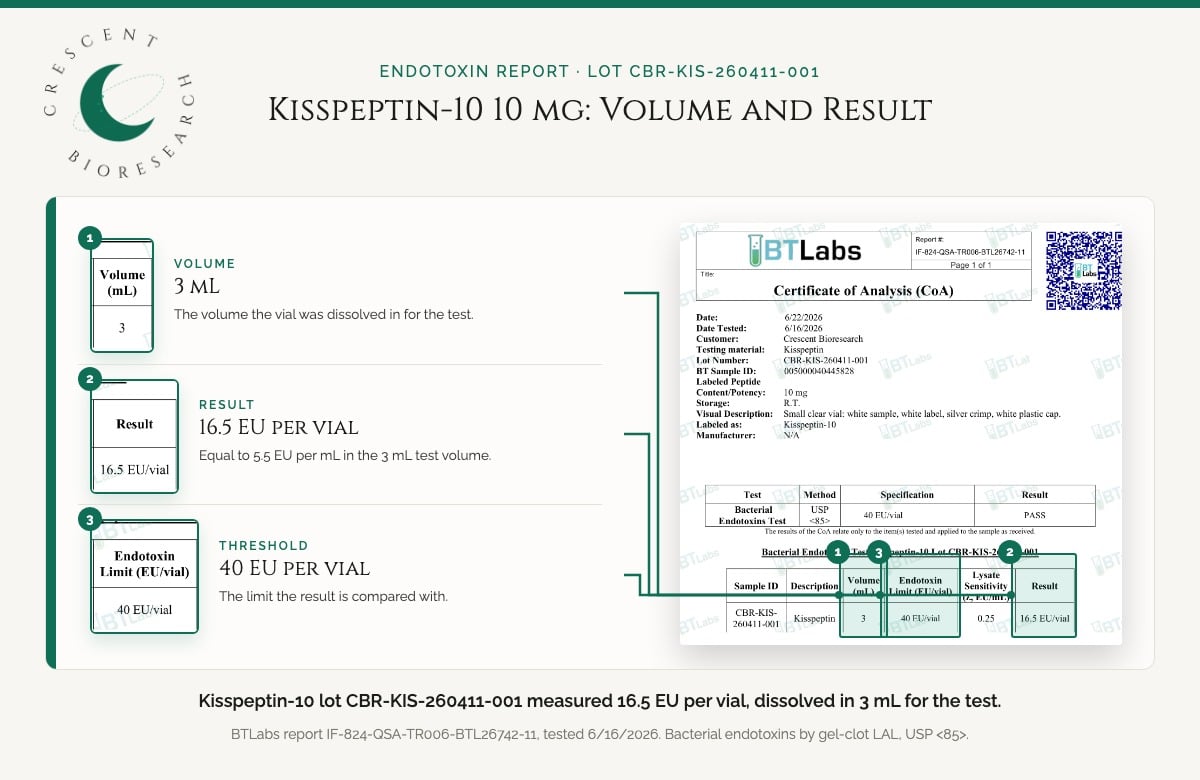
Crescent Bioresearch Kisspeptin-10 Certificate Prints the Endotoxin Value and Its Test Volume: 16.5 EU per Vial, 5.5 EU per mL

Kisspeptin-10 10 mg endotoxin report, lot CBR-KIS-260411-001: 16.5 EU per vial, 40 EU per vial threshold, PASS

The endotoxin certificate for Kisspeptin-10 lot CBR-KIS-260411-001 reports 16.5 EU per vial against a 40 EU per vial threshold, with the vial dissolved in 3 mL for the test. In that volume the concentration is 5.5 EU per mL.

ALBANY, N.Y., Oct. 21, 2026 — Crescent Bioresearch, a supplier of laboratory compounds, has published the Kisspeptin-10 certificate of analysis for lot CBR-KIS-260411-001. The lot measured 16.5 EU of endotoxin per vial against a threshold of 40 EU per vial. The page also prints the volume the laboratory used to dissolve the vial, 3 mL. A per-vial figure converts to a concentration only when the volume is known.

Kisspeptin-10, also known as Metastin 45-54, KP-10, KISS-1 (112-121) and human Kisspeptin-10, sequence YNWNSFGLRF-NH2, CAS 374675-21-5, is supplied by Crescent Bioresearch as Kisspeptin-10 10 mg for laboratory research.

The figures on the page

BTLabs, an independent laboratory in West Palm Beach, Florida, tested the lot on June 16, 2026, by the gel-clot Limulus amebocyte lysate (LAL) test under USP General Chapter 85, Bacterial Endotoxins Test. The test measures endotoxin, the lipopolysaccharide left behind by Gram-negative bacteria, in endotoxin units (EU). The page reads: test volume 3 mL; threshold 40 EU per vial; lysate sensitivity 0.25 EU/mL; result 16.5 EU per vial; determination PASS. The vial holds 10 mg.

One vial, three concentrations

The vial contains 16.5 EU of endotoxin, and that amount does not change. The concentration does, and it depends on the volume the research entity adds. Dissolved in 1 mL, the solution contains 16.5 EU per milliliter. Dissolved in 3 mL, the volume the laboratory used, it contains 5.5 EU per milliliter. Dissolved in 5 mL, it contains 3.3 EU per milliliter. The same vial produces three different concentrations according to a choice made at the bench.

Why the volume belongs on the certificate

A research entity works with solutions, and its endotoxin requirement is usually written as a concentration. To compare a certificate against that requirement, it has to convert the per-vial result into its own concentration, and that conversion requires the volume. A certificate that gives a per-vial result without a volume leaves the research entity to guess how the sample was prepared. A certificate that gives a concentration without a volume cannot be traced back to the vial. The Kisspeptin-10 certificate lists the result, the threshold and the test volume together. With these three figures, the result converts to EU per mL at any volume.

Per milligram

For planning by mass, the result is divided by the fill. The vial holds 10 mg, so 16.5 EU per vial is 1.65 EU per milligram, and that figure does not change with the volume. The threshold of 40 EU per vial converts the same way, to 4 EU per milligram for this fill.

A school exam shows the same thing

A student scores 35 on an exam where the passing mark is 70 percent. Whether that is a pass depends on how many points the exam was out of. 35 out of 40 is 87.5 percent and a pass. 35 out of 100 is a fail. A score cannot be judged without knowing what it was out of.

The Kisspeptin-10 certificate gives both numbers: 16.5 EU in the vial, and the 3 mL the laboratory dissolved it in for the test. With both, a research entity can work out the concentration for any volume it uses: 5.5 EU per mL in 3 mL, or 3.3 EU per mL in 5 mL.

Why all four figures are needed

Every calculation above depends on the result being printed. A certificate that reports a pass and no value gives a research entity nothing to divide by the volume and nothing to divide by the fill, so it cannot be converted to a concentration or compared with another lot. The concentration matters because endotoxin in a solution can cause effects of its own, and a research entity has to know how much is there before it can credit a result to Kisspeptin-10. Each figure is labeled on the Kisspeptin-10 annotated endotoxin report.

“A research entity does not use a vial. It uses a solution it makes from the vial,” Crescent Bioresearch said. “To know what is in that solution, it needs the endotoxin value and the volume.”

SOURCE DOCUMENTS

Bacterial Endotoxins Test report IF-824-QSA-TR006-BTL26742-11, issued by BTLabs, West Palm Beach, Florida, for Kisspeptin-10 lot CBR-KIS-260411-001, tested June 16, 2026, by gel-clot LAL; USP General Chapter 85, Bacterial Endotoxins Test.

ABOUT CRESCENT BIORESEARCH

Crescent Bioresearch is a supplier of laboratory compounds, founded around a framework of critical assessment. It works with research entities nationwide in pursuit of preserving the integrity of scientific research through its transparency approach. Follow the Crescent Discovery Series to dive into the latest breakthroughs and findings within prominent literature.

Find Crescent Bioresearch on Instagram, TikTok, X and Facebook, and every certificate we publish, at crescentbioresearch.com/links.

Kisspeptin-10 product page (for research entities): crescentbioresearch.com/kisspeptin-10

Media Contact:
Name: Media Relations
Company: Crescent Bioresearch
Email: media@crescentbioresearch.com
Website: https://crescentbioresearch.com

Texas Counseling Center Issues Service-Information Update on Appointment Access

In-person appointments serve Houston and Dallas areas, with telehealth options for eligible clients statewide

HOUSTON, Texas — October 21, 2026 — Texas Counseling Center today issued a consolidated appointment-access overview to clarify the distinction between its Houston- and Dallas-area office appointments and statewide telehealth options for eligible clients. The service-information update brings existing access information into one reference for prospective clients reviewing appointment formats before scheduling.

The overview documents existing arrangements. It does not announce a new office, additional appointment capacity or an expanded service area. Statewide telehealth access does not mean in-person appointments are available throughout Texas.

Appointment Formats by Area

The overview identifies three access categories:

  • Houston area: In-person appointments for people who prefer an office setting.
  • Dallas area: In-person appointments for people seeking counseling in Dallas.
  • Across Texas: Telehealth appointments for eligible clients located within the state, subject to applicable requirements.

These categories describe formats to discuss with the center, not confirmed openings. A listed format does not establish availability for every person or requested service.

What to Confirm Before Scheduling

Work schedules, transportation, family responsibilities and distance from an office can affect appointment planning. The overview organizes the questions prospective clients should resolve before making arrangements:

  • Is the requested service offered in person, through telehealth or through either format?
  • For an in-person appointment, would the visit take place in the Houston or Dallas area, and at which specific location?
  • What telehealth requirements apply to the person’s circumstances?
  • Which scheduling options are currently available for the requested service?

Being located in Texas is part of the stated telehealth access criteria. Location alone does not establish eligibility or appointment availability; both require confirmation with Texas Counseling Center.

Prospective clients should confirm the service, format, location and scheduling details with the center before arranging transportation or setting aside time for an appointment. The overview is limited to appointment access and does not provide guidance on the 99213 CPT code.

About Texas Counseling Center

Texas Counseling Center provides counseling for individuals, couples, teenagers and families. The center offers in-person appointments in the Houston and Dallas areas and telehealth appointments for eligible clients across Texas, subject to applicable requirements.

Media Contact

Texas Counseling Center
Email: Info@texascounseling.center
Website: https://texascounseling.center/.

Immigration Evaluations of Texas Clarifies Location Availability and Report Scope

Houston-based organization outlines location-dependent availability, case-specific arrangements and the limits of assessment reports

HOUSTON, Texas — October 21, 2026 — Immigration Evaluations of Texas today issued a clarification identifying five matters individuals should confirm before an appointment: the assessment’s purpose, available records, applicable process, estimated completion timeline and documentation scope. The announcement provides guidance for individual requests; it does not announce an Austin office or establish a uniform appointment format.

The clarification separates two questions: whether an appointment is available in a particular location and what the requested engagement will include. Confirmation of availability does not, by itself, confirm the records to be reviewed, the documentation to be prepared or the completion schedule.

Five Points to Confirm Before an Appointment

The organization identifies the following topics for discussion before proceeding:

  • Purpose: What is the requested assessment intended to address?
  • Records: What relevant information and records are available for review?
  • Process: Which steps apply to the requested assessment?
  • Timeline: What is the estimated completion timeline for the engagement?
  • Documentation: Who are the intended report recipients, and what are the assessment’s limits?

These topics are a discussion checklist, not a standard service package. The arrangements must be established for each request.

Houston and Austin Availability

Individuals seeking an immigration psychological evaluation in Houston should confirm the appointment format and documentation arrangements for their specific request.

Individuals seeking an immigration evaluation in Austin should confirm availability directly with the organization. Availability depends on both location and evaluation type; the announcement does not establish that every evaluation type is available in every location.

Questions about location availability and appointment arrangements can be directed to the organization at info@immigrationevalsoftx.com.

What a Report Can Address

The evaluator determines the appropriate assessment scope and presents findings supported by the information obtained. A request for particular documentation does not determine what the evaluator can support in a report.

Establishing intended recipients and assessment limits before proceeding helps distinguish the documentation requested from the documentation the engagement can provide.

About Immigration Evaluations of Texas

Immigration Evaluations of Texas is a Houston-based organization providing immigration-related assessment and documentation services for individuals and families. The organization provides information about assessment requirements, evaluation processes and appointment arrangements. Availability and documentation scope are determined for each engagement.

Media Contact

Immigration Evaluations of Texas
Email: info@immigrationevalsoftx.com
Website: immigrationevaluationsoftexas.com

Browser Gaming and the Business of Free Online Entertainment: Emerging Opportunities

The digital entertainment industry continues to evolve as consumers explore new ways to access games, videos, and interactive content. Among these developments, browser-based gaming offers an interesting business model built around accessibility, content distribution, and advertising.

Unlike traditional gaming products that require purchases or installations, many browser games can be played directly through a website. This approach creates opportunities for developers, publishers, advertisers, and technology providers.

For businesses exploring digital entertainment, understanding the economics of free online gaming is increasingly relevant.

The Business Model Behind Free Browser Games

Free browser gaming platforms such as funox generally focus on attracting players by offering convenient access to different games.

Instead of charging users for every title, some platforms generate revenue through advertising, licensing agreements, or partnerships with developers.

Advertising-supported models can include display placements and advertisements integrated into appropriate moments of gameplay.

However, generating sustainable revenue requires more than attracting visitors.

Operators must balance advertising income with player satisfaction, loading performance, and content quality.

Excessive advertising may discourage repeat visits, making the overall user experience an important business consideration.

Why Game Variety Matters

A broad game catalog allows publishers to serve audiences with different interests.

For example, Ragdoll Archers appeals to players who enjoy physics-based combat, while Idle Mining Empire offers a progression-focused management experience.

Mahjongg Dimensions provides a different type of entertainment through three-dimensional tile-matching puzzles.

These examples illustrate how a gaming platform can attract visitors interested in action, simulation, and casual puzzles.

However, simply increasing the number of available games does not guarantee commercial success.

Effective organization, quality control, and relevant recommendations are necessary to help visitors find suitable experiences.

Opportunities for Independent Game Developers

Independent developers can benefit from distributing games through established browser gaming platforms.

Publishing partnerships may provide access to audiences that would otherwise be difficult to reach independently.

Possible commercial arrangements include licensing fees, advertising revenue sharing, and distribution agreements.

For developers, the terms of these partnerships are important.

Contracts should clearly address intellectual property ownership, exclusivity, revenue calculations, and reporting requirements.

A transparent distribution model can support long-term relationships between game creators and publishers.

Technology and Infrastructure Costs

Although browser games eliminate the need for conventional installations, delivering them still involves technical expenses.

Platforms may require cloud hosting, content delivery networks, security systems, and analytics infrastructure.

Game files must be optimized to load efficiently across different devices and connection speeds.

Technologies such as HTML5 and WebGL support interactive browser experiences, while caching and asset compression can reduce unnecessary data transfers.

As a platform grows, infrastructure planning becomes essential for maintaining reliable performance.

Poor loading times or technical interruptions can affect player retention and advertising opportunities.

Search Visibility and Audience Acquisition

Discoverability is another important factor in the business of browser gaming.

Players frequently search for specific titles, genres, or gaming experiences.

A website featuring Tower Defense, for example, may attract strategy enthusiasts, while a collection of cooking games can appeal to an entirely different audience.

Search engine optimization, useful game descriptions, and organized category pages can help platforms reach relevant visitors.

Social media and gaming communities may also contribute to discovery through gameplay clips, recommendations, and discussions.

However, audience acquisition strategies should be evaluated against their costs and long-term value.

Challenges Facing Gaming Businesses

Free online gaming platforms operate in a competitive environment.

They must manage content licensing, advertising quality, website security, and changing user expectations.

Privacy compliance is particularly important when websites use analytics, cookies, or advertising technologies.

Businesses also need to consider differences in device performance and regional internet connectivity.

Maintaining a sustainable platform requires regular investment in technology, content management, and user experience.

Emerging Opportunities in Browser Gaming

The continued development of web technologies creates opportunities for new types of interactive entertainment.

Developers can experiment with lightweight games, more sophisticated graphics, and improved mobile compatibility.

Publishers may explore partnerships with independent studios or develop specialized gaming collections for particular audiences.

Businesses that combine reliable technology with engaging content and responsible monetization may be better positioned to build lasting audiences.

Final Thoughts

Browser gaming represents a digital entertainment business model centered on accessibility and content discovery.

Its commercial potential extends beyond individual games to include publishing, advertising, licensing, and technology services.

For entrepreneurs and developers, the opportunity lies in creating enjoyable gaming experiences while building sustainable systems for distribution and revenue generation.