Introduction: Choosing the Right ADU in Washington State
When planning adu construction Seattle WA, one of the most important decisions homeowners face is whether to build a detached or attached accessory dwelling unit (ADU). The choice directly impacts your construction cost, long-term rental income, permitting complexity, and how well the structure performs in Washington’s wet Pacific Northwest climate.
In simple terms, detached ADUs offer full separation from the main home, while attached ADUs share at least one wall or structural connection. In Seattle, Bellevue, Tacoma, and surrounding cities, this decision is shaped by lot size, zoning rules, and moisture-heavy weather conditions that affect building durability.
So, what’s better in Washington?
Detached ADUs provide more privacy and rental potential, while attached ADUs are typically more affordable and easier to integrate into existing structures. The right option depends on your budget, property layout, and long-term goals like rental income or multigenerational living.
This guide breaks down cost differences, design factors, permitting rules, and real-world performance in Washington’s climate so you can make a confident, informed decision.
What Is an ADU in Washington State? (Detached vs Attached Explained)
Accessory Dwelling Units (ADUs) are secondary housing units built on the same lot as a primary residence. Washington State has expanded ADU-friendly zoning in cities like Seattle to address housing shortages and affordability concerns.
Detached ADU
A standalone structure separate from the main home.
Common uses:
- Backyard cottages
- Rental units
- Guest houses
Attached ADU
Connected to the main home through a shared wall or conversion of existing space.
Common uses:
- Basement apartments
- Garage conversions
- Side additions
In Seattle’s dense neighborhoods, zoning laws often determine whether you can build detached structures based on lot coverage and setbacks.
Detached vs Attached ADUs: Key Differences in Washington Homes
To understand what works best for adu construction Seattle WA, you need to compare practical differences beyond just appearance.
1. Privacy & Rental Value
- Detached ADUs offer full privacy → higher Airbnb or long-term rental value
- Attached ADUs offer moderate privacy → better for family use
2. Construction Complexity
- Detached: Requires full utility hookups (water, sewer, electrical)
- Attached: Uses existing systems → lower engineering complexity
3. Space Efficiency
- Detached ADUs require yard space
- Attached ADUs maximize existing square footage
4. Noise & Separation
- Detached: Better sound isolation
- Attached: May require additional insulation upgrades
Comparison Table
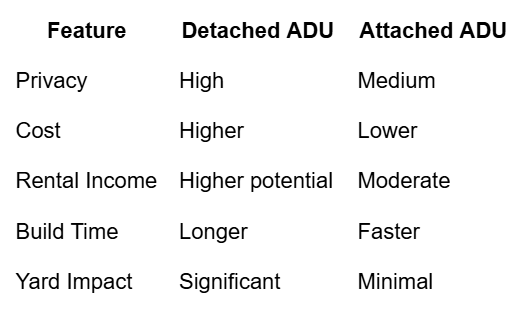
From a contractor’s perspective in Washington, detached ADUs are increasingly popular in suburban areas like Bothell and Sammamish, while attached units dominate Seattle’s tighter urban lots.
At this stage of planning, many homeowners consult Everett, WA ADU construction experts to evaluate zoning feasibility, cost breakdowns, and site-specific constraints before committing to design.
Cost Breakdown: Detached vs Attached ADUs in Seattle (2026 Estimates)
Understanding cost is critical when evaluating adu construction Seattle WA projects, especially given Washington’s high labor and permitting expenses.
Detached ADU Costs
- Average range: $220,000 – $450,000+
- Higher due to:
- Foundation work
- Separate utility connections
- Roofing and exterior siding
Attached ADU Costs
- Average range: $120,000 – $300,000
- Lower due to:
- Shared structure
- Reduced excavation
- Existing plumbing/electrical tie-ins
ROI Considerations in Seattle Market
Seattle rental market data (2025 estimates):
- 1-bedroom ADU rent: $1,800 – $2,800/month
- Detached units often command 10–25% higher rent
- ROI timeline: 7–12 years depending on financing
In high-demand neighborhoods like Ballard, Capitol Hill, and West Seattle, detached ADUs often outperform attached units due to tenant privacy expectations and lifestyle preferences.
Many homeowners evaluating ROI consult Crafthaus Remodel early in the design phase to align ADU layout decisions with long-term resale value and rental strategy.
Permitting and Building Codes for ADUs in Washington
Washington State and Seattle have specific ADU regulations that significantly influence design choice.
Key Requirements
- Minimum lot size rules (varies by zoning)
- Height restrictions (typically 24–30 ft for detached units)
- Setback requirements (5–10 feet minimum in most zones)
- Energy efficiency compliance (WA State Energy Code)
Permit Timeline
- Seattle ADU permit approval: 4–9 months
- Inspection phases: foundation, framing, final walkthrough
Climate Impact Considerations
Washington’s heavy rainfall means:
- Proper drainage is mandatory
- Mold-resistant materials are required
- Roof pitch must handle moisture load
Detached ADUs often require additional waterproofing engineering, especially in flood-prone or tree-heavy neighborhoods.
Which ADU Type Works Best in Washington? (Decision Guide)
Choosing between detached and attached ADUs depends on your goals.
Choose Detached ADU if:
- You want rental income optimization
- You have a large backyard
- You prioritize privacy
- You plan long-term investment growth
Choose Attached ADU if:
- You want lower upfront cost
- Your lot size is limited
- You prefer faster construction
- You are converting existing space
Expert Insight from Seattle Builders
In Seattle’s competitive housing market, detached ADUs often deliver stronger appreciation and tenant demand, but attached ADUs remain the most practical solution for urban infill lots.
Homeowners often begin planning with Everett, WA adu construction experts to evaluate feasibility before architectural design begins.
Conclusion: Making the Right ADU Investment in Washington
In Washington’s evolving housing market, choosing between detached and attached ADUs is not just a design decision—it’s a financial and lifestyle strategy. Detached units offer higher rental value and independence, while attached units provide affordability and faster construction.
For most homeowners evaluating adu construction Seattle WA, the best choice depends on lot size, budget, and long-term income goals. Working with experienced professionals ensures your project aligns with zoning laws, moisture-resistant construction standards, and ROI expectations in the Seattle region.
FAQ: Detached vs Attached ADUs in Washington
1. What is the main difference between detached and attached ADUs?
Detached ADUs are standalone units built separately from the main house, while attached ADUs share at least one wall or structural connection. Detached units offer more privacy and rental value, while attached units are more cost-effective and easier to build within existing home structures.
2. How much does an ADU cost in Seattle, Washington?
In Seattle, ADU construction typically ranges from $120,000 for attached units to over $450,000 for detached units. Costs depend on size, site conditions, utility connections, and finishes. Detached units cost more due to separate foundations and infrastructure requirements.
3. Do ADUs require permits in Washington State?
Yes. All ADUs require permits in Washington State. In Seattle, the approval process typically takes 4–9 months and includes zoning review, structural plans, and multiple inspections to ensure compliance with state energy and safety codes.
4. Which ADU type has better rental income potential?
Detached ADUs generally generate higher rental income due to increased privacy and tenant appeal. In Seattle, detached units can earn 10–25% more rent compared to attached units, especially in high-demand neighborhoods.
5. Can I build an ADU on a small Seattle lot?
Yes, but attached ADUs are usually more suitable for smaller lots due to space limitations and zoning restrictions. Detached ADUs require sufficient yard space and setback clearance, which may not be available in dense urban areas.