36.6 of 40: Crescent Bioresearch MOTS-c Endotoxin Sits 3.4 EU Below Its Limit, a Margin a Pass Alone Would Not Show

MOTS-c 40 mg endotoxin report, lot CBR-MOT-260403-001: 36.6 EU per vial, 40 EU per vial threshold, PASS. Crescent Bioresearch

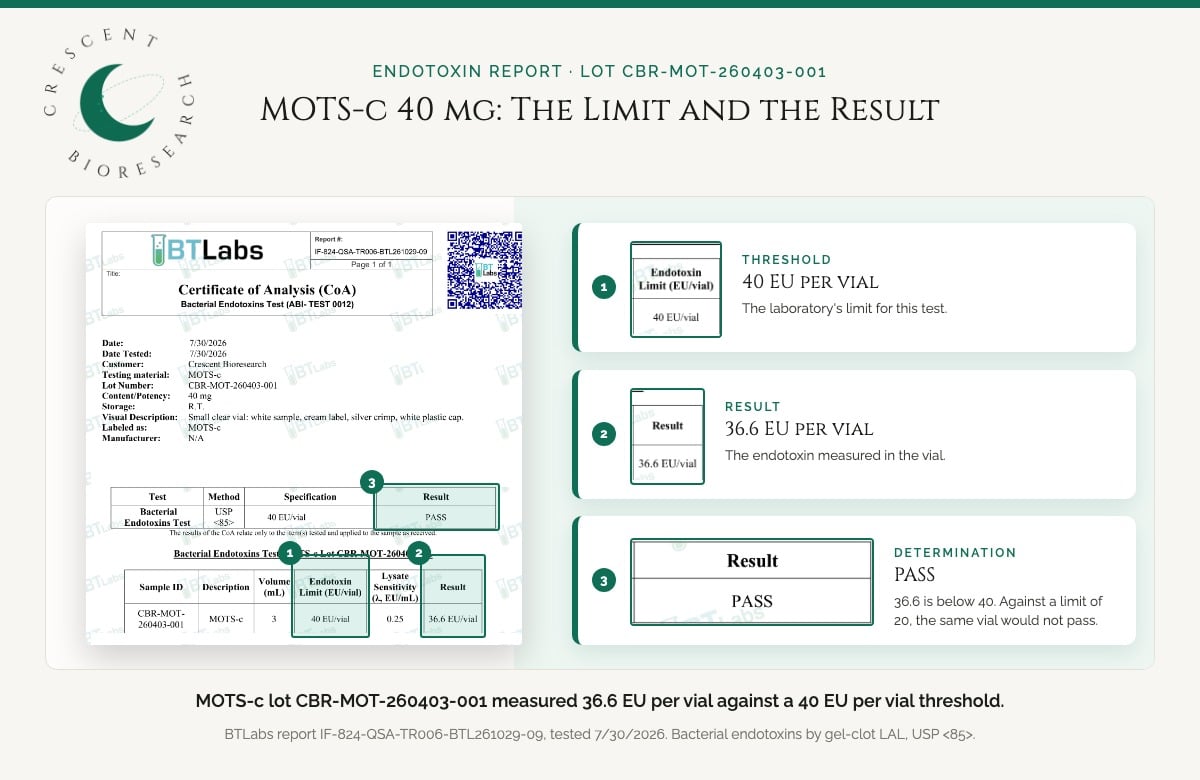
MOTS-c lot CBR-MOT-260403-001 measured 36.6 EU per vial against the testing laboratory's threshold of 40 EU per vial, with a lysate sensitivity of 0.25 EU/mL. Against a stricter limit of 20 EU per vial, the same result would not pass.

ALBANY, N.Y., Oct. 22, 2026 — Crescent Bioresearch, a supplier of laboratory compounds, has published the MOTS-c certificate of analysis for lot CBR-MOT-260403-001. The endotoxin result is 36.6 EU per vial, the threshold is 40 EU per vial, and the lot passed at 91.5 percent of the threshold. The threshold belongs to the laboratory that ran the test. The measured value is printed beside it.

MOTS-c, also known as MOTSc, from the mitochondrial open reading frame of the 12S rRNA type-c, sequence MRWQEMGYIFYPRKLR, CAS 1627580-64-6, is supplied by Crescent Bioresearch as MOTS-c 40 mg for laboratory research.

The page

BTLabs, an independent laboratory in West Palm Beach, Florida, tested the lot on July 30, 2026, by the gel-clot Limulus amebocyte lysate (LAL) method under USP General Chapter 85, Bacterial Endotoxins Test. Endotoxin is lipopolysaccharide, a residue of Gram-negative bacteria, measured in endotoxin units (EU). The laboratory dissolved the 40 mg vial in 3 mL, measured 36.6 EU per vial, compared it with its 40 EU per vial threshold and recorded a pass. The lysate sensitivity was 0.25 EU/mL, and per milligram the result is 0.92 EU.

Whose question the pass answers

A pass states that the result fell below the threshold the testing laboratory chose. That is one question, asked by one party. A research entity asks a different question of the same vial: does this lot meet the limit my work requires? The testing laboratory does not know what that work is and did not set its threshold for it. The pass on the page is therefore the testing laboratory’s conclusion, and the measured value is what allows anyone else to reach their own.

Two research entities, one vial

Consider two research entities receiving vials from this lot. The first has set its own limit at 40 EU per vial, the same as the laboratory’s, and for it the pass on the page is also its own answer. The second works with a model that responds to small amounts of endotoxin and has set its limit at 20 EU per vial, and for it the lot sits above the limit. The vial is the same in both cases. The number, 36.6, is what lets the second research entity reach the answer that fits its work.

An airport luggage scale shows the same thing

A passenger checks a bag at the airport, and the agent says it is overweight. The scale has no number on it. It only shows a red light for overweight and a green light for within the limit. The bag weighs 40 pounds, but the passenger has no way of knowing that. The passenger cannot tell whether the bag is one pound over or ten, so there is no way to know how much to take out. If the light had been green, the passenger would not know how much room was left to add anything either. With the number on the scale, both questions are easy: a 40-pound bag against a 35-pound limit means 5 pounds have to come out.

An endotoxin certificate that prints only “pass” is that green light. The MOTS-c certificate prints the number: 36.6 EU per vial against the laboratory’s limit of 40, which leaves 3.4 EU of room. A research entity that holds its work to a stricter limit, such as 20 EU per vial, can see from the same number that this lot is over its own line.

Why the value sits beside the verdict

A certificate that reports only a pass has made the decision for every research entity that reads it, against a threshold none of them chose. A research entity with a stricter limit has no way to see where the lot stands, and a research entity comparing lots has nothing to compare.

For this lot, a research entity sees that the pass was the laboratory’s, against 40, and sees the 36.6 it needs to apply its own limit. At 36.6 EU per vial the amount sits close to the threshold, so a research entity will want to account for it and make sure what it records can be traced to MOTS-c and not to endotoxin. The MOTS-c annotated endotoxin report shows where the threshold, sensitivity and result appear.

“The pass on this certificate is the testing laboratory’s answer to the testing laboratory’s question,” Crescent Bioresearch said. “A research entity has its own question and its own limit, and the measured value is what lets it answer.”

SOURCE DOCUMENTS

Bacterial Endotoxins Test report IF-824-QSA-TR006-BTL261029-09, issued by BTLabs, West Palm Beach, Florida, for MOTS-c lot CBR-MOT-260403-001, tested July 30, 2026, by gel-clot LAL; USP General Chapter 85, Bacterial Endotoxins Test.

ABOUT CRESCENT BIORESEARCH

Crescent Bioresearch is a supplier of laboratory compounds, founded around a framework of critical assessment. It works with research entities nationwide in pursuit of preserving the integrity of scientific research through its transparency approach. Follow the Crescent Discovery Series to dive into the latest breakthroughs and findings within prominent literature.

Find Crescent Bioresearch on Instagram, TikTok, X and Facebook, and every certificate we publish, at crescentbioresearch.com/links.

Media Contact:
Name: Media Relations
Company: Crescent Bioresearch
Email: media@crescentbioresearch.com
Website: https://crescentbioresearch.com/links
Crescent Bioresearch Kisspeptin-10 Certificate Prints the Endotoxin Value and Its Test Volume: 16.5 EU per Vial, 5.5 EU per mL

Kisspeptin-10 10 mg endotoxin report, lot CBR-KIS-260411-001: 16.5 EU per vial, 40 EU per vial threshold, PASS

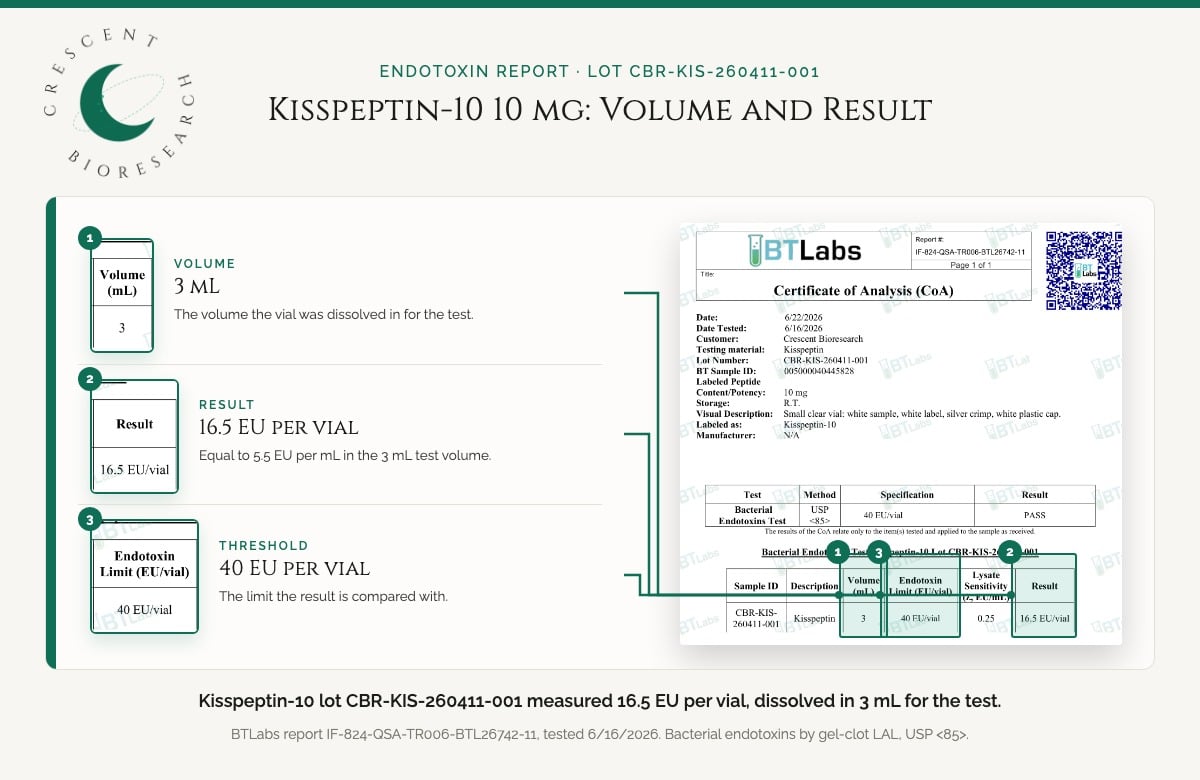
The endotoxin certificate for Kisspeptin-10 lot CBR-KIS-260411-001 reports 16.5 EU per vial against a 40 EU per vial threshold, with the vial dissolved in 3 mL for the test. In that volume the concentration is 5.5 EU per mL.

ALBANY, N.Y., Oct. 21, 2026 — Crescent Bioresearch, a supplier of laboratory compounds, has published the Kisspeptin-10 certificate of analysis for lot CBR-KIS-260411-001. The lot measured 16.5 EU of endotoxin per vial against a threshold of 40 EU per vial. The page also prints the volume the laboratory used to dissolve the vial, 3 mL. A per-vial figure converts to a concentration only when the volume is known.

Kisspeptin-10, also known as Metastin 45-54, KP-10, KISS-1 (112-121) and human Kisspeptin-10, sequence YNWNSFGLRF-NH2, CAS 374675-21-5, is supplied by Crescent Bioresearch as Kisspeptin-10 10 mg for laboratory research.

The figures on the page

BTLabs, an independent laboratory in West Palm Beach, Florida, tested the lot on June 16, 2026, by the gel-clot Limulus amebocyte lysate (LAL) test under USP General Chapter 85, Bacterial Endotoxins Test. The test measures endotoxin, the lipopolysaccharide left behind by Gram-negative bacteria, in endotoxin units (EU). The page reads: test volume 3 mL; threshold 40 EU per vial; lysate sensitivity 0.25 EU/mL; result 16.5 EU per vial; determination PASS. The vial holds 10 mg.

One vial, three concentrations

The vial contains 16.5 EU of endotoxin, and that amount does not change. The concentration does, and it depends on the volume the research entity adds. Dissolved in 1 mL, the solution contains 16.5 EU per milliliter. Dissolved in 3 mL, the volume the laboratory used, it contains 5.5 EU per milliliter. Dissolved in 5 mL, it contains 3.3 EU per milliliter. The same vial produces three different concentrations according to a choice made at the bench.

Why the volume belongs on the certificate

A research entity works with solutions, and its endotoxin requirement is usually written as a concentration. To compare a certificate against that requirement, it has to convert the per-vial result into its own concentration, and that conversion requires the volume. A certificate that gives a per-vial result without a volume leaves the research entity to guess how the sample was prepared. A certificate that gives a concentration without a volume cannot be traced back to the vial. The Kisspeptin-10 certificate lists the result, the threshold and the test volume together. With these three figures, the result converts to EU per mL at any volume.

Per milligram

For planning by mass, the result is divided by the fill. The vial holds 10 mg, so 16.5 EU per vial is 1.65 EU per milligram, and that figure does not change with the volume. The threshold of 40 EU per vial converts the same way, to 4 EU per milligram for this fill.

A school exam shows the same thing

A student scores 35 on an exam where the passing mark is 70 percent. Whether that is a pass depends on how many points the exam was out of. 35 out of 40 is 87.5 percent and a pass. 35 out of 100 is a fail. A score cannot be judged without knowing what it was out of.

The Kisspeptin-10 certificate gives both numbers: 16.5 EU in the vial, and the 3 mL the laboratory dissolved it in for the test. With both, a research entity can work out the concentration for any volume it uses: 5.5 EU per mL in 3 mL, or 3.3 EU per mL in 5 mL.

Why all four figures are needed

Every calculation above depends on the result being printed. A certificate that reports a pass and no value gives a research entity nothing to divide by the volume and nothing to divide by the fill, so it cannot be converted to a concentration or compared with another lot. The concentration matters because endotoxin in a solution can cause effects of its own, and a research entity has to know how much is there before it can credit a result to Kisspeptin-10. Each figure is labeled on the Kisspeptin-10 annotated endotoxin report.

“A research entity does not use a vial. It uses a solution it makes from the vial,” Crescent Bioresearch said. “To know what is in that solution, it needs the endotoxin value and the volume.”

SOURCE DOCUMENTS

Bacterial Endotoxins Test report IF-824-QSA-TR006-BTL26742-11, issued by BTLabs, West Palm Beach, Florida, for Kisspeptin-10 lot CBR-KIS-260411-001, tested June 16, 2026, by gel-clot LAL; USP General Chapter 85, Bacterial Endotoxins Test.

ABOUT CRESCENT BIORESEARCH

Crescent Bioresearch is a supplier of laboratory compounds, founded around a framework of critical assessment. It works with research entities nationwide in pursuit of preserving the integrity of scientific research through its transparency approach. Follow the Crescent Discovery Series to dive into the latest breakthroughs and findings within prominent literature.

Find Crescent Bioresearch on Instagram, TikTok, X and Facebook, and every certificate we publish, at crescentbioresearch.com/links.

Kisspeptin-10 product page (for research entities): crescentbioresearch.com/kisspeptin-10

Media Contact:
Name: Media Relations
Company: Crescent Bioresearch
Email: media@crescentbioresearch.com
Website: https://crescentbioresearch.com

DTF Halftone Generator DTPrep Offers 20% Off in Black Friday Deal

DTPrep Web Interface

Lightning Plugins announced a Black Friday deal on DTPrep, its DTF halftone generator for direct-to-film printers. Through December 10, 2026, customers save 20% on DTPrep Web, the Photoshop plugin, and the combined plan with code BLACKFRIDAY26.

DTF Halftone Generator DTPrep Offers 20% Off in Black Friday Deal

The browser-based DTF halftone generator and its Photoshop plugin are discounted through December 10th, with no Photoshop required for the web version.

ORLANDO, Fla. — Oct 21, 2026 — Lightning Plugins today announced a Black Friday deal on DTPrep, its popular DTF halftone generator for direct-to-film printers. From now through December 10th 2026, customers save 20% on DTPrep Web, the DTPrep Photoshop plugin, and the combined Web & Photoshop plan with code BLACKFRIDAY26.

Every pixel in a DTF transfer is printed, backed with white ink, and coated in adhesive powder. That works well for solid artwork. It causes problems with soft gradients, shadows, and glows. Semi-transparent pixels print as hazy halos, specks too small to print turn into noise, and large solid areas press into a stiff patch on the shirt. Halftones solve all three, but the standard Photoshop process is a long chain of manual steps that are hard to adjust later.

A DTF Halftone Generator That Runs in the Browser

DTPrep Web brings that professional prep workflow to a single interactive page at dtprep.com/dtf-halftone-generator. Most online halftone tools produce a single fixed result. DTPrep shows a live preview, so printers can switch between round and line halftones, adjust size and frequency, and refine the color knockout before downloading. It works alongside Affinity, Canva, Procreate, and other design apps.

The generator also handles the cleanup that usually follows halftoning:

  • automatic removal of semi-transparent pixels

  • removal of dots too small to print

  • a shadow color boost that restores color lost during halftoning

  • optional halftoning across the entire design for a softer feel

  • knockout of any garment color, not just black

Also Available for Photoshop

Designers who prefer to work inside Photoshop can use Lightning DTPrep for Photoshop, a plugin for Photoshop 23.3 and later. It offers real-time halftones and color knockouts directly in the Photoshop workspace. The Black Friday discount applies to both versions.

“A lot of DTF printers design in Canva or Procreate and then get stuck on the halftones. I built the web version so anyone can prep a print-ready file with the same control a pro gets in Photoshop.” said Jason Murphy, founder of Lightning Plugins.

Pricing and Availability

The Black Friday deal runs from now through December 10th, 2026 with code BLACKFRIDAY26. The discounted rate is locked in for the life of the subscription. Every DTPrep plan includes a 7-day money-back guarantee.

About Lightning Plugins
Lightning Plugins is an independent software developer based in Orlando, Florida, and a member of PRINTING United Alliance. It builds Adobe Photoshop plugins and browser-based tools for print shops and designers, including DTPrep, the DTF halftone generator used by hundreds of professional print shops, along with Lightning Rez Fixer and Lightning Cutlines.

Media Contact:
Name: Jason Murphy
Company: Lightning Plugins
Email: jason407@gmail.com
Website: https://dtprep.com/

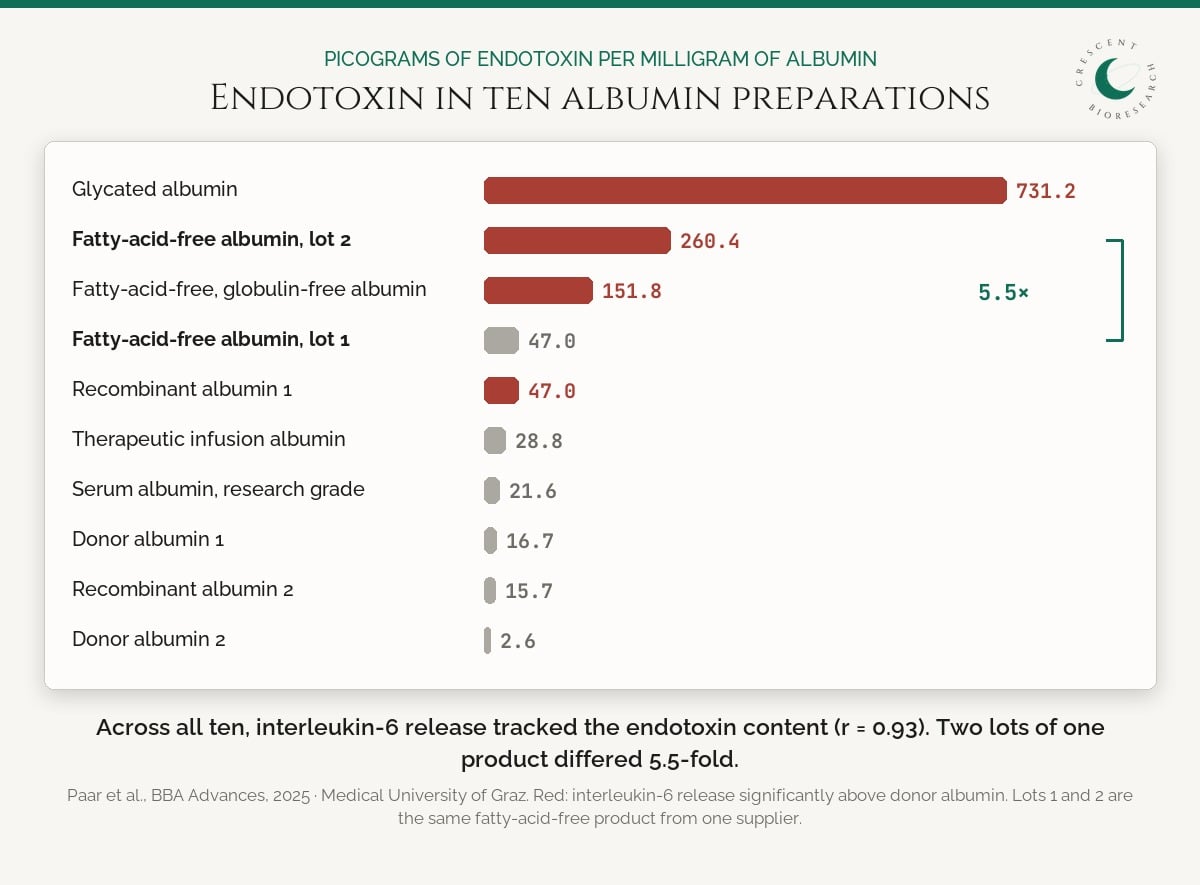
Two Lots of the Same Commercial Albumin Differed 5.5-Fold in Endotoxin, and the Immune Response Followed the Endotoxin, Crescent Bioresearch Examination Shows

Albumin endotoxin chart, Crescent Bioresearch: LPS in ten human serum albumin preparations, glycated 731.2 pg/mg, two lots 5.

Investigators at the Medical University of Graz found that the inflammatory activity of commercial research albumins tracked their measured endotoxin content, and that an apparent effect of the protein's own chemistry disappeared once endotoxin was entered as a control variable and tested against.

ALBANY, N.Y., Oct. 20, 2026 — Two containers of the same research-grade albumin, sold under one product number, were found to carry 47.0 and 260.4 picograms of endotoxin per milligram of protein. The gap was 5.5-fold, and the response of human blood cells to the two lots followed it. That observation is one of several in a 2025 study in BBA Advances from the Medical University of Graz, which Crescent Bioresearch, a supplier of laboratory compounds, has examined for what it demands of an endotoxin certificate. The demand is a figure for every sample, because the study’s most important correction could not have been made without one, and because the endotoxin field on a typical certificate of analysis supplies no figure at all.

Lipopolysaccharide, the endotoxin of Gram-negative bacteria, is present wherever those organisms have been, and purified or recombinant proteins carry it unless it has been removed. The Limulus amebocyte lysate assay quantifies it, and the Graz investigators expressed it in picograms per milligram of protein, a unit that can be compared across preparations, divided, and entered into a calculation. The study turned on all three operations.

Ten preparations, four properties

Albumin is the most abundant protein in human plasma and is in daily use in clinical and research settings alike. Earlier reports had linked particular forms of it to immune stimulation, among them albumin partly oxidized at its single free cysteine and albumin modified by glucose, the form that accumulates in the blood of people with diabetes. The Graz group, working across the Medical University of Graz and the University of Graz, assembled ten human albumin preparations, from therapeutic infusion solution to commercial research grades, and characterized each for four properties: oxidation state, degree of glycation, fatty acid load and endotoxin content.

Each preparation was then added to freshly isolated human blood immune cells, with release of the inflammatory signal interleukin-6 as the readout, and to reporter cell lines engineered to signal when the innate immune receptors TLR4 or TLR2 are activated.

The response followed one of the four

The therapeutic albumin produced no interleukin-6 and activated neither receptor. Several research-grade products, among them fatty-acid-free, glycated and recombinant preparations, induced substantial interleukin-6 release and activated both receptors. Across the ten, interleukin-6 release correlated with endotoxin content at a coefficient of 0.93. Fatty acid load and degree of glycation showed no consistent relationship with the response.

The glycated product carried 731.2 picograms of endotoxin per milligram, the highest of any commercial albumin tested. When the investigators glycated low-endotoxin albumin themselves, to the same degree as that product and well beyond it, the result produced no interleukin-6 and no receptor activation. Low-endotoxin albumin heavily loaded with fatty acids, and low-endotoxin albumin prepared in its reduced and oxidized forms, were likewise inert.

One product number, two materials

The two lots of fatty-acid-free albumin from a single supplier were the clearest illustration. At 47.0 picograms per milligram, the first lot did not reach a significant interleukin-6 response. At 260.4, the second did. Nothing on the label distinguished them. The authors observed that information on contaminants in research-grade albumin is often not provided, and recommended that each product be systematically characterized before use.

A correlation that did not survive a control

Early in the analysis, the share of albumin in its reduced form appeared to protect against inflammation, correlating with lower interleukin-6 release. Reported on its own, that would have stood as a property of the protein’s chemistry. The reduced form, however, also tracked endotoxin content. When the investigators held endotoxin constant in a partial correlation, the protective relationship vanished, and direct testing of low-endotoxin reduced and oxidized albumin confirmed that oxidation alone did not trigger the response.

A partial correlation requires a value for every sample. The correction was available to the Graz group because each of the ten preparations carried a measured endotoxin figure. Had the preparations arrived with a word in the endotoxin field, the confounding variable would have had no value to hold constant, the apparent protection would have survived, and a property of the protein would have entered the literature where the cause was a contaminant the certificate never quantified.

The authors recorded the limits of their work: isolated human cells and reporter lines, substantial variation between blood donors, and a four-hour exposure that may have been too short to capture slower activation by fatty acids. The response to the endotoxin-bearing preparations stood out in every experiment regardless.

What the study asks of a certificate

Three operations made the Graz findings possible. The investigators compared endotoxin across preparations, which requires a figure in a common unit. They divided it per milligram, which requires a figure and a mass. They entered it as a control variable, which requires a figure for every sample. A certificate reporting pass or fail permits none of the three. It reports that a laboratory compared an unseen value against an unseen limit, and it leaves the research entity holding the material with no way of repeating the comparison or of carrying the value into its own analysis, as the Graz group carried theirs.

“An effect of the protein’s chemistry appeared in the data, and it was dismantled only because the investigators held a measured endotoxin figure for every preparation and could account for it,” Crescent Bioresearch said. “Two lots under one product number differed more than five-fold, and measurement alone revealed it. A certificate that reports a pass in place of the number has removed the tool that exposed the error, and a result attributed to the wrong cause does not stay in one laboratory. It enters the literature, and the literature is where it has to hold.”

METHODOLOGY

This examination is based on Paar M, Fengler VH, Schweiger M, et al., “Albumin does not induce IL-6 release and toll-like receptor activation in vitro: Role of endotoxin contamination and biochemical modifications,” BBA Advances 2025;8:100174.

ABOUT CRESCENT BIORESEARCH

Crescent Bioresearch is a supplier of laboratory compounds, founded around a framework of critical assessment. It works with research entities nationwide in pursuit of preserving the integrity of scientific research through its transparency approach. Follow the Crescent Discovery Series to dive into the latest breakthroughs and findings within prominent literature.

Find Crescent Bioresearch on Instagram, TikTok, X and Facebook, and every certificate we publish, at https://crescentbioresearch.com/kooajj

Media Contact:
Name: Media Relations
Company: Crescent Bioresearch
Email: support@crescentbioresearch.com
Website: https://crescentbioresearch.com/links
VENOMTV Presents Korean-Language Sports Information Covering Football, Baseball and More

VENOMTV Korean sports news and information platform logo

VENOMTV presents a Korean-language multi-sport information website covering football, baseball, basketball, and combat sports. The platform combines sports news, match information, and highlight discovery for Korean-speaking sports fans in South Korea and worldwide.

SEOUL, South Korea — October 18, 2026 — VENOMTV (베놈티비) is a Korean-language sports information website serving fans interested in football, baseball, basketball, combat sports and other major sporting categories. The platform brings together sports-related information and highlight discovery, providing Korean-speaking audiences with an online destination for exploring different areas of the sporting world.

Designed primarily for Korean-speaking sports fans, VENOMTV focuses on helping visitors discover information about teams, leagues and competitions. Its multi-sport coverage reflects the varied interests of audiences who follow more than one sport and want to explore related news and content online.

Coverage Across Multiple Sports

VENOMTV covers several major sporting categories, offering visitors different ways to explore sports-related information. Its coverage includes:

  • Football: Sports news and match-related information for fans interested in football teams, leagues and competitions.

  • Baseball: Sports information for audiences following baseball teams, leagues and tournaments.

  • Basketball: Coverage for fans interested in basketball teams and competitions.

  • Combat Sports: Information related to combat sports and sporting events.

  • Other Major Sports: Additional sports-related content for visitors with varied sporting interests.

This multi-sport approach brings several categories together within one website. Rather than concentrating exclusively on a single discipline, VENOMTV caters to audiences whose interests span different competitions and sporting events.

Sports News and Highlight Discovery

Digital platforms give sports fans different ways to follow competitions, explore news and discover content related to their favorite teams. VENOMTV combines its broad sports information focus with highlight discovery, allowing visitors to explore material connected to the sporting categories covered by the website.

The platform’s content focus includes sports news, match-related information and sports highlights. These areas support its role as a sports information resource for Korean-speaking audiences who want to explore multiple disciplines through a dedicated online destination.

For fans interested in football, baseball, basketball or combat sports, a multi-sport website provides an opportunity to browse different categories without limiting their interests to one area. VENOMTV’s coverage is organized around this range of sporting interests, with Korean-language content serving as its central audience focus.

A Platform for Korean-Speaking Fans

VENOMTV is primarily intended for Korean-speaking sports audiences, particularly fans in South Korea. Its introduction to a wider international audience provides readers outside the country with information about the website, its focus and the sporting categories it covers.

Readers can learn more about VENOMTV and explore the platform through its official website: VENOMTV.

By bringing together information about multiple sports and supporting highlight discovery, VENOMTV maintains its focus on providing a Korean-language destination for sports-related content.

About VENOMTV

VENOMTV (베놈티비) is a Korean-language multi-sport information website serving sports fans, primarily in South Korea. The platform covers football, baseball, basketball, combat sports and other major sports, with a focus on sports news, match-related information and highlight discovery.

Website: https://venomtv1.com/

Media Contact:
Name: VENOMTV Media Team
Company: VENOMTV
Email: nntv0102222@gmail.com
Website: https://venomtv1.com/

Hyaluronan Sample Credited With Inflammatory Response Carried a Severe Endotoxin Load, Crescent Bioresearch Examination Shows

CBR-PR-006 (005, hyaluronan): Hyaluronan endotoxin chart, Crescent Bioresearch: umbilical cord hyaluronan at 2,000 pg/mL LPS

Investigators at the University of British Columbia traced the immune activation produced by one hyaluronan preparation to the endotoxin it carried. Their remedy was a figure in picograms, and a figure is the only form of result that can be held against it.

ALBANY, N.Y., Oct. 20, 2026 — For the better part of two decades, fragments of hyaluronan were credited with switching on immune cells. A 2016 study in Scientific Reports from the University of British Columbia found that the activity belonged to endotoxin carried in one preparation, and that the only means of separating the molecule from the contaminant was a measured figure. Crescent Bioresearch, a supplier of laboratory compounds, has examined that study for what it asks of the endotoxin line on a certificate of analysis, a line that across the laboratory supply industry is routinely reduced to a single word.

Endotoxin is the lipopolysaccharide of the outer membrane of Gram-negative bacteria. It is detected by the Limulus amebocyte lysate assay, and a complete report of that assay carries three figures: the quantity found, the limit it was held to and the sensitivity of the lysate that found it. The hyaluronan study is a record of why the first of those figures cannot be exchanged for a verdict.

A molecule with a reputation

Hyaluronan sits in healthy tissue as a very large molecule and is broken into smaller fragments during inflammation. For years those fragments were reported to act as danger signals in their own right, capable of switching on macrophages and dendritic cells, and the literature settled on a model in which large hyaluronan is anti-inflammatory and small hyaluronan is pro-inflammatory. A few earlier reports had already questioned that model, including one that traced the activity of enzyme-generated fragments to endotoxin rather than to the fragments themselves.

The University of British Columbia group set out to test the question systematically. The investigators exposed mouse macrophages and dendritic cells, grown from bone marrow and taken directly from the spleen and peritoneum, to pharmaceutical-grade hyaluronan in sizes ranging from more than one million daltons down to a fragment of four sugars, to hyaluronan purified from rooster comb and from human umbilical cord, to fragments generated by sonication, hydrogen peroxide and enzyme digestion, and to hyaluronan bound to the heavy-chain proteins that form during inflammation.

One preparation responded, and it carried the contaminant

Of every hyaluronan form tested, only the umbilical cord preparation drove the cells to produce the inflammatory signals tumor necrosis factor alpha and interleukin-12 and to raise their co-stimulatory surface markers, at levels comparable to purified lipopolysaccharide. The response was unchanged in cells lacking CD44, the cell surface receptor for hyaluronan, a first indication that it did not run through hyaluronan’s own receptor. Two hyaluronidase enzymes of the kind used in earlier studies to generate fragments produced the same response, and that response persisted after the enzymes themselves were digested and heat-inactivated.

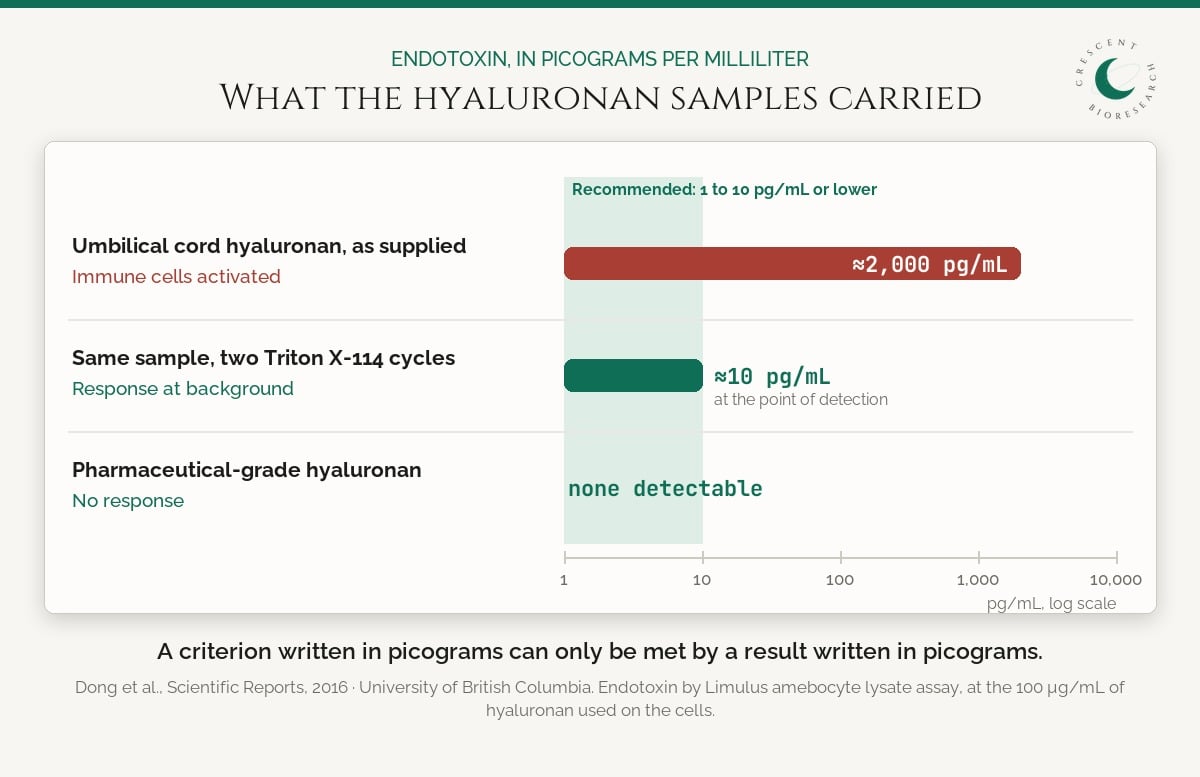
When the investigators measured the preparations with the Limulus amebocyte lysate assay, the umbilical cord material carried approximately 2 nanograms of endotoxin per milliliter at the concentration used on the cells, while no endotoxin was detectable in any of the purified preparations. Two cycles of phase separation with Triton X-114 lowered it more than 100-fold, to approximately 10 picograms per milliliter, the point of detection of the assay, and the inflammatory signals fell to background levels.

The investigators concluded that endotoxin-free hyaluronan and its fragments did not stimulate macrophages or dendritic cells in their models, and that earlier findings warrant review of the sources and methods behind them. The authors noted that other inflammatory pathways and the complexed forms of hyaluronan generated in living tissue were beyond what their mouse models could exclude.

The remedy was written as a figure

The study’s recommendation was not a word but a number. The authors advised that the endotoxin content of hyaluronan preparations be confirmed at 1 to 10 picograms per milliliter or lower, and that removal be monitored by measurement, ideally down to 1 to 3 picograms per milliliter, because picogram quantities of endotoxin were sufficient to activate the cells they were studying.

A criterion expressed in picograms can only be met by a result expressed in picograms. A pass issued against a threshold the certificate does not print carries no unit and no magnitude, and the research entity holding it cannot determine whether the material sits beneath a criterion of this kind, near it, or many times above it. The detection limit of the assay matters equally, since a reading of none detected only signifies as much as the lowest concentration the assay can see, a figure the investigators reported alongside their result.

A label that states its limit

A bakery labels a loaf safe for customers with a gluten allergy. One customer reacts to trace amounts and another tolerates a small quantity, and the word on the label serves neither, because neither can tell what limit the bakery applied. A label stating the measured gluten in parts per million allows each customer to hold the loaf against a personal limit. A certificate that prints a pass and neither the measured value nor the threshold behind it is the first label, and a research entity working with macrophages or dendritic cells is the customer who reacts to trace amounts.

“The hyaluronan study is a record of what a research entity can only see with a number in hand,” Crescent Bioresearch said. “The investigators separated a biological effect from a contaminant because they measured the contaminant, reduced it, and measured it again. A certificate that offers a single word in place of that figure leaves a research entity unable to make that distinction for the lot in hand.”

“Every laboratory compound carries an endotoxin load that is either measured and stated or left to assumption, and the hyaluronan record shows how readily an unmeasured contaminant can be mistaken for the molecule under study,” the company said. “The significance of a numerical endotoxin value is greater than that of a singular pass or fail. With no number to work against, a certificate reporting only the latter raises questions about its own validity.”

METHODOLOGY

This examination is based on Dong Y, Arif A, Olsson M, et al., “Endotoxin free hyaluronan and hyaluronan fragments do not stimulate TNF-α, interleukin-12 or upregulate co-stimulatory molecules in dendritic cells or macrophages,” Scientific Reports 2016;6:36928.

ABOUT CRESCENT BIORESEARCH

Crescent Bioresearch is a supplier of laboratory compounds founded around a framework of critical assessment. It works with research entities nationwide in pursuit of preserving the integrity of scientific research through its transparency approach. Follow the Crescent Discovery Series to dive into the latest breakthroughs and findings within prominent literature.

Find Crescent Bioresearch on Instagram, TikTok, X and Facebook, and every certificate we publish, at crescentbioresearch.com/links.

Media Contact:
Name: Media Relations
Company: Crescent Bioresearch
Email: pr@crescentbioresearch.com
Website: https://crescentbioresearch.com/links

Notaron Expands Online Notarization Access Across Arizona

CEO At Arizona launch event

Remote online notarization platform now serves title, escrow, legal and mortgage professionals and residents statewide under Arizona's RON framework

FOR IMMEDIATE RELEASE

PHOENIX — October 20, 2026 —

Notaron, an online notary platform built for real estate, title, legal and mortgage professionals, today announced expanded access to its on-demand Arizona online notary service, backed by a newly onboarded pool of Arizona-commissioned notaries. Arizona businesses and residents, from Phoenix and Tucson to Flagstaff, Yuma and rural communities, can now have documents notarized by a live commissioned notary over secure audio-video, without scheduling an appointment or leaving home or office.

The new Arizona notary pool joins Notaron’s 24/7 nationwide network in a state where remote closings, out-of-state property owners and seasonal residents make in-person notarization a recurring bottleneck. Sessions typically take under 10 minutes, and pricing starts at $25 per notarization.

What Arizona residents and professionals get

  • 24/7 on-demand live notaries. Nights, weekends and the eve of a closing deadline, with no appointment required.

  • Real estate and mortgage-ready. Notaron is MISMO compliant and supports hybrid closings, so title and escrow teams can run seller-side, buyer-side or full eClosings.

  • Online notary for law firms. Firms can bill clients directly or bill to matter, with no setup fee and a satisfaction guarantee.

  • White-label option. Enterprise accounts can run Notaron under their own domain and sender address.

  • Verifiable results. Every completed session issues a proof certificate that serves as a public verification and audit trail for the notarization.

  • Available nationwide. Arizona signers can be anywhere in the state, elsewhere in the U.S. or abroad; Notaron notaries hold commissions that authorize remote online notarization.

Notaron customers rate the service 4.9 out of 5 based on in-app post-session reviews.

“Arizona has had one of the clearest remote notarization frameworks in the country since 2020, but access has lagged the law,” said Adam Babish, founder and CEO of Notaron. “A title officer in Scottsdale, an attorney in Tucson or a seller who lives out of state shouldn’t have to chase a notary across town the night before a deadline. We’ve spent more than 20 years in escrow and signing services, and we built Notaron to make a compliant notarization as easy as a video call.”

Press release image

Remote online notarization in Arizona

Arizona authorized remote online notarization through Senate Bill 1030, which took effect July 1, 2020 after the Governor moved the start date forward to April 10, 2020 during the pandemic. Under A.R.S. § 41-376 and the Secretary of State’s rules, a RON notary must verify the signer’s identity through credential analysis and identity proofing, keep a tamper-evident electronic journal, retain an audio-video recording of each session, and attach a certificate stating that the notarization involved communication technology. Notaron’s platform is built to meet those requirements, and Arizona also recognizes online notarizations properly performed by commissioned notaries in other states.

About Notaron

Notaron (notaron.com) is a remote online notarization platform serving real estate, title, escrow, legal and mortgage professionals nationwide, as well as individuals who need a document notarized on demand. Founded by a team with more than 20 years in escrow, notary and mortgage operations, Notaron connects signers with live commissioned notaries 24/7 over secure audio-video, with sessions that typically take under 10 minutes and pricing starting at $25. Notaron is MISMO compliant, supports hybrid closings and offers white-label deployments for enterprise customers.

Media Contact:
Name: Adam Babish
Company: Notaron
Email: info@notaron.com
Website: https://notaron.com/

De Denver à Paris et Londres : la prochaine étape de l’expansion internationale de PCM

De Denver à Paris et Londres : la prochaine étape de l’expansion internationale de PCM

P. Caldray Markets (PCM), société de courtage basée à Denver, envisage d'étendre ses activités de négociation institutionnelle à l'Europe, en ciblant la France et le Royaume-Uni. Fondée en 2019, PCM compterait environ 65 personnes et plus de 90 relations institutionnelles.

PARIS — October 20, 2026 — P. Caldray Markets envisage son expansion internationale de Denver à Paris et Londres

P. Caldray Markets (PCM), société de courtage spécialisée basée à Denver aux États-Unis, envisage d’étendre ses activités de négociation institutionnelle à l’Europe, avec la France et le Royaume-Uni comme premiers marchés visés. Selon des sources proches de la société, cette initiative marquerait une nouvelle étape dans le développement international de PCM, fondée en 2019. La société indique s’adresser principalement aux investisseurs institutionnels, aux clients fortunés et aux family offices privés, et limiter volontairement la taille de sa clientèle afin d’assurer un accompagnement personnalisé dans l’exécution des transactions.

Press release image

Activités et positionnement de PCM

PCM concentre ses activités sur quatre domaines : les transactions de blocs de titres, les introductions en Bourse (IPO) et les investissements pré-IPO, les investissements en situations spéciales et les fonds quantitatifs personnalisés. Pour les transactions de blocs, la société met l’accent sur la liquidité institutionnelle et l’exécution d’ordres importants avec une incidence limitée sur les cours, notamment par la mise en relation de plusieurs institutions afin d’explorer des conditions de prix décotées. Les stratégies en situations spéciales couvrent notamment l’arbitrage sur fusions-acquisitions, les rachats d’actions et les produits dérivés optionnels. Les fonds quantitatifs personnalisés visent, quant à eux, à mettre des capacités de recherche institutionnelle à la disposition de clients fortunés. En interne, PCM considère cette approche spécialisée et sur mesure comme un modèle susceptible d’être adapté à plusieurs marchés.

Selon les données communiquées dans le document d’origine, l’équipe principale de négociation et de recherche de PCM compterait environ 65 personnes et la société aurait noué des relations de coopération avec plus de 90 institutions dans le monde. Les actifs de clients sous gestion seraient passés d’environ 2 milliards à environ 10 milliards de dollars américains ces dernières années. Toujours selon ces informations, le rendement cumulé des portefeuilles des clients au premier semestre 2026 représenterait environ 1,09 milliard de dollars américains ; PCM aurait servi plus de 2 800 clients et serait présente sur plus de 15 marchés clés.

Stratégie européenne et objectifs pour 2026

Le choix de la France et du Royaume-Uni comme premières destinations européennes s’inscrit, selon la société, dans une stratégie mûrement réfléchie. PCM indique que l’un de ses objectifs pour 2026 consiste à construire une communauté financière centrée sur la France et à favoriser des interactions entre les marchés européens, américains et asiatiques. Elle prévoit d’inviter entre 2 000 et 3 000 investisseurs en France à découvrir son modèle de négociation institutionnelle, avec l’objectif de recruter, à terme, plusieurs centaines de membres ou clients clés. Le document d’origine désigne Hugues Beaumont, cofondateur de PCM et conseiller principal pour l’Europe francophone, comme responsable de cette région. Il y est présenté comme titulaire d’un MBA de la Harvard Business School et ancien conseiller principal en investissement chez Goldman Sachs. Selon ce même document, il pourrait contribuer au développement des activités françaises, au recrutement de clients, à la création éventuelle d’une succursale et au lancement envisagé de fonds privés spécialisés. Une source connaissant le marché européen estime que Paris et Londres offriraient deux points d’appui complémentaires : Paris pour ses réseaux de capitaux et de gestion de fortune, et Londres pour son écosystème mature de négociation institutionnelle.

Discussions préliminaires avec des institutions européennes

Selon les sources citées dans le document d’origine, plusieurs institutions financières et banques européennes auraient entamé des discussions préliminaires avec PCM au sujet de collaborations potentielles. Les pistes évoquées concernent notamment l’accès aux canaux de négociation institutionnelle, les synergies autour des actifs et les services destinés aux clients fortunés. Certains observateurs du secteur considèrent que l’arrivée de nouveaux modèles de négociation pourrait à la fois enrichir l’offre spécialisée du marché européen et ouvrir des possibilités de coopération avec des acteurs locaux désireux de renforcer leurs capacités. Concurrence et coopération pourraient ainsi avancer de concert.

Perspectives et conditions de réalisation

PCM présente les activités européennes comme une priorité stratégique pour les prochaines années. Selon le document d’origine, la constitution des équipes, la préparation réglementaire et l’adaptation locale des produits sont en cours. Des observateurs cités dans ce document estiment que le modèle développé aux États-Unis, associé à quelque 10 milliards de dollars d’actifs sous gestion selon les chiffres communiqués par PCM, pourrait répondre à une demande européenne croissante en services de gestion de patrimoine spécialisés. Si les initiatives prévues en France et au Royaume-Uni se concrétisent et si les discussions avec les acteurs locaux progressent, la société pourrait étendre l’application de son modèle. De Denver à Paris et Londres, cette nouvelle étape demeure un projet dont l’exécution dépendra notamment des conditions de marché et des exigences réglementaires locales.

Press release image

À propos de P. Caldray Markets

P. Caldray Markets (PCM) présente ses activités autour des marchés de capitaux, des transactions institutionnelles, des investissements pré-IPO, des situations spéciales et de la recherche quantitative personnalisée. Selon les documents de la société, PCM a été fondée en 2019 et est basée à Denver, dans le Colorado. Son projet de développement vise notamment la France et le Royaume-Uni. Les services éventuellement proposés dans chaque juridiction restent soumis aux autorisations et exigences réglementaires applicables.

Contact presse

Société : P. Caldray Markets

Contact : Louis-Arthur Valençay

Adresse : 1801 North Broadway, Unit 502, Denver, CO 80202, États-Unis

Site web : https://pcmcp.com

Courriel : contact@pcmcp.com

Media Contact:
Name: Louis-Arthur Valençay
Company: P. CALDRAY MARKETS
Email: jackchi978721@gmail.com
Address: 1801 North Broadway, Unit 502, Denver, CO 80202
Website: https://pcmcp.com

P. Caldray Markets announces plan to expand institutional trading to France and the United Kingdom

P. Caldray Markets announces plan to expand institutional trading to France and the United Kingdom

P. Caldray Markets (PCM), a Denver-based brokerage founded in 2019, announced plans to expand institutional trading operations to France and the United Kingdom, with Hugues Beaumont leading the French market.

P. Caldray Markets announces European expansion

DENVER – October 19, 2026 – P. Caldray Markets (PCM), a Denver-based brokerage firm founded in 2019, announced today its plan to expand institutional trading operations into Europe, with France and the United Kingdom as initial target markets. The company said the move aims to serve institutional investors, high-net-worth individuals, and private family offices. PCM stated that it deliberately limits its client base to ensure personalized transaction execution.

Press release image

The company reported that its core trading and research team comprises approximately 65 professionals and that it has established cooperative relationships with more than 90 institutions worldwide. Client assets under management have grown from about $2 billion to approximately $10 billion in recent years, according to PCM. The firm also reported cumulative portfolio returns for clients in the first half of 2026 of approximately $1.09 billion and said it has served over 2,800 clients across more than 15 key markets.

Business activities and positioning

PCM focuses on four areas: block trades, initial public offerings (IPOs) and pre-IPO investments, special situations investments, and customized quantitative funds. For block trades, the company emphasizes institutional liquidity and the execution of large orders with limited market impact, including connecting multiple institutions to explore discounted pricing. Special situations strategies include merger arbitrage, share buybacks, and options derivatives. Customized quantitative funds aim to provide institutional research capabilities to high-net-worth clients. PCM considers this specialized, tailored approach a model that can be adapted to multiple markets.

European strategy and 2026 objectives

PCM said its choice of France and the United Kingdom as first European destinations is part of a well-considered strategy. One of its objectives for 2026 is to build a financial community centered on France and foster interactions among European, American, and Asian markets. The company plans to invite between 2,000 and 3,000 investors in France to learn about its institutional trading model, with the goal of recruiting several hundred members or key clients. Hugues Beaumont, co-founder of PCM and senior advisor for French-speaking Europe, will lead the region. He holds an MBA from Harvard Business School and is a former senior investment advisor at Goldman Sachs. According to PCM, he will contribute to developing French activities, recruiting clients, potentially establishing a branch, and launching specialized private funds.

Preliminary discussions with European institutions

PCM reported that several European financial institutions and banks have initiated preliminary discussions about potential collaborations. Topics include access to institutional trading channels, asset synergies, and services for high-net-worth clients. The company said it is in the process of preparing regulatory applications in France and the United Kingdom, with the aim of launching operations in the second half of 2027, subject to approval by local authorities. PCM added that team building, regulatory preparation, and local product adaptation are underway.

Outlook and conditions for implementation

PCM presents European activities as a strategic priority for the coming years. The company said it believes its model, combined with approximately $10 billion in assets under management as reported by PCM, could meet growing European demand for specialized wealth management services. However, the company acknowledged that execution will depend on market conditions and local regulatory requirements. PCM plans to provide further updates as regulatory processes advance.

About P. Caldray Markets

P. Caldray Markets (PCM) is a brokerage firm focused on capital markets, institutional transactions, pre-IPO investments, special situations, and customized quantitative research. Founded in 2019 and headquartered in Denver, Colorado, PCM is planning expansion into France and the United Kingdom. Any services offered in each jurisdiction remain subject to applicable regulatory approvals and requirements.

Press release image

Press contact

Company: P. Caldray Markets

Contact: Louis-Arthur Valençay

Address: 1801 North Broadway, Unit 502, Denver, CO 80202, United States

Website: https://pcmcp.com

Email: contact@pcmcp.com

Media Contact:
Name: Louis-Arthur Valençay
Company: P. CALDRAY MARKETS
Email: jackchi978721@gmail.com
Address: 1801 North Broadway, Unit 502, Denver, CO 80202
Website: https://pcmcp.com

AI book-writing service Dictate outlines how expert interviews become nonfiction books in four to eight weeks

Michael Giannulis, founder of Dictate, beside the line: turn what you know into a published book, in your own voice

Dictate, an AI book-writing service from Appendment LLC, turns experts' recorded phone interviews into nonfiction books written in each author's own voice, with a goal of a finished book in four to eight weeks.

TARPON SPRINGS, US — October 19, 2026 — Dictate, an artificial intelligence (AI) book-writing service operated by Appendment LLC, today outlined how its voice-first process turns recorded phone interviews into nonfiction manuscripts, along with its goal of a finished book in four to eight weeks. The Tarpon Springs, Florida, company built the service, an alternative to traditional ghostwriting services, for consultants, coaches, doctors, financial advisors, attorneys, educators, pastors, ministry leaders and other professionals who have expertise to share but not the time to write a book by hand.

The company’s materials estimate that writing a nonfiction book the traditional way takes 500 to 1,000 hours. Dictate replaces most of that work with conversation. Authors take part in guided phone interviews with an AI interviewer, up to 15 hours in total depending on the package, in sessions of about an hour each. The author’s own interview and review pace sets the timeline.

How the process works

Before the first interview, the system researches the author’s background, publications, talks and online presence, along with existing books in the author’s field, so that its questions are informed from the start. Each interview builds on the last. A Content Scorecard tracks coverage across seven categories, including stories, frameworks and evidence, to show which parts of the book still need material.

From the interviews, the system produces a book blueprint with a thesis, a chapter-by-chapter outline and three working title options. The author reviews and approves the blueprint before writing begins.

Chapters are then drafted alongside the remaining interviews. Dictate’s Voice DNA profile analyzes how the author actually speaks, including vocabulary, sentence rhythm, personality and signature phrases, and uses that profile to write each chapter in the author’s own voice. A Continuity Ledger tracks facts, names, dates and timelines across chapters to keep the manuscript consistent. According to the company, every story, framework and fact in a Dictate book comes from the author’s own interviews and uploaded materials rather than being invented by the software.

The work is divided among five specialized AI agents: an interviewer, an analyst that builds the research file, an architect that designs the blueprint, a writer and an editor. Authors read each chapter in an online author portal and leave comments, which the editor applies while keeping the author’s voice consistent. A full description of the seven-step process is available on the company’s How It Works page.

From manuscript to launch

The finished manuscript is delivered as print-ready PDF, EPUB e-book and Microsoft Word files, suitable for self-publishing platforms such as Amazon Kindle Direct Publishing and IngramSpark, or for traditional and hybrid publishers. Authors also receive an Author’s Toolkit with biographies, Amazon description copy, back cover text and quote graphics.

People behind the process

Dictate pairs its AI with human support. Within 48 hours of purchase, each author is assigned an Author Concierge, a dedicated person who helps the author build a Marketing Blueprint around the book’s goals before writing begins. A support team then guides the author through getting started, with book-support calls available as needed and a customer support center throughout the project, so authors are not left alone with software.

Books for pastors, ministry leaders and nonprofits

Dictate also works with pastors, evangelists and ministry leaders who want to turn sermons, teaching and years of ministry into a book, as well as with leaders of nonprofit organizations. The company offers discounted pricing for ministry and nonprofit authors. More information is available on its ministry page.

Authors keep full copyright to their books. Dictate claims no ownership of the finished work and takes no royalties.

“Most experts already explain their ideas out loud every day, to clients, on stages and on calls,” said Michael Giannulis, founder of Dictate. “Dictate is built around that habit. The author talks, the system does the drafting, and every chapter comes back to the author for review in the author’s own words. The goal is a finished book in four to eight weeks, and the author’s own pace sets the clock.”

The method behind the service is laid out in Giannulis’s field guide, Talk Your Book Into Existence, available on Amazon in Kindle, paperback and Audible editions. The book argues for what it calls “extraction, not generation”: the author supplies the stories, frameworks and opinions by talking, and the AI organizes and shapes those spoken words into prose. A summary of the book is available on the Talk Your Book page.

About Dictate

Dictate is an AI-powered book-writing service provided by Appendment LLC and based in Tarpon Springs, Florida. Through guided phone interviews and Voice DNA voice profiling, Dictate turns the spoken expertise of consultants, coaches, doctors, advisors and other professionals into publication-ready nonfiction manuscripts written in each author’s own voice. Authors keep full copyright and pay no royalties to Dictate. More information is available at startdictate.com.

Media Contact:
Name: Michael Giannulis
Company: Dictate
Email: hello@startdictate.com
Phone: +17279456110
Website: https://startdictate.com