No Room for “Close Enough”: YP-MFG on the Four Hidden Bars Behind the iPhone Duo Hinge Story

On October 24, 2026 ,iPhone Duo’s first day on sale — photos of cracked inner screens near the hinge began appearing on social media. One Australian user said he heard “the crack” after fewer than 20 folds. Apple has not confirmed a widespread defect, and the root cause is still undetermined. But the incident has pushed a problem that usually lives hidden inside the device into the spotlight: the foldable hinge is the hardest precision structural component in consumer electronics.

 

What public reporting shows

According to user reports relayed by MacRumors, most screen failures cluster near the hinge, commonly appearing as a bright line on one side of the display. The Australian user described feeling “something under the inner screen near the hinge” during folding, followed by an audible cracking sound — while both the screen surface and the external hinge showed no visible damage. He received a replacement unit at the Apple Store the same day.

The second clue comes from durability testing. Digital reviewer JerryRigEverything’s test video showed that the iPhone Duo, rated IP68, let large amounts of dust enter the body through multiple hinge gaps during the dust test — dust that eventually invaded the folding mechanism and disabled the magnets holding the device closed. In the reverse-bend test, the mid-frame deformed, and the 7.6-inch inner screen developed a permanent green line and lost touch response.

To be clear: these are individual user cases and third-party tests. Apple has not publicly confirmed any widespread hardware defect, and some reviewers’ repeated-folding tests produced no cracks — only wear after thousands of cycles. The cause remains under I haven’t seen any updates on that order for a long timeinvestigation. But the pattern itself already says enough: every failure concentrates on the 

A hinge is not “one part” — it’s a stack of tolerances

A folding hinge is typically assembled from dozens of miniature parts: gears, damper plates, slide rails, limit blocks, cover plates, seals. Together they determine the trajectory the screen follows when folded.

Here’s a commonly misunderstood point: precision is not just “making every part as accurate as possible.” Say every part is held to ±0.01 mm. Twenty parts stacked linearly, and in the worst case the accumulated error reaches the ±0.2 mm level — while the step-height the screen’s crease zone can tolerate is often only on the order of 0.05 mm.

So the real capability is not “can we hold ±0.01,” but “do we know which dimensions to tighten and which to relax.” That is tolerance stack-up analysis, and it happens at the drawing stage — not next to the machine.

In Bao’an, Shenzhen, YP-MFG (Shenzhen Yaopeng Metal Products Co., Ltd.), which makes precision structural parts, is no stranger to this kind of problem. The factory started with rapid prototyping in 2005 and now operates 3,500 m² of owned factory space with 180+ machines and 90+ engineers and technicians, supplying custom parts to consumer electronics, robotics, automotive and medical industries on a long-term basis. In the folding-structure inquiries it receives, the most common request is not “make the precision even higher” — it’s “help us run the tolerance chain.”
Why dust gets in: the gaps are designed

IP68 is a whole-device dust-and-water rating under specific conditions; it does not mean “no gap will ever admit dust.” The hinge is the only opening on the device that must move relative to itself, and dust protection relies on three design layers: mating-gap control (typically on the 0.02–0.05 mm order), labyrinth structures (making dust travel a longer path), and the absorbing action of lubricating grease.

Of these three, the first two are purely machining and assembly problems. If the gap is too large, dust goes straight through; if too small, folding resistance rises and wear accelerates. Finding the right value between the two comes down to part consistency — across a hundred pieces in one batch, gap variation must stay small enough, or the design values look beautiful on paper but don’t hold up in assembly.

This also explains why “dust jams the magnetic latch” is usually not the fault of any single part, but batch inconsistency exposed after long-term use.

Why the mid-frame deforms under pressure

Reverse bending that deforms the mid-frame and produces green lines on the inner screen is a textbook symptom of insufficient structural stiffness. A foldable’s mid-frame must balance “thin” against “rigid”: wall thickness, rib layout, material choice (6061 or 7075 aluminum, titanium, magnesium), plus heat treatment and surface treatment — every one of these affects final stiffness.

One easily overlooked detail: anodizing changes part dimensions and introduces surface stress. If the dimensional compensation before and after anodizing is not done right, the preload in assembly drifts from the design value. Such deviations are invisible on a single part — but once assembled into the finished device, they become “this one spot always fails first.”

Three things that often get skipped

First, DFM review. Can a 0.4 mm wall thickness be machined? Will it deform after machining? Does the structure need to change? Asked at the drawing stage, these questions cost nothing; asked after mass production, they cost entire mold batches and lead times.

Second, inspection methods. A caliper can’t measure step-height deviation; a visual check can’t see flatness. CMM, step-height gauges, optical scanning, plus fold-life test benches — that’s what turns “looks fine” into “proven fine in the data.” YP-MFG’s approach is to run prototyping and production under one shared set of process documents and inspection standards, with CMM confirming dimensions batch by batch.

Third, assembly stress. Screw torque, adhesive dispensing volume, pressing sequence — all of these reshape the internal stress distribution of parts after assembly. Many “cracked after a few uses” cases are rooted not in the part, but in the assembly.

What this means for procurement

Foldables have pushed the point of reliability verification forward as a whole: problems once found only at the finished-device stage must now be predicted at the parts stage. Accordingly, the criteria for selecting suppliers have changed too.

There are really only four questions to ask: who runs the tolerance chain (sales or engineers)? What does the inspection report look like (does it have CMM data)? Where is surface treatment done (in-house or outsourced)? And how is confidentiality enforced (NDA and drawing permissions)? The answers to these four predict whether a project will collapse at mass production far better than a quote sheet does.

The last one matters especially in folding projects: the hinge structure is itself the product’s most closely guarded secret. YP-MFG signs NDAs on request and moves drawings through controlled workflows — in projects like these, such arrangements are not a plus; they’re the entry ticket.

Conclusion

0.05 mm is just a number on a drawing — in a user’s hand, it’s a “crack.” Foldables magnify this gap: they leave no room for “close enough.”

About YP-MFG 

YP-MFG is the global brand of Shenzhen Yaopeng Metal Products Co., Ltd., focused on precision custom parts manufacturing since 2005. The company operates a 3,500 m² owned production base in Bao’an, Shenzhen, equipped with 180+ machines and 90+ engineers and technicians, providing one-stop services in CNC machining, sheet metal fabrication, die casting, vacuum casting, 3D printing, surface treatment and assembly. ISO 9001:2015 certified and run to IATF 16949 practices, it serves 10,000+ customers across North America, Europe, Asia-Pacific, Latin America and Australia with a 98.7% on-time delivery rate.

Company Details

Company Name: YPMFG

Contact Person: garson

Email: ypmfg01@gmail.com

Phone: +86 134 2340 4327

Address: shenzhen, guangdong, China

Website: https://ypmfg.com/

Why Does My Neck Keep Hurting?

Common Causes of Neck Pain and Headaches

Neck pain is one of the most common musculoskeletal complaints among adults. It may develop after prolonged screen use, an awkward sleeping position, repetitive work, stress, or an injury. For some people, discomfort remains in the neck. For others, it spreads into the shoulders or upper back and contributes to recurring headaches.

Neck pain is often influenced by several factors rather than one isolated problem. Understanding those factors can help guide appropriate treatment and support longer-term improvement.

Why Is Neck Pain So Common?

The neck supports the head while allowing movement in several directions. Computer work, smartphone use, driving, reading, lifting, stress, and physical activity all place different demands on the cervical spine and surrounding muscles.

Common Causes of Neck Pain

Prolonged Sitting and Screen Time

Remaining in one position for extended periods may increase strain and fatigue in the neck and upper back.

Muscle Tension

Stress, repetitive activity, and sustained postures may contribute to persistent tightness around the neck and shoulders.

Joint Stiffness

Reduced movement in the cervical or upper thoracic joints may make turning, looking up, or prolonged positioning uncomfortable.

Previous Injury

Falls, sports injuries, and motor vehicle accidents may contribute to symptoms that continue after the initial event.

Daily Movement Habits

Workstation setup, sleep position, physical activity, and repetitive tasks can influence recurring symptoms.

Can Neck Pain Cause Headaches?

In some cases, headaches may be linked to structures in the neck. These are often called cervicogenic headaches. They may begin near the neck or base of the skull and can be influenced by neck movement or sustained positions.

  • Headache associated with neck stiffness
  • Pain near the base of the skull
  • Symptoms after desk work or driving
  • Reduced neck movement
  • Pain that changes with neck position

“Many people are surprised to learn that the neck can contribute to recurring headaches. The relationship becomes clearer when symptoms are reviewed together with movement and daily activity patterns.”

— Bhoomika Pathak, Registered Physiotherapist

How Can Physiotherapy Help?

Physiotherapy for Neck Pain may include mobility work, strengthening, manual therapy, postural education, movement retraining, ergonomic recommendations, and a home program. The plan should reflect the person’s symptoms, daily demands, and goals.

“Two people can describe neck pain very differently. Looking beyond the painful area often helps identify the factors affecting movement and recovery.”

— Akshita Baidhwan, Registered Physiotherapist

Common Mistakes

  • Ignoring recurring symptoms for months
  • Avoiding movement completely
  • Relying only on repeated self-cracking for temporary relief
  • Changing pillows repeatedly without addressing daytime factors
  • Focusing only on pain instead of strength, mobility, and endurance

“A quick fix may provide temporary comfort, but lasting improvement usually requires attention to the factors that repeatedly provoke symptoms.”

— Krupita Mehta, Registered Physiotherapist

What Patients Often Overlook

Neck symptoms may be influenced by workstation setup, sleep habits, stress, upper-back mobility, shoulder function, and general activity levels. A comprehensive assessment considers how these factors interact. Physiotherapy is one example of a multidisciplinary clinic where neck pain can be assessed within the broader context of movement and daily function.

“Long-term progress often depends on giving people practical strategies they can use independently during work, exercise, and everyday life.”

— Umma Salma, Registered Physiotherapist

Frequently Asked Questions

Can neck pain cause dizziness?

The neck may contribute to dizziness-like symptoms in some cases, but dizziness has many possible causes and should be properly assessed.

Why do I wake up with neck pain?

Sleep position, pillow support, muscle tension, and daytime loading may all contribute.

Is exercise safe?

The appropriate activity depends on the symptoms and suspected cause. Individual guidance may be useful.

Are all headaches related to the neck?

No. Headaches have many possible causes. New, severe, or unusual headaches require medical attention.

Final Thoughts

Recurring neck pain and headaches should not be reduced to posture alone. Assessment of movement, strength, daily demands, sleep, stress, and activity habits can provide a clearer path forward.

Company Details

Company Name: Hope2Health Physiotherapy

Contact Person: Krupita Mehta

Email: info@hpe2health.ca

Phone: +1 519-601-9599

Address: 155 Clarke Rd, London, Ontario,  Canada

Website: https://hope2health.ca/

AI Video Cloning Offers Small Businesses New Ways to Repurpose Marketing Content

AI-powered video tools are giving businesses another way to adapt visual content, test advertising concepts and streamline creative workflows.

Creating fresh video content for every marketing campaign can be challenging for small businesses. Product demonstrations, social media promotions and digital advertisements often require repeated filming and editing, putting pressure on teams with limited time and resources.

AI video cloning offers an alternative by allowing users to adapt selected elements of an existing video while preserving aspects of its original movement and timing. Rather than starting every project from scratch, businesses can explore new visual concepts using suitable reference footage.

Two tools serving different aspects of this workflow are CloneCut AI, which focuses on recreating viral-style videos by replacing people, products, objects or backgrounds, and AI Ad Maker, which includes an ad clone video feature for advertising-oriented creative workflows.

Practical Applications for Business Video Production

For online retailers, AI video cloning can help explore different ways to present a product. A business might experiment with alternative backgrounds or visual settings while retaining the structure of a suitable product demonstration. This can help marketing teams develop creative options before investing in additional production.

Advertising teams can also use reference videos to explore alternative campaign concepts. AI Ad Maker’s ad clone video functionality provides an option for marketers looking to adapt existing advertising approaches to new creative requirements.

For social media content, video cloning can support the development of visual variations for different campaign themes. However, businesses should ensure each version has a clear purpose rather than producing repetitive content solely to increase publishing frequency.

A Workflow That Prioritizes Quality

AI-generated video still requires human oversight. Businesses should begin with a clear marketing objective, choose appropriate reference footage and identify which visual elements need to change.

After generation, each video should be reviewed for unnatural movement, visual inconsistencies, inaccurate product details and other artifacts. Teams should also evaluate performance against relevant campaign goals, such as audience engagement, click-through rates or conversions, rather than assuming that faster production automatically improves results.

Responsible Use Remains Essential

Before adapting existing footage, businesses should confirm they have the necessary rights to use the source video, music, logos and other protected material. The use of identifiable people’s likenesses may also require appropriate consent.

Generated advertisements should accurately represent the products or services being promoted. Businesses should avoid misleading viewers through fabricated endorsements, unrealistic product demonstrations or synthetic scenes presented as genuine events.

Making Video Production More Flexible

AI video cloning is best viewed as a complement to established creative workflows, not a replacement for marketing strategy or editorial judgment.

CloneCut AI offers a workflow for transforming selected elements of viral-style reference videos, while AI Ad Maker provides an advertising-focused option through its ad clone video feature. Businesses evaluating these tools should consider their specific requirements, output quality and applicable usage terms.

By combining AI-assisted production with careful review and clear campaign objectives, small businesses can explore more flexible approaches to video marketing while keeping accuracy, originality and audience trust at the center of their content strategy.

The AI Sales Cycle is Moving Faster Than AI Readiness

Artificial intelligence has created an unusual business challenge: organizations can become convinced they need the technology before they are fully prepared to use it.

A compelling demonstration can quickly elevate AI from an operational detail to an executive priority, bringing budgets, leadership attention, and pilot discussions with it. However, enthusiasm does not resolve practical implementation questions. Data must still be usable, systems must connect, employees must adapt, and key stakeholders must be engaged.

That gap between enthusiasm and capability emerged during my recent Applying AI conversation with DJ Perry and Mike Walsh. Deciding to move quickly is simply not the same as being prepared to execute quickly.

The AI Decision May Be Moving Faster Than the Business

AI adoption spans from individual productivity tools to deeply integrated enterprise workflows.

Preparing an organization for adoption is usually far harder than acquiring the software. The OECD’s 2025 study of AI adoption in firms identifies several barriers to implementation, including skills, data maturity, uncertainty around return on investment, and the organizational changes required to adopt AI effectively.

These structural challenges cannot be bypassed during procurement. While a platform can be purchased overnight, clean data, established governance, trained employees, and integrated workflows take time to build. Consequently, the actual timeline depends less on deployment speed and more on foundational readiness.

Your Data May Be the Real Implementation Timeline

Data clearly illustrates the divide between urgency and execution.

While organizations envision AI summarizing records, analyzing trends, or forecasting outcomes, these features rely heavily on data quality, consistency, and accessibility. Years of incomplete CRM notes do not magically transform into a reliable knowledge base simply because a new model is introduced. Disconnected systems remain disconnected, and uncaptured information cannot be analyzed.

Data preparation is therefore a core strategic requirement rather than a post-purchase cleanup task. Frequently, the technology is ready long before the data is.

AI Projects Rarely Have One Owner

Deploying AI transforms routine technology purchases into cross-functional initiatives.

Operations defines the use case, finance evaluates economics, IT manages security, compliance reviews regulatory exposure, and data teams structure the inputs. Ultimately, frontline employees must adapt to altered routines.

Readiness requires identifying and involving these essential stakeholders early, not to create bureaucracy, but to ensure smooth alignment before implementation begins.

A Successful Demo is Not a Successful Deployment

AI demonstrations are designed to make complex tasks look effortless, summarizing documents, scanning records, or automating repetitive actions in seconds.

However, a demonstration only proves capability under ideal conditions; deployment must prove that value can be sustained in daily operations.

A proof of concept becomes far more valuable when framed around specific business outcomes, such as reduced processing time, eliminated manual steps, or expanded capacity, turning the pilot from a product trial into a structured, measurable experiment.

Readiness Also Means Being Willing to Change the Work

Inserting modern technology into legacy processes without structural changes usually yields disappointing performance.

A Federal Reserve analysis of AI and productivity highlights the broader challenge of measuring AI adoption and its economic impact. The underlying lesson is that access to technology alone does not guarantee meaningful productivity gains.

If an AI tool generates a complex report in seconds, but an employee spends the next hour manually validating, reformatting, and routing it, the business process remains slow. Real readiness requires evaluating the complete workflow to ensure the surrounding organization is agile enough to capture the efficiency the technology provides.

Readiness Turns Speed Into Progress

None of this suggests organizations should delay action until every operational variable is perfected. Controlled experimentation often reveals hidden gaps in governance, workflow design, and workforce training.

While urgency can initiate an investment, organizational readiness determines whether AI generates true operational value.

Explore more conversations about artificial intelligence, technology, and operational transformation through the Applying AI podcast on Receivables Info.

About Adam Parks

Adam Parks, MBA, is the Founder and CEO of Receivables Info and a recognized leader in the receivables management industry. With nearly two decades of experience spanning debt portfolio management, technology, consulting, marketing, and operations, he brings a practical perspective to industry transformation. As host of the Receivables Podcast and a former President of RMAI, Parks regularly explores emerging trends in AI, compliance, recovery strategy, technology, and operational performance.

How AI Visualization Is Changing the Way People Plan Home Renovations

Home renovation has always involved a certain amount of imagination.

A homeowner can look at paint samples, flooring materials, architectural drawings, and inspiration photos, but there is still a difficult question to answer: What will all of this actually look like when it comes together?

That uncertainty is one reason renovation decisions can be stressful. Changing a wall color is relatively easy to reverse. Changing a room layout, exterior material, window configuration, or major architectural feature is considerably more expensive.

New visualization tools are making that early planning process easier. Instead of making decisions almost entirely from drawings and reference images, homeowners can increasingly explore ideas digitally before construction begins.

Visualization Comes Before Construction

Good renovation planning starts long before contractors arrive.

Homeowners typically need to make decisions about layout, circulation, furniture, materials, storage, lighting, and the relationship between different rooms. Exterior renovations introduce another set of questions involving windows, doors, finishes, rooflines, and architectural proportions.

Traditionally, these ideas might be communicated through sketches, floor plans, mood boards, or professional renderings.

AI-assisted visualization adds another option.

For exterior projects, for example, an AI elevation rendering can help people explore different visual directions during the concept stage. Instead of trying to mentally combine a new material, color palette, window treatment, and architectural detail, homeowners can evaluate the overall direction more visually.

That makes it easier to identify ideas worth developing further.

Why Renovation Mistakes Often Start Early

Many expensive renovation problems are not caused by poor construction. They begin with decisions that were not fully considered before construction started.

A kitchen island may technically fit but leave an uncomfortable circulation route. New furniture may overwhelm a room that looked spacious on paper. An exterior material may look attractive as an individual sample but feel very different when applied across an entire façade.

These are planning problems.

The earlier they are discovered, the easier they are to address.

Visualization therefore works best as a decision-making tool rather than simply a way of producing attractive images. The objective is not to make the project look finished before it begins. It is to expose potential problems while changes are still inexpensive.

Floor Plans Are Becoming Easier to Understand

Architectural floor plans communicate a large amount of information efficiently, but not every homeowner is comfortable reading them.

Professionals can usually infer spatial relationships from a two-dimensional drawing. Someone renovating a home for the first time may find it harder to understand how room dimensions, circulation, furniture, and openings will feel at full scale.

Three-dimensional visualization helps translate that technical information into something more intuitive.

For example, homeowners can convert a 2D floor plan to 3D to get a clearer sense of how spaces connect and how different areas relate to one another.

This can be particularly helpful for open-plan renovations.

Removing a wall between a kitchen and living area may sound straightforward, but the resulting space still needs logical zones. Furniture placement, dining space, kitchen circulation, storage, and walking routes all compete for the same floor area.

Viewing the proposed arrangement spatially can make those relationships easier to evaluate.

AI Makes Comparing Alternatives Faster

The real advantage of digital visualization is not necessarily producing one perfect concept. It is being able to compare several possibilities.

Consider a living room renovation.

One version might preserve the current layout and update finishes. Another might relocate furniture and change lighting. A third could introduce built-in storage or a different focal point.

Without visualization, homeowners may choose an option largely because it is the easiest one to imagine.

When multiple ideas can be explored more quickly, the decision becomes less dependent on imagination alone.

This is especially useful at the beginning of a project, when the cost of changing direction is still low.

It Can Also Improve Conversations With Professionals

Renovations involve a surprising amount of communication.

Homeowners may work with architects, interior designers, contractors, electricians, plumbers, cabinet makers, or landscape professionals. Each person interprets the project through a different area of expertise.

Visual references can reduce ambiguity.

Saying “I want the room to feel more open” leaves considerable room for interpretation.

Showing a preferred layout or visual direction creates a more specific conversation. A professional can then explain which parts are feasible, which may require modification, and which could create technical or budget problems.

Visualization is therefore not only useful for making decisions. It can also help homeowners communicate those decisions.

What AI Visualization Cannot Replace

Despite its usefulness, visualization should not be confused with professional construction documentation.

An image may show what an idea could look like, but it does not determine whether a wall is load-bearing. It does not verify electrical capacity, plumbing requirements, building regulations, waterproofing systems, or structural performance.

Major renovations still require qualified professionals where appropriate.

The most effective workflow is to use visualization for what it does well: exploring options and establishing direction.

Once a concept has been selected, technical experts can determine how that concept should actually be built.

A More Iterative Approach to Home Design

Perhaps the biggest change is that homeowners no longer have to treat early design decisions as fixed.

Digital tools encourage experimentation.

A layout can be reconsidered. An exterior direction can be compared with another. Different visual ideas can be discarded without purchasing materials or beginning demolition.

That creates a more iterative renovation process:

Explore several ideas first, narrow them down, discuss the strongest options with professionals, and only then move toward detailed planning and construction.

For homeowners, this can make renovation feel less like a leap of faith.

There will always be surprises in construction, and no visualization can eliminate them completely. But the more clearly a project can be understood before physical work starts, the easier it becomes to make deliberate decisions rather than expensive corrections.

AI is unlikely to remove the complexity of renovating a home. What it can do is make the earliest and most uncertain stage of that process easier to see.

What an Instagram Profile Analyzer Can Actually Tell You

Before you pay a creator for a collaboration, you want evidence that their account fits the brief. If you run a startup’s Instagram account, you want to know whether your recent posts are connecting with the people you hope to reach.

A profile analyzer can help you organize that evidence. It cannot turn public activity into a complete account audit. The useful question is not whether its score looks impressive, but which observations support it and which numbers remain unavailable.

Treat the output as a starting dataset, not a verdict.

Start With the Boundary Between Public and Private

On a public profile, you can generally observe follower and following counts. Individual posts expose timestamps, along with like and comment counts where those counts are visible. Availability can vary with Instagram’s interface and the access method a tool uses.

These are observations of public activity. They are not a record of everyone who encountered the content.

Reach belongs on the other side of that boundary. So do saves and shares, which public profile inspection generally cannot establish. Audience demographics also require access to the owner’s Insights rather than an inference from profile appearance.

That distinction matters when you are paying for a collaboration. A visible comment count cannot tell you how many accounts saw a post. A follower total cannot establish whether the audience is concentrated in your target market.

For your own startup account, use Insights to answer those questions directly. For a creator’s account, ask for supporting evidence. If an analyzer claims to estimate private metrics, keep the estimate separate from observed data. Without a disclosed method and an appropriate source, a precise-looking number can create more confidence than the evidence warrants.

Run a Quick Check, Then Inspect the Sample

A free tool such as the Fameoria profile analyzer can be a useful first pass before a deeper manual review. Use that pass to orient yourself, then check the source posts behind any summary you plan to rely on.

An analyzer typically takes a sample of recent posts and extracts the visible counts it can access. It may add the available interactions and divide by the number of sampled posts to produce an average.

“Recent” needs a definition. A fixed number of posts might cover a short campaign for an active account or several months for an infrequent poster. Those samples describe different operating conditions.

Check whether the tool selects posts by publication date or profile position. Pinned posts can make those approaches diverge. Also check whether different content formats are mixed together, since a combined summary may obscure differences relevant to your planned collaboration.

Record the collection date and the earliest sampled post date. Note exclusions, too. If the tool cannot retrieve a post, that is missing data, not evidence that the post received no engagement.

Prefer a Typical Post Over a Distorted Average

A mean is easy to compute and easy to misread. One unusually successful post can pull it far above what most posts receive.

That does not make the successful post irrelevant. It means you should distinguish exceptional performance from a repeatable pattern. Open the outlier and inspect its context before using it to justify a collaboration budget.

The median often gives you a more honest picture of a typical sampled post. It is less sensitive to one extreme observation, although it can still conceal meaningful differences between formats.

A compact calculation is: for each eligible post, calculate visible interactions as likes plus comments, then sort those totals and take the middle value. If there are two middle values, average them. If you express the result relative to follower count, label that denominator as the follower count observed on the collection date.

That last qualification matters. Today’s follower count is not necessarily the count that existed when an older post was published. Without historical snapshots, you cannot reconstruct that denominator reliably.

Hidden likes introduce another problem. An unavailable like count is not zero. Treating it as zero depresses the result, while excluding every affected post may bias the sample toward content with visible counts.

Either report comments separately or calculate a likes-based summary only for eligible posts. State how many posts were excluded and why. An unexplained aggregate is less useful than a narrower metric with clear limitations.

Treat Suspicious Patterns as Questions

Some patterns deserve investigation, but none establishes a cause by itself.

A sudden follower jump alongside flat visible engagement is worth a second look. The account may have received publicity or run a campaign. A profile snapshot alone cannot show that a jump happened, so you need historical observations before making that claim.

Generic comments also warrant inspection. Repeated praise with little connection to the actual post offers less evidence of audience interest than a discussion about its subject. Still, short comments are not automatically suspicious. Look for patterns across posts rather than judging one enthusiastic response.

Posting gaps can affect how you interpret recent averages. A sample that straddles a long break may combine two different publishing habits. Ask whether the creator has resumed a sustainable schedule, or whether your startup’s own posting cadence changed during the period.

For collaboration vetting, read the posts relevant to your product category. A strong response to unrelated content may say little about your proposed campaign. For an internal review, compare similar content before drawing conclusions about a change in performance.

The aim is to identify questions worth asking, not to turn a weak signal into an accusation.

Build a Small Evidence Trail

For private numbers, ask the creator for an Insights screenshot or an export where available. Specify the reporting period and the metric you need. A screenshot without its date range is difficult to interpret.

Request reach for relevant content, then ask about saves and shares. If audience fit matters, request the available demographic breakdown. Do not assume an account-wide audience summary describes everyone reached by a particular post.

Check whether the evidence distinguishes paid activity from organic activity where relevant. A screenshot is supporting material, not an independent audit, and it may need context from the creator. Request only what the decision requires, allowing unrelated details to be redacted.

You can also maintain a simple spreadsheet over a few weeks. Keep an account sheet with observation date, follower count and following count. Keep a post sheet with a stable post identifier and publication timestamp. Add the content format and each visible interaction count in separate columns.

Use a blank or a clearly defined missing-value label for unavailable data. Never silently substitute zero.

Revisit the same posts at roughly comparable ages. Otherwise, an older post has had more time to accumulate interactions than a newly published one. Keep your observation schedule consistent enough to make comparisons useful.

What the Analyzer Is Really For

Over time, that modest record gives you something a one-off analyzer cannot: changes observed under a method you understand. Combine it with relevant Insights evidence and manual review, and you have a firmer basis for deciding what to test next.

Wysera Launches an AI Agent That Writes Marketing Content in a Company’s Own Voice

Wysera launches an AI agent that writes marketing content in a company's own voice

Wysera has launched an AI agent that drafts marketing copy, social posts and replies in a company's stored brand voice, holding every piece for human approval before it publishes rather than posting automatically.

DOVER, US — October 31, 2026 — Wysera has launched an artificial intelligence (AI) agent that writes marketing copy in a company’s own voice rather than in the generic register most AI writing tools produce, and it is available to businesses worldwide from this month.

The agent stores a company’s brand voice as a versioned document that every part of the system reads from, drafts email, social posts, articles and replies against it, and holds each piece for a person to approve before anything publishes. Wysera built it in response to a shift that has made generated content cheap and abundant while making it steadily less effective, as both buyers and search engines have grown better at recognising copy that no human wrote.

The cost of producing written content collapsed over the past two years. Anyone can now generate a month of posts in an afternoon. The predictable consequence is that most of it reads the same way, because most of it is produced by the same handful of models given roughly the same instruction.

That creates two distinct costs. The first is commercial. Buyers have become fluent at spotting machine written copy, and a post that reads like a template damages trust faster than publishing nothing would. The second is mechanical. Search engines have moved to demote generic, mass produced material, which means volume alone no longer buys visibility and can actively work against it.

The result is a position many small businesses now find themselves in: more content than ever, less return from it than before, and no practical way to produce writing at useful volume that still sounds like a person wrote it.

Press release image

The approach rests on treating brand voice as a stored asset rather than as a prompt typed fresh each time.

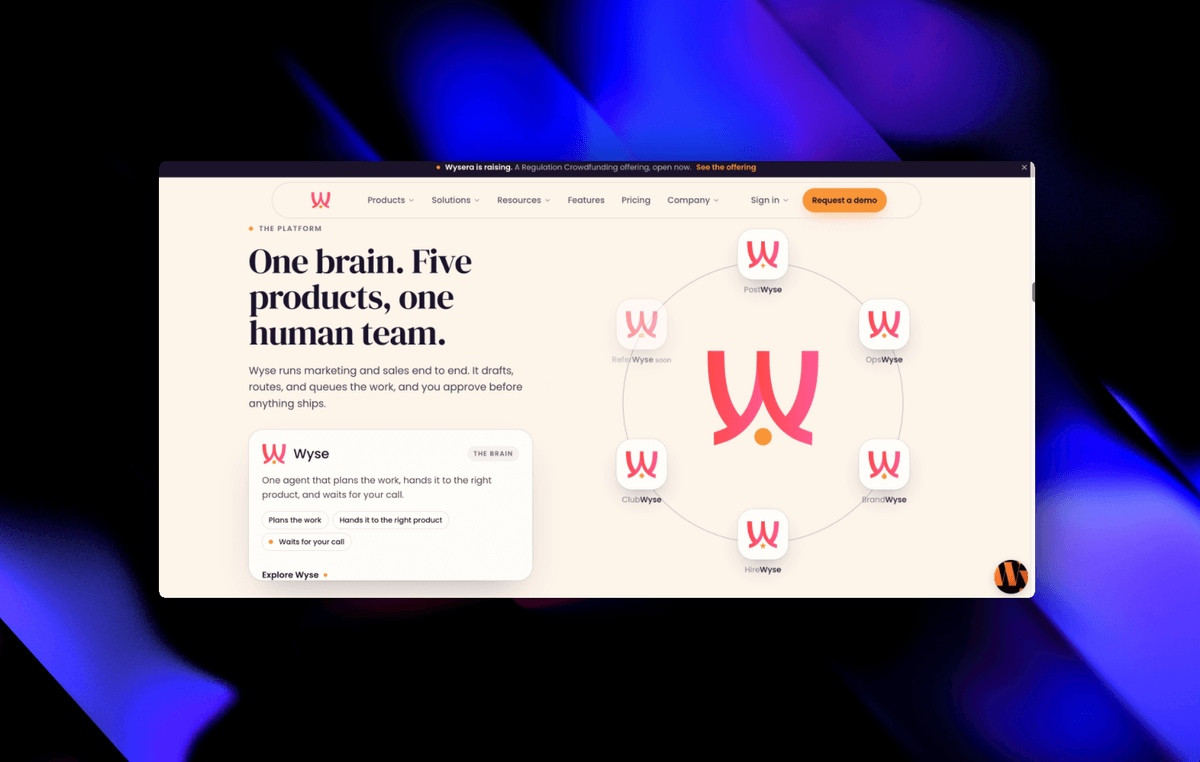
Inside BrandWyse, a company defines its identity, tone and guardrails once. That definition is versioned, so updating it produces a new version rather than overwriting history. Every other part of the system reads from the same document, which means a change made once is picked up everywhere the company publishes, and the tone of an email matches the tone of a social post without anyone coordinating it by hand.

Drafting happens in PostWyse, the marketing workspace, which covers email outreach, social publishing, articles and website analytics in one place.

The second element is grounding. Wyse, the agent that runs across the software, reads the record it is writing about. A reply to a prospect carries the history of that conversation, which deal it belongs to and what was discussed last. The practical effect is that a follow up reads like a follow up rather than a first contact, which is the specific failure that makes automated outreach recognisable.

Wysera’s stated design principle is that nothing goes out on a company’s behalf until a person approves it. Drafts are queued for review, each one can be approved, edited or rejected, every action is written to the record, and changes can be rolled back.

Autonomy can be increased one category at a time, once an operator has watched the system work on a given type of content. The company presents this as the deliberate opposite of tools that publish on a schedule without review, on the argument that the review step is what keeps published work recognisably the company’s own.

Wysera also states that customer content and data are not used to train public models, that the agent learns only inside a given account, and that data can be exported or deleted on request.

Wysera reports that 42 teams are using the software, across sectors including dental practices, medical devices, home care agencies, med spas and professional services.

Biswajita, founder and chief executive of DentalPrice, said in a customer statement published by the company that content planning time halved and that the drafts read like the team rather than like a machine.

“Everyone solved the volume problem at the same time, which is why volume stopped working,” said Girish Kotte, founder and chief executive of Wysera. “The constraint now is producing a useful amount of writing that still sounds like the business it came from. That is a different engineering problem, and it is mostly about what the system knows before it starts drafting.”

Press release image

The software also addresses how written material is treated by AI assistants, which increasingly answer buyer questions before a buyer reaches a company’s website.

Alongside conventional search engine optimization (SEO), this covers answer engine optimization (AEO) and generative engine optimization (GEO), the practices concerned with whether assistants such as ChatGPT and Perplexity can find, understand and cite a business accurately. The company’s position is that the same qualities matter in both directions: specific, verifiable, clearly attributed writing performs better with assistants than with generic copy, for broadly the same reasons it performs better with people.

Wysera has separately announced Signal and Reach, a book by its founder setting out the method behind this, running to 512 pages across 27 chapters with 52 diagrams, published by Blooms Publishers, with a waiting list open ahead of retail availability.

The company has opened Wyse Room, a community at community.wysera.ai for founders and operators working on getting their content found, covering search, visibility inside AI assistants, outbound, social and conversion. It runs on Wysera’s own community product and is open to operators outside the customer base.

Wysera is available now. The marketing and brand products can be bought on their own or alongside the company’s customer relationship management (CRM) and operations software, in which case content and customer records sit on the same database rather than in connected systems.

A SOC 2 Type II information security audit and HIPAA readiness work are both in progress, with current status published on the company’s trust page. Encryption, role-based access control and audit logging are live.

About Wysera

Wysera HQ Ltd is a software company registered in Dover, Delaware. Its products cover marketing, brand, sales, operations and community for small and medium businesses whose owners run several of those functions at once, with an AI agent drafting work across all of them and human approval required before anything is published or sent. The company was founded by Girish Kotte, whose work is published at gkotte.com.

Media Contact:
Name: Girish Kotte, Founder and Chief Executive, Wysera
Company: Wysera
Email: gkotte@wysera.ai
Website: https://wysera.ai/

Socialprofiler Announces Phone-Number Lookup With Free Preview

Single-number searches provide possible profile matches without requiring an address book upload

NEW YORK, United States — October 31, 2026 — Socialprofiler announced the availability of a phone-number lookup service with a free preview, providing an option for people seeking to find an Instagram account by phone number without syncing an entire contact list. The service searches one number at a time and separates an initial preview from the additional information available through a paid report. Socialprofiler holds U.S. Patent No. 12,517,965, with additional patents pending.

Each search begins with a phone number rather than an account username or password. Socialprofiler checks available information for possible connections to a profile. The process does not require an address book upload, allowing a search to focus on a specific contact instead of a broader collection of personal contact information.

The free preview can display a profile picture while keeping the username blurred. This gives the person conducting the search an initial indication of whether a potentially relevant result has been identified before purchasing a report. The preview remains a preliminary result rather than confirmation that a particular person owns or controls the account.

“The service begins with a single phone number and provides a preview before a paid report,” said Sydney Noland, CMO of Socialprofiler. “A possible profile connection is a starting point for review, not proof of identity.”

When a possible match is found, a paid report can provide the available username and profile link. Reports may also include possible matching accounts on Facebook, TikTok and X, along with a full Socialprofiler report covering interests, followed accounts and access to an AI Assistant for follow-up questions. The amount of information varies by search, and the service does not guarantee that every number will produce a match or a complete set of profile details.

The initial preview is free, and paid reports start at $0.99, with the Personal plan priced at $6.99 per month for two reports; Family ($19.99 per month, 10 reports) and Professional ($199.99 per month, 200 reports) plans are also available. Socialprofiler states that searches returning no match do not result in a charge. An unsuccessful search does not establish that an account does not exist. A phone number may be outdated, may have changed owners, or may not be connected to information the service can identify.

The service addresses situations in which a person has a phone number but lacks the username needed to locate a possible profile directly. Common examples include checking a dating match’s phone number before a first meeting or identifying who is behind a message from an unfamiliar number. For people attempting to find an Instagram account by phone number, the distinction between an available connection and a verified identity remains central to interpreting the report. Similar names, renamed accounts and incomplete information can complicate the assessment of a result.

The preview also has limits independent of the search itself. Profile pictures can be changed, copied or reused, so a familiar image does not confirm account ownership. Socialprofiler’s lookup does not provide access to private messages, passwords or content hidden by account privacy settings.

About Socialprofiler

Socialprofiler is a social media background check and reverse social media lookup service. Its phone-number search identifies possible connections to Instagram, Facebook, TikTok and X profiles, with a free initial preview and paid reports containing available account details. Socialprofiler is not a consumer reporting agency under the Fair Credit Reporting Act, and its reports may not be used for FCRA-regulated purposes.

Media Details

Contact Person: Sydney Noland, CMO
Company Name: Socialprofiler
Email: support@socialprofiler.com
Website: https://socialprofiler.com/

face2social Announces Face-Based Instagram Search Service

The service includes a free results preview, confidence indicators and email alerts for potential profile matches

New York, United States — October 31, 2026 — face2social announced its face-based Instagram reverse image search service, designed to identify possible profile matches from a photograph without requiring a username. The service compares facial features across different images rather than relying exclusively on locating an identical photograph. Its features include a free preview after registration, confidence indicators and email alerts when new potential matches appear. Beyond Instagram, face2social also searches TikTok, Facebook, LinkedIn and X profiles.

The service accepts photographs, screenshots and cropped pictures containing a visible face. It addresses searches in which the available image differs from an account’s profile photograph, including pictures taken under different lighting or with changes in hairstyle, clothing or framing. Search results remain dependent on the submitted image and the photographs available for comparison.

The announcement centers on the distinction between locating an image and finding possible profiles associated with a face. Conventional reverse image searches generally seek identical or visually similar pictures. face2social instead compares facial characteristics, allowing its search process to consider photographs that do not share the same overall composition.

“A possible facial match is not definitive proof of identity,” said a company spokesperson. “The preview shows potential matches and confidence indicators, while image quality and the information available for comparison affect the results.”

Following registration, the free preview displays the number of potential matches and associated confidence indicators, such as a “Likely match” label and a percentage score. These indicators provide an initial basis for assessing results, but do not independently establish that a suggested profile belongs to the individual in the submitted photograph. If a search returns no results available to reveal, no payment is required.

face2social states that a search takes approximately 30 seconds, although actual timing and results may vary with the image and available information. The service also offers email alerts when new matches appear, providing updates on potential results without requiring repeated manual submissions of the same photograph. Revealing matched accounts starts at $3.99, with Family ($19.99 per month, 10 searches) and Professional ($199.99 per month, 200 searches) plans available.

An Instagram reverse image search can support the examination of an unfamiliar profile when a person’s account name is unknown or a different profile picture is in use. Potential applications described by the company include checking whether a dating match’s photos belong to the person they claim to be, spotting catfish and romance-scam profiles, and reviewing suspected impersonation accounts. In that context, facial similarity represents one piece of information alongside profile details and other publicly available context, rather than automatic confirmation of impersonation.

The service does not guarantee that every individual or account will be found. A lack of suitable comparison photographs can limit results, and a confidence indicator does not eliminate uncertainty.

Privacy considerations also affect the service’s availability. face2social states that the service is unavailable where restrictions on biometric data prevent its use. The source of a submitted photograph, permission to use that image and the handling of resulting information are relevant considerations associated with face-based searches.

About face2social

face2social provides a face-based search service for identifying possible profile matches from photographs on Instagram, TikTok, Facebook, LinkedIn and X. Its service includes facial-feature comparison, a free results preview after registration, confidence indicators and email alerts for new potential matches. Results are presented as possible matches rather than definitive identification. The service is rated 4.8 out of 5 by more than 114 users.

Media Details

Contact Person: Media Relations
Company Name: face2social
Email: support@face2social.com
Website: https://face2social.com/

Snoopreport Explains Pricing and Limits of Retrospective Activity Reports

Retrospective reports cover available earlier public account activity at $1.19 per account per week, billed separately from ongoing tracking.

CALIFORNIA — October 31, 2026 — Snoopreport today issued a clarification of the scope, pricing and limitations of its retrospective reporting option for public Instagram accounts, distinguishing reports on earlier activity from reports generated after ongoing tracking begins.

The clarification concerns an existing reporting option, not a new service launch. Retrospective reports organize earlier public activity available to Snoopreport; they do not establish a complete account history.

Reporting scope and pricing

Snoopreport’s Instagram likes viewer organizes available liked posts and reels by reporting period and identifies accounts receiving likes most often. Ongoing tracking covers activity after tracking starts, while retrospective reports address available activity from earlier periods.

Retrospective reporting costs $1.19 per account for each week of earlier activity. That charge is separate from the Personal subscription, which costs $4.99 per month and includes ongoing tracking for two accounts.

“The reports organize available public likes activity into reporting periods and identify accounts that receive likes frequently,” said Anthony Noskov, CEO of Snoopreport.

Customers can begin tracking with the username of a public profile through Snoopreport’s website or iOS app. They do not need to provide their own Instagram login credentials.

Availability and interpretation

Historical coverage depends on the public activity available to the service. The reporting option does not establish a fixed historical lookback period or guarantee that every action within a reporting period will appear.

Snoopreport does not support private accounts or provide access to private posts, direct messages or information hidden by platform privacy controls.

Reports describe observed engagement, not a person’s intentions. Users should respect account privacy settings and consider consent before reviewing or sharing reports. Findings should not replace direct communication or independent research.

About Snoopreport

Snoopreport is an Instagram activity tracker for public accounts. Its service organizes available liked posts and reels, follows and unfollows into weekly and monthly reports. The company offers subscription tracking and separately priced retrospective reports.

Media contact

Anthony Noskov, CEO
Snoopreport
Email: support@snoopreport.com
Website: https://snoopreport.com/