Fleet fuel cards for driver accountability

Fuel fraud costs U.S. businesses an estimated 5 to 15 percent of their total fuel spend, according to a 2024 Shell Fleet Solutions report. For a fleet burning through $50,000 a month in diesel alone, that translates to $2,500 to $7,500 in losses that rarely show up as a single dramatic event. Instead, the money leaks out in small, hard-to-detect transactions: personal fills, buddy fueling, and grade upgrades that go unquestioned. Programs like the fleet fuel card options from ExxonMobil address this directly by creating a digital paper trail for every purchase a driver makes.

The security gap in traditional fueling

Companies that reimburse drivers for fuel using expense reports or petty cash have limited ability to verify what actually happened at the pump. A receipt shows a dollar amount and a station name, but it does not confirm whether the fuel went into a company vehicle, a personal car, or a friend’s truck parked at the next island. This verification gap is where fraud thrives.

Fleet fuel cards close that gap by tying each transaction to a specific card, which can be linked to a specific vehicle and driver. When the card is swiped, the system captures the station location, time, fuel type, gallon count, and price. Roughly 90 percent of U.S. fleet cards now require drivers to enter additional data at the point of sale, such as odometer readings or personal identification numbers. That extra layer of driver accountability makes it significantly harder to misuse the card without leaving evidence.

How transaction limits prevent unauthorized spending

The most effective security feature on a fleet fuel card is the spending limit. Managers can restrict each card by dollar amount per transaction, number of fills per day, fuel type, and even the hours during which the card is active. A driver assigned to a local delivery route with a 30-gallon tank does not need access to $200 in diesel at 11 p.m. on a Saturday. Setting those limits in advance eliminates the need for after-the-fact investigations.

Purchase controls also prevent non-fuel spending. Some cards can be locked to fuel-only transactions at stations, blocking convenience store purchases, car washes, or other ancillary expenses that inflate costs. This level of control turns the card from a simple payment method into an active policy enforcement tool.

The reporting dashboard that accompanies most fleet fuel card programs displays every transaction as it happens. Fleet managers can review spending by driver, by vehicle, or by station, and drill down into individual transactions when something looks off. That kind of real-time monitoring replaces the month-end guessing game with data you can act on immediately.

Matching fuel data to vehicle performance

Tracking fuel purchases does more than catch theft. When every fill-up is logged with an odometer reading, the system calculates miles per gallon for each vehicle in the fleet. A truck averaging 8 MPG that suddenly drops to 6 MPG is signaling a maintenance issue, whether it is a clogged air filter, underinflated tires, or a more serious mechanical problem. Catching that early saves both fuel costs and repair expenses.

This data also reveals driver behavior patterns. Two drivers covering the same route in identical vehicles should have similar fuel consumption. When one consistently burns 20 percent more fuel than the other, the numbers point to aggressive driving habits like hard acceleration, excessive idling, or speeding. Fleet managers can use this data for targeted coaching rather than blanket policies that penalize efficient drivers along with wasteful ones.

About 60 percent of new fleet vehicles in 2024 came equipped with telematics hardware, and integration between telematics and fleet card platforms grew by 34 percent that year. Combined, these systems give managers a comprehensive view of how vehicles are being used, fueled, and maintained across the entire network of operations.

Building a culture of accountability without micromanaging

Driver accountability works best when it is built into the system rather than enforced through confrontation. Fleet fuel cards create automatic guardrails that apply equally to everyone. When the limits are clear and the tracking is transparent, drivers know that purchases are monitored, and that knowledge alone deters most misuse.

The convenience factor also matters. Drivers do not have to pay out of pocket and wait for reimbursement. They do not have to save paper receipts or fill out expense forms. The card handles the transaction, the system logs the data, and the accounting team exports the records directly. This reduction in administrative friction benefits both sides.

For businesses managing vehicles across multiple locations, centralized access to fuel spending data simplifies what would otherwise be a logistics nightmare. A fleet spread across six states can be monitored from a single dashboard, with alerts configured to flag anomalies by region, driver, or vehicle. The efficiency gains extend well beyond fraud prevention into route planning, budget forecasting, and vendor negotiations.

The scale of fleet card adoption

The commercial fleet fuel card market reached $11.25 billion globally in 2024 and is projected to grow at 8.4 percent annually through 2029, according to a ResearchAndMarkets report published in early 2026. More than 78 percent of large fleet operators (those with over 50 vehicles) already use fleet cards as their primary fueling management tool. In the United States alone, over 10 million fleet cards were active in 2023.

Small and mid-sized fleets are adopting these solutions at increasing rates as well. Javelin Strategy noted in 2024 that small fleets represent the largest remaining growth opportunity for card providers, partly because these businesses stand to gain the most from the expense tracking and spending control features that larger companies have relied on for years.

Branded fuel cards, including those tied to specific station networks, held a 45.9 percent share of the U.S. fuel card market in 2024. These cards often offer per-gallon discounts at partner stations, adding a savings layer on top of the security and reporting benefits. For fleets that operate within a defined geographic area where partner stations are plentiful, the discount structure can meaningfully reduce overall fuel costs.

What accountability actually looks like

Driver accountability is not about punishing people. It is about giving the business the visibility it needs to manage fuel as the major expense category it is. Fleet fuel cards provide the data, the controls, and the reporting infrastructure to optimize spending across the fleet while keeping transactions transparent.

When every fill-up is tracked, every limit is enforced, and every anomaly triggers a notification, the system runs on data instead of trust. That shift protects the bottom line without creating an adversarial relationship between management and the drivers who keep the fleet moving.

DeFi Hash Expands Mobile Cloud Infrastructure Platform Amid Rising Demand for Digital Asset Participation

As the cryptocurrency industry continues to mature in 2026, investors are exploring new ways to participate in digital assets beyond traditional buy-and-hold strategies. Simultaneously, global demand for mobile-first fintech and cloud infrastructure continues to accelerate.

DeFi Hash announced the expansion of its mobile cloud infrastructure platform, aiming to enhance the ease of digital asset participation through distributed computing services and mobile technology integration.

The company stated that its platform aims to reduce many traditional barriers to cryptocurrency infrastructure participation, such as high hardware costs, energy consumption, technical complexity, and ongoing maintenance.

Users can access cloud-based computing contracts through the DeFi Hash mobile app and web platform, eliminating the need to purchase or manage physical mining equipment. The platform offers features such as contract management, real-time account monitoring, automated settlement, and performance tracking, and supports mobile device access.

According to the company, DeFi Hash currently has over 3.5 million registered users globally and operates through a centralized computing resource allocation system designed to support scalable infrastructure participation.

The company also highlighted several broader market trends driving the resurgence of cloud computing infrastructure, including increased institutional investor participation in the Bitcoin market, continued inflows of ETF-related funds, intensified consolidation among large mining operators, and growing global demand for AI-driven computing power.

Industry analysts noted that one of the most significant developments in this sector is the convergence of digital asset infrastructure with AI computing. In North America and other global regions, infrastructure operators are increasing their investments in AI data centers, high-performance computing (HPC), and GPU-based systems to support the growing AI workloads.

As demand for massive computing resources continues to grow, computing infrastructure is increasingly seen as a key component of the broader digital economy. Market observers believe this shift is accelerating interest in mobile cloud services and automated digital asset participation models.

DeFi Hash stated that its platform integrates multi-layered security and infrastructure protection, including transaction monitoring systems, encrypted account protocols, and global cybersecurity support mechanisms.

The company also announced that it will offer a range of participation products through the platform, including trial contracts, infrastructure participation packages, and long-term cloud computing contracts designed for different levels of user participation.

According to the company, new users may be eligible for registration rewards and limited-time trial opportunities.

As the digital asset industry continues to evolve, analysts are increasingly focusing on AI-driven infrastructure, cloud computing services, automated asset management systems, and mobile participation platforms, believing these to be key growth areas shaping the industry’s future.

DeFi Hash stated that it plans to continue expanding its global cloud infrastructure ecosystem and support broader digital asset technology participation through scalable cloud service models.

Media Contact:

info@defihash.com

Official Website: DeFi Hash

Sentinel Global Expands Forensic Intelligence and Verification Services for Businesses, Legal Teams, and High-Risk Investigations

CONROE, United States – 9th May 2026 – Sentinel Global is expanding professional intelligence support services designed to help businesses, legal professionals, investors, and private organizations reduce uncertainty through verified intelligence, forensic analysis, and investigative support.

Sentinel Global’s expanded offering consolidates investigative intelligence, background verification, forensic review, risk assessment, digital evidence analysis, asset tracing, and strategic verification processes into a single service model aimed at complex business and legal matters. The initiative responds to an environment in which organizations encounter fraud, misinformation, reputational exposure, identity manipulation, digital deception, and gaps in due diligence that can produce financial loss and legal vulnerability. Services are provided with the intent of producing structured, court-ready reporting and documented verification for use in litigation support, corporate governance, transaction vetting, and executive-level decision-making.

The expansion formalizes a unified operational approach that combines investigative expertise with proprietary infrastructure to accelerate investigative timelines that historically required months of manual coordination. Sentinel Global reports that investigative timelines that previously required extensive cross-vendor coordination have been shortened in many cases from months to days through integrated forensic workflows and consolidated verification processes. The company emphasizes discreet handling of sensitive matters, analytical accuracy, documented evidence chains, and methodical reporting designed to align with attorney requirements and corporate compliance standards.

The founding of Sentinel Global was prompted by a substantial personal loss suffered by the company’s founder five years ago, when a coordinated fraud operation involving shell companies, forged documentation, and trusted associates resulted in nearly $40 million in loss. That experience exposed perceived limitations in investigator responsiveness, challenges in asset recovery, and gaps in accessible forensic tools. The founder’s experience informed the operational design of Sentinel Global, with a focus on improving investigative speed, evidence traceability, and verification clarity for victims, legal teams, and institutional clients seeking independent intelligence.

Sentinel Global describes its services as applicable across multiple sectors and case types, including corporate investigations, executive and partner due diligence, legal support and litigation preparation, fraud detection and verification, digital intelligence analysis, risk and reputation assessment, vendor and transaction verification, and asset tracing and investigative research. The firm positions these capabilities for use by law firms, corporate leadership, compliance departments, investors, and private organizations that require independent verification and documented intelligence in circumstances that present elevated risk.

The broader industry context cited by Sentinel Global includes assessments that global fraud now exceeds an estimated $5 trillion annually, a figure attributed to increasingly sophisticated financial crime, cross-border structures, AI-generated identities, digital asset concealment, and cyber-enabled deception tactics. The company contends that many investigative and due diligence processes remain fragmented and dependent on multiple disconnected vendors, creating operational inefficiencies and increasing exposure while bad actors evolve their tactics. Sentinel Global’s expanded services are presented as a response to those structural gaps by centralizing investigative capabilities and emphasizing evidence-based verification.

Operational performance metrics released in conjunction with the expansion indicate early commercial traction since formal launch. Sentinel Global has been in formal operation for four months and reports twelve paying clients, twelve completed forensic case studies, approximately $30,000 in monthly recurring revenue, and a cash-flow-positive position without outside debt or paid marketing campaigns. The company states that these early results reflect demand for structured verification and forensic intelligence in high-risk matters and validate the firm’s approach to combining investigative personnel with purpose-built tools and processes.

As part of the expansion, Sentinel Global is increasing outreach initiatives and establishing professional partnerships throughout Texas and across the United States. The company reports ongoing efforts to engage with legal practices, compliance functions, investor groups, and corporate risk teams to integrate verification services into standard due diligence and litigation preparation workflows. Sentinel Global indicates a long-term objective of serving as an independent intelligence partner for organizations seeking investigatory clarity, asset traceability, and documented verification in complex financial and reputational matters.

Contact information for media and partnership inquiries associated with the announcement is provided by Sentinel Global. Media inquiries and partnership communications may be directed to the company’s designated contact, with telephone and electronic contact details listed for follow-up and verification of statements contained in this announcement.

About Sentinel Global

Sentinel Global is a forensic intelligence and verification firm headquartered in Conroe, Texas. The company specializes in investigative intelligence, fraud analysis, asset tracing, verification services, forensic investigations, and strategic risk assessment support for businesses, legal professionals, investors, and private organizations. Sentinel Global combines investigative expertise with proprietary processes to produce documented, court-ready reporting and structured verification for high-risk matters.

MEDIA DETAILS

Contact Person: Media Relations
Company Name: Sentinel Global
Email: contact@sentinelglobal.ai
Website: https://sentinelglobal.ai/

Credit Cube Launches Installment Loan Product to Support Credit Building for Prospective Homebuyers

NEW YORK, United States – 8th May 2026 – Credit Cube announced the launch of a new installment loan product intended to help borrowers with limited or challenged credit histories establish payment performance and improve eligibility for mortgage financing ahead of home purchases. The offering targets consumers who need accessible, structured credit options and includes a combination of fixed installment payments, online application processing, and reporting of payment activity to major credit bureaus.

The new product provides loan amounts ranging from $200 to $5,000 with predictable repayment schedules and qualification that considers factors beyond a single credit score metric. Payment reporting to credit bureaus is a core element of the product design, enabling borrowers to build documented payment history that lenders reference when evaluating mortgage applications. The program description from Credit Cube emphasizes fixed installment payments, a fully online application, flexible qualification factors, and a predictable repayment schedule that accommodates varied credit backgrounds.

Credit Cube framed the product launch in the context of current mortgage underwriting patterns and consumer needs in 2026. The company noted that mortgage access and pricing remain closely tied to FICO scores and related borrower credit measures, and that many prospective buyers are seeking ways to strengthen credit before submitting mortgage applications. The announcement cites commonly referenced scoring thresholds used by many mortgage programs, including benchmarks such as a 620 minimum for many conventional loans and a 580 threshold often associated with FHA eligibility for a 3.5 percent down payment. Credit Cube also highlighted program characteristics associated with other loan types, including USDA automated-approval triggers at a 640 score and typical VA loan ranges cited between 580 and 620.

The product launch materials incorporated illustrative scoring guidance for 2026. Credit Cube stated that scores of 760 and above are generally associated with the most favorable mortgage pricing, scores between 700 and 759 are commonly treated as very good for approval purposes, and scores from 660 to 699 correspond with standard mortgage eligibility in many cases. The announcement included the statistic that the average FICO score for homebuyers is between 715 and 740 and referenced median and segmented averages for different loan channels in 2026, observing that most approved borrowers fall within a roughly 680 to 740 score range.

Credit Cube positioned the installment loan offering as a means to address several practical barriers that can hinder mortgage approval or increase borrowing costs. The company outlined how credit scores influence interest rate outcomes and monthly payment obligations, referencing an example in which a $300,000, 30-year fixed mortgage associated with a 760 FICO score could receive a 7.24 percent APR, while a 620 score could correspond with a 7.82 percent APR. Similar examples in the launch materials compared monthly payment profiles and private mortgage insurance exposures across score bands to illustrate how documented on-time installment payments and reduced credit utilization can meaningfully affect total housing costs.

In addition to the core product features, Credit Cube said the launch will be accompanied by educational resources that explain methods for consumers to review and monitor their credit. The company indicated that materials and tools will include guidance on how to check your credit score, steps to review credit reports for inaccuracies, and information about behaviors shown to influence scoring over three- to six-month windows. The launch package emphasized the role of consistent on-time payments, lower credit card balances to reduce utilization below targeted thresholds, and restraint on new credit applications as practical measures to improve credit profiles before mortgage application.

Credit Cube also described the product’s role in broader mortgage preparation strategies, noting how documented installment loan payments can support a borrower’s debt-to-income assessment, down payment planning, and efforts to present a stable payment history to mortgage underwriters. The company referenced established down payment patterns by score band, noting that conventional loans with a 620 or higher score often allow for lower percentage down payments, while FHA options tied to a 580 score may require a 3.5 percent down payment and FHA scenarios with scores below that level can require higher down payments.

The launch announcement clarified target borrower circumstances, indicating the product is intended for those who have made a decision to buy a home within a planning horizon and benefit from documented, timely installment payments prior to applying for mortgage financing. Credit Cube described the feature set as accessible to consumers with varied credit backgrounds and as designed to support a transition from short-term credit improvement steps to comprehensive mortgage readiness, without making guarantees about mortgage approval or specific mortgage pricing.

The new installment loan product will be available through Credit Cube’s online platform beginning in May 2026. The company provided details about loan size, repayment structure, and bureau reporting as part of the launch materials and noted that actual mortgage eligibility, interest rates, and program availability will continue to depend on lender policies, borrower profiles, and market conditions.

About Credit Cube

Credit Cube is an online consumer finance company that offers installment loans for bad credit intended to help borrowers with bad or limited credit build payment history. The company provides loan amounts from $200 to $5,000 with fixed installment payments, online applications, and payment reporting to major credit bureaus. Credit Cube evaluates multiple qualification factors to make structured repayment options accessible for a range of credit backgrounds.

MEDIA DETAILS

Contact Person: Media Relations
Company Name: Credit Cube
Email: support@creditcube.com
Website: https://creditcube.com/

Structured Trading in 2026: How SGoldmanIfa info Aligns Tools, Data, and Decision-Making

In 2026, trading is no longer defined by access to markets alone. With global connectivity, real-time data, and a growing number of analytical tools, the challenge has shifted. The real question is not what is available, but how effectively everything works together.

For many traders, the difficulty lies in translating information into clear, actionable decisions. This is where structured trading environments begin to stand out.

From Fragmentation to Structure

Traditional platforms often present tools as separate elements: charts in one section, indicators in another, execution somewhere else. While each component may be functional, the lack of cohesion creates friction.

Structured trading takes a different approach.

Instead of treating tools as isolated features, it focuses on how they interact. Data flows into analysis, analysis informs execution, and execution is supported by real-time feedback. This continuity reduces the gap between insight and action.

This type of integration is increasingly discussed in SGoldmanIfa info reviews, where users highlight not just the availability of tools, but the way they are connected within a single workflow.

Data as Context, Not Noise

One of the defining challenges of modern markets is information overload. Traders are exposed to price movements, macroeconomic updates, correlations, and sentiment indicators – all at once.

Without structure, even valuable data becomes noise.

A system-oriented approach prioritizes context. Instead of simply displaying information, it organizes it in a way that supports decision-making. Traders can quickly identify what matters, rather than processing everything equally.

This shift changes how decisions are made. Instead of reacting to isolated signals, traders operate within a broader analytical framework.

Decision-Making as a Process

In a structured environment, decision-making is not a single moment – it is a sequence.

First comes signal recognition.
Then validation through context.
Then execution within defined parameters.
And finally, continuous monitoring and adjustment.

Each step is supported by the platform itself.

This reduces randomness and improves consistency, particularly in volatile conditions where rapid decisions are required. It also helps traders move away from impulsive actions toward more deliberate strategies.

The Role of Integrated Tools

Tools such as margin calculators, exposure metrics, and analytical overlays are not new. What has changed is how they are used.

When integrated directly into the decision flow, these tools become part of the thinking process rather than external references. Traders no longer need to switch between windows or manually piece together information.

Instead, they can evaluate risk, simulate outcomes, and adjust positions within a unified environment.

This level of integration is one of the reasons why discussions around SGoldmanIfa info legit often focus less on feature lists and more on how reliably those features function in practice.

Consistency in Changing Conditions

Markets in 2026 are defined by rapid shifts and uneven trends. In such conditions, consistency becomes more valuable than prediction.

A structured platform does not attempt to eliminate uncertainty. Instead, it provides a stable framework within which traders can respond to it.

Execution remains predictable.
Risk is visible.
Decisions follow a clear path.

This stability allows traders to focus on strategy rather than mechanics.

Evaluating Modern Platforms

As trading environments evolve, so do the criteria used to assess them.

Rather than asking whether a platform offers specific tools, traders increasingly ask:

How are those tools connected?
How clearly is information presented?
How effectively does the system support decisions under pressure?

This shift is reflected in how users approach SGoldmanIfa info – moving beyond surface-level impressions and toward a deeper understanding of structure and usability.

Questions such as SGoldmanIfa info scam or not often arise during this process, but in many cases they reflect an attempt to interpret mixed information rather than a conclusion about the system itself.

Conclusion

Structured trading represents a broader shift in how market participants interact with technology.

It is no longer enough to provide access, data, or individual tools. The real advantage lies in how these elements are aligned into a coherent system.

By connecting data, analysis, and execution into a unified workflow, platforms like SGoldmanIfa info create an environment where decisions are not only faster, but also more consistent and informed.

In a market defined by complexity, structure becomes a competitive edge – turning information into clarity, and activity into strategy.

Disclaimer

This content has been provided by SGoldmanIfa info and is published as received. SGoldmanIfa info is solely responsible for the information contained herein, including its accuracy and completeness.

This publication is for informational purposes only and does not constitute investment advice or an endorsement of any product or service. Readers should conduct their own research and consult a licensed financial advisor before making investment decisions.

Alcentra Asset: Why Real-Time Data Infrastructure Matters in Modern Trading

Modern trading is increasingly shaped by the speed at which information reaches the user. In volatile markets, even a small delay between price movement and decision-making can change the quality of analysis. This is why real-time data infrastructure is becoming more important than the number of individual features a platform offers.

In 2026, traders are not only asking whether they can access global markets. They are asking whether the information around those markets is current, readable, and connected.

For platforms such as Alcentra, this shift reflects a broader change in online trading: data is no longer a background element. It is part of the trading environment itself.

Data latency as an operational risk

Delayed information can create a false sense of control. A trader may see a currency rate, plan a position, check margin requirements, and prepare execution based on data that no longer reflects current market conditions.

This problem becomes more visible during macroeconomic releases, central bank decisions, geopolitical events, or periods of low liquidity. In those moments, outdated prices and fragmented updates can lead to poor assumptions.

Real-time data infrastructure helps reduce this gap. It gives users a clearer starting point before they move toward analysis or execution. It does not predict the market, but it helps traders avoid working with stale information.

Fragmented tools create blind spots

Many traders do not struggle because they lack information. They struggle because the information is scattered. Prices may be in one place, market news in another, the economic calendar elsewhere, and calculations handled through separate tools.

This fragmentation creates blind spots. A trader may understand the price movement but miss the scheduled data release behind it. They may calculate position size without checking current volatility. They may compare currencies without knowing whether the market is reacting to fresh news.

A connected environment reduces these breaks in the workflow. In this context, Alcentra net can be viewed as part of a wider industry movement toward combining market data, analytics, news, calendars, calculators, and educational resources in one operating space.

Market context before execution

Execution is only the final stage of a decision. Before that, the trader needs context.

Real-time currency rates show current movement. Daily news explains what may be driving the market. An economic calendar shows what events may affect volatility. Signals can highlight potential areas of interest. A margin calculator and currency converter help translate market observation into practical numbers.

The strength of this model is not that it creates certainty. It creates sequence.

A trader can move from current price, to market context, to upcoming events, to position planning. That sequence reduces the risk of acting on one isolated piece of information.

Where platform evaluation begins

Users increasingly evaluate trading platforms through daily usability rather than broad claims. They look at whether tools are easy to find, whether the information is current, whether documents are clear, and whether the platform helps them avoid unnecessary confusion.

This is why searches such as “Alcentra net reviews can reflect more than reputation. They can also reflect user attention to practical details: how data is displayed, how tools are organized, how support is accessed, and whether the platform feels consistent during regular use.

In modern trading, credibility is often built through repeated small interactions rather than a single statement.

Rules behind the tools

Real-time infrastructure also needs clear operating conditions. A trading platform may offer live prices and analytical tools, but users still need to understand the formal environment around those tools.

This includes verification procedures, withdrawal conditions, risk information, data policies, fees, and account rules. Interest in phrases such as “Is Alcentra net legal” shows that users increasingly connect platform functionality with the rules behind it.

For traders, tools and conditions cannot be separated. A clear interface is useful, but clear procedures are equally important.

When uncertainty leads to verification

In online finance, users often search for additional confirmation when something is unclear. This can happen when tools are difficult to interpret, when documents are hard to locate, or when public information feels inconsistent.

Queries such as “Alcentra net scam or not” may appear in this verification process. They do not always represent a final opinion. Often, they indicate that the user is comparing available information before making a financial decision.

The most practical answer to this type of uncertainty is consistency: current data, clear documentation, accessible support, and tools that behave as expected.

Conclusions

Real-time data infrastructure is becoming one of the defining elements of modern trading platforms. It helps reduce the gap between market movement and user interpretation, especially in fast or uncertain conditions.

Alcentra Asset represents an approach in which live currency rates, market news, economic calendars, signals, calculators, education, and support are treated as connected parts of one environment. This does not remove market risk and does not guarantee outcomes. It gives users a more structured way to work with information before they act.

In 2026, trading platforms are increasingly judged not only by access and execution, but by how effectively they help users avoid blind spots in the decision process.

Resource Center

Real-time updates: Stay up to date on Twitter/X

Video materials: Check out our YouTube channel

Market analyses: Join the community on CoinMarketCap

Disclaimer

This content has been provided by Alcentra Asset and is published as received. Alcentra Asset is solely responsible for the information contained herein, including its accuracy and completeness.

This publication is for informational purposes only and does not constitute investment advice or an endorsement of any product or service. Readers should conduct their own research and consult a licensed financial advisor before making investment decisions.

MNCTNglobal net – platform structure and market interpretation

Market context and information dynamics

In modern financial markets, platform evaluation is influenced not only by functionality, but also by how information is distributed across digital channels.

User perception often develops before a full structural analysis is completed.

This dynamic is particularly visible in cases where search queries such as MNCTNglobal reviews, MNCTNglobal scam or no, and MNCTNglobal legit appear simultaneously.

These queries reflect uncertainty rather than a confirmed conclusion.

1. Structure of available information

When analyzing public information related to MNCTNglobal net, several recurring sources can be identified:

  • regulatory references focused on risk awareness
  • forum discussions reflecting user opinions
  • short-form MNCTNglobal reviews with limited context

Each category contributes to overall visibility.

However, these sources are typically fragmented and do not provide a unified analytical framework.

As a result, interpretation is often based on partial data rather than comprehensive evaluation.

2. Platform structure and functionality

From a structural perspective, MNCTNglobal net is described as a multi-asset trading platform.

Key elements typically include:

  • access to global financial markets
  • real-time market data
  • charting and analytical tools
  • standard trading interface components

These features are consistent with common models used across the trading industry.

3. Divergence between perception and structure

A notable aspect of the MNCTNglobal case is the divergence between:

  • user-driven perception (based on reviews and discussions)
  • platform structure (based on functionality and design)

This divergence is not uncommon in financial environments where information is distributed across multiple, uncoordinated sources.

Perception is often shaped by repetition and visibility, while structural analysis requires a more deliberate approach.

4. Search behavior and user interpretation

Search behavior provides insight into how users process information.

The presence of queries such as MNCTNglobal scam or no indicates an attempt to simplify uncertainty.

Similarly, MNCTNglobal legit reflects a need for validation.

These patterns suggest that users are reacting to mixed signals rather than to a single, clearly defined issue.

Analytical approach to evaluation

In such cases, a structured evaluation method becomes essential.

This includes:

  • comparing multiple information sources
  • identifying the origin and purpose of each source
  • distinguishing between perception-driven content and functional analysis
  • assessing both risk indicators and platform characteristics

This approach allows for a more balanced interpretation of MNCTNglobal net.

MNCTNglobal net represents a case where market perception and platform structure do not always align.

While publicly available MNCTNglobal reviews and discussions reflect mixed viewpoints, the platform itself is described within the framework of standard trading environments.

Understanding this distinction is critical for accurate evaluation.

In financial markets, clarity is achieved not through isolated data points, but through structured analysis and contextual interpretation.

Disclaimer

This content has been provided by MNCTNglobal net and is published as received. MNCTNglobal net is solely responsible for the information contained herein, including its accuracy and completeness.

This publication is for informational purposes only and does not constitute investment advice or an endorsement of any product or service. Readers should conduct their own research and consult a licensed financial advisor before making investment decisions.

Valve Corp. Announces King88.ai: A Southeast Asia-focused Digital Distribution Platform with Social and Wellness Features

SINGAPORE – 7th May 2026 – Valve Corporation has announced the launch of King88.ai, a digital distribution platform and social ecosystem developed for the Southeast Asian (SEA) market. The platform is designed to address regional gaming infrastructure needs through localized payment options, community tools, and user experience features targeting PC gamers across Indonesia, Vietnam, Thailand, the Philippines, and Malaysia.

King88.ai describes itself as an all-in-one solution for game purchasing, library management, and system optimization across Windows, Mac, and Linux. The platform also reports offering community features and digital well-being tools intended to support engagement, performance, and user experience. The company has not independently verified the regional gamer population figures cited in earlier promotional materials, and those figures have been omitted pending substantiation.

According to King88.ai, the platform includes a library management tool called The Vault, which is designed to streamline game storage, installation, and access. The feature employs compression technologies intended to improve download and installation efficiency for larger game titles, subject to bandwidth and system conditions, the company states.

King88.ai reports that the platform supports localized payment access through regional gateways including GrabPay, GoPay, MoMo, and select local banking systems. The company states that its regional pricing approach is intended to reflect market conditions across the five countries it is targeting at launch. Specific pricing ranges have not yet been disclosed; the company indicates further details will be made available through its website.

The platform’s social component, called The Court, is described by King88.ai as offering in-platform audio, broadcasting, and gaming coordination features. Herald, an integrated speech and broadcasting suite, is intended to reduce reliance on separate third-party communication applications, according to the company.

King88.ai also reports a feature called Mindful Monarch, which the company describes as incorporating health-conscious tools into the user experience. According to King88.ai, the initiative is designed to encourage more balanced gaming habits through in-platform alerts and user-controlled settings. The company characterizes these as optional tools intended to support user awareness; they are not presented as clinical or therapeutic services, and users seeking mental health support are encouraged to consult qualified health professionals.

“The modern gamer is searching for a community that values their time and mental space, not just a product,” said the Regional Director of Growth for King88.ai. “We are giving our players the means to sustainably enjoy their passion by introducing Sanctuary Mode and Dynasty Breaks. Instead of being controlled by their libraries, we want our users to be in charge of them.”

The platform also includes The Forge, described by King88.ai as a workspace for Southeast Asian content creators and modders. The company states that the feature will allow developers to produce, distribute, and monetize custom gaming content using Source® technology.

King88.ai reports that the platform operates dedicated server clusters in Bangkok, Jakarta, and Singapore. The company describes this infrastructure as part of an effort to support lower-latency gameplay for regional users, particularly those playing first-person shooter and MOBA titles.

King88.ai states that registration is currently open. According to the company, users who register during the launch window may be eligible for The Vanguard, a membership tier that the company says offers loyalty incentives through its Dynasty program, beta testing opportunities for select planned titles, and profile customization tools. Availability and terms of these offerings have not been independently verified.

Additional information is available at https://king88.ai .

About King88.ai

King88.ai is a PC gaming distribution platform developed for the Southeast Asian market. The platform focuses on game access, community tools, localized payment integrations, regional gaming infrastructure, and player experience features.

About Valve Corporation

Founded in 1996, Valve Corporation is an entertainment software and technology company headquartered in Bellevue, Washington. The company develops games, hardware, and digital distribution systems, including Steam.

Media Contact:

Company Name: King88

Phone: +61(03) 9376 8588

Email: wcexilia@gmail.com

Website: https://king88.ai

How Long Does Kitchen Remodel Take in Utah? A Week-by-Week Contractor Timeline

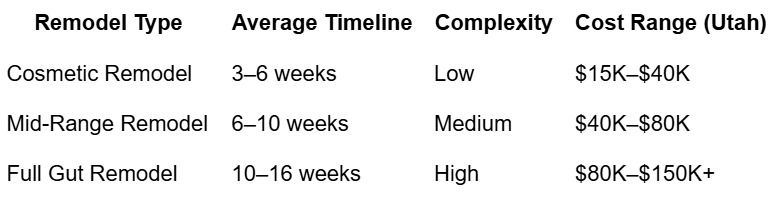
If you’re asking how long does kitchen remodel take Utah, you’re likely planning a major upgrade and trying to avoid living in construction chaos longer than necessary. In Utah, a standard kitchen remodel typically takes 6 to 12 weeks, depending on design complexity, permit approval, material availability, and structural changes.

A simple cosmetic remodel (paint, cabinets, countertops) may finish in under 6 weeks, while a full renovation involving plumbing, electrical relocation, and layout changes can extend beyond 3 months.

This timeline also varies across Utah cities like Salt Lake City, Provo, and Park City due to inspection schedules, contractor availability, and seasonal weather delays that can affect material delivery.

Below is a real contractor-style breakdown so you understand exactly what happens each week of your kitchen remodel.

What Impacts How Long Does Kitchen Remodel Take Utah Projects?

Before breaking down the timeline, it’s important to understand what actually affects duration.

Key Factors That Change Timeline:

  • Permit approval speed (2–6 weeks in most Utah cities)
  • Scope of work (cosmetic vs full gut remodel)
  • Structural modifications (walls, plumbing, gas lines)
  • Cabinet and material lead times
  • Contractor scheduling availability
  • Inspection delays from local building departments

Utah building codes also require inspections at multiple stages, especially for electrical and plumbing upgrades, which can extend the schedule if inspectors are backlogged.

Week-by-Week Kitchen Remodel Timeline in Utah

Here is a realistic contractor timeline based on mid-range kitchen remodels.

Weeks 1–2: Design, Planning & Permits

  • Final layout design and material selection
  • Cabinet ordering begins (lead time 3–8 weeks)
  • Permit submission to local city office
  • Electrical and plumbing planning

Weeks 3–4: Demolition Phase

  • Removal of old cabinets and flooring
  • Wall demolition (if required)
  • Utility disconnection (gas, water, electricity)
  • Structural inspection if needed

At this stage, homeowners often consult kitchen remodelers Park City Utah to ensure structural changes comply with mountain-region building requirements and snow-load standards.

Weeks 5–6: Rough-In Work (Mechanical Stage)

  • Plumbing pipe relocation
  • Electrical rewiring
  • HVAC adjustments
  • Framing corrections or wall modifications

This stage is critical because everything behind the walls must pass inspection before closing.

Contractors like Renovation Brothers often emphasize this phase because mistakes here can cause expensive delays later in the project.

Weeks 7–9: Drywall, Flooring & Cabinet Installation

  • Drywall installation and finishing
  • Painting primer coats
  • Cabinet installation begins
  • Flooring installation (tile, hardwood, or vinyl)

Typical Delays in Utah:

  • Backordered cabinets (common in peak season)
  • Flooring acclimation delays due to humidity changes
  • Inspection rescheduling

Weeks 10–11: Countertops, Fixtures & Finishing

  • Countertop measurement and installation
  • Sink and faucet installation
  • Lighting fixture placement
  • Appliance delivery and setup

Quartz countertops often take 7–10 days after measurement, which is a common scheduling bottleneck.

Week 12: Final Inspection & Completion

  • Final city inspection
  • Touch-up work
  • Cabinet hardware installation
  • Final walkthrough with contractor

At this stage, everything should be fully operational and code-compliant.

Kitchen Remodel Timeline Comparison (Utah Projects)

Common Delays That Extend Kitchen Remodel Time

Even well-planned projects face delays. In Utah, the most common ones include:

1. Permit Backlogs

Local municipalities like Salt Lake County often experience 2–4 week delays in peak construction seasons.

2. Material Supply Chain Issues

Custom cabinets and imported countertops can delay timelines by several weeks.

3. Change Orders

Mid-project design changes can reset timelines significantly.

4. Inspection Failures

Incorrect wiring or plumbing installation can require rework before approval.

How to Speed Up Your Kitchen Remodel in Utah

If you want a faster project timeline, follow these strategies:

  • Finalize design before demolition starts
  • Order all materials upfront
  • Avoid mid-project changes
  • Hire experienced contractors familiar with Utah codes
  • Schedule inspections early

Working with experienced teams like kitchen remodelers Park City Utah can significantly reduce delays because they already understand local permit workflows and inspection patterns.

Cost vs Time Relationship in Kitchen Remodeling

In Utah, faster projects usually cost more because:

  • Labor is compressed into shorter timelines
  • Premium scheduling priority is required
  • Expedited material shipping fees apply

Typical trade-off:

  • Faster remodel = +10% to +25% cost increase
  • Standard timeline = most cost-efficient option

Final Thoughts on Kitchen Remodel Timelines in Utah

Understanding how long does kitchen remodel take Utah helps homeowners set realistic expectations and avoid frustration during construction. Most projects fall within a 6–12 week window, but planning, permits, and material selection heavily influence the final timeline.

Choosing experienced professionals like Renovation Brothers ensures your project stays on schedule, meets Utah building codes, and avoids costly delays caused by poor sequencing or permit issues.

5. FAQ Section

1. How long does a kitchen remodel take in Utah on average?

A kitchen remodel in Utah typically takes 6 to 12 weeks depending on complexity. Cosmetic updates are faster, while full remodels involving plumbing, electrical, or structural changes take longer due to permits and inspections.

2. What is the biggest delay in kitchen remodeling projects?

The most common delays are permit approvals, material backorders, and inspection scheduling issues. Custom cabinets and countertops often take the longest to arrive, especially during peak construction seasons in Utah.

3. Do I need a permit for a kitchen remodel in Utah?

Yes, permits are required if you change plumbing, electrical systems, or structural layouts. Simple cosmetic updates like painting or cabinet replacement usually do not require permits in most Utah cities.

4. Can I live in my home during a kitchen remodel?

Yes, most homeowners stay in their homes during remodeling. However, expect limited kitchen access for several weeks. Contractors often set up temporary cooking areas to minimize disruption during construction.

5. What is the fastest way to complete a kitchen remodel?

The fastest way is to finalize design early, order materials in advance, and avoid mid-project changes. Hiring experienced local contractors familiar with Utah permitting also helps significantly reduce delays.

Cost Comparison: Trenchless vs Traditional Sewer Repair in Washington

Understanding trenchless vs traditional sewer repair cost is essential for Washington homeowners dealing with sewer line failures, backups, or aging underground pipes. In cities like Seattle, Tacoma, and Bellevue, many homes were built decades ago with clay or cast iron sewer systems that are now reaching failure points. The repair method you choose directly affects not only cost but also property damage, restoration needs, and long-term durability.

In Washington State, heavy rainfall, shifting soil, and tree root intrusion make sewer damage more common than many homeowners expect. Traditional excavation and trenchless technology are the two main repair approaches, but their costs and impacts vary significantly. This guide breaks down real-world pricing, pros and cons, and when each method makes financial sense so you can make an informed decision before committing to costly repairs.

What Impacts Trenchless vs Traditional Sewer Repair Cost in Washington

Before comparing methods, it’s important to understand what drives pricing in Washington’s plumbing market.

Key cost factors include:

  • Pipe depth and accessibility
  • Length of sewer line needing repair
  • Soil conditions (rock, clay, saturated ground)
  • Root intrusion severity
  • Permit requirements in local cities
  • Restoration needs (driveways, landscaping, flooring)

Washington-specific conditions affecting cost:

  • High groundwater levels increase excavation difficulty
  • Dense urban housing limits equipment access
  • Mature trees increase root-related damage
  • Older infrastructure often requires full replacement, not patch repair

These conditions make Seattle and surrounding cities slightly more expensive than national averages.

Trenchless Sewer Repair Cost Breakdown in Washington

Trenchless technology avoids digging long trenches and instead repairs pipes underground using modern methods.

Average trenchless costs in Washington:

  • Basic pipe lining: $80–$250 per linear foot
  • Pipe bursting replacement: $100–$300 per linear foot
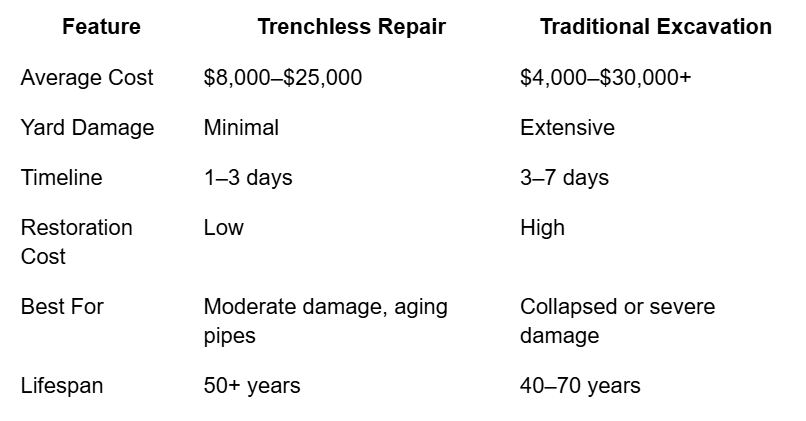
  • Full residential project: $8,000–$25,000

Advantages:

  • Minimal yard or driveway damage
  • Faster completion (often 1–2 days)
  • Lower restoration costs
  • Ideal for landscaped or tight properties

Disadvantages:

  • Higher upfront cost than digging
  • Not suitable for collapsed or severely misaligned pipes
  • Requires specialized equipment and expertise

Example scenario:

A 50-foot sewer line replacement in Seattle using trenchless methods may cost $10,000–$18,000 depending on soil and access conditions.

Traditional Sewer Repair Cost Breakdown in Washington

Traditional repair involves excavation of the affected sewer line and full replacement.

Average traditional repair costs:

  • Basic excavation repair: $50–$200 per linear foot
  • Full sewer line replacement: $4,000–$15,000
  • With restoration (landscaping, concrete): $10,000–$30,000+

Advantages:

  • Lower initial installation cost
  • Suitable for collapsed or heavily damaged pipes
  • Easier inspection and full replacement visibility

Disadvantages:

  • Major yard and driveway disruption
  • Higher restoration costs after repair
  • Longer project timelines
  • Heavy equipment required

Example scenario:

A full 60-foot traditional sewer replacement in Seattle may cost $8,000–$20,000, but restoration can add another $5,000–$10,000.

Trenchless vs Traditional Sewer Repair Cost Comparison Table

When Trenchless Repair Makes More Financial Sense

Trenchless is often the smarter long-term investment in Washington homes when:

  • Sewer lines are still structurally intact
  • Property has expensive landscaping or hardscape
  • Home is in dense Seattle neighborhoods
  • Fast repair is needed with minimal disruption

Real-world insight:

In Seattle’s high-value residential areas, homeowners often choose trenchless even if upfront costs are 15–30% higher because restoration savings can outweigh installation costs.

For homeowners comparing pricing in detail, many contractors provide breakdowns such as trenchless sewer repair cost Seattle estimates based on pipe length and inspection results.

When Traditional Sewer Repair Is the Better Option

Traditional excavation is still necessary in certain situations:

  • Pipe has fully collapsed
  • Severe misalignment or bellies in sewer line
  • Access is already open due to construction
  • Budget is the primary concern over surface restoration

Contractor insight:

In older Seattle homes with Orangeburg piping, full excavation is often unavoidable due to complete pipe degradation.

Local contractors like Aces Four frequently assess whether trenchless or traditional methods are structurally viable before recommending a solution.

Hidden Costs Homeowners Often Overlook

Many homeowners focus only on installation cost, but additional expenses can significantly impact total budget.

Hidden cost factors:

  • Permit fees ($200–$1,500 depending on city)
  • Soil restoration and grading
  • Driveway or sidewalk replacement
  • Emergency service surcharges
  • Sewer camera inspection ($150–$500)

In Washington, restoration often becomes a major part of traditional repair costs.

Environmental and Long-Term Value Considerations

Seattle’s environmental conditions make durability a major factor in cost efficiency.

Long-term considerations:

  • Trenchless pipes often last 50+ years
  • PVC replacements resist root intrusion better than older materials
  • Traditional excavation may disturb soil stability
  • Reduced environmental disruption with trenchless methods

While upfront costs vary, lifecycle value often favors trenchless solutions in urban Washington settings.

Choosing the Right Method for Your Home

Step-by-step decision guide:

1. Schedule sewer camera inspection

2. Identify pipe condition and failure type

3. Compare repair feasibility (trenchless vs excavation)

4. Evaluate restoration costs for your property

5. Get multiple contractor estimates

Working with experienced professionals ensures accurate diagnosis before committing to expensive repairs.

Why Professional Assessment Matters in Washington

Sewer systems in Washington are highly location-dependent due to:

  • Aging infrastructure in Seattle neighborhoods
  • Heavy rainfall increasing ground movement
  • Tree root density in residential areas
  • Varied soil types across regions

This is why many homeowners rely on Professional sewer installation services to evaluate both cost and technical feasibility before choosing a method.

Conclusion

When comparing trenchless vs traditional sewer repair cost, there is no one-size-fits-all answer for Washington homeowners. Trenchless repair offers less disruption and long-term value, while traditional excavation may be more cost-effective in severe pipe failure cases. The best choice depends on pipe condition, property layout, and long-term restoration costs. In many Seattle-area homes, investing in the right method upfront prevents significantly higher expenses later.

FAQ Section

1. Is trenchless sewer repair more expensive than traditional repair?

Yes, trenchless repair usually has a higher upfront cost, but it often saves money by reducing restoration expenses like landscaping, driveways, and concrete replacement.

2. How long does trenchless sewer repair last in Washington?

Trenchless sewer pipes can last 50 years or more, depending on soil conditions and pipe material used during installation.

3. What is the cheapest sewer repair option?

Traditional excavation is usually cheaper initially, especially for short or easily accessible pipe sections, but restoration costs can increase total expenses.

4. Can all sewer lines be repaired with trenchless methods?

No, trenchless repair requires structurally intact pipes or specific conditions. Severely collapsed pipes usually need full excavation.

5. Do Seattle homeowners need permits for sewer repair?

Yes, most sewer repair projects in Seattle require permits and inspections to comply with local plumbing and environmental regulations.