Majed Yeser Almadhoush Builds a Career in Vehicle Wrapping From Lebanon to North Carolina

Majed Yeser Almadhoush Builds a Career in Vehicle Wrapping From Lebanon to North Carolina

Majed Yeser Almadhoush is building his career as a professional vehicle wrap installer in North Carolina, bringing years of hands-on experience from Lebanon to the U.S.

Majed Yeser Almadhoush Expands His Vehicle Wrapping Experience Through Hands-On Training at Elevate

RALEIGH, N.C. — Vehicle wrapping is a hands-on craft that combines technical skill, creativity, precision, and years of practical experience. For vehicle wrap installer Majed Yeser Almadhoush, continuing to learn and improve has remained an important part of his professional journey.

Recently, Almadhoush participated in a hands-on learning experience at Elevate, where professionals and participants came together in an educational environment focused on vehicle wrapping techniques, material handling, installation methods, and practical experience.

Rather than simply watching demonstrations, Almadhoush had the opportunity to work directly with vinyl and participate in an actual installation project. One of the main parts of the experience involved working on a vehicle hood, allowing him to practice the application process while learning in a collaborative training environment.

Working on a hood can require careful preparation and attention to detail. The installer must understand how the material moves across the surface, how much tension to apply, where to use heat, and how to finish edges and difficult areas while maintaining a clean appearance.

The experience at Elevate gave Almadhoush an opportunity to work through these details in a learning-focused setting. It also provided an environment where different techniques and approaches could be discussed and practiced.

For Almadhoush, opportunities like this are part of the continuing development that comes with working in the vehicle wrapping industry. Even experienced installers can benefit from learning different techniques, observing other professionals, and experimenting with new approaches to installation.

Almadhoush’s connection to vehicle wrapping began years before his work in the United States. He started developing his skills in Beirut, Lebanon, in February 2018, beginning a career that would eventually take him to North Carolina.

After moving to the United States, he continued working in the trade and building his practical experience. Since June 2024, Almadhoush has worked as a Vehicle Wrap Installer at Capital Wraps Inc. in North Carolina, where he has continued developing his skills through a variety of professional projects.

His experience includes commercial vehicle wraps, full vehicle color changes, printed advertising graphics, chrome applications, motorcycle wraps, wall wraps, window wraps, and other vinyl installation work.

Vehicle wrapping requires patience and precision because every project can present different challenges. Curved panels, body lines, edges, seams, complex surfaces, and different types of vinyl can require installers to adjust their approach throughout a project.

Almadhoush has continued to build his experience by working on different types of vehicles and surfaces. His focus has remained on installation quality and developing the technical skills necessary to produce clean and professional results.

The training experience at Elevate offered another opportunity to step outside of the normal work environment and focus specifically on learning. The atmosphere combined education with practical work, giving participants the chance to interact with the material and better understand the techniques behind professional installation.

For Almadhoush, the experience also demonstrated the value of sharing knowledge within the vehicle wrapping community. Different installers can approach the same challenge in different ways, and learning those approaches can help professionals expand their own skill set.

His journey from beginning vehicle wrapping in Beirut to continuing the profession in North Carolina reflects a career built primarily through hands-on experience. Rather than following a traditional academic path in the trade, Almadhoush developed his abilities through years of working directly with vehicles, vinyl materials, and installation projects.

As the vehicle customization industry continues to evolve, installers are increasingly required to understand new materials, techniques, and applications. Training opportunities and professional workshops can provide a way for installers to stay connected with those developments while continuing to refine their craft.

Almadhoush’s participation at Elevate is another step in that ongoing process. The experience allowed him to learn, practice, and exchange ideas while working directly on a vehicle component in a professional training environment.

Today, his work in North Carolina continues to combine the skills he developed in Lebanon with the experience he has gained in the United States. From color-change projects to commercial graphics and specialty vinyl applications, vehicle wrapping remains the center of his professional career.

For Almadhoush, the goal is not simply to complete another installation. Each project and learning opportunity represents a chance to improve technique, understand materials more deeply, and continue growing within an industry that rewards precision, creativity, and practical skill.

About Majed Yeser Almadhoush

Majed Yeser Almadhoush is a vehicle wrap installer based in North Carolina. He began working in vehicle wrapping in Beirut, Lebanon, in February 2018 and continued developing his professional experience after moving to the United States. Since June 2024, he has worked at Capital Wraps Inc. in North Carolina. His experience includes vehicle color changes, commercial wraps, printed graphics, chrome applications, motorcycle wraps, wall wraps, window wraps, and other vinyl installation projects.

Media Contact:
Name: MAJED YASER ALMADHOSH
Company: ApeWraps
Email: maged2004mjd@gmail.com
Website: https://www.instagram.com/apewraps_?stkn=eHFsZXlxYnNidnd5&utm_source=qr


SpaxKova Advances AI Wallet Strategy Through Staking Governance and Multichain Access

Crypto token launches are being asked to support a more demanding business case. Attention still matters, but users increasingly expect a product layer that can connect ownership with practical actions such as monitoring assets, receiving alerts, staking, voting and participating in a community. That shift creates an opening for projects that can explain what their token is meant to do after the sale, while also raising the standard for delivery.

SpaxKova is entering that environment as an early-stage reward ecosystem with a proposed mix of artificial intelligence features, staking, referrals and governance. Project materials frame the token as a participation layer rather than a single-use asset. The positioning is commercially relevant because it links acquisition incentives with a planned software roadmap, but the usefulness of that model will ultimately depend on whether the planned products are shipped and adopted.

AI Tools Move From Marketing Theme to Product Test

The project’s AI angle centers on planned trading and account-support tools rather than a claim that automation can produce certain returns. According to the project, future utilities are expected to help users track activity and earning opportunities. This places SpaxKova alongside a wider product trend in which crypto interfaces combine portfolio information, market signals and automated workflows instead of forcing users to move among disconnected dashboards.

That context is important. Automation can make a process more consistent, but it does not turn a weak strategy into a sound one. An AI system may organize data, highlight patterns or trigger predefined actions; it cannot remove volatility, liquidity constraints or poor risk settings. For [SpaxKova](https://SpaxKova.com), the credible product opportunity is therefore operational assistance and a clearer user journey, not a promise of trading performance.

Product quality will be judged through details that promotional language cannot settle. Users will need to know what data an assistant reads, how its signals are explained, which actions remain under human control and whether an audit trail is available. Project materials describe AI-powered trading tools as a future access benefit, so they should be treated as planned functionality rather than as a completed service.

Wallet and Assistant Milestones Define the Delivery Sequence

The roadmap provides a sequence for turning the token proposition into a platform. Project materials place the presale and community-building phase in the third quarter of 2026, followed by a planned wallet launch in the fourth quarter. An AI assistant is scheduled for the first quarter of 2027, with centralized exchange listing milestones proposed for the second quarter and Tier-1 listing targets for the third quarter of 2027.

The wallet is strategically important because it could become the point where the project’s separate features meet. A coherent interface could show token balances, staking status, referral activity and future AI functions in one place. It could also reduce the operational friction that often appears when a token sale, staking contract and community program use separate processes. The roadmap, however, states timing rather than proving that this integration has been completed.

The assistant represents the more ambitious part of the sequence. If developed as described, it could connect tracking and earning information to the wallet experience and give the token a role in product access. The challenge is that AI-enabled crypto software competes with specialized dashboards, bots and portfolio applications. SpaxKova will need usable features and dependable execution, not simply an AI label, to earn repeat engagement.

Token Allocation Connects Incentives With Operating Priorities

SpaxKova’s disclosed allocation divides the supply among seven categories. Liquidity receives 30 percent, staking rewards 20 percent, the public sale 15 percent and development 15 percent. Marketing receives 10 percent, while the team and advisors and partners each receive 5 percent. The percentages total 100 percent and show that liquidity and reward funding are central to the stated design.

Those allocations offer a framework for commercial analysis. A large liquidity category signals an intention to support market access, while the development share indicates resources reserved for building the wallet, assistant and other ecosystem functions. The staking pool gives the reward program an identifiable supply source. Still, allocation percentages alone do not disclose release timing, vesting, custody arrangements or the conditions governing access to liquidity.

Staking may encourage holders to remain involved and can make participation easier to understand. Project materials also describe Auto Staking, under which an approved allocation can move into staking without a separate manual sequence. That convenience does not guarantee durable demand. Rewards are denominated in tokens, and their economic value depends on market conditions, liquidity, lockup rules and whether users find reasons to return beyond collecting additional units.

Referrals Governance and Community Programs Broaden Participation

The reward model extends beyond staking. The team says the ecosystem is expected to include referral bonuses, holding-based incentives, governance voting and access to exclusive community events. These mechanisms address different stages of the user relationship: referrals can support acquisition, rewards can encourage retention and governance can give active participants a formal channel for expressing preferences.

Their effectiveness will depend on design. Referral programs can expand distribution, but incentives should not become the only reason new users arrive. Governance also needs a defined scope, transparent voting procedures and decisions that matter. Community events may sustain attention, yet they are not substitutes for software utility. The business logic is strongest when these programs lead users back to a functioning wallet and useful tools.

Project materials present automatic smart-contract reward distribution as part of the model. That could reduce administrative friction if implementation matches the description. Readers considering [SpaxKova](https://SpaxKova.com) should nevertheless separate mechanisms described for the ecosystem from products already available and review the applicable terms before treating any reward as earned or accessible.

Multichain Payments Lower Onboarding Friction

The project says its sale supports payment with BTC, ETH, BNB, SOL, XRP, USDT, USDC, ADA and DOGE. Materials also identify ERC20, TRC20, BEP20, Polygon and Solana among the supported networks. This approach reflects a practical reality: prospective participants often hold assets in different wallets and may avoid an offering if entry requires several swaps or a bridge.

Payment breadth can improve conversion by shortening the path from interest to participation. Stablecoin support may be especially useful to users who prefer not to introduce another volatile asset into the payment step. Bitcoin and major smart-contract assets extend the addressable audience further. None of this eliminates operational risk, however; selecting the wrong network or destination can lead to an irreversible loss, so the exact route and transaction details remain critical.

Multichain intake is also different from a multichain product. Accepting payments across several networks does not by itself establish that every future ecosystem feature will operate natively on all of them. Clear documentation will be needed to explain where tokens are issued, how balances are recognized, which wallet functions are supported and whether users must switch networks for staking or governance.

Security Claims and Execution Risk Remain Central

According to the project, its trust messaging includes an audit reference, KYC verification, locked liquidity, a disclosed team and smart-contract security claims. These are relevant categories for early-stage due diligence, particularly when automated rewards and several payment networks are involved. They should be understood as project-stated signals, not as proof that technical, operational or market risks have disappeared.

A careful assessment would still examine the scope and date of any audit, the contracts covered, remediation status, liquidity-lock terms and the identity checks actually performed. Token holders also need clarity on vesting, reward eligibility, claim procedures and governance powers. Security is an ongoing operating discipline; a label attached before launch cannot account for later code changes, integrations or user-interface risks.

SpaxKova’s opportunity is to turn a collection of incentives into a coherent product: a wallet that organizes participation, an assistant that adds useful information, and token mechanics that support access without overwhelming the underlying utility. Its risk is equally clear. The project is early, several important functions remain planned or under development, and competition for crypto users is intense. Delivery schedules may change, adoption is uncertain and staking alone cannot create lasting demand. The next meaningful evidence will come from shipped products, transparent operating details and whether users continue to engage when incentives are no longer the entire story.

Official website: https://SpaxKova.com
Github: https://github.com/SPX-Token/SpaxKova

EnduraData Awarded U.S. Army Contract for High-Performance Enterprise Linux File Replication

Enduradata EPDCloud

EDpCloud Selected to Provide Continuous Linux Data Replication and File Synchronization Across Critical Data Centers and Cloud Environments

EDEN PRAIRIE, US — September 17, 2026 — EnduraData, Inc., a leading provider of enterprise cross-platform data synchronization and real-time file replication solutions, today announced that its signature software platform, EDpCloud, has been selected by the U.S. Army to drive its enterprise-wide Linux file replication and digital records synchronization infrastructure.

The award, executed under the Army’s Computer Hardware Enterprise Software and Solutions (CHESS) ITES-SW2 contract vehicle, provides multi-CPU enterprise Linux licenses for continuous file replication, change data capture, and cross-site data synchronization.

Enterprise-Grade Linux File Replication and Data Resilience

Under the agreement, EDpCloud will deliver continuous, high-speed Linux file replication across production data centers, remote locations, and Continuity of Operations (COOP) disaster recovery sites. EDpCloud was selected to support hundreds of millions of critical enterprise documents and multi-terabyte data repositories, providing 24/7 availability, real-time file sync, and robust cloud data mobility.

Key capabilities provided by EDpCloud for high-density Linux file replication include:

* Real-Time Linux File Synchronization: Instant detection and automated mirroring of file updates, access control lists (ACLs), and extended attributes across multi-CPU Linux architectures.
* Hybrid Cloud & Multi-Site Replication: Automated data replication between physical servers, virtual machines, and public/private cloud environments to ensure rapid failover and operational continuity.
* High-Efficiency Bandwidth Optimization: Built-in byte-level differential transfer, data compression, and optimized socket payloads for fast, secure file transfer across wide area networks (WAN).
* Legacy System Modernization: Modern replacement for end-of-life replication tools (such as Repliweb and Attunity), enabling seamless integration into existing Linux kernel configurations and automated IT workflows.

“We are proud to support mission-critical defense operations with automated, secure, and ultra-reliable Linux file replication,” said Aba El Haddi, CTO of EnduraData. “EDpCloud was designed from the ground up to solve complex enterprise data movement challenges—ensuring that data remains synchronized, secure, and available across local data centers and cloud architectures without interruption.”

About EnduraData

EnduraData, Inc. is an enterprise software company specializing in automated Linux file replication, cross-platform data synchronization, automated file transfers, and continuous data protection solutions. Its flagship software, EDpCloud, empowers government agencies, defense organizations, healthcare leaders, and global enterprises to mirror, consolidate, and protect critical files automatically across Linux, UNIX, Windows, and hybrid cloud environments.

For more information about EnduraData’s Linux file replication solutions, visit www.enduradata.com.

Media Contact:
Name: Rich Gruenhagen
Company: Endura Data
Email: sales@enduradata.com
Phone: +1 (952) 746-4160
Address: 6440 Flying Cloud Dr #210
Website: https://www.enduradata.com

Employment Is Income, Not Security: The Lesson Paul Smith Learned the Hard Way

Most people treat a job title, a salary, and a security pass as proof of stability. Paul Smith learned early that they are none of those things. By the time he was escorted from the building of the multi-billion-pound international drinks business he had been running as Managing Director, he had already been made redundant twice before. The third time, in 2004 at the age of 39, came with no payoff and a security guard walking him out. The experience did not surprise him. It simply confirmed a conclusion he had reached years earlier: employment produces income. It does not produce security.

That distinction sits at the centre of how Smith has thought about money, risk, and work ever since. It is also the reason he spent more than two decades building a parallel financial position while still climbing the corporate ladder, and why the company he later co-founded teaches the same principle to students today.

Control Was Never Guaranteed

Smith’s first encounter with the limits of control came long before any job title. At fourteen, raised in a Yorkshire mining village, he spent fifteen months in hospital with Crohn’s disease. Multiple major operations followed. During one of them he was given last rites; doctors told his mother to say goodbye. He survived, but the experience left a permanent mark. Time, he realised, is the only resource that cannot be replaced. Everything else—health, employment, status—can be withdrawn without notice.

That early lesson made the later redundancies feel less like personal failures and more like predictable events. At seventeen, sponsored by Ford through a mechanical engineering degree, he arrived at the Dagenham engine plant expecting to train. Instead he was handed two production lines and sixty workers because the previous foremen had been lost to heart attack, stroke, and industrial accident. A job, he saw on day one, can disappear for reasons that have nothing to do with performance or loyalty.

The pattern continued. Early roles connected to Ford Woolwich and Rowntree Mackintosh both ended in redundancy. Nine years at Cadbury and a spell as Operations Director at Whitbread followed, each accompanied by the familiar markers of corporate stability: salary, title, career path. None of those markers prevented the positions from eventually vanishing. The final redundancy, from the Managing Director role at Allied Distillers—responsible for twenty-six sites across more than a hundred countries—simply completed the sequence. Seniority changed nothing about the speed or finality of the decision.

Building Parallel Capacity While Still Employed

What separated the third redundancy from the first two was preparation. From the age of seventeen, while still a student and full-time employee, Smith had been buying, renovating and selling property. His first London flat cost under £10,000; eighteen months of refurbishment work turned it into a sale of more than £30,000. He continued the process through the subsequent two decades of corporate roles, living by a rule he still teaches: do not leave full-time employment until property income reaches at least three times salary.

That quiet, parallel activity meant the 2004 redundancy removed a salary but left the underlying financial structure intact. In the years that followed he expanded into other businesses alongside the property holdings. In 2014 he and his wife Aniko co-founded Touchstone Education to formalise and scale the same approach for others.

The curriculum still carries the central lesson. Students are taught to treat employment income as useful but temporary, and to build additional streams that do not depend on any single employer’s decision. The goal is not to reject paid work. It is to ensure that paid work is never the only leg supporting the structure.

The Practical Difference

A salary can be stopped. A title can be removed. A security badge can be taken back at the door. Assets that generate income independently of an employer’s payroll cannot be revoked in the same way. Smith’s experience across three redundancies, from factory floor to international boardroom, simply made that reality impossible to ignore.

For anyone still treating a single employment income as their primary form of financial security, the pattern is worth examining before it arrives uninvited. Employment remains a practical way to generate cash flow and access finance. It is not, and never was, a guarantee of continuity.

SpaxKova Builds Utility Roadmap Around AI Wallet Staking and Multichain Access

Crypto projects are increasingly being judged by what their tokens are expected to do after an initial sale. Branding and market attention still influence early participation, but the commercial discussion has shifted toward products, access models, liquidity planning and mechanisms that can keep users engaged. SpaxKova enters this environment with a proposed ecosystem connecting token ownership to staking, referrals, governance and AI-assisted tools.

The concept reflects a wider product-driven trend in digital assets. Traders now expect alerts, portfolio monitoring, market data and automated functions to operate within more coherent interfaces. At the same time, users are paying closer attention to contract security, token distribution and the distinction between an announced roadmap and a working service. For SpaxKova, that means its longer-term relevance will depend less on its presale narrative than on whether the team can deliver usable infrastructure.

AI Utility Moves From Branding Toward Product Design

Project materials describe SpaxKova as an AI-powered reward ecosystem rather than a single-purpose token. Its proposed utility includes access to AI-powered trading tools, staking, referral bonuses, governance voting and community events. The commercial logic is to give holders several ways to interact with the ecosystem instead of relying exclusively on market trading.

The AI component remains a planned feature. According to the project, an AI assistant for tracking and earning is scheduled for the first quarter of 2027. That description places the product closer to an information and portfolio-support layer than to an autonomous trading system. The distinction matters because AI can organize data, identify patterns and make monitoring more efficient, but it does not remove market risk or guarantee that a trading decision will succeed.

Readers evaluating SpaxKova should therefore separate the proposed product experience from features that have already been delivered. Useful AI tools require more than a label: they need reliable data, understandable outputs, risk controls and a clear explanation of how users remain responsible for decisions. The roadmap establishes a direction, but actual performance will only become assessable after the software is released and used under real market conditions.

Wallet and Assistant Roadmap Creates a Product Sequence

The project’s schedule presents development as a sequence beginning with the presale and community-building phase in the third quarter of 2026. A wallet launch is planned for the fourth quarter, followed by the AI assistant in the first quarter of 2027. Centralized exchange listings are listed for the second quarter of 2027, while targets involving larger exchanges appear in the third quarter.

This order has a recognizable platform strategy. A wallet could become the user-facing entry point for holding tokens and interacting with rewards. An assistant could subsequently add monitoring and AI-oriented functions, while later exchange access could broaden token availability. If the components are integrated effectively, the wallet may serve as more than storage by connecting identity, participation and ecosystem services within one interface.

Roadmaps, however, are statements of intent rather than evidence of completion. Wallet development involves security, compatibility and user-support demands, while an AI assistant introduces questions about data quality and the presentation of risk. Exchange milestones also depend on parties and conditions outside the project’s direct control. Delays or changes would not be unusual for an early-stage crypto platform, making delivery updates and transparent product demonstrations important measures of progress.

Token Allocation Links Rewards With Liquidity Planning

SpaxKova’s published allocation model assigns 30% of the token supply to liquidity, the largest individual category. Staking rewards receive 20%, while the public sale and development each receive 15%. Marketing accounts for 10%, with 5% allocated to the team and another 5% to advisors and partners. Together, the categories account for the entire stated supply.

A large liquidity allocation signals that tradability and market access are central to the proposed design. The development share provides a defined pool for building the wallet, assistant and other ecosystem functions, while the staking allocation supports the project’s reward-led positioning. The relatively smaller team and advisor categories may also help readers understand how directly controlled allocations compare with those intended for public participation and ecosystem use.

Percentages alone do not establish economic sustainability. Release schedules, vesting arrangements, wallet visibility, liquidity conditions and the rules governing rewards can materially affect how an allocation operates in practice. A 20% staking pool, for example, explains where rewards may come from but not how quickly they will be distributed or how long they can support participation. Those operational details remain essential to evaluating supply pressure and incentive durability.

Staking and Referrals Target Ongoing Participation

Project materials position staking as a central engagement mechanism rather than a secondary feature. The described auto-staking process is intended to reduce the number of steps between an approved presale allocation and participation in the reward system. In principle, this could simplify an experience that otherwise requires users to claim tokens, locate a separate pool and approve additional transactions.

Referral bonuses add a distribution layer by rewarding participants for bringing other users into the ecosystem. Governance voting and community events are proposed as additional reasons to remain involved. These mechanisms can support retention when they are tied to meaningful products, transparent rules and decisions that users consider important.

Staking cannot independently create lasting demand. Rewards funded through token emissions may encourage early holding, but they can also increase circulating supply when recipients sell. Referral programs can expand awareness, yet growth driven mainly by incentives may weaken once bonuses decline. SpaxKova’s business case therefore depends on whether its wallet and AI tools generate recurring utility beyond the reward cycle.

Multichain Payments Reduce Presale Friction

The project says its payment flow accepts BTC, ETH, BNB, SOL, XRP, USDT, USDC, ADA and DOGE. Support is described across networks including ERC20, TRC20, BEP20, Polygon and Solana. This approach can make participation more accessible to users whose assets are already distributed across different wallets and chains.

Payment flexibility has a practical commercial benefit: fewer users need to exchange one asset for another or move funds through an unfamiliar network before participating. Stablecoins can offer a particularly direct route because their unit values are generally easier to calculate during a transaction. Multiple options may also broaden the addressable audience beyond the users of any single blockchain.

That convenience does not eliminate operational risk. Sending an asset through the wrong network, copying an incorrect destination or misunderstanding allocation procedures can result in irreversible losses. Participants considering SpaxKova still need to confirm the selected asset, network, address and applicable terms before transferring funds. A broad payment menu improves onboarding only when the interface communicates those choices clearly.

Security Claims Require Independent Verification

According to the project, its trust signals include audit and KYC references, locked-liquidity messaging, a doxxed team and a smart contract described as secure. These claims address concerns that routinely shape early-stage token due diligence. Publishing tokenomics, payment methods and a development schedule also gives prospective users specific assertions to examine.

Such statements should not be interpreted as proof that technical or commercial risk has been removed. An audit evaluates defined code at a particular point, while KYC concerns identity verification rather than product quality or business execution. Locked liquidity may restrict certain movements but does not guarantee adequate market depth, stable pricing or successful platform development. Readers should examine the scope, timing and supporting documentation behind each claim.

SpaxKova is ultimately proposing a transition from a reward-centered token launch to a product ecosystem built around a wallet, AI assistance and participation tools. Its allocation plan, multichain payment support and engagement mechanisms provide a structured commercial outline. The decisive phase will come as scheduled features move from project materials into software that users can test. Competition among crypto wallets, trading interfaces and AI tools is substantial, and execution remains uncertain. Consistent delivery, clear product boundaries and transparent operating terms will determine whether the ecosystem can sustain attention after its initial incentives.

Official website: https://SpaxKova.com
Github: https://github.com/SPX-Token/SpaxKova

Easy Forklift Certification launches one-hour online forklift operator training in English and Spanish

Easy Forklift Certification online course ad with training details in English and Spanish.

Easy Forklift Certification has launched an online forklift certification course covering the classroom portion of OSHA 29 CFR 1910.178 training for all seven truck classes, in English and Spanish, for $59 per operator.

SHERIDAN, Wyoming, September 15, 2026 — Easy Forklift Certification has launched an online forklift operator training course that lets warehouse and industrial workers complete the classroom portion of their certification in about an hour. The course, available at Easy Forklift Certification, covers all seven powered industrial truck classes and pallet jacks, is offered in English and Spanish, and costs $59 per operator.

The launch addresses a long-standing gap for smaller employers and individual operators. Traditional in-person classes typically cost $150 to $300 per person and require a full day away from work. Federal safety figures cited by OSHA put forklift-related deaths at roughly 85 per year in the United States, with about 34,900 serious injuries, and OSHA standard 29 CFR 1910.178 requires every operator to be trained and evaluated before operating a truck without supervision.

“Most of the workers who need this training are at small warehouses, farms, and construction yards that cannot afford to send a crew to a classroom for a day,” said Scott Davis, founder of Easy Forklift Certification. “A warehouse worker in rural Texas should have the same access to forklift safety training as someone at a major distribution center in Chicago. The classroom part of that training does not need to happen in a classroom.”

How the course works

The online forklift certification course is self-paced and runs in any modern browser on a laptop, tablet, or phone. It covers the formal instruction topics required under 29 CFR 1910.178(l), including truck controls and instrumentation, load capacity and stability, refueling and recharging, and the workplace hazards operators are most likely to encounter. Content is aligned with the ANSI B56.1-2020 and CSA B335-25 industry standards.

Operators finish with a certification exam that allows unlimited retakes. On passing, they can immediately download a certificate of completion and a printable wallet card. Access to the course materials remains open for three years, matching the OSHA requirement that operator evaluations be repeated at least every three years.

Employers and groups

Employers, staffing agencies, and safety managers can enroll multiple operators through group forklift certification pricing, which reduces the per-operator cost to $50 for teams of two to four, $40 for five to nine, and $30 for ten or more. Employers receive the documentation needed to record the classroom portion of training and can then conduct the hands-on practical evaluation that OSHA requires with their own qualified personnel.

The company also publishes a free forklift practice test and a guide to forklift certification requirements by state, covering all 50 states.

Guarantees and support

The course carries a 100 percent pass guarantee and a seven-day money-back guarantee. Support is available by email Monday through Friday, 9:00 a.m. to 5:00 p.m. Central Time.

About Easy Forklift Certification

Easy Forklift Certification provides online forklift operator training that covers the knowledge-based portion of certification under OSHA standard 29 CFR 1910.178. The company’s mission is to make forklift safety training affordable, fast, and accessible to every operator who needs it. The course is not affiliated with, endorsed by, or approved by OSHA. Employers remain responsible for the hands-on evaluation and for ensuring all certification requirements are met.

Media contact
Scott Davis, Founder
Easy Forklift Certification

Media Contact:
Name: Scott Davis
Company: Easy Forklift Certification
Email: hello@easyforkliftcertification.com
Website: https://easyforkliftcertification.com

SEOAgent releases a new software update for coding agents, adding Grok bot support and Open Knowledge Format publishing to improve visibility in AI search.

SEOAgent released version 1.0 of its SEO harness for coding agents, adding Grok bot support, Open Knowledge Format publishing for AI search visibility, and product screenshot capture from the customer's codebase.

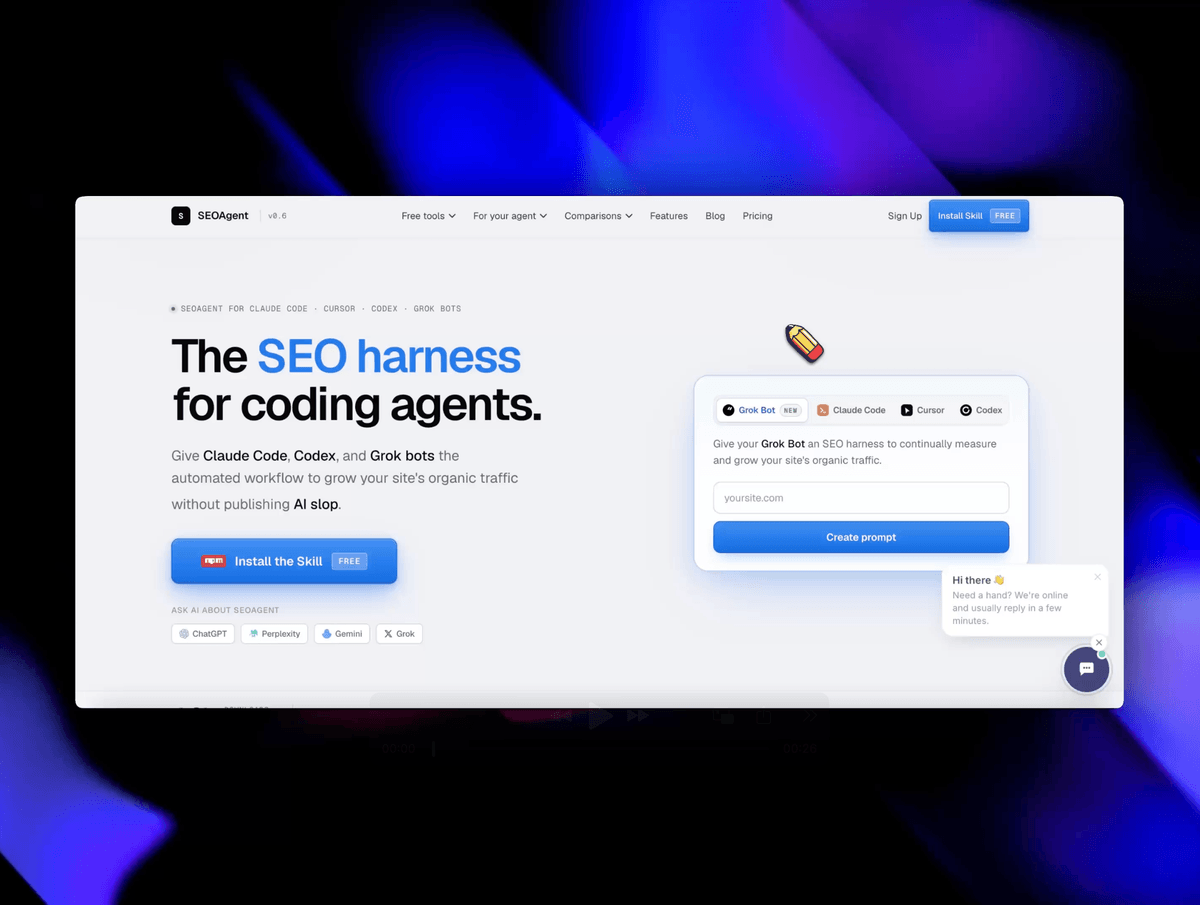
NEW YORK CITY, US — September 15, 2026 — SEOAgent, an independent software company, today released version 1.0 of its search engine optimization (SEO) harness for coding agents. The release adds support for Grok bots, automated publishing of the Open Knowledge Format (OKF), and automated product screenshot capture. SEOAgent’s free local component is available worldwide today through the public npm registry.

Version 1.0 extends SEOAgent beyond Claude Code, Cursor and Codex to Grok bots, adding to the total number of first-class supported coding agents with its harness, alongside a standalone command line interface for teams that run the tooling directly. Configuration guidance for each environment is published at seoagent.com, including a dedicated page for Grok bots at seoagent.com/for/grok-bots.

The release adds automated publishing of the Open Knowledge Format, an open specification published by Google Cloud in June 2026. OKF represents organizational context as directories of markdown files with YAML frontmatter, so that AI systems can consume a structured account of a business without a proprietary integration. SEOAgent generates an OKF bundle from the customer’s own codebase and content, publishes it on the customer’s domain, and regenerates it as the site changes. SEOAgent also operates a free AI readiness checker that reports what an AI system can currently determine about a given site.

A third addition covers product imagery. SEOAgent identifies pages where a product image is missing, renders the relevant interface directly from the customer’s existing codebase, saves the image file into the project, and inserts it with descriptive alternative text. Where a capture is not possible, the software reports the gap rather than substituting a generated placeholder.

Press release image

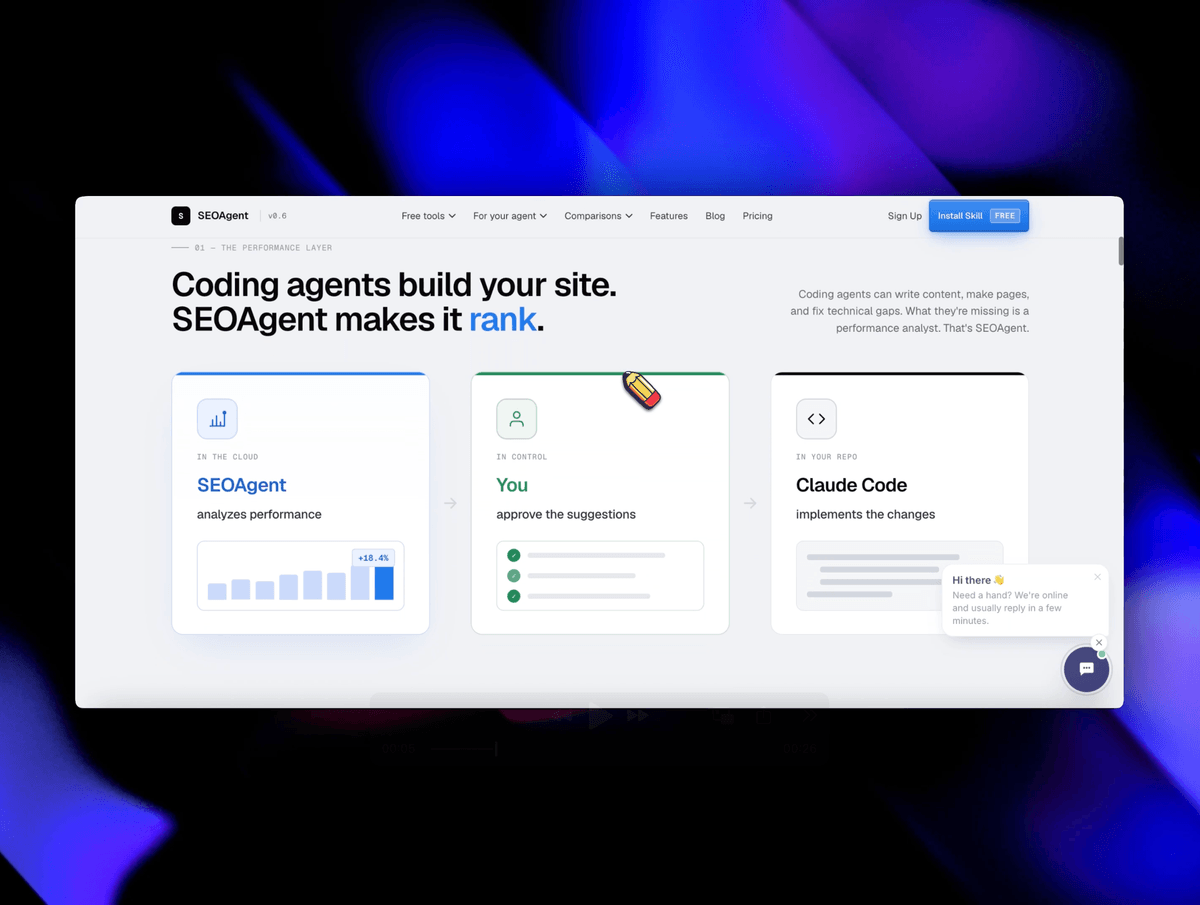
SEOAgent addresses a change in how software businesses build websites: marketing pages increasingly ship from the same code repository as the product itself, rather than from a separate content management system. Conventional SEO software operates as a browser-based advisory layer, it crawls a site, scores it, and returns recommendations that someone must then locate in a file, apply, and deploy. Coding agents can already make those file changes. What they lack is the performance data and research context needed to decide which changes are worth making.

“A coding agent can already edit files. The open question is which edits are worth making,” said Alec Lindsay, founder of SEOAgent. “That question needs performance data behind it, and it needs a person to sign off.”

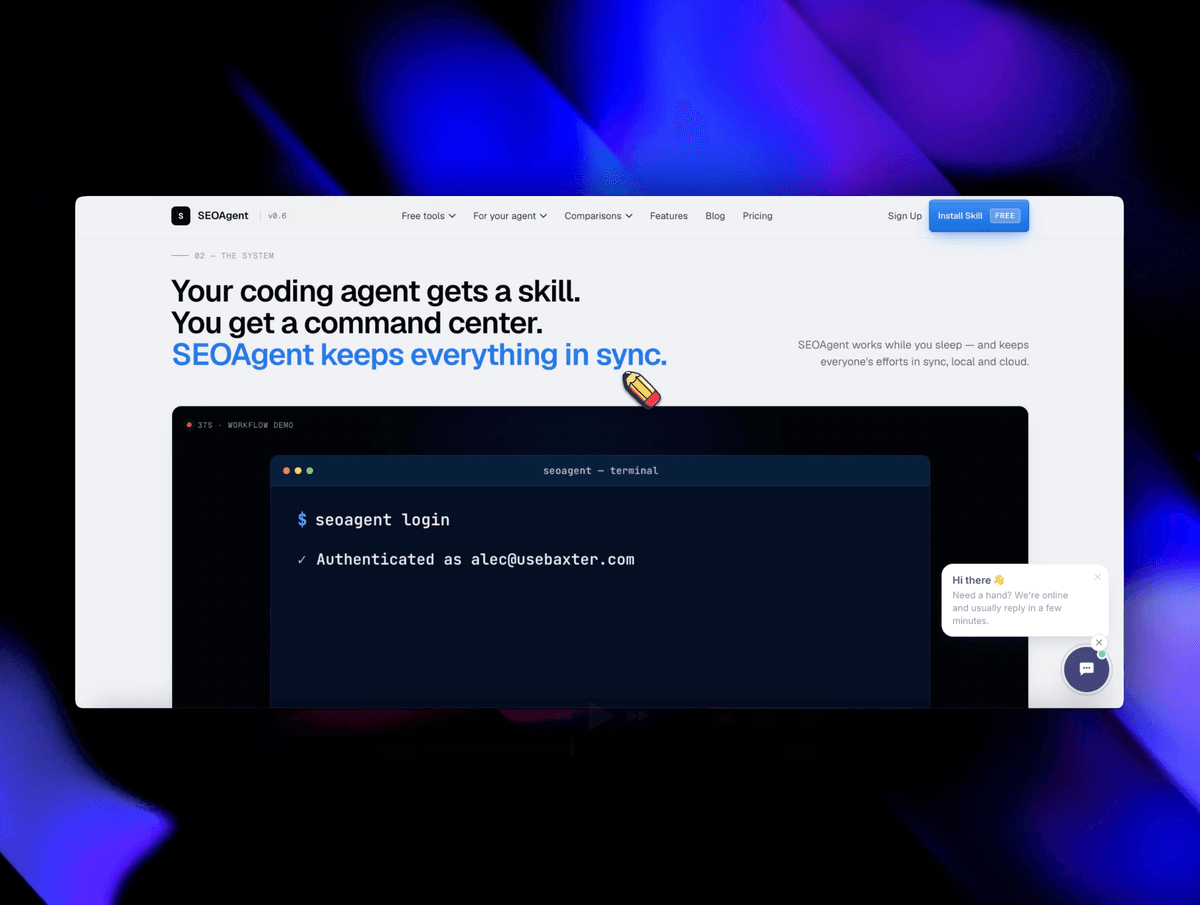
SEOAgent ships in two parts. The free component, called the Skill, installs locally with a single command and requires no account. Once installed, a coding agent can audit an existing site, correct technical issues such as missing metadata and structured data markup, and build new landing pages and articles directly in the project. Because it runs on the language model the customer already subscribes to through their coding agent, there is no additional AI subscription and no per-query metering.

The paid tier, Autopilot, connects to Google Search Console and to third-party keyword and competitor data. It tracks how existing pages perform, researches the search results a page competes in, and queues suggested changes for review. Approved changes are pulled back into the local codebase with one command. The cloud service does not modify live websites directly; every change passes through the same review process a development team applies to any other code change. Autopilot subscribers also receive a weekly backlink outreach workflow that identifies prospective linking sites and drafts outreach emails the customer reviews before any message is sent.

Rather than generating articles from a keyword alone, a practice search engines have moved to demote, SEOAgent prompts for material the business already holds: founder notes, recurring support tickets, objections raised on sales calls, internal benchmarks and customer case studies. That material becomes the substance of the page, with the software handling structure, metadata and internal linking.

“The failure mode we designed around is a tool that produces a large amount of content nobody asked for and nobody reviews,” Lindsay said. “Everything here ends in a file change that a person reads before it ships.”

Press release image

The Skill is available now at no cost and, according to the company, has grown to nearly 8,000 downloads over the past month from the npm registry. Autopilot is priced at 49 US dollars per site per month and includes a seven day trial.

Alongside the paid product, SEOAgent maintains several free diagnostic tools, including a live benchmark that scores published coding agent skills, a grader that measures how much context a skill consumes, and checkers for sites built on the Lovable platform.

The company reports that a SOC 2 audit, a standard information security assessment for software vendors, is in progress.

Press release image

About SEOAgent

SEOAgent is an independent software company that builds SEO tooling for teams whose websites ship from a code repository. Its products serve founders, independent developers, SaaS and development teams, and SEO freelancers managing multiple client codebases. SEOAgent publishes its positioning, pricing and product documentation in machine-readable form so that both people and AI systems can verify its claims.

Media contact

Alec Lindsay
Founder, SEOAgent
Email: support@seoagent.com
seoagent.com

Media Contact:
Name: Alec Lindsay
Company: SEOAgent
Email: support@seoagent.com
Website: https://seoagent.com/

Designing a Home Office That Works Beyond the Desk

Working from home has changed the way many people think about residential space. A room that once served as a spare bedroom, storage area, or occasional guest room may now need to support several hours of focused work every day.

Simply placing a desk against an available wall is often enough for short-term use, but a more permanent home office requires greater consideration. Lighting, noise, storage, privacy, furniture clearance, and the relationship between the office and the rest of the household all affect whether the space remains comfortable over time.

Before buying a larger desk or expensive office chair, it can be useful to reconsider the layout itself. The ability to draw floor plans online makes it easier to explore different arrangements and see how a workspace fits into the broader home.

The Desk Is Only One Part of a Home Office

A common mistake is to plan an office around the desk and deal with everything else afterward.

The desk may fit perfectly, but the chair could block a doorway. Storage might have to share the same wall as a monitor. A frequently used hallway could run directly behind the workspace, creating constant movement during meetings.

These are layout problems rather than furniture problems.

A floor plan provides a better way to evaluate them because it shows the office in relation to the surrounding rooms.

Consider the Noise Around the Workspace

The quietest-looking room is not necessarily the quietest room in practice.

A home office beside a living room may work well for someone who works independently, but it can become difficult when children are watching television or family members are using the space during video meetings.

A workspace near a bedroom may provide greater separation during the day, but it could also introduce practical problems if the room is frequently used for other purposes.

There is no universal answer. The right choice depends on the household.

The important point is to consider the office as part of the home’s circulation rather than treating it as an isolated box.

https://floor-plan.ai/nuxt_img/floor-plan-creator/Smart-Drawing-Canvas.webp

Small Homes Require More Careful Planning

In a large house, creating a dedicated office may simply mean assigning one room to work.

Smaller homes are less forgiving.

An office might need to share space with a guest room, occupy part of a bedroom, or fit into a section of the living area. In these situations, the arrangement of furniture becomes closely connected to the overall floor plan.

For example, a compact two-bedroom apartment might not have enough space for a separate office. One option could be to create a small work zone near a window in the living room. Another might be to use part of the second bedroom as a flexible office and guest space.

Both ideas can work, but their practicality depends on the circulation around them.

A desk that looks fine in isolation may become inconvenient once a sofa, storage cabinet, and doorway are included.

Think in Terms of Zones

Rather than asking only where the desk should go, consider what activities need to happen in the area.

A practical work zone might require space for:

  • a desk and chair;
  • monitor or equipment;
  • storage;
  • task lighting;
  • background space for video calls;
  • and enough clearance to move comfortably.

The exact requirements vary, but the principle is consistent: the office should support the activity rather than simply contain the furniture.

Why Testing the Layout Before Buying Furniture Helps

Furniture can be expensive, particularly when a home office requires a desk, shelving, storage, lighting, and ergonomic equipment.

A layout can be changed on screen much more easily than furniture can be returned, moved, or replaced.

Suppose a homeowner is considering a large L-shaped desk. On its own, the desk may appear to provide excellent working space. Once placed into the room, however, it might reduce the available passage or prevent a cabinet door from opening properly.

Testing that arrangement in a floor plan makes the potential problem visible before the purchase.

The same process works for smaller decisions, such as whether a bookcase should sit behind the desk or against another wall.

https://internal-copper-t3wns8n8.edgeone.dev?eo_token=d330d4cfb87a1943916ad37f68b45777&eo_time=1789376930

A Home Office Also Needs to Work When You Are Not Working

A dedicated office is relatively straightforward to plan because its purpose is clear. Multi-use spaces are more challenging.

If a room needs to function as both a guest bedroom and office, for example, the layout should allow each use without one permanently compromising the other.

A sofa bed may provide flexibility, but it needs enough clearance to open. A desk positioned beside a window may offer excellent daylight, but the room should still have enough circulation when it becomes a guest room.

These details are easy to overlook when planning from a furniture catalog. They become more obvious when the entire room is viewed as a layout.

Digital Planning Is Useful for More Than New Construction

You do not need to be designing a new house to benefit from a floor plan.

Existing homes can be mapped and adjusted to explore changes such as:

  • converting a spare room into an office;
  • reorganizing an open living area;
  • adding storage;
  • creating a study zone for children;
  • or separating work and relaxation areas.

This makes online floor planning particularly relevant for gradual home improvements.

A homeowner does not have to redesign the entire property. Sometimes a single room or small section of the plan is enough to test an idea.

Keep Practical Constraints in Mind

Digital floor planning is useful for exploring arrangements, but it cannot automatically resolve every real-world limitation.

Electrical outlets, structural walls, heating and cooling systems, windows, plumbing, accessibility, and local building requirements may all influence whether a proposed layout is feasible.

For straightforward furniture planning, those details may simply need to be represented accurately. For renovation or construction, professional verification becomes important before work begins.

The floor plan is therefore best viewed as a planning aid that helps identify possibilities and potential problems early.

A Better Workspace Starts With the Space Around It

A productive home office is not necessarily the one with the most expensive furniture or the largest desk. Often, its effectiveness depends on whether the surrounding layout supports concentration without interfering with the rest of the household.

That is why considering the floor plan before making furniture decisions can be worthwhile.

By testing different locations, circulation paths, storage arrangements, and room relationships digitally, homeowners can make more informed choices while the options are still easy to change.

The result may be a dedicated office, a flexible guest-and-work room, or simply a better-defined workspace within an existing living area. What matters is not following a particular home-office trend, but finding an arrangement that works with the way the home is actually used.

Company Details

Company Name: Floor Plan AI
Contact Person: Flora
Email: wfang100707@gmail.com
Address: Hong Kong, China
Website: https://floor-plan.ai/

Reducing Telecom Churn Through Network Analytics

Subscriber churn is rarely caused by one isolated event.

A customer may not change broadband providers because of a single temporary Wi-Fi interruption. More often, churn develops through repeated frustration. The connection may feel inconsistent, video meetings may freeze, streaming quality may occasionally decline, or support may take several attempts to resolve an issue.

Over time, these experiences can influence how a subscriber evaluates the service.

This is why operators are increasingly looking beyond traditional network monitoring. A modern network analytics platform can help turn large volumes of technical information into insights that support both network operations and customer retention.

Instead of waiting for subscribers to report problems, operators can identify patterns earlier and take a more proactive approach.

Convert Technical Data Into Experience Signals

Broadband networks generate large amounts of information.

Gateways, Wi-Fi access points, routers, connected devices, and service platforms can reveal changes in performance, connectivity, signal quality, and usage patterns.

Raw measurements are valuable to engineers, but they become even more useful when connected to the subscriber experience.

A single temporary drop may not matter. Repeated drops at similar times, however, could indicate a pattern worth investigating.

Analytics helps identify these patterns. It allows operators to move from isolated data points toward a clearer understanding of what subscribers may actually be experiencing inside the home.

Identify Problems Before the Customer Calls

Traditional support is reactive. A subscriber notices a problem, contacts support, explains the symptoms, and begins troubleshooting.

Analytics creates an opportunity to move some of this process earlier.

If network data indicates recurring instability or a decline in Wi-Fi quality, operators can identify the issue before dissatisfaction becomes severe. In some cases, proactive optimization may resolve the problem without requiring a support interaction.

Telecom diagnostics can also provide additional visibility into recurring network conditions, helping teams understand whether an issue is isolated or part of a broader pattern.

In other cases, the operator can be better prepared when the customer eventually contacts support.

Both outcomes can create a more informed service experience.

Give Support Teams Better Context

A support conversation can become longer when the representative has limited information.

The customer may be asked to restart equipment, describe indicator lights, test different devices, or explain where problems occur inside the home. These steps can still be useful, but analytics can reduce unnecessary investigation by providing additional context.

Analytics insight — Practical support use

  • Connectivity history: Identify repeated interruptions
  • Wi-Fi quality: Detect possible local wireless issues
  • Device status: Understand current operating conditions
  • Performance trends: Reveal recurring problems
  • Population comparison: Determine whether an issue is widespread
  • Historical support data: Reduce repeated troubleshooting

Better context allows representatives to focus on the most relevant possibilities and provide more targeted assistance.

Segment Subscribers More Intelligently

Not every household uses broadband in the same way.

One home may connect a few phones and a television. Another may include remote workers, gamers, smart home devices, security cameras, streaming equipment, and dozens of wireless endpoints.

Network analytics can help operators understand these differences.

Instead of treating every customer as part of one uniform population, teams can identify groups with similar technical environments or experience patterns. This can improve network planning and support prioritization while making retention initiatives more relevant.

A subscriber whose connection is stable but whose Wi-Fi environment is congested has a different problem from someone experiencing repeated access network interruptions.

Analytics helps separate those situations.

Connect Network Quality With Customer Retention

Technical teams often measure performance using engineering metrics, while customer teams focus on satisfaction, support history, and retention.

Analytics becomes particularly powerful when these perspectives are connected.

A network issue may appear minor from a technical perspective but become important if it occurs repeatedly for the same subscriber.

Similarly, a customer who has contacted support several times about related issues may deserve additional attention, even if each individual incident appears relatively small.

Combining technical and operational context provides a more complete picture of the subscriber experience.

Use Trends Instead of Isolated Events

One of the strongest advantages of analytics is the ability to identify change over time.

A subscriber’s connection may technically remain within acceptable thresholds while gradually becoming less stable. Looking only at the current condition could miss this trend.

Historical analysis can reveal whether performance is improving, remaining stable, or declining.

This creates additional opportunities for proactive maintenance and service improvement.

Improve Network Planning

Analytics can also reveal patterns across larger subscriber populations.

If many subscribers in one geographic area experience similar problems, the issue may require broader network attention.

If a particular type of home environment frequently shows Wi-Fi quality problems, support teams can prepare more effective guidance.

These insights can influence infrastructure planning, service optimization, and future support processes.

The result is not only faster troubleshooting. It is a network environment that can continuously learn from operational data.

Make Proactive Support More Targeted

Proactive support is most useful when it is relevant.

Customers do not want unnecessary notifications about issues they have never noticed. Analytics can help operators prioritize situations where intervention is likely to create real value.

This might involve identifying persistent connectivity degradation, repeated device failures, or recurring Wi-Fi problems.

The focus should be on meaningful patterns rather than every temporary fluctuation.

Scalability Is a Continuous Process

There is no single setting that turns an ACS into a platform capable of efficiently managing ten million devices.

Scalability comes from architecture, automation, monitoring, operational discipline, and continuous optimization working together.

Distributed resources help manage workload. Intelligent scheduling reduces traffic peaks. Automation improves consistency. Monitoring identifies capacity pressure. Segmentation reduces the risk of large campaigns.

When these principles are built into the management environment early, the ACS can grow alongside the subscriber base instead of becoming an operational limitation.

Large-scale device management is ultimately about creating predictable systems for unpredictable real-world conditions.

A platform that is designed with this reality in mind can support continued network growth while maintaining reliable device management and a stronger subscriber experience.

Frequently Asked Questions

  1. Can TR-069 support more than ten million devices?
    Yes. TR-069 can be used in very large device populations. Practical scalability depends heavily on the ACS implementation and surrounding infrastructure.
  2. Why are traffic peaks more important than average traffic?
    A platform may perform well during normal activity but struggle when millions of devices attempt to communicate within a short period.
  3. Should devices report frequently?
    Only when the information has operational value. Reporting frequency should balance visibility with platform efficiency.
  4. How does automation improve scalability?
    It allows organizations to manage larger populations without increasing manual workload at the same rate.
  5. Why use staged firmware campaigns?
    Staging reduces risk, distributes workload, and gives teams a chance to identify issues before an update reaches the entire population.

Company Details

Company Name: Friendly Technologies Ltd.
Contact Person: Ariela Ross-Jayyousi
Email: sales.hq@friendly-tech.com
Phone: +972-3-753-9000
Address: Ramat Gan, Israel
Website: https://friendly-tech.com/

How AI Is Changing Employee Benefits Decisions: From Guesswork to Data-Driven Strategy

By Jennifer Schaefer, MBA, ChFC, CLU, RHU, REBC, SHRM-SCP
Founder & CEO, JS Benefits Group | Forbes Business Council Contributor | Co-Host, Executive Leaders Radio

For years, employers have made many workforce decisions using a familiar formula: review what happened last year, look at current trends, compare available options, and make a decision before a deadline.

That approach is becoming increasingly difficult to justify in a data-driven business environment.

Employees have different priorities, organizations are managing increasingly diverse workforces, and employers have access to more information than ever before.

The opportunity is not simply to collect more data. It is to use that data more intelligently.

Artificial intelligence is beginning to change how employers can evaluate workforce needs, identify patterns, understand employee preferences and make better-informed decisions.

Moving Beyond Traditional Workforce Decisions

Many workforce decisions have historically been based on limited information.

Leaders may review employee surveys, participation numbers, turnover reports and other information before determining whether changes are necessary.

The problem is that a single snapshot may not tell the entire story.

A company’s workforce changes throughout the year. Employee demographics change. Preferences change. Hiring changes the composition of the organization. Different groups of employees may have very different priorities.

AI and advanced analytics create the possibility of moving from occasional analysis toward a more continuous approach to employee benefits strategy.

Instead of asking only what changed, employers can begin asking better questions.

What patterns are appearing across the workforce?

Which programs are employees actually using?

Are employee preferences changing?

Are certain groups experiencing different challenges?

What factors appear to influence engagement and retention?

The answers require more than a spreadsheet. They require meaningful analysis.

The Growing Role of Workforce Data

Organizations generate enormous amounts of workforce information.

Employers may have access to information involving employee demographics, participation, engagement, preferences, retention and other workforce characteristics.

The challenge is turning that information into something useful.

AI can help identify relationships and patterns that may be difficult to see through manual analysis alone.

For example, an employer might discover that participation differs substantially between employee groups, that certain programs have very low engagement, or that employee preferences are changing over time.

These observations do not automatically tell an employer what to change.

They do, however, provide a better starting point for asking the right questions.

The goal should not be to replace human judgment with an algorithm. The goal is to give leaders better information with which to make decisions.

AI Can Help Employers Better Understand Employees

One of the biggest limitations of traditional workforce strategy is the assumption that employees have relatively uniform needs.

They don’t.

A younger employee may have very different priorities from an employee approaching retirement. An employee with a family may evaluate workplace programs differently from a single employee. Employees in different geographic areas may have different expectations and priorities.

A single strategy must often serve all of them.

Data-driven analysis can help employers understand those differences.

AI can potentially identify workforce patterns and help employers evaluate whether their overall employee strategy is aligned with the people they are actually trying to attract and retain.

This does not mean creating a completely different experience for every employee.

Instead, it can mean using workforce data to make better decisions about employee programs, communication, workplace resources, wellness initiatives and other areas that influence employee experience.

The Connection Between Employee Experience and Retention

Employee experience has become increasingly connected to recruiting and retention.

Compensation is important, but employees evaluate the overall employment experience.

Workplace flexibility, professional development, recognition, wellness resources and employee programs can all influence how employees perceive the value of working for an organization.

AI can potentially help employers understand which programs matter most to different segments of their workforce.

That creates an opportunity to move away from the idea that more programs automatically mean a better employee experience.

An organization could offer numerous programs and still provide an experience that employees do not value.

The better question is whether the organization is investing in the areas that produce meaningful value for employees while supporting broader business objectives.

Better Decisions Require Better Data

Data can help determine where an organization should focus its attention.

Instead of relying exclusively on assumptions, leaders can examine patterns across their workforce and identify areas that deserve additional attention.

For example, participation data might reveal differences between employee groups. Engagement data might identify programs that are underused. Workforce trends might reveal changes in employee preferences that leadership had not previously recognized.

Technology can make analysis faster, but the quality of the decision still depends on the quality of the underlying data and the expertise interpreting it.

Data is valuable because it can help organizations ask better questions.

AI Does Not Replace Human Expertise

The rise of AI does not mean employers no longer need experienced professionals.

In many ways, it makes human expertise more important.

AI can identify patterns, organize information and assist with analysis. It cannot independently understand every business objective, employee population, organizational culture or strategic priority.

Workforce decisions can also have significant consequences for employees.

An experienced advisor can take data-driven findings and put them into context.

That may mean comparing different strategies, evaluating potential outcomes, explaining tradeoffs or helping leadership understand how a proposed change could affect employees.

The most effective model is therefore not humans versus AI.

It is humans using AI to make better-informed decisions.

The Future of Workforce Strategy Is More Data-Driven

The workplace is moving toward a more analytical model.

Employers have more data available to them, technology continues to advance, and sophisticated analysis is becoming increasingly accessible.

The organizations that benefit most will not necessarily be the ones using the most technology.

They will be the ones asking better questions.

Instead of simply asking what employees want, organizations can look for evidence.

Instead of assuming every employee has the same priorities, leaders can examine differences across their workforce.

Instead of waiting for an annual review, organizations can evaluate trends throughout the year.

AI can help make that possible.

But the ultimate objective remains the same: build a workplace strategy that works for both employees and the organization.

The future of workforce strategy will not simply be about having more data.

It will be about knowing what to do with it.

About the Author

Jennifer Schaefer, MBA, ChFC, CLU, RHU, REBC, SHRM-SCP, is Founder & CEO of JS Benefits Group, an employee benefits consulting firm. She is also a Forbes Business Council Contributor and Co-Host of Executive Leaders Radio.